
Alloy Adventures: Choosing the Right Welded Pipe for Extreme Conditions
Mar 23, 2026
When Extreme Conditions Demand the Best: What You Need to Know About Duplex 2205 Welded Pipe
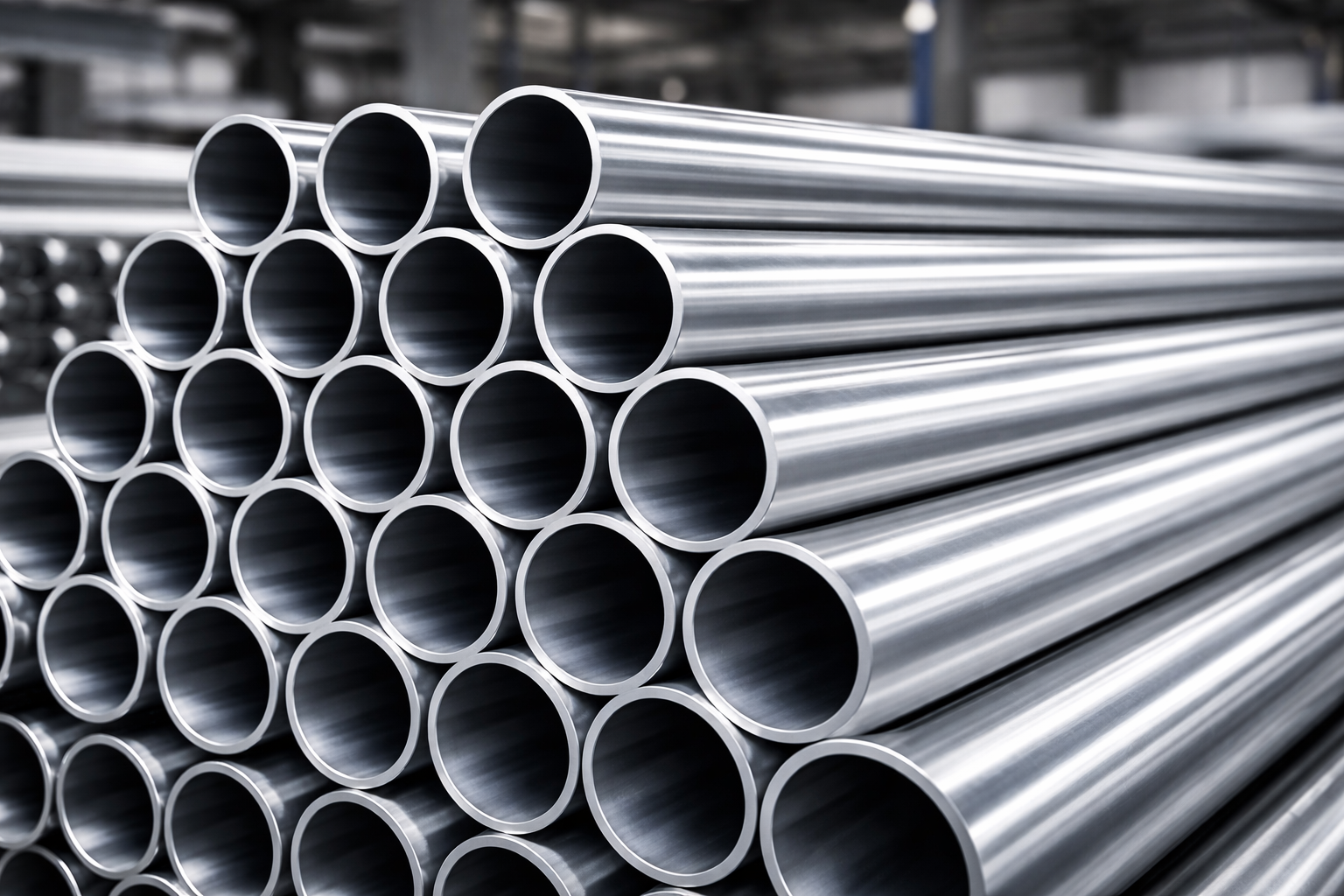
Duplex 2205 welded pipe is a high-strength, corrosion-resistant piping solution made from a dual-phase (ferritic + austenitic) stainless steel alloy. Here’s a quick snapshot of what makes it stand out:
| Property | Detail |
|---|---|
| UNS Designations | S31803 / S32205 |
| Yield Strength | 550 MPa (80,000 psi) minimum |
| Tensile Strength | 800 MPa (116,000 psi) minimum |
| Key Alloying Elements | 22% Chromium, 5% Nickel, 3% Molybdenum |
| Pitting Resistance (PREN) | Minimum 35 |
| Available Sizes | 1/2″ to 24″ NB, wall thickness 0.5–20mm |
| Primary Standard | ASTM A790 / ASME SA790 |
| Temperature Limit | Up to 600°F (315°C); 450°F in sour service |
| Key Benefit Over 316L | Roughly twice the strength; superior chloride corrosion resistance |
When you’re sourcing pipe for oil and gas platforms, chemical processing plants, or marine environments, getting the alloy wrong is not an option. A pipe failure in a chloride-rich or high-pressure environment doesn’t just cost money — it costs time, safety, and credibility.
That’s exactly why engineers and procurement professionals keep coming back to Duplex 2205. Its unique two-phase microstructure — roughly equal parts ferrite and austenite — gives it a rare combination of high strength and excellent resistance to stress corrosion cracking. It outperforms standard 316L stainless in nearly every demanding condition, while remaining more cost-effective than higher-nickel superalloys.
In this guide, we’ll walk through everything you need to choose the right Duplex 2205 welded pipe: metallurgy, dimensions, manufacturing standards, pressure ratings, industry applications, and quality certifications.
I’m Billy Walker, Vice President of James Duva Inc., where we’ve been supplying specialty stainless steel and high-nickel alloy piping components — including Duplex 2205 welded pipe — to the power, process, and water treatment industries since 1978. With sourcing relationships across leading manufacturers like Sandvik, Salem Tube, and Bristol, I’ve seen what separates a reliable alloy selection from a costly one.
Understanding the Metallurgy of Duplex 2205
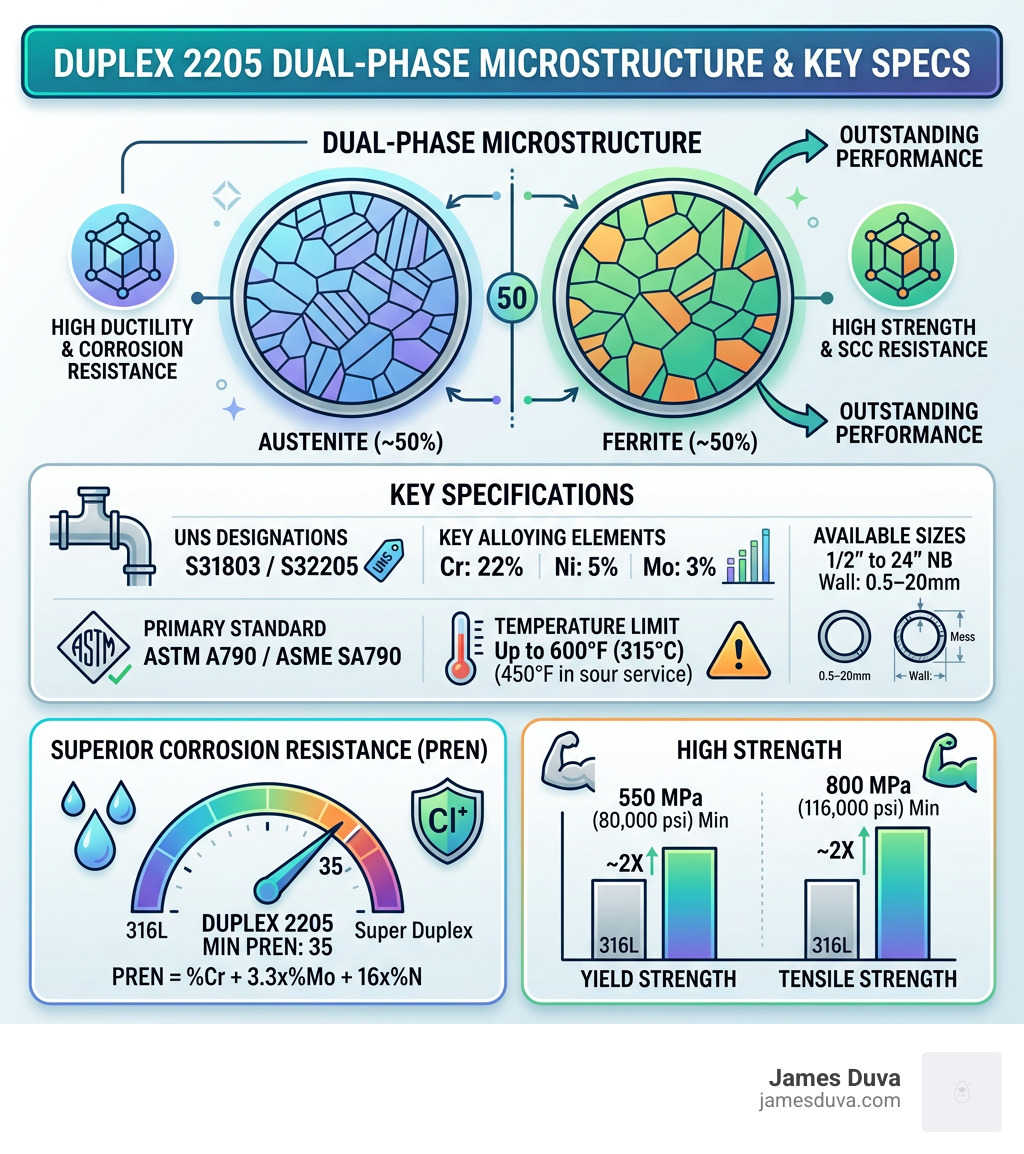
To understand why Duplex 2205 welded pipe is such a workhorse, we have to look at its DNA. Most duplex stainless steels are either austenitic (like the 300 series) or ferritic (like the 400 series). Duplex 2205 is the best of both worlds. It consists of a microstructure that is roughly 50% austenite and 50% ferrite. This “dual-phase” nature is what gives the material its name and its legendary physical properties.
The chemical composition is meticulously balanced to achieve this state. Key designations include UNS S31803 and the more highly specified UNS S32205 (often referred to by its Werkstoff number, WNR 1.4462). While S31803 was the original duplex 22% chromium alloy, the S32205 variant was introduced with higher minimum levels of chromium, molybdenum, and nitrogen to ensure even better corrosion resistance.
Here is the typical chemical breakdown we see in high-quality Duplex 2205 welded pipe:
- Chromium (21-23%): The primary driver for corrosion resistance.
- Nickel (4.5-6.5%): Stabilizes the austenitic phase and adds toughness.
- Molybdenum (2.5-3.5%): Specifically boosts resistance to pitting and crevice corrosion in chloride environments.
- Nitrogen (0.08-0.20%): Increases yield strength and enhances pitting resistance, especially near weld zones.
For a deeper dive into these technical nuances, check out A Comprehensive Guide to Duplex 2205 Properties or explore James Duva’s duplex stainless steel inventory to see the forms available for your next project.
The Superior Strength of Duplex 2205 Welded Pipe
If we had to pick one reason why our customers in New Jersey and beyond switch from 316L to Duplex 2205, it’s the strength. Duplex 2205 welded pipe boasts a minimum yield strength of 550 MPa (80,000 psi). To put that in perspective, that is roughly double the yield strength of standard austenitic stainless steels.
This high strength allows engineers to design systems with thinner walls, which can significantly reduce the overall weight of a piping system—a massive advantage for offshore platforms where every ton counts. Beyond just “pushing” limits, this alloy is designed to survive. It offers excellent resistance to Stress Corrosion Cracking (SCC), a common “silent killer” of 300-series stainless steel in hot chloride environments.
The material’s performance is codified under standards like ASTM A790 and ASME SA790, which cover seamless and welded ferritic/austenitic stainless steel pipe. These specifications ensure that the pipe can handle the high-pressure demands of modern industrial processes. We discuss these advantages further in our articles on Exploring the Versatility of Duplex 2205 Stainless Steel and Understanding Duplex 2205 Properties, Advantages, and Applications.
Manufacturing and Dimensional Standards
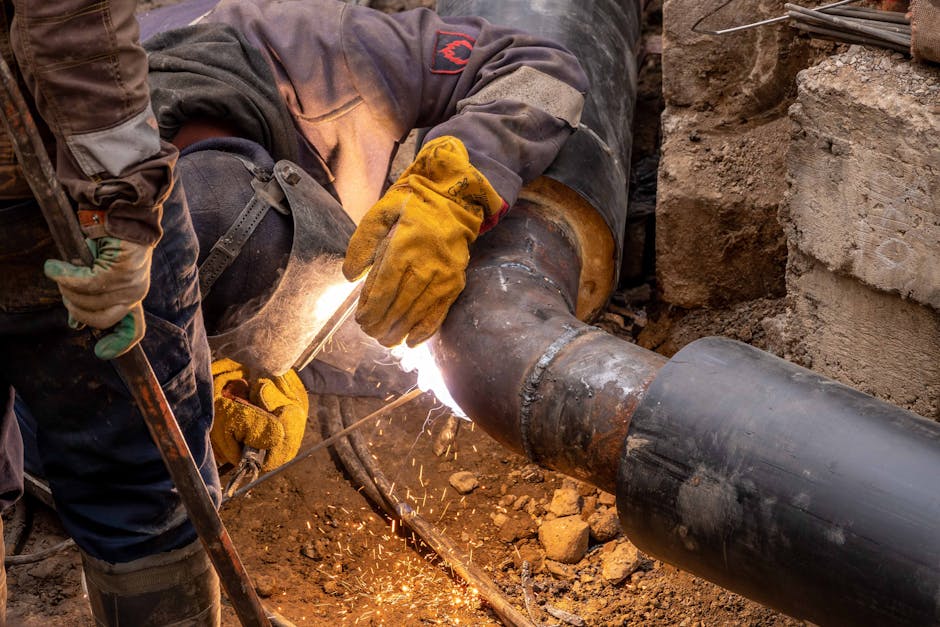
When it comes to Duplex 2205 welded pipe, the manufacturing process is critical to the pipe’s final integrity. Unlike seamless pipe, which is extruded from a solid billet, welded pipe is formed from flat strips or plates that are rolled and joined.
Two common methods include:
- ERW (Electric Resistance Welding): Often used for smaller diameters.
- EFW (Electric Fusion Welding): Typically used for larger, heavy-wall pipes where filler metal might be used, though ASTM A790 often specifies automatic welding without the addition of filler metal to maintain the precise 50/50 phase balance.
A common question we get at James Duva is about the “weld decay” or the risk of the seam. Modern manufacturing uses longitudinal welds that are strictly controlled. After welding, the pipe undergoes a solution annealing process to ensure the weld zone has the same corrosion resistance as the base metal. For more on the pros and cons of these types, read Seamless Pipe and Welded Pipe: What’s the Difference?.
Standard Sizes and Schedules for Duplex 2205 Welded Pipe
We stock and supply a wide array of sizes to meet diverse industrial needs. Generally, Duplex 2205 welded pipe is available from 1/2″ to 24″ NB (Nominal Bore).
- Schedules: Common schedules include SCH 10S, SCH 40S, and SCH 80S. However, for extreme pressure, we can source up to SCH XXS.
- Dimensions: Outer diameters (OD) can range from 5.0 mm up to a massive 1219.2 mm for specialized large-scale applications.
- Wall Thickness: Typically ranges from 0.5 mm to 20 mm.
Selecting the right schedule is vital for pressure containment. You can learn more about finding the perfect fit in our guide on Unlocking the Potential of Duplex 2205.
Manufacturing Processes for Duplex 2205 Welded Pipe
The secret to a high-quality Duplex 2205 welded pipe lies in the heat treatment. According to ASTM standards, these pipes must be furnished in a heat-treated condition.
The standard procedure involves solution annealing at temperatures between 1875°F and 2010°F (1025°C to 1100°C), followed by rapid quenching in water or air. This rapid cooling is non-negotiable; if the cooling is too slow, brittle intermetallic phases (like sigma phase) can form, which drastically reduces toughness and corrosion resistance.
Because of this specific requirement, welding duplex requires more finesse than welding carbon steel. You can find a deeper look at these technical requirements in Duplex 2205 vs Other Stainless Steels: A Comparative Analysis.
Performance in Corrosive and High-Pressure Environments
In corrosion, the Pitting Resistance Equivalent Number (PREN) is king. Duplex 2205 typically has a PREN of 35 or higher, calculated using the formula %Cr + 3.3(%Mo) + 16(%N). Compare this to 316L, which usually sits around 24, and you can see why Duplex 2205 is the preferred choice for chloride-heavy environments.
It is particularly effective in sour service (environments containing hydrogen sulfide). It complies with NACE MR0175 and ISO 15156, making it a staple for downhole tubing and subsea pipelines.
| Feature | 316L Stainless Steel | Duplex 2205 Welded Pipe |
|---|---|---|
| Pitting Resistance | Moderate | Superior (PREN 35+) |
| Yield Strength | ~290 MPa | ~550 MPa |
| SCC Resistance | Low | High |
| Cost | Lower | Moderate (but high value) |
| Weight for same pressure | Heavier | Lighter (thinner walls) |
If you are dealing with aggressive media, you might want to browse our High-Performance Alloy Solutions.
Critical Applications Across Global Industries
Where do we actually see Duplex 2205 welded pipe in action? Generally, anywhere that is wet, salty, or under high pressure.
- Oil & Gas: Subsea flowlines, manifolds, and offshore platform piping. Its resistance to sulfide stress cracking is a lifesaver here.
- Chemical Processing: Used for heat exchangers, pressure vessels, and tanks handling organic acids and chloride solutions.
- Desalination Plants: High-pressure RO (Reverse Osmosis) piping and seawater intake systems.
- Pulp and Paper: Digesters, bleaching equipment, and stock-handling systems where corrosive chemicals are prevalent.
- Marine Engineering: Shipbuilding, propellers, and shafts exposed to brackish water.
Choosing between grades can be tricky, especially when considering Super Duplex. Our guide Selecting the Right Duplex Stainless Steel: 2205 or 2507 helps clarify those choices.
Quality Assurance and Testing Protocols
At James Duva, we know that a pipe is only as good as the paperwork that proves it. For Duplex 2205 welded pipe, quality assurance is rigorous. ASTM A790 mandates several tests to ensure the material meets the “extreme condition” promise:
- Hydrostatic Testing: Every pipe is tested under water pressure to ensure no leaks.
- NDT (Non-Destructive Testing): This includes ultrasonic or eddy current testing to find internal flaws without damaging the pipe.
- PMI (Positive Material Identification): To verify the chemical composition is exactly what was ordered.
- MTC (Material Test Certificate): We provide certificates to EN 10204 3.1, giving you full traceability back to the heat of the steel.
- Radiography: For EFW pipes, 100% X-ray of the weld seam is often performed to ensure weld perfection.
These protocols are essential for safety-critical applications, as discussed in Deciphering the Duel: Duplex 2205 vs Super Duplex 2507 for Industrial Applications.
Frequently Asked Questions
What is the temperature limit for Duplex 2205?
While Duplex 2205 is a beast in many areas, it does have a “kryptonite”: temperature. It is generally limited to a maximum service temperature of 600°F (315°C). In sour service, this limit is often lowered to 450°F. Above these temperatures, the material is at risk of “475°C embrittlement,” where the ferritic phase becomes extremely brittle, leading to potential catastrophic failure. It is also not recommended for cryogenic use, as it loses toughness at very low temperatures.
Is filler metal required for welding 2205 pipe?
Per ASTM A790, Duplex 2205 welded pipe can be manufactured using an automatic welding process without the addition of filler metal. However, when performing field welds or repairs, we almost always recommend using a filler metal (like 2209). This is because the filler metal is typically “over-alloyed” with extra nickel to ensure the weld pool solidifies with the correct 50/50 austenite-ferrite balance.
How does 2205 compare to Super Duplex 2507?
Think of 2205 as the all-rounder and 2507 as the specialist. As we explain in Duplex 2205 vs Super Duplex: Key Differences, Uses & Benefits, Super Duplex 2507 contains more chromium (25%) and molybdenum, pushing its PREN above 40. While 2507 offers even better corrosion resistance for extreme seawater applications, it is more expensive and harder to fabricate. For most “extreme” industrial conditions, 2205 offers the better balance of performance and price.
Conclusion
Choosing the right Duplex 2205 welded pipe is about more than just reading a spec sheet; it’s about ensuring the longevity and safety of your entire operation. Its dual-phase structure provides a unique shield against corrosion and pressure that traditional stainless steels simply can’t match.
Since 1978, James Duva Inc. has been the trusted partner for industrial leaders across the United States. Based in Branchburg, NJ, we pride ourselves on being a one-stop shop for high-grade nickel alloys and stainless steel. Whether you need a single cut length of pipe or a full project’s worth of schedules and sizes, our expertise ensures you get the right material, on time, and with all the necessary certifications.
Ready to secure the piping for your next “alloy adventure”? Explore our products or contact our team in New Jersey today to discuss your specific project requirements. We’re here to help you navigate the complexities of extreme conditions with confidence.
About James Duva Inc.
Since 1978, James Duva Inc. has been your trusted source for stainless steel and high-nickel alloy industrial products. Whether you’re in the water treatment, process or power industry, we pride ourselves on always having what you need. Say goodbye to your sourcing problems with just one call to James Duva.