
In Depth Guide to Stainless Steel Alloy Properties
Mar 10, 2026
Understanding Stainless Steel Alloys: The Foundation of Industrial Performance
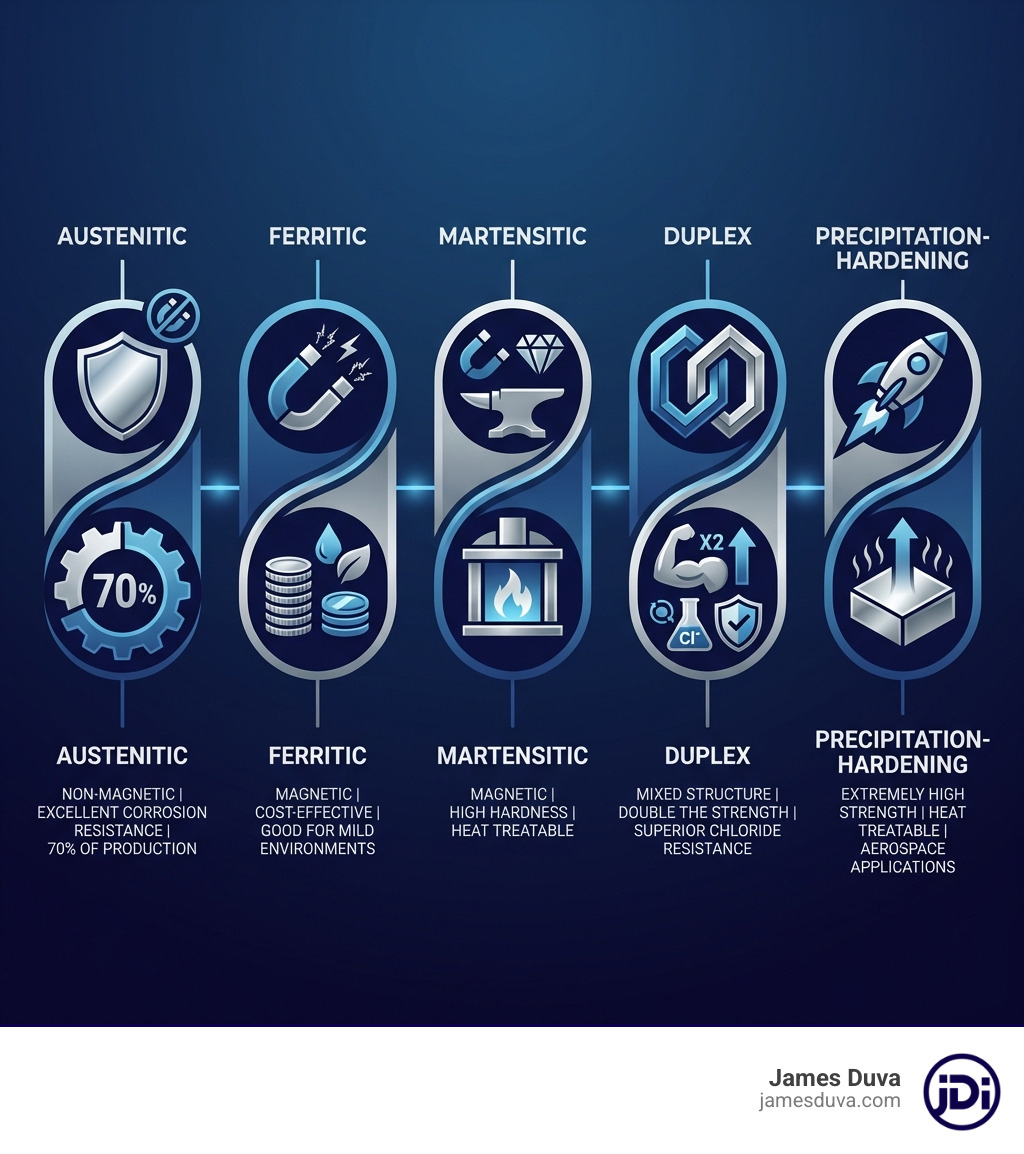
Stainless steel alloys are iron-based metals containing a minimum of 10.5% chromium, which forms a protective oxide layer that resists corrosion. These versatile materials are classified into five main families—austenitic, ferritic, martensitic, duplex, and precipitation-hardening—each offering unique combinations of strength, corrosion resistance, and fabrication properties for industrial applications.
Key Facts About Stainless Steel Alloys:
- Minimum Composition: At least 10.5% chromium content
- Corrosion Protection: Self-healing passive oxide film
- Most Common Type: Austenitic (304/316), accounting for 70% of production
- Recyclability: 100% recyclable with no loss of quality
- Primary Applications: Chemical processing, oil & gas, food processing, marine environments, and power generation
Finded in 1913 by Harry Brearley, stainless steel revolutionized manufacturing. Today, over 100 grades exist, each engineered for specific performance requirements.
The “stainless” quality comes from chromium, which forms a thin, self-repairing passive oxide layer when exposed to oxygen. This invisible barrier, just nanometers thick, prevents rust and restores itself if scratched.
Adding elements like nickel, molybdenum, and nitrogen further improves properties. Nickel boosts ductility and corrosion resistance, while molybdenum improves resistance to pitting in chloride environments. These adjustments create alloys suited for demanding conditions, from cryogenic plants to high-temperature furnaces.
Selecting the right stainless steel alloy requires understanding corrosion resistance, mechanical properties, fabrication characteristics, and total lifecycle cost. For professionals in chemical processing, oil & gas, and power generation, the right grade means the difference between reliable operation and costly downtime.
I’m Billy Walker, Vice President of James Duva Inc., where we’ve been supplying high-quality stainless steel alloys and specialty piping components to the power, process, and water treatment industries since 1978. Our expertise in sourcing domestic stainless steel ensures our clients receive the right materials for their critical applications.
Learn more about stainless steel products at James Duva
The Science Behind Stainless Steel: Composition and Properties
At its core, stainless steel is an iron-based alloy, but it’s the precise blend of other elements that open ups its remarkable capabilities. These alloying elements fundamentally alter the steel’s crystal structure, mechanical properties, and environmental resistance. Understanding these components is key to appreciating the utility of stainless steel alloys.
The Role of Primary Alloying Elements
Chromium (Cr): The defining element, all stainless steel alloys contain at least 10.5% chromium. It forms the passive oxide film that prevents corrosion. Higher chromium content (up to 30%) improves corrosion and heat resistance.
Nickel (Ni): Crucial for austenitic grades, nickel promotes an austenitic microstructure, providing excellent ductility, formability, toughness (even at cryogenic temperatures), and weldability. It also improves resistance to acidic corrosion.
Molybdenum (Mo): Added to improve resistance to pitting and crevice corrosion in chloride environments (e.g., seawater). Molybdenum stabilizes the passive film, making it essential for grades like 316 and Duplex steels used in harsh conditions.
Nitrogen (N): Improves both strength and corrosion resistance. In austenitic and duplex steels, nitrogen stabilizes the austenitic phase, boosts tensile properties, and improves pitting resistance, especially when combined with molybdenum.
Manganese (Mn): Acts as an austenite former, sometimes replacing nickel to reduce cost (e.g., 200 series). It contributes to strength and hot workability but can reduce corrosion resistance compared to high-nickel grades.
Silicon (Si): Improves oxidation resistance and strength. Used in specialty steels for resisting concentrated acids.
Carbon (C): Carefully controlled in most grades. High carbon increases hardness (key for martensitic grades) but can cause sensitization during welding, leading to intergranular corrosion. Low-carbon “L” grades (e.g., 304L, 316L) are used to prevent this and improve weldability.
Mechanical Properties: Strength, Hardness, and Ductility
The interplay of these alloying elements dictates the mechanical properties of stainless steel alloys:
Strength: The ability to withstand forces without breaking. Yield strength is the point of permanent deformation. Strengths vary widely: annealed 304 stainless steel has a yield strength of ~210 MPa, while 17-4 PH can reach over 1,700 MPa.
Hardness: Resistance to indentation or scratching. Martensitic steels are known for high hardness, achieved through heat treatment, making them ideal for cutting tools.
Ductility: The ability to deform without fracturing. Austenitic steels have excellent ductility, allowing them to be easily formed into complex shapes.
Melting Point Range
Most stainless steel alloys share a relatively narrow melting point range, typically from 1,325 to 1,530 °C (2,417 to 2,786 °F). This is an important consideration for manufacturing and high-temperature applications.
Understanding how these different alloys change steel’s properties is crucial for selecting the optimal material. We invite you to explore more about corrosion resistance and how different alloys change steel’s properties on our website.
Austenitic Stainless Steels (300 & 200 Series)

As the most common type (70% of production), austenitic steels are the workhorses of the industry. Our clients in New Jersey’s chemical, oil & gas, and power sectors rely on them for their balanced properties. Key characteristics include:
- Non-Magnetic: In their annealed state, they are non-magnetic, though significant cold working can induce slight magnetism.
- Excellent Corrosion Resistance: High chromium and nickel content provide superior resistance to a wide range of corrosives.
- High Ductility and Formability: They can be easily formed, bent, and welded.
- Excellent Toughness: They maintain toughness even at cryogenic temperatures.
- Good Weldability: Generally easy to weld, though care is needed with higher carbon grades.
Common Grades:
- Grade 304: The most widely used grade (“18/8” steel), with ~18% chromium and 8% nickel. It offers excellent corrosion resistance, formability, and weldability for applications from kitchen equipment to industrial piping.
- Grade 316: Often called “marine grade,” 316 adds 2-3% molybdenum to a 304 base. This addition significantly boosts resistance to pitting and crevice corrosion in chloride-rich environments (e.g., saltwater, sulfuric acid). It is ideal for marine hardware and chemical processing equipment.
- 200 Series: In these grades, manganese and nitrogen replace some nickel to reduce cost. They offer good strength but have less robust corrosion resistance than the 300 series, making them suitable for less demanding, cost-sensitive applications.
Our team at James Duva understands the nuances of these materials. We can help you steer the various types of stainless steel and find the perfect fit. To dig deeper, explore 304 and 316 stainless steel at James Duva.
Ferritic Stainless Steels (400 Series)
Ferritic steels have a body-centered cubic (BCC) crystal structure, giving them a unique set of properties.
Key characteristics include:
- Magnetic: Their crystal structure makes them magnetic.
- Lower Nickel Content: With little to no nickel, they are a more cost-effective option.
- Good Ductility and Formability: They offer good ductility, especially in thinner sections.
- Resistance to Stress Corrosion Cracking (SCC): They exhibit excellent resistance to SCC.
- Moderate Corrosion Resistance: Good for many applications, but generally moderate compared to austenitic grades.
Common Grades:
- Grade 430: A general-purpose grade with 16-18% chromium, offering good corrosion resistance in mild environments. Common uses include kitchenware and decorative trim.
- Grade 409: A cost-effective grade with 11-12% chromium. Its formability and oxidation resistance make it ideal for automotive exhaust systems.
Ferritic steels are an excellent choice where magnetism isn’t an issue and the corrosive environment isn’t overly aggressive. For specific product needs, you can see ferritic stainless steel products available through James Duva.
Martensitic Stainless Steels (400 Series)

Known for exceptional strength and hardness, martensitic steels were among the first developed, historically used for cutlery.
Their defining characteristics include:
- High Hardness and Strength: They can be hardened to very high levels through heat treatment.
- Magnetic: Martensitic steels are magnetic.
- Moderate Corrosion Resistance: Their resistance is generally lower than that of austenitic or duplex grades.
- Hardenable by Heat Treatment: Their higher carbon content allows for hardening upon rapid cooling.
Common Grades:
- Grade 410: A basic martensitic grade with 11.5-13.5% chromium. It provides good strength, hardness, and moderate corrosion resistance for applications like turbine blades, fasteners, and pump shafts.
- Grade 420: With higher carbon than 410, this grade achieves greater hardness. It’s used for surgical instruments and knife blades requiring a sharp, durable edge.
- Grade 440C: One of the hardest martensitic grades, offering excellent wear resistance for ball bearings and specialized cutting tools.
When your application demands robust strength and hardness, martensitic stainless steel alloys are often the answer. Learn more about the specific properties of 410 Stainless Steel at James Duva and explore our range of Martensitic stainless steel at James Duva.
The Advanced Families of Stainless Steel Alloys
Beyond the common types, advanced stainless steel alloys are engineered for the most demanding environments in chemical processing, oil & gas, and power generation. These alloys push performance boundaries in strength and corrosion resistance. Our expertise in New Jersey ensures clients get the right high-performance materials, whether that’s an advanced stainless steel or another option like a nickel alloy. We offer insights into When to Choose Nickel Alloys Over Stainless Steel in Industrial Applications. For a deeper dive, explore advanced stainless steel alloys at James Duva.
Duplex Stainless Steels (e.g., 2205)
Duplex steels have a mixed microstructure of roughly 50% austenite and 50% ferrite. This dual-phase structure gives them superior performance.
Key characteristics include:
- High Strength: With roughly double the yield strength of austenitic grades (e.g., Duplex 2205 has a yield strength of ~450 MPa vs. 304’s ~210 MPa), they allow for thinner, lighter designs.
- Excellent Corrosion Resistance: Their high chromium, molybdenum, and nitrogen content provides outstanding resistance to pitting, crevice corrosion, and stress corrosion cracking (SCC).
- Magnetic: Due to their ferritic content, duplex steels are magnetic.
- Good Weldability and Formability: While requiring more care than austenitic steels, they have good weldability and formability.
- PREN Value: Their Pitting Resistance Equivalent Number (PREN), calculated as PREN = %Cr + 3.3 * %Mo + 16 * %N, quantifies pitting resistance. A value over 35, typical for Duplex 2205, indicates excellent performance.
Common Grades:
- Duplex 2205: The most common duplex grade, 2205 combines high strength and corrosion resistance. It’s a workhorse for oil & gas pipelines, marine systems, and chemical plants.
- Super Duplex (e.g., 2507): With even higher alloy content and PREN values (e.g., 2507 has a PREN of ~43), these are designed for the most aggressive environments like offshore platforms and desalination plants.
Duplex stainless steel alloys provide robust solutions where standard grades fall short. For a detailed comparison, explore Duplex 2205 vs. Other Stainless Steels: A Comparative Analysis. You can also find a comprehensive range of Duplex stainless steel at James Duva for your demanding projects.
Precipitation-Hardening (PH) Stainless Steel Alloys (e.g., 17-4 PH)
For applications requiring extreme strength, PH steels are the solution. They combine the corrosion resistance of stainless steel with the high strength of alloy steels. A heat treatment process called aging creates microscopic precipitates that dramatically increase hardness and strength.
Key characteristics include:
- Extremely High Strength: PH steels achieve some of the highest strengths available, with grades like Custom 465 reaching over 1,700 MPa, making them ideal for highly stressed components.
- Heat Treatable: They are supplied in a soft state for easy machining and then aged at low temperatures to achieve full strength with minimal distortion, a major advantage for precision parts.
- Combines Properties: They offer corrosion resistance comparable to austenitic 304 with strengths exceeding hardened martensitic steels.
- Magnetic: Most PH stainless steels are magnetic.
Common Grades:
- 17-4 PH (Type 630): The most common PH grade, named for its ~17% chromium and 4% nickel content. It offers corrosion resistance similar to 304 but with much higher strength (around 1400 MPa in the H900 condition). It’s widely used in aerospace, nuclear, and chemical processing applications.
- Custom 465: An ultra-high-strength grade offering superior strength and toughness for critical aerospace and medical applications.
PH stainless steel alloys are indispensable where high strength and corrosion resistance are non-negotiable. For more on high-performance materials, check out our insights on Nickel-Based Alloys in the Aerospace Industry. We also offer a range of PH stainless steel at James Duva for your specialized requirements.
Fabrication, Standardization, and Analysis
Successfully using stainless steel alloys requires understanding their behavior during fabrication. Welding and machining each family presents unique challenges. Quality control depends on proper standardization and analysis.
At James Duva, we provide not just materials, but also the expertise for successful fabrication. Whether you need to know about custom alloy pipes or require specialized custom fabrication services at James Duva, we’re here to help.
Welding and Machining Considerations for stainless steel alloys
Fabricating stainless steel requires a nuanced approach due to how different compositions respond to heat and mechanical force.
- Work Hardening in Austenitic Grades: Austenitic steels harden rapidly when machined (work hardening), which increases tool wear. This requires rigid tooling, lower cutting speeds, and proper lubrication.
- Galling: Galling, or cold-welding under pressure, is a concern, especially with austenitic grades. It can be mitigated by using dissimilar materials, different hardness levels, or anti-galling lubricants.
- Higher Cutting Forces for Duplex: The high strength of duplex steels requires higher cutting forces and more rigid machinery. Their machinability is lower than austenitic grades, necessitating slower speeds and higher feed rates.
- Preheat Requirements for Martensitic Grades: Due to high hardenability, martensitic steels are prone to weld cracking. Preheating before welding and post-weld heat treatment (tempering) are often required to prevent brittleness and restore ductility.
- General Considerations: For all grades, proper selection of welding consumables and parameters is vital. Controlling heat input is key to avoiding sensitization in austenitic steels or maintaining phase balance in duplex steels. Correct cutting fluids and speeds are critical for good machining results.
Understanding these fabrication nuances is essential. We offer expertise in various joining methods, including those used for butt-weld fittings. For specialized requirements, explore our services related to welding stainless steel at James Duva and our insights into machining stainless steel at James Duva.
Grading Systems and Material Analysis for stainless steel alloys
With over 100 grades, standardized systems are essential for clear communication about material properties. They ensure everyone uses the same language for specification.
Standardization Bodies: Global bodies like the American Society for Testing and Materials (ASTM) maintain standards. The Unified Numbering System (UNS), like UNS S30400 for 304 stainless, is common in the U.S. These systems provide a consistent way to specify an alloy’s composition and performance.
Compositional Analysis: Verifying the exact elemental composition of stainless steel alloys is critical for ensuring the material meets specifications and will perform as expected.
Technologies for Elemental Analysis:
- X-Ray Fluorescence (XRF): A non-destructive method for rapid elemental analysis. Handheld XRF analyzers are invaluable for sorting scrap metal and verifying alloy composition during manufacturing.
- Optical Emission Spectroscopy (OES): A precise, lab-based method providing highly accurate composition data. OES is used for quality control during steel production, detecting a wide range of elements with high precision.
- Laser Induced Breakdown Spectroscopy (LIBS): Offers superior analysis of light elements like carbon, which is crucial for distinguishing between standard and low-carbon (“L”) grades like 304 and 304L.
These advanced technologies are fundamental to maintaining the quality of stainless steel alloys. For more insights, explore Navigating the World of Steel Alloys. We also offer comprehensive material analysis services at James Duva to ensure your materials meet the highest standards.
Frequently Asked Questions about Stainless Steel Alloys
Here are answers to some of the most common questions about stainless steel alloys.
Why are some stainless steels magnetic and others are not?
Magnetism in stainless steel alloys is determined by their crystal structure.
- Magnetic Steels: Ferritic, martensitic, and duplex steels are magnetic. Their body-centered cubic (BCC) crystal structure contains ferrite, which is ferromagnetic.
- Non-Magnetic Steels: Austenitic steels are generally non-magnetic due to their face-centered cubic (FCC) crystal structure. However, cold working (bending or forming) can induce slight magnetism by partially changing the structure to magnetic martensite. Grades like 310 and 316 are more resistant to this change.
Understanding this distinction is vital for applications sensitive to magnetic fields. For a deeper dive, learn more about stainless steel properties on our website.
What is the main difference between Grade 304 and 316 stainless steel?
The key difference between these two popular austenitic grades is the addition of molybdenum to Grade 316.
- Grade 304: The standard “18/8” steel (18% Cr, 8% Ni), it offers excellent general corrosion resistance and is suitable for a wide range of applications.
- Grade 316: Adds 2-3% molybdenum to the 304 base. This addition significantly improves resistance to pitting and crevice corrosion, particularly in chloride environments like seawater. This makes it the “marine grade” choice for more aggressive conditions.
While 316 offers superior corrosion resistance in specific environments, 304 remains an excellent and more cost-effective choice for many less demanding applications. To understand which grade best suits your needs, explore our comparison of 304 vs 316 stainless steel at James Duva.
Can stainless steel rust?
Yes, though highly resistant, stainless steel alloys can rust in specific aggressive conditions. The term “stainless” means it stains less, not that it’s stain-proof. The protective passive film can be compromised by:
- Chloride Exposure: High concentrations of chlorides (e.g., salt water, de-icing salts) can break down the passive layer, causing pitting. This is why Grade 316 is preferred in marine environments.
- Low-Oxygen Environments: The passive film requires oxygen to self-repair. In tight crevices or under deposits where oxygen is restricted, corrosion can occur.
- Galvanic Corrosion: Contact with a less noble metal, like carbon steel, in the presence of moisture can cause the stainless steel to show rust at the contact point as the other metal corrodes.
- Surface Contamination: Iron particles from tools or fabrication can embed in the surface and disrupt the passive layer, creating rust spots.
Proper grade selection and maintenance are key. When used correctly, stainless steel alloys provide decades of reliable, corrosion-resistant service.
Conclusion
Stainless steel alloys offer a spectrum of properties for any industrial challenge. From versatile austenitic grades like 304 and 316 to high-strength martensitic, PH, and duplex alloys, each family plays a vital role.
The precise blend of elements like chromium, nickel, and molybdenum dictates everything from corrosion resistance to strength and weldability. Understanding these compositions is key to successful application.
Durable, long-lasting, and 100% recyclable, stainless steel is a sustainable choice. Its value ensures its prominence in the chemical processing, oil & gas, and power generation industries we serve.
Selecting the correct stainless steel alloy grade is not a one-size-fits-all decision; it requires careful consideration of the specific environment, mechanical demands, and fabrication requirements of your project. For expert guidance and a comprehensive inventory of high-quality stainless steel products, trust the specialists at James Duva Inc. We’re here to help you steer the complexities and deliver the optimal solutions for your needs.
Explore our full range of stainless steel products and find how we can be your trusted partner for high-performance materials.
About James Duva Inc.
Since 1978, James Duva Inc. has been your trusted source for stainless steel and high-nickel alloy industrial products. Whether you’re in the water treatment, process or power industry, we pride ourselves on always having what you need. Say goodbye to your sourcing problems with just one call to James Duva.