
The Complete Guide to Stainless Steel Suppliers
May 29, 2026
Why Choosing the Right Stainless Steel Supplier Matters
Finding a reliable stainless steel supplier is one of the most critical decisions for any industrial buyer — especially when project timelines and material quality are on the line.
Quick answer: What should you look for in a stainless steel supplier?
- Grade range — Do they stock 304, 316, 2205, and specialty alloys?
- Product formats — Sheets, plates, bars, tubes, pipes, and structural shapes
- Processing services — Cutting, polishing, custom sizing, and fabrication
- Technical expertise — Can they advise on grade selection and material properties?
- Delivery reliability — Consistent lead times and inventory depth
- Certifications — Quality standards and mill documentation
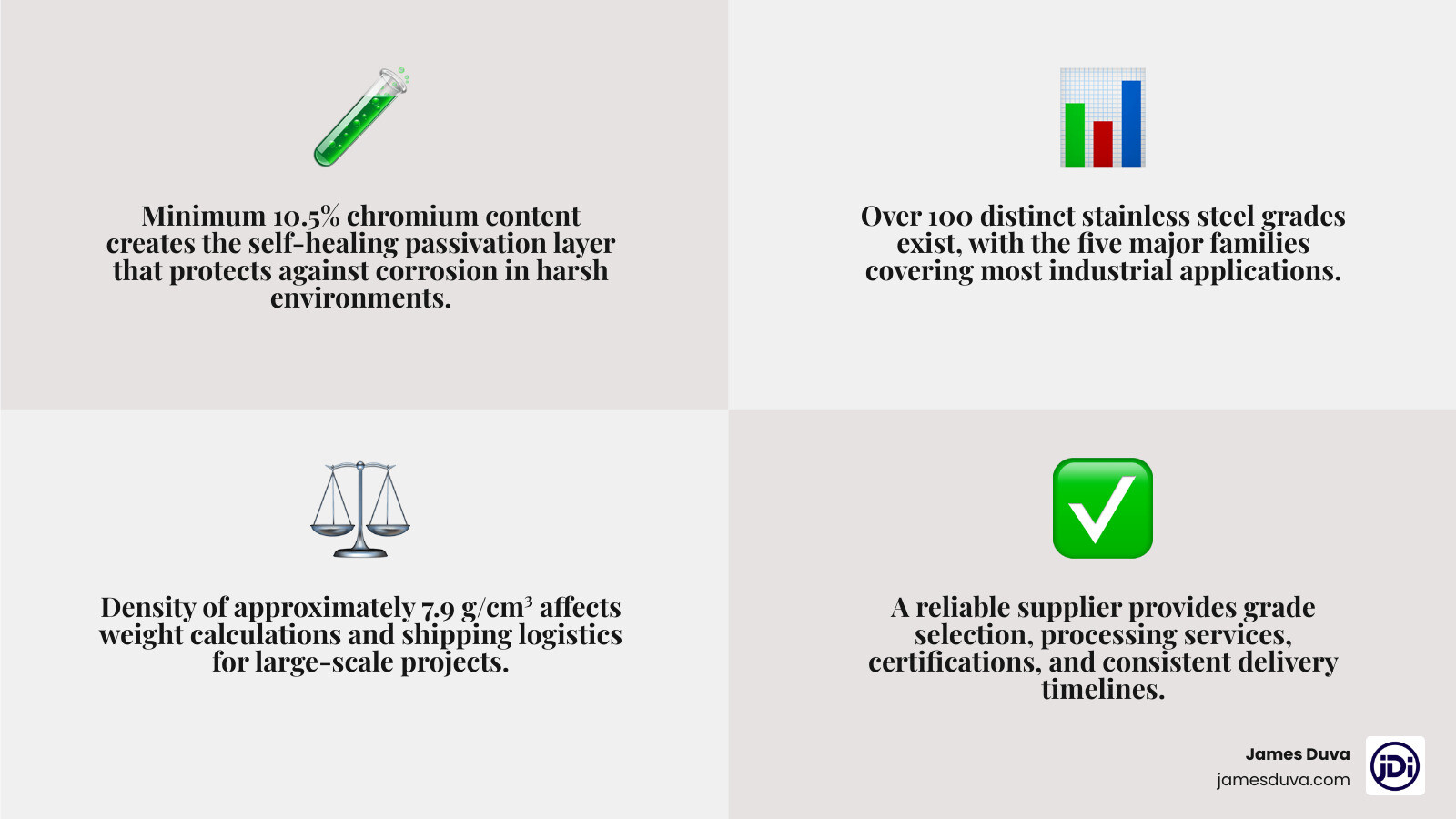
Stainless steel is an iron alloy with a minimum of 10.5% chromium. That chromium forms a thin, self-healing oxide layer on the surface — called a passivation layer — that gives stainless steel its signature corrosion resistance. With more than 100 grades available and a density of approximately 7.9 g/cm³, it’s one of the most versatile industrial metals in use today.
For professionals in chemical processing, oil and gas, or water treatment, getting the wrong material — or the right material from an unreliable source — can cause costly delays and safety risks.
I’m Billy Walker, Vice President of James Duva Inc., a stainless steel supplier serving the power, process, and water treatment industries since 1978. Over the decades, I’ve helped engineers and contractors source specialty piping components and high-nickel alloys from leading domestic manufacturers, so I’ll walk you through everything you need to know to source confidently.
Understanding Grades and Formats
A good supplier does more than sell metal. We help match the right grade and product form to the job so you are not overbuying performance or underbuying reliability.
Stainless steel comes in more than 100 grades, but most industrial requirements fall into five major families:
- Austenitic
- Ferritic
- Martensitic
- Duplex
- Precipitation hardening
For a broader material overview, see A Comprehensive Introduction to Stainless Steel: Facts and Industry Insights.
Understanding Grades and Types from a Stainless Steel Supplier
Here is the simple version of how the main families differ.
Austenitic stainless steels
- Best known for corrosion resistance, formability, and weldability
- Common grades include 304/304L and 316/316L
- Frequently used in food processing, medical equipment, piping, tanks, and architectural applications
Ferritic stainless steels
- Typically have lower nickel content
- Good for moderate corrosion resistance and often chosen for appliances, exhaust systems, and decorative uses
- Common examples include 409 and 430
Martensitic stainless steels
- Known for strength and hardness
- Often used where wear resistance matters, such as shafts, fasteners, valves, and certain tooling components
- Grade 410 is a common example
Duplex stainless steels
- Combine austenitic and ferritic microstructures
- Offer higher strength and improved resistance to pitting and crevice corrosion
- 2205 Duplex is a widely specified grade for chemical processing, marine, and chloride-rich environments
Precipitation hardening stainless steels
- Designed for high strength after heat treatment
- Common in aerospace, energy, and demanding mechanical applications
- 17-4 PH is one of the best-known grades
When we help customers choose a grade, we usually look at five things:
- Corrosion exposure
- Strength requirement
- Fabrication method
- Temperature range
- Budget
A few of the most common grades deserve a closer look:
304/304L
- Often the default choice for general corrosion resistance
- Economical, widely available, and easy to fabricate
- Common in tanks, tubing, sheet metal parts, and sanitary service
316/316L
- Similar to 304, but with molybdenum added for better corrosion resistance
- Better suited to chloride exposure and more aggressive environments
- Often used in process piping, marine-adjacent service, and pharmaceutical equipment
2205 Duplex
- Stronger than 304 and 316
- Excellent resistance to stress corrosion cracking and chloride attack
- Valuable in oil and gas, chemical plants, and water treatment systems
A supplier should also understand the basic science behind the product, not just the part number. Stainless steel contains at least 10.5% chromium, which creates the passivation layer that helps protect the surface. Density is about 7.9 g/cm3, so weight planning matters for shipping, lifting, and structural design. For buyers focused on tubing and alloy selection, our article on stainless tubing suppliers goes deeper.
Common Shapes and Industrial Formats
The same grade can be supplied in very different forms depending on how it will be used.
Common stainless product formats include:
Sheets
- Thin flat material for panels, housings, enclosures, kitchen and sanitary surfaces, and formed parts
Coils
- Rolled flat stock for high-volume fabrication, stamping, and slit-to-width requirements
Plates
- Thicker flat products used for pressure vessels, tanks, heavy fabrications, and structural components
Bars
- Round, flat, square, and hex forms used in machining and mechanical parts
Tubes
- Common in instrumentation, process systems, heat exchangers, and structural applications
Pipe
- Used for fluid transport and pressure-containing systems
Structural shapes
- Angles, channels, beams, and tees for support frames and architectural or industrial structures
Typical mill and decorative finishes include:
- 2B
- 2D
- Hot rolled annealed and pickled
- Bright annealed
- No. 3 polish
- No. 4 brushed
- No. 8 mirror
- Cold drawn
- Centerless ground
Finish matters more than many buyers expect. It affects appearance, cleanability, corrosion performance, and downstream fabrication. In food, medical, and architectural applications, surface finish is often part of the specification, not an afterthought.
Why Are Alloys So Valuable in Industry?
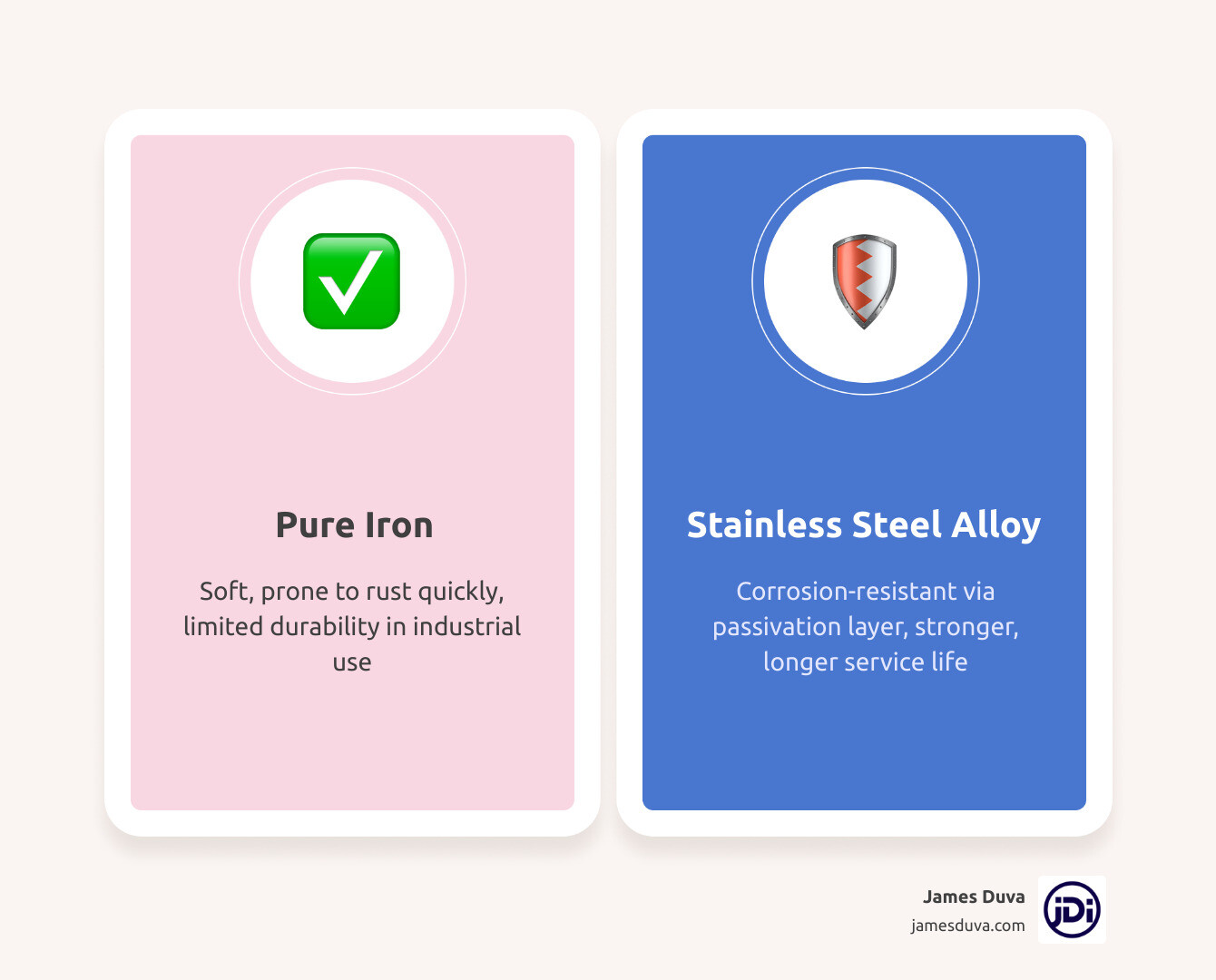
Pure metals are useful, but they often have limitations. Pure iron, for example, is too soft for many industrial jobs and far too eager to rust when moisture shows up. Metals, like people, usually perform better with the right support system.
That is where alloys come in.
By combining iron with chromium, nickel, molybdenum, and other elements, stainless steel gains:
- Better corrosion resistance
- Higher strength
- Improved toughness
- Better heat resistance
- Longer service life
The passivation layer created by chromium is a major reason stainless steel performs so well. If the surface is scratched, that oxide film can reform in the presence of oxygen. That self-healing behavior is one of the material’s biggest advantages. For a neutral technical reference on the material itself, see stainless steel.
To explore more end uses, visit Stainless Steel Applications for Every Industry.
A quick comparison helps:
| Material | Corrosion Resistance | Weight | Relative Cost | Typical Strength-to-Weight Use |
|---|---|---|---|---|
| Stainless steel | Excellent to very high, depending on grade | High | Moderate to high | Best when durability and corrosion resistance matter |
| Carbon steel | Low without coating | High | Usually lower upfront | Good for dry service and structural value |
| Aluminum | Good natural corrosion resistance | Low | Varies by alloy | Excellent where low weight matters |
In plain terms:
- Stainless steel vs carbon steel
- Stainless costs more upfront in many cases, but it resists rust far better and usually needs less maintenance
- Stainless steel vs aluminum
- Aluminum is much lighter, often around one-third the weight of stainless, but stainless is generally stronger, harder, and more weight resistant
Industrial Applications Across Sectors
A capable stainless steel supplier should understand how materials perform in real service, not just on a data sheet.
Construction:
- Beams
- Piping systems
- Handrails
- Cladding
- Structural supports
Oil and gas:
- Fittings
- Flanges
- Valves
- Instrumentation tubing
- Corrosion-resistant piping assemblies
For flow control components, see our Ball Valves.
Automotive and aerospace:
- Frames
- Exhaust systems
- Engine components
- Fasteners
- Heat-resistant parts
Medical and consumer goods:
- Implants
- Surgical equipment
- Sterile processing equipment
- Kitchenware
- Appliances
Food processing and beverage:
- Tanks
- Conveyors
- Washdown equipment
- Sanitary tubing
- Storage and transfer systems
Chemical processing and water treatment:
- Pumps
- Valves
- Pipe spools
- Storage vessels
- Corrosion-resistant internals
That range of applications is exactly why grade selection matters so much. The right alloy in the wrong environment can still fail. The right alloy from the right supplier usually makes life much quieter, and in industrial purchasing, quiet is beautiful.
Sustainability and Recycling in 2026
Stainless steel has a strong sustainability story, especially in 2026 when buyers are paying closer attention to life-cycle value.
Key facts:
- Stainless steel has a recycling rate that exceeds 90%
- About 80% of stainless steel is recycled at the end of its life
- It can be recycled repeatedly without losing key properties
That matters because stainless is not just durable in service. It also remains valuable after service. Scrap recovery, remelting, and reuse reduce demand for virgin raw material and support circular manufacturing.
At James Duva, we believe sustainable sourcing means more than using a recyclable material. It also means helping customers choose grades that last, minimizing rework, and reducing waste through correct sizing and smart procurement. Long service life is an environmental benefit too.
Key Services and Processing Capabilities of a Stainless Steel Supplier
Inventory is important, but service is what turns inventory into a solution.
A modern supplier may provide:
- Custom cutting
- Shearing and slitting
- Laser cutting
- Waterjet cutting
- Band saw cutting
- Plate processing
- Tube and bar cutting
- Polishing
- Documentation and traceability
- Inventory planning and release programs
For a broader look at consolidated sourcing, read One-Stop Solution: Sourcing Stainless Steel and Nickel Alloy Products Made Easy.

Custom Fabrication and Finishing
Different product forms need different processing methods.
For sheet and coil, suppliers often offer:
- Cut-to-length blanks
- Slit coils
- Sheared sheets
- Laser-cut profiles
For plate:
- Band saw cutting
- Waterjet cutting
- Plasma or laser profile cutting
- Machining prep
For bars and tubes:
- Precision cutoff
- Deburring
- End finishing
- Bundling and job labeling
Finishing services can be just as important as cutting. Common options include:
- No. 4 brushed finish
- No. 8 mirror finish
- Bright annealed surfaces
- Polished tube and pipe
- Directional grain finishing
One detail many buyers overlook is grain direction on polished products. If appearance matters, especially on visible architectural or equipment surfaces, the grain should be specified on the order. Otherwise, parts may arrive technically correct but visually inconsistent. That is the kind of issue that can turn a smooth project into a meeting.
Factors for Choosing a Distributor
If you are evaluating suppliers in New Jersey or across the Mid-Atlantic, focus on practical criteria, not just a polished brochure.
Here is what we recommend:
- Reputation
- Look for a long track record and real industrial experience
- Product range
- Make sure the supplier supports the grades and forms you actually need
- Technical knowledge
- They should understand corrosion, fabrication, pressure service, and alloy substitution risks
- Quality certifications and documentation
- Ask about mill test reports, traceability, and quality systems
- Delivery reliability
- Inventory depth and realistic lead times matter more than optimistic promises
- Processing capability
- Value-added services can reduce your own labor and shorten schedules
- Communication
- Fast, accurate quoting and clear answers are a sign of operational discipline
- Regional fit
- A supplier familiar with the Mid-Atlantic and New Jersey industrial market can often support projects more efficiently
For buyers working in New Jersey, a supplier with local market knowledge and strong technical support can simplify sourcing, reduce delays, and improve coordination from quote to delivery. James Duva brings that regional experience together with specialty alloy expertise to support demanding industrial applications.
Frequently Asked Questions about Stainless Steel Suppliers
What is the most common grade offered by a stainless steel supplier?
304 and 304L are usually the most common grades. They are popular because they balance corrosion resistance, availability, formability, and cost. For many general industrial and sanitary applications, 304 is the first grade buyers consider. When chloride exposure or stronger corrosion resistance is needed, 316 or 316L is often the next step up.
How does stainless steel density affect shipping and logistics?
Stainless steel has a density of about 7.9 g/cm3, so it is relatively heavy compared with aluminum. That affects freight cost, lifting equipment, storage planning, and structural handling. For example, a plate order may be compact, but it can still require serious rigging attention. A supplier that understands logistics will help with packaging, bundle weights, and practical shipment planning.
Can stainless steel be recycled indefinitely without losing quality?
Yes. Stainless steel can be recycled again and again without losing the essential properties that make it valuable. That is one reason it is widely used in industries that care about both durability and sustainability. With recycling rates above 90% and roughly 80% recovered at end of life, it remains one of the most circular engineering materials available.
Conclusion
Choosing the right stainless steel supplier is really about reducing risk. You want the right grade, the right format, the right processing, and the right support before problems start.
At James Duva Inc., we have served industrial customers from Branchburg, New Jersey since 1978, supplying high-grade stainless steel and nickel alloy products for demanding applications in chemical processing, oil and gas, and related sectors. We focus on being a one-stop shop with the technical experience to help customers source with confidence.
If you are ready to explore product options, start here:
- James Duva stainless steel category
- Expert Stainless Tubing Suppliers: Discover the Quality of James Duva
- One-Stop Solution: Sourcing Stainless Steel and Nickel Alloy Products Made Easy
The best supplier relationship should make your project easier, not more exciting. In metal procurement, boring is often a compliment.
About James Duva Inc.
Since 1978, James Duva Inc. has been your trusted source for stainless steel and high-nickel alloy industrial products. Whether you’re in the water treatment, process or power industry, we pride ourselves on always having what you need. Say goodbye to your sourcing problems with just one call to James Duva.