
Decoding 1/4 Inch Stainless Steel Round Bar: Grades, Uses, and Buying Tips

Mar 2, 2026
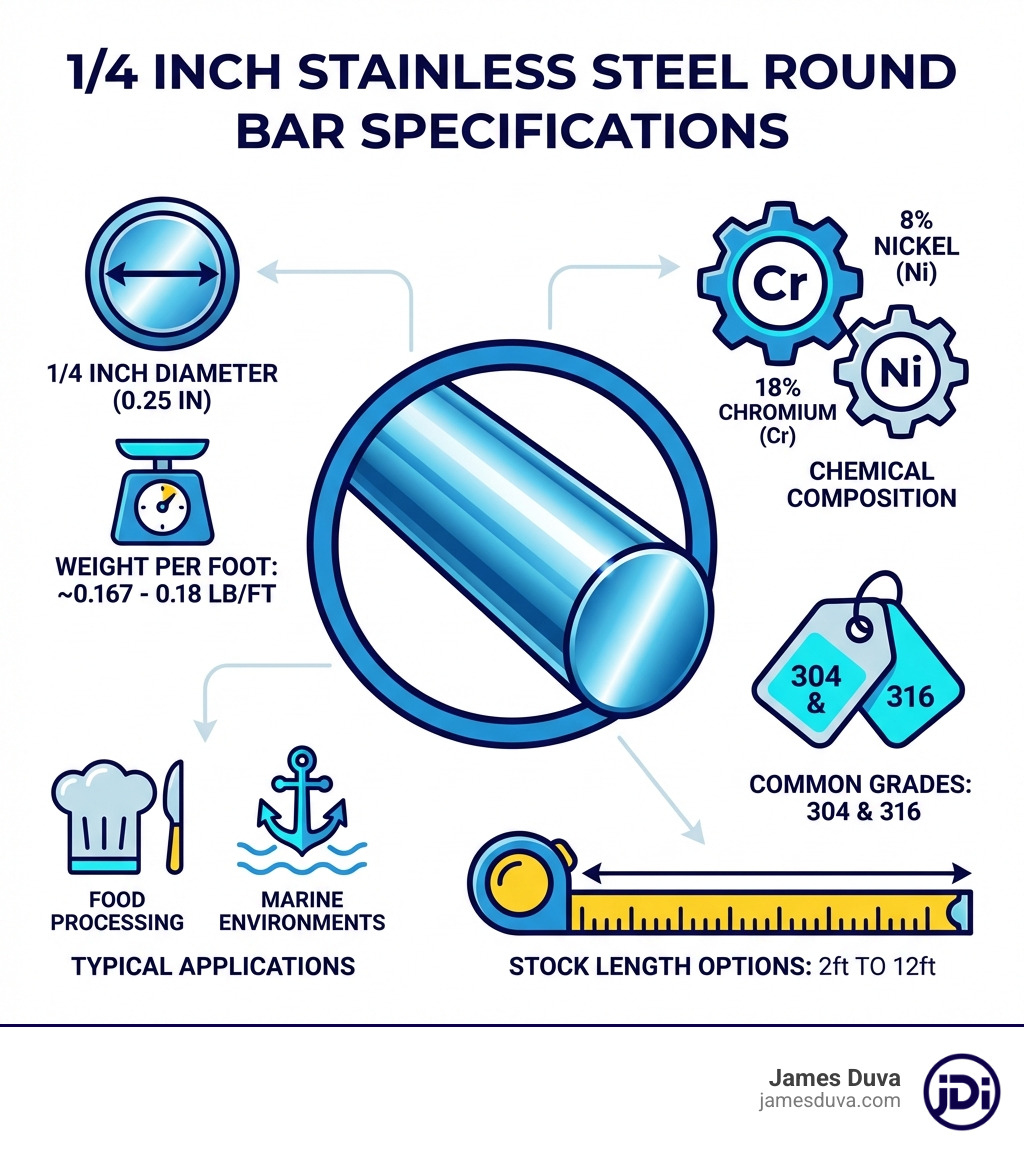
1/4 inch stainless steel round bar is a solid cylindrical rod with a 0.25-inch diameter, most commonly manufactured from Type 304 or 316 stainless steel. To understand what is stainless steel, one must look at its alloy definition and the specific stainless steel basics that make it so durable. Here are the essential specifications:
Quick Specifications:
- Diameter: 0.25 inches (1/4 inch)
- Weight: Approximately 0.167-0.18 lb/ft
- Common Grades: 304, 304L, 316, 303
- Standard: ASTM A276
- Typical Composition: 18% chromium, 8% nickel
- Properties: Corrosion resistant, non-magnetic (annealed), easily welded
- Stock Lengths: 2ft, 4ft, 6ft, 12ft, or cut-to-size
This versatile industrial product serves as raw material for fasteners, shafts, supports, and precision components across chemical processing, food service, marine, and architectural applications.
Why 1/4 inch matters: This diameter strikes an ideal balance between strength and workability. It’s large enough for structural support yet small enough for detailed machining work. The 0.25-inch size is commonly stocked, making it readily available with shorter lead times than custom diameters.
Type 304 remains the most popular choice due to its exceptional combination of corrosion resistance and mechanical properties similar to structural steels. Type 304L (low carbon variant) is recommended when welding is required to prevent carbide precipitation.
I’m Billy Walker, Vice President at James Duva Inc., and I’ve spent years helping industrial professionals source specialty 1/4 inch stainless steel round bar and other piping components for power, process, and water treatment applications. Our company has served these industries since 1978, providing reliable access to domestic stainless steel from leading manufacturers.
Technical Specifications of 1/4 Inch Stainless Steel Round Bar
When you are looking for the right stainless steel round bar, you aren’t just buying a piece of metal; you are buying a set of performance promises. The 1/4 inch stainless steel round bar is governed by strict stainless steel standards to ensure that every rod performs predictably under pressure.
Most of the bars we supply conform to ASTM A276. This is the “gold standard” for stainless steel bars and shapes, covering hot-finished or cold-finished bars (except for bars for reforging). It ensures that the stainless steel composition and mechanical properties meet the rigorous demands of industrial use.
Comparing Common Grades
Choosing between grades like 303, 304, and 316 is like choosing the right tool for a job. You wouldn’t use a sledgehammer to hang a picture frame, right? Here is how they stack up:
| Property | Type 303 | Type 304 | Type 316 |
|---|---|---|---|
| Machinability | Excellent | Good | Fair |
| Weldability | Poor | Excellent | Excellent |
| Corrosion Resistance | Good | Excellent | Superior (Marine Grade) |
| Tensile Strength (PSI) | 90,000 | 85,000 – 90,000 | 75,000 – 80,000 |
| Yield Strength (PSI) | 35,000 | 34,000 – 40,000 | 30,000 |
Type 304/304L is often called the “18-8” alloy because it contains approximately 18% chromium and 8% nickel. It is non-magnetic in the annealed condition, though it can become slightly magnetic if it has been heavily cold-worked. Its mechanical properties are impressively similar to structural steels, but with the added “superpower” of resisting rust.
Chemical Composition of 1/4 Inch Stainless Steel Round Bar
What exactly is inside that 1/4 inch stainless steel round bar? It’s a recipe designed for durability. What is stainless steel made of exactly? It starts with iron, but the “secret sauce” lies in the stainless-steel-chemistry of alloying elements.
For a standard 304 grade, the chemistry looks like this:
- Chromium (18.00-20.00%): This is what makes it “stainless.” It creates an invisible, self-healing oxide layer on the surface that prevents rust.
- Nickel (8.00-10.50%): Nickel improves corrosion resistance and provides the alloy steel with its characteristic formability and ductility.
- Carbon (0.08% max): In the standard 304 grade, carbon is kept low to maintain strength.
The 304 vs. 304L Difference
If your project involves a lot of welding, you’ll want to look at 304L. The “L” stands for “Low Carbon” (0.03% max). Why does this matter? When you weld stainless steel, high heat can cause “carbide precipitation,” which makes the metal vulnerable to corrosion at the weld joints. By using 304L, you significantly reduce this risk. It’s a small detail in the chemistry that makes a massive difference in the field.
Weight and Measurement Standards
In metalworking, precision is everything. You can’t just “eyeball” a 1/4 inch stainless steel round bar. We measure these bars by their diameter and their length.
Weight Matters
Knowing the weight is crucial for shipping costs and structural calculations. According to steel facts, a 1/4 inch diameter 304 stainless steel round bar typically weighs:
- 0.167 to 0.18 lbs per foot.
- A full 12-foot bar weighs approximately 2.0 to 2.16 lbs.
When ordering, keep in mind that stock lengths can vary slightly. Standard lengths are often 12 feet, but “random lengths” can range between 11 and 13 feet. If you need something specific, many suppliers (including us) offer cut-to-size services. Our standard saw cut tolerance is usually -0″ to +1/8″, though tighter tolerances of +/- 1/16″ are available for precision projects. You can use a stainless-steel-weight-calculator to estimate the total load for your order.
For more background on alloys, grades, and selection, browse our stainless steel resources.
Key Advantages and Material Grades
Why is the 1/4 inch stainless steel round bar such a staple in New Jersey machine shops and manufacturing plants? It comes down to versatility. There are different types of stainless steel, and how many types of stainless steel are there depends on the specific application, as each offers unique stainless steel properties.
- Corrosion Resistance: This is the big one. Whether it’s exposed to rain, chemical cleaners, or industrial acids, stainless steel stays clean and functional.
- Weldability: 304 and 316 grades are incredibly easy to weld using standard methods like TIG or MIG.
- Machinability: While 304 is “moderate” to machine, 303 is the king of the machine shop. If you are making thousands of small screws or fittings, 303 will save you a fortune in tool wear.
- Heat Resistance: 304 stainless can handle oxidation at temperatures up to 1,600°F.
Comparing 304 to 316 and 17-4 PH
When you step up from 304, you usually do it for one of two reasons: more corrosion resistance or more strength. Understanding stainless-steel-grades is key to making the right choice.
- Type 316: Often called “Marine Grade.” It contains molybdenum, which gives it a massive boost in resisting “pitting” from saltwater and chlorides. If your project is near the Jersey Shore or involves harsh chemicals, 316 is the way to go.
- 17-4 PH: This is a precipitation-hardening grade. It is significantly stronger than 304 or 316 and can be heat-treated to achieve very high hardness levels. It’s common in aerospace and high-stress mechanical parts.
- Specialty Alloys: For even more extreme environments, we sometimes look toward alloy 317l bar or alloy 825 bar. These are the “heavy hitters” of the stainless steel grades world, designed for high-acid or high-pressure situations.
If you are dealing with extremely complex chemical environments, you might even consider duplex-stainless-steel, which combines the best traits of austenitic and ferritic steels.
Workability of 1/4 Inch Stainless Steel Round Bar
One of the best things about a 1/4 inch stainless steel round bar is how well it responds to stainless steel fabrication.
Cold Working and Annealing
These bars are typically supplied in the “annealed” condition, which means they are at their softest and most ductile state. However, if you need more strength, stainless steel “work hardens.” This means that as you bend it, roll it, or draw it, the steel alloy actually gets stronger.
Finishes and Appearance
The finish you choose depends on whether the bar will be hidden inside a machine or displayed on a building.
- Mill Finish: This is the standard “dull” or matte look. It might have some scuffs or scratches from the manufacturing process, but it’s the most economical choice for structural parts.
- Cold Finished: These bars have a smoother surface and tighter size tolerances than hot-rolled bars.
- Polished/Ground: If you are making architectural railings or kitchen equipment, you might want a polished finish for that classic “stainless” shine.
In some high-temperature aerospace applications, you might even see inconel-alloys used in similar round bar formats, though 304 stainless remains the go-to for 90% of general industrial needs.
Industrial Applications and Use Cases
Where will you find a 1/4 inch stainless steel round bar in the real world? Just about everywhere! Because it’s so easy to form and weld, it’s a favorite for stainless steel applications for every industry.
1. Food and Beverage Industry
From dairy processing to beer brewing, stainless steel is the law. Its non-porous surface doesn’t harbor bacteria, and it can withstand the harsh cleaning chemicals used in “clean-in-place” systems. You’ll see 1/4 inch rods used as supports, handles, and internal components in commercial ovens and mixers.
2. Chemical Processing
In the chemical world, things get messy. Parts exposed to acetic, nitric, or citric acids need the protection that only a high-quality uses of steel grade like 304 or 316 can provide. These bars are used for valve stems, pump shafts, and agitation equipment.
3. Marine Hardware
Saltwater is the enemy of metal. 316 stainless round bar is used for boat fittings, coastal stainless-steel-infrastructure, and marine fasteners. It keeps things from seizing up or rusting away in the salty Atlantic air.
4. Architecture and Construction
Next time you see a modern glass railing or a fancy hanging light fixture, look closely. Those thin, strong supports are often 1/4 inch stainless steel round bar. They provide a sleek, minimalist look while offering the structural integrity needed for safety. For more on how these materials shape our world, check out our Comprehensive Introduction to Stainless Steel Facts and Industry Insights.
Frequently Asked Questions about 1/4 Inch Stainless Bar
We get a lot of questions about these rods. Here are the most common ones we hear at our Branchburg office:
What is the weight per foot of a 1/4 inch 304 stainless round bar?
A 1/4 inch (0.25″) diameter 304 stainless steel round bar typically weighs 0.167 lbs per foot. Some manufacturers list it as high as 0.18 lbs/ft depending on the exact alloy density and manufacturing tolerances. If you’re calculating for a large shipment, it’s always safer to use the slightly higher number for your weight estimates!
Can 1/4 inch 304 stainless steel be hardened by heat treatment?
No. Unlike some carbon steels, 304 stainless steel cannot be hardened by heat treatment. If you need it to be harder, it must be “cold worked” (like cold drawing or rolling). If your application absolutely requires a bar that can be heat-treated to a high hardness, you should look into the 400-series stainless steels or a precipitation-hardening grade like 17-4 PH.
When should I use 304L instead of standard 304 for round bars?
You should reach for 304L whenever your project involves welding. The lower carbon content (0.03% max) prevents “sensitization” during the welding process. This ensures that the area around the weld remains just as corrosion-resistant as the rest of the bar. For most other non-welded applications, standard 304 is perfectly fine and often slightly easier to find in a wide range of lengths. For more answers to common queries, visit our stainless-steel-faq.
Conclusion
The 1/4 inch stainless steel round bar might be “skinny,” but it carries a lot of weight in the industrial world. Whether you need the general-purpose reliability of 304, the free-machining ease of 303, or the marine-grade toughness of 316, this size is a versatile powerhouse.
At James Duva Inc., we’ve been the trusted stainless steel supply for businesses across New Jersey and beyond since 1978. We don’t just sell metal; we provide the expertise to make sure you get the exact stainless steel industrial products for your specific environment.
If you are looking for a stainless steel supplier or need a custom quote for your next project, we are here to help. You can browse our full range of materials in our stainless steel section or contact James Duva directly at our Branchburg, NJ location.
Let’s build something that lasts!
About James Duva Inc.
Since 1978, James Duva Inc. has been your trusted source for stainless steel and high-nickel alloy industrial products. Whether you’re in the water treatment, process or power industry, we pride ourselves on always having what you need. Say goodbye to your sourcing problems with just one call to James Duva.