
Metals That Can Take the Heat (and the Rust!): A Comprehensive Guide

Feb 24, 2026
Why Heat-Resistant Metals Matter for Critical Applications
Heat resistant metals are specialized materials engineered to maintain their strength and integrity in extreme temperature environments where standard metals would fail. They are essential for industries like power generation, aerospace, and chemical processing, where material failure isn’t just costly—it’s catastrophic.
Key types of heat-resistant metals:
- Stainless Steel (Grades 309, 310, 321) – Up to 1,150°C (2,102°F)
- Nickel Alloys (Inconel, Hastelloy) – Up to 1,100°C (2,012°F)
- Refractory Metals (Tungsten, Molybdenum, Tantalum) – Up to 3,422°C (6,192°F)
- Titanium Alloys – Up to 600°C (1,112°F)
- Cobalt Alloys – Up to 1,495°C (2,723°F)
From jet engines operating over 1,100°C to chemical processing equipment, the right metal prevents dangerous failures. A mere 20°C temperature change can alter corrosion rates tenfold in high-temperature oxidation conditions, making material selection critical.
Components must withstand not just heat, but also oxidation, thermal cycling, creep, and corrosion—often simultaneously. Choosing the wrong alloy can lead to catastrophic failures, costly downtime, and safety hazards.
As Billy Walker, Vice President of James Duva Inc. in Branchburg, NJ, I’ve spent decades helping engineers source heat resistant metals for demanding applications across New Jersey and beyond. Our expertise ensures you get the right material specification for your critical high-temperature needs, whether you are looking for stainless steel bar and plate or advanced nickel alloys.
See our high-temperature alloy solutions to explore materials engineered for extreme conditions. You can start with our dedicated high-temperature alloys category or contact our team in New Jersey for application-specific advice.
What Defines a Heat-Resistant Metal?
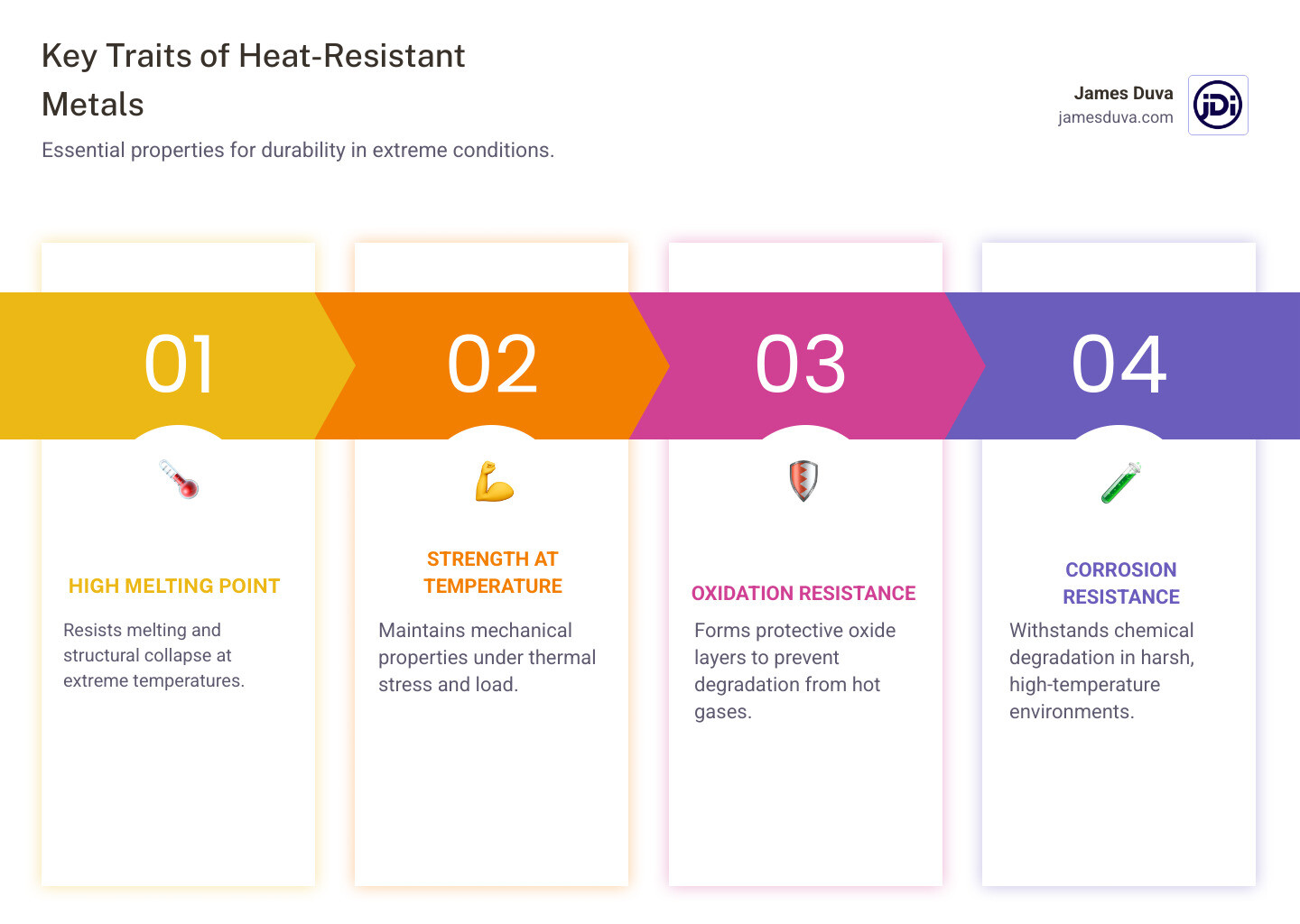
When we talk about heat resistant metals, we’re seeking alloys that perform consistently in environments exceeding 650°C (1200°F), maintaining their structural integrity under extreme thermal stress. Explore our high-temperature material options to find the right fit for your project. A high melting point is crucial, but it’s only one piece of the puzzle. A metal that doesn’t melt but becomes soft and weak when hot is not suitable for a critical component like a turbine blade.
Here’s what truly defines a heat-resistant metal:
- High-Temperature Strength: The ability to retain mechanical properties like tensile strength as temperatures soar, preventing the material from weakening or deforming under load.
- Oxidation Resistance: The formation of a stable, protective oxide layer on the surface that acts as a shield against scaling and degradation from exposure to oxygen.
- Corrosion Resistance: The ability to resist chemical attacks from agents like sulfur or chlorides often present in high-temperature industrial environments.
- Creep Resistance): The capacity to resist slow, permanent deformation under sustained stress at high temperatures, preventing components from sagging or deforming over time.
- Thermal Fatigue Resistance: The durability to endure repeated cycles of heating and cooling without cracking or failing due to internal stresses from expansion and contraction.
- Low Thermal Expansion: A lower coefficient of thermal expansion helps maintain dimensional stability and precise tolerances in tightly engineered assemblies.
The magic behind these properties often lies in the alloying elements we introduce. Chromium is a superstar for oxidation and corrosion resistance, forming that crucial protective oxide layer. Nickel improves strength, toughness, and resistance to various forms of high-temperature corrosion. Molybdenum, cobalt, and titanium also play vital roles, contributing to high-temperature strength and creep resistance. Through careful selection, we can tailor alloys to meet specific challenges.
When choosing materials, it’s about understanding the entire thermal and chemical environment. We pride ourselves on helping our clients steer these complex choices for applications throughout New Jersey and the surrounding region. Learn more about high-temperature alloys at James Duva and let us guide you to the perfect solution.
A Closer Look at the Top Heat-Resistant Metals
Navigating heat resistant metals requires understanding the champions of the field. These are the alloys that form the backbone of modern industry, each offering a unique set of properties for specific extreme heat conditions. While pure metals like Tungsten boast incredible melting points, it’s often the ingenious combinations in alloys—sometimes called superalloys—that provide the optimal balance of strength, corrosion resistance, and fabricability needed for real-world applications.
Ready to see who’s who in the hot seat? Let’s dive in. You can always browse our full product categories to see the range of materials we offer, from bar and plate products to specialized nickel alloys and titanium alloys.
Stainless Steel: The Versatile Workhorse
Stainless steel is a cost-effective iron-chromium alloy, often with nickel, offering a fantastic balance of formability and resistance to both corrosion and heat. For demanding high-temperature applications, we turn to specialized grades:
- Grade 310: A true star for high-temperature service up to 1,150°C (2,102°F), ideal for furnace parts and heat exchangers.
- Grade 309: Offers good heat resistance up to 1,093°C (2,000°F).
- Grade 321: Titanium-stabilized, making it excellent for welded applications or prolonged exposure to moderate-to-high temperatures, like aircraft exhausts.
- Grade 446: A high-chromium ferritic steel with exceptional heat resistance up to 1,150°C (2,102°F), especially in sulfurous atmospheres.
These grades are workhorses in furnaces, heat exchangers, and boilers. Explore our stainless steel bar and plate products or dig deeper with our guide to stainless steel grades to match a grade to your operating environment in New Jersey or beyond.
Nickel Alloys: The Gold Standard
When the heat really turns up, nickel alloys (or superalloys) are the gold standard. They offer exceptional strength, creep resistance, and oxidation resistance, even when operating close to their melting points. Key examples include our high-performance nickel alloys:
- Inconel: Grades like 600, 718, and X-750 can withstand temperatures up to ~1,090°C (2,000°F). They are indispensable for turbine blades, combustion liners, and rocket components in aerospace and power generation.
- Hastelloy: Known for extreme corrosion and heat resistance up to 1,100°C (2,012°F), these alloys are valued in harsh chemical processing environments.
The superior performance of nickel alloys makes them the go-to choice when failure is not an option, though they can be more challenging to machine.
Refractory Metals: Pushing the Absolute Limits
For the absolute boundaries of heat resistance, we turn to refractory metals, an elite group with melting points above 2000°C (3632°F).
- Tungsten (W): Boasts the highest melting point of any metal at 3,422°C (6,192°F), making it ideal for rocket nozzles and furnace windings.
- Molybdenum (Mo), Tantalum (Ta), Rhenium (Re), and Niobium (Nb): These metals also have incredibly high melting points and are used in aerospace, electronics, and as alloying elements in superalloys.
While their temperature tolerance is best, their primary weakness is poor oxidation resistance, often requiring protective coatings or use in a vacuum. They are also expensive and difficult to fabricate. Learn about refractory metals at James Duva by visiting our refractory metals product page or contact us for refractory metal sourcing and local support from our Branchburg, NJ office.
Titanium Alloys: The Lightweight Champion
Titanium alloys are lightweight champions, valued where a high strength-to-weight ratio is critical. With a maximum service temperature around 600°C (1,112°F), their value lies in their exceptional performance within this range, combined with their light weight and outstanding corrosion resistance.
Key characteristics include:
- High Strength-to-Weight Ratio: Critical for aerospace and high-performance automotive applications.
- Excellent Corrosion Resistance: A stable oxide layer provides superior protection in marine and chemical environments.
Key Selection Factors and Trade-Offs
Choosing the right heat resistant metals is a careful balancing act of weighing various factors against specific engineering requirements. It’s crucial to look beyond just the maximum operating temperature. A material might boast an impressive melting point, but if it corrodes or deforms under stress, it’s not the right fit.
Here’s a simplified comparison of some key characteristics:
| Metal Type | Max Temp (Continuous) | Cost (Relative) | Machinability | Corrosion Resistance |
|---|---|---|---|---|
| Stainless Steel | ~1150°C (310 grade) | Low-Medium | Good | Good |
| Nickel Alloys | ~1100°C | High | Difficult | Excellent |
| Refractory Metals | >2000°C | Very High | Very Difficult | Poor (in air) |
| Titanium Alloys | ~600°C | Medium-High | Moderate-Difficult | Excellent |
(Note: “Max Temp” refers to typical continuous service temperatures in air, not melting points. “Cost” is relative.)
This table highlights the compromises involved. Making the right choice can save you significant time and money by preventing costly failures. Our experts in Branchburg, NJ are here to help engineers across New Jersey evaluate options for furnaces, reactors, and other high-temperature systems. Contact our experts for material selection help for more insights into stainless steel and nickel alloy selection.
Beyond Melting Point: Creep, Fatigue, and Corrosion
In real-world applications, heat resistant metals face more than just high temperatures. We must consider:
- Creep Deformation: The slow, permanent stretching of a material under constant load in a hot environment.
- Thermal Fatigue: Cracking caused by repeated cycles of heating and cooling, which generate internal stresses.
- High-Temperature Corrosion: This includes several forms of attack. Oxidation is the reaction with oxygen. Sulfidation, carburization, and halogen corrosion involve reactions with sulfur, carbon, or halogen elements, respectively, which can rapidly degrade the metal. Hot corrosion is an accelerated attack caused by molten salts depositing on the surface, often seen in gas turbines.
Understanding these degradation mechanisms is essential for selecting a material that will thrive, not just survive. Explore our high-temperature alloy products in the high-temperature alloys category designed for resilience in chemical processing, oil & gas, and power generation.
Practical Trade-Offs: Cost vs. Performance for Heat Resistant Metals
Engineering decisions almost always involve balancing performance with practical constraints. Key trade-offs include:
- Cost vs. Performance: The highest-performing materials like refractory metals or nickel superalloys come with a higher initial cost. However, a lifecycle cost analysis often proves their worth by preventing costly failures and downtime.
- Fabrication (Machinability & Weldability): The very strength that makes these metals heat-resistant also makes them difficult to machine and weld. Materials like Inconel require specialized tooling and techniques, increasing manufacturing costs.
- Availability: Common stainless steels are readily available, while specialized alloys may have longer lead times.
- Density/Weight: For weight-sensitive applications like aerospace, a lighter material like titanium may be chosen over a denser but more heat-resistant one.
Our goal at James Duva Inc. is to help you conduct a thorough analysis, ensuring the material you choose makes both technical and economic sense for your operation in New Jersey. You can compare options directly in our product categories or discuss your design with our team. Ready to discuss your project’s needs? Request a quote for your project.
The Future of High-Temperature Performance
The relentless demand for materials that can withstand ever-higher temperatures is driving innovation in materials science. From more efficient power generation to next-generation aerospace and defense capabilities, the future is being shaped by advanced alloy design and sophisticated manufacturing techniques. These developments promise to revolutionize industries that rely on high-temperature components, paving the way for more efficient and durable systems.
We are committed to staying at the forefront of these innovations, ensuring our clients in New Jersey and across the region have access to the best materials science has to offer.
Advanced Alloys and Processing for Heat Resistant Metals
The cutting edge of heat resistant metals research includes new classes of materials like Refractory High-Entropy Alloys (RHEAs). Unlike traditional alloys based on one primary element, RHEAs are composed of multiple refractory metals in roughly equal proportions. This unique recipe creates materials with exceptional strength-to-weight ratios and stability at temperatures above 1200°C, making them candidates for hypersonic aircraft and fusion reactors.
Creating these complex alloys requires advanced processing, particularly powder-based methods. Since these materials have extremely high melting points, conventional casting is often impractical. Powder metallurgy techniques are key:
- Precise Control: Elemental powders can be mixed precisely to create complex alloy compositions.
- Advanced Consolidation: Techniques like Additive Manufacturing (3D printing) and Hot Isostatic Pressing (HIP) consolidate these powders into dense, high-performance components with intricate shapes that were previously impossible to make.
Related advanced processes, such as Spark Plasma Sintering (SPS), are also being explored in research labs worldwide to further refine microstructures at high temperature. While many of these technologies are still emerging, they directly influence the next generation of stainless and nickel alloys that suppliers like James Duva will bring to market.
The synergy between advanced alloy design and innovative powder processing will continue to drive breakthroughs in heat resistant metals. If you’re exploring custom alloy solutions for your next high-temperature project, we’re here to help. Review our high-temperature alloys to see current options, and contact us for custom alloy solutions to discuss what’s possible for your application.
Frequently Asked Questions about Heat-Resistant Metals
We often get asked similar questions about heat resistant metals, and it’s understandable! Here are some of the most common inquiries we receive:
Is titanium better than stainless steel for heat?
It depends on the application. Titanium alloys have a superior strength-to-weight ratio, but specialized stainless steel grades like 310 can withstand higher continuous temperatures (up to 1,150°C for 310 SS vs. ~600°C for common titanium alloys). If weight is a critical factor, titanium might be “better.” If maximum temperature is the priority, a high-grade stainless steel could be the winner.
What is the most machinable heat-resistant metal?
Generally, stainless steel offers the best balance of heat resistance and machinability. It can be worked using conventional methods, though it’s tougher than standard carbon steel. In contrast, nickel alloys (like Inconel) and refractory metals are significantly more challenging to machine, requiring specialized tools and processes.
What is the difference between a refractory metal and a superalloy?
This is a key distinction in heat resistant metals:
- Refractory Metals: These are pure elements (like Tungsten, Molybdenum) with exceptionally high melting points—all above 2000°C (3632°F). They are used for the most extreme temperatures but often have poor oxidation resistance.
- Superalloys: These are complex nickel, cobalt, or iron-based alloys engineered for a superior balance of high-temperature strength, creep resistance, and oxidation resistance. They are the workhorses of jet engines and gas turbines.
In short, refractory metals offer raw temperature tolerance, while superalloys provide a more balanced, practical solution for harsh, hot environments.
If you still have questions about selecting stainless steel, nickel alloys, or other high-temperature metals for your New Jersey facility, our team in Branchburg is ready to help—just contact us for technical support.
Conclusion: Finding the Right Alloy for Your Application
Choosing the right heat resistant metals is a critical decision that impacts the safety, efficiency, and longevity of your high-temperature applications. The optimal choice always depends on the specific demands of your project: temperature, corrosive agents, mechanical strength, weight, budget, and fabrication feasibility. From versatile stainless steels and high-performance nickel alloys to lightweight titanium and extreme-temperature refractory metals, each material offers a unique solution.
At James Duva Inc., we have decades of expertise in high-performance alloys. Based in Branchburg, NJ, we are a trusted partner for diverse industries, providing the insights and high-grade materials needed to succeed in the most demanding environments. We don’t just supply metals; we provide solutions, backed by a deep inventory of stainless steel bar and plate, nickel alloys, and more.
Let us help you steer the intricate world of heat resistant metals.
Explore our inventory of bar and plate products to start your search, or browse all high-temperature alloys. For personalized guidance and a competitive quote, please contact us for a quote or technical advice. Our New Jersey-based team is ready to support your next high-temperature project from material selection through delivery.
About James Duva Inc.
Since 1978, James Duva Inc. has been your trusted source for stainless steel and high-nickel alloy industrial products. Whether you’re in the water treatment, process or power industry, we pride ourselves on always having what you need. Say goodbye to your sourcing problems with just one call to James Duva.