
A Complete Breakdown of Different Ball Valve Types
May 29, 2026
Structural Classifications of Ball Valve Types
Ball valve types are one of the most important decisions you’ll make when designing or maintaining a fluid control system. Choose the wrong type and you risk leaks, pressure failures, or costly downtime.
Here’s a quick overview of the main ball valve types:
| Ball Valve Type | Best For |
|---|---|
| Floating ball | Low to medium pressure, small to mid-size pipes |
| Trunnion-mounted | High pressure, large-diameter pipelines |
| One-piece body | Low-cost, non-critical applications |
| Two-piece body | General industrial use, moderate maintenance needs |
| Three-piece body | Frequent cleaning, sanitary, and inline serviceability |
| Full port | Pigging operations, unrestricted flow |
| Reduced port | Cost-sensitive installs where some flow restriction is acceptable |
| V-port | Throttling and flow control applications |
| Soft-seated | Standard temperatures, tight shutoff required |
| Metal-seated | High heat, abrasive, or corrosive media |
Ball valves show up everywhere — from residential gas lines to offshore oil platforms, from pharmaceutical clean rooms to buried natural gas pipelines. Over 3,000 facilities on the Outer Continental Shelf alone rely on high-pressure ball valves for oil and gas collection and treatment. Yet despite how common they are, selecting the right type is far from simple.
The core principle is straightforward: a hollow ball rotates 90 degrees to open or close flow. But the details — body construction, port size, seating material, mounting mechanism — determine whether a valve lasts years or fails in months.
This guide breaks down every major classification so you can match the right valve to your application with confidence.
I’m Billy Walker, Vice President of James Duva Inc., where I’ve spent years helping engineers and procurement professionals source the right Ball Valves and specialty piping components — including stainless steel and high-nickel alloy ball valve types — for demanding industries like power, process, and water treatment. Let’s get into what separates one design from another.
When we talk about Industrial Valves: Types, Applications, and Importance in Manufacturing, the structural design of the ball itself is the first major fork in the road. How the ball is supported within the valve body dictates its pressure rating and how it creates a seal.
According to a News – Ball valve classification introduction, the primary structural distinction lies between floating and trunnion-mounted designs. This structural choice affects everything from the torque required to turn the handle to the valve’s longevity in high-velocity systems.
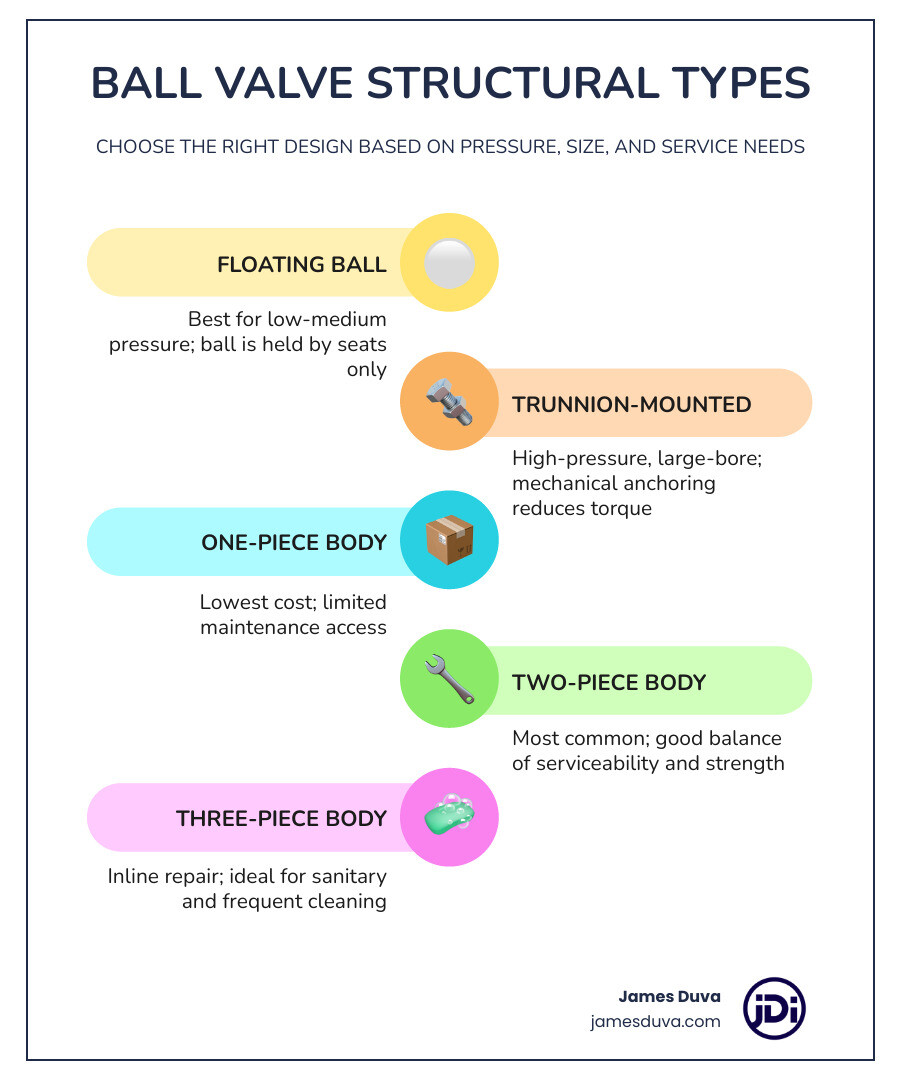
Floating vs. Trunnion Ball Valve Types
In a floating ball valve, the ball is not held in place by a shaft at the bottom. Instead, it “floats” between two seat rings. When the valve is closed, the upstream pressure of the fluid actually pushes the ball against the downstream seat. This creates a very tight, bubble-tight seal. We typically see these used in low to medium-pressure applications and smaller pipe sizes (usually under 4 inches).
However, as pressure and pipe size increase, that “pushing” force becomes too much for the seats to handle. This is where trunnion-mounted valves come in. As noted in the research on What Is Ball Valve?- Parts, Types, And Working, trunnion designs anchor the ball at both the top and the bottom with mechanical supports (trunnions).
Because the ball is fixed, the fluid pressure doesn’t move the ball; instead, it pushes the seats against the ball. This design is essential for large-bore pipelines and high-pressure systems (often above 580 psi or 40 bar) because it significantly reduces operational torque. You don’t want to need a six-foot cheater bar just to shut off a valve! Trunnion valves are also the standard for API 6D requirements in the oil and gas industry.
Body Construction: One-Piece, Two-Piece, and Three-Piece Designs
Beyond how the ball is held, we have to look at how the valve body itself is put together. This is a critical factor for Understanding the Vital Role of Industrial Valves in Fluid Control Systems.
- One-Piece Ball Valves: These are the most economical. The body is cast as a single solid piece of metal. While they are great for preventing leaks (fewer joints mean fewer leak paths), they are almost impossible to repair. If the seat wears out, you usually have to replace the entire valve. They also typically feature a reduced port design.
- Two-Piece Ball Valves: These are the workhorses of the industry. The body is split into two parts, which are threaded or bolted together. This allows for a larger ball and a “full port” flow. They are more serviceable than one-piece valves but still usually require being removed from the line for significant maintenance.
- Three-Piece Ball Valves: These are the “gold standard” for serviceability. The center section containing the ball and seats is held between two end caps by bolts. To perform maintenance, you simply remove the bolts and swing the center section out. You can replace seats and seals without ever disturbing the pipe connections. This is a massive time-saver for Understanding Ball Valves: Types, End Connections, and Materials in sanitary or high-cycle environments.
Port Configurations and Flow Control
The “port” is the hole in the center of the ball. Its size and shape determine how much fluid can pass through and how much pressure you’ll lose across the valve. When selecting Ball Valves for your system, understanding port configuration is essential.
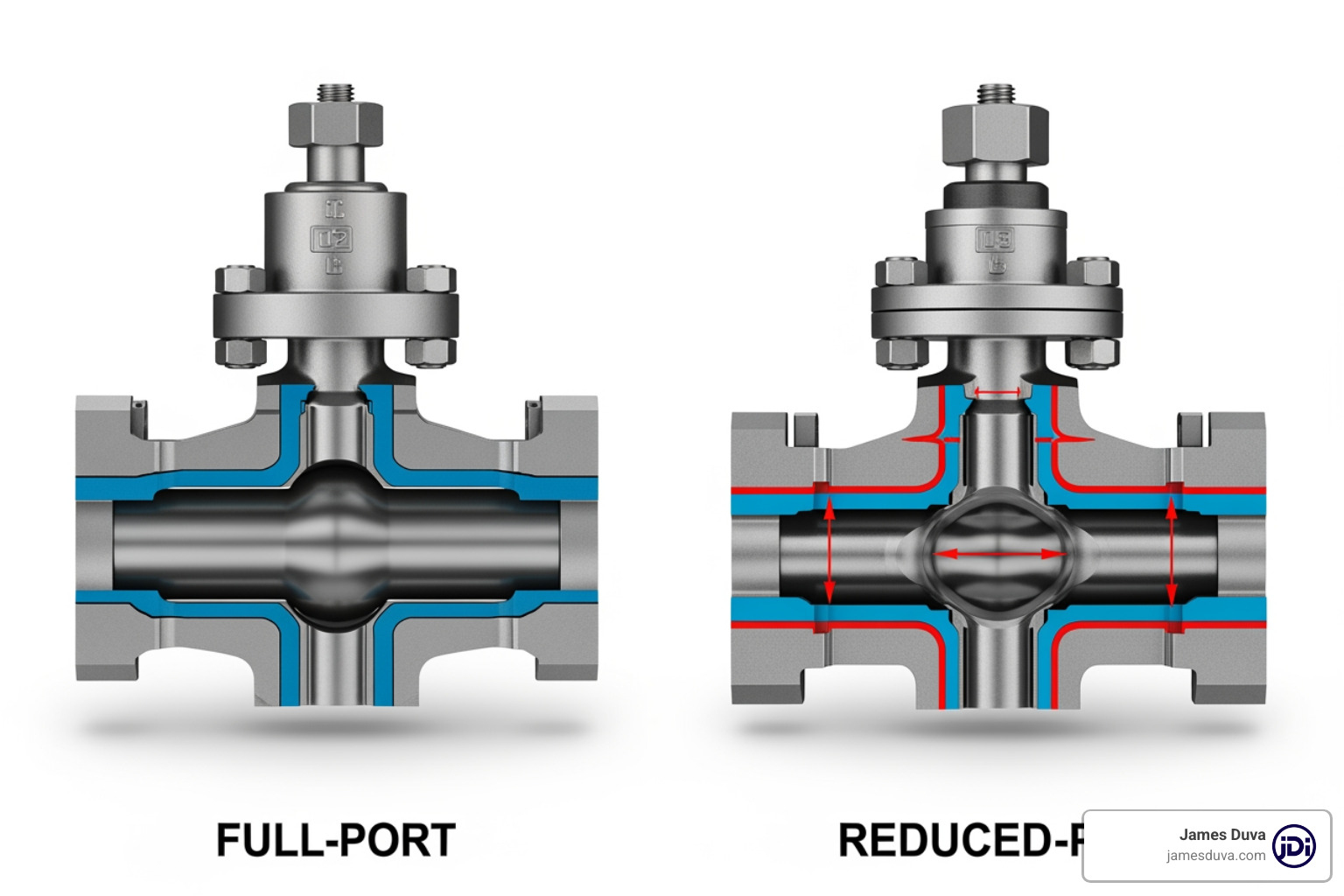
- Full Port (Full Bore): The hole in the ball is the same diameter as the pipe. This means there is virtually no restriction to flow and no pressure drop. These are mandatory for “pigging” operations in pipelines, where a cleaning device (the pig) must pass through the valve.
- Reduced Port (Standard Bore): The hole in the ball is one pipe size smaller than the pipe itself. For example, a 2-inch reduced port valve might have a 1.5-inch opening. These are cheaper and lighter, making them fine for applications where a small pressure drop isn’t a deal-breaker.
- Standard Port: These fall somewhere in between, offering a middle ground on cost and flow efficiency.
Specialized Ball Valve Types for Throttling and Directional Flow
While standard ball valves are great for on/off service, they aren’t naturally good at “throttling” (controlling flow at a specific rate). If you leave a standard ball valve partially open, the high-velocity fluid can erode the seats, leading to leaks.
However, 2 Most Common Types Of Ball Valves | Cross Process Solutions highlights that V-port ball valves solve this. These have a V-shaped notch in the ball, allowing for a more linear and precise flow control.
We also use multi-port valves for mixing or diverting. An L-port valve can divert flow from one inlet to one of two different outlets. A T-port valve can do the same, but it can also allow all three ports to be connected at once. These are incredibly useful in complex processing plants where you need to switch media between different tanks or lines.
Material Selection: Soft-Seated vs. Metal-Seated Valves
The “seats” are the rings that seal against the ball. Choosing the right material here is just as important as choosing the right metal for the body. You can find many of these options in our Product Categories: Valves.
| Material Type | Temperature Range | Media Compatibility | Best Use Case |
|---|---|---|---|
| PTFE (Teflon) | -50°F to 400°F | Most chemicals | Standard industrial fluids |
| PEEK | Up to 550°F | High-pressure steam | Power plants, steam lines |
| Reinforced PTFE | -50°F to 450°F | Slightly abrasive | Chemical processing |
| Metal-to-Metal | Up to 1000°F+ | Slurries, extreme heat | Mining, refining, oil & gas |
Soft-seated valves use polymers like PTFE. They provide a “bubble-tight” seal because the material is slightly elastic. However, they can melt or deform at very high temperatures and can be shredded by abrasive “slurries” (liquids with solid particles).
Metal-seated valves use hardened metals or specialized coatings. They can handle temperatures up to 750°F (400°C) and even higher in specialized designs. They are the only choice for abrasive media like sand-laden oil or mining tailings. While they might not always provide a 100% “bubble-tight” seal like Teflon, they are incredibly durable.
Why Are Alloys So Valuable in Industry?
At James Duva Inc., we specialize in high-grade stainless steel and nickel alloys for a reason. Pure metals, like pure iron, are often too soft for industrial use and are incredibly prone to oxidation (rust). In an industrial setting, rust isn’t just an eyesore; it’s a structural failure waiting to happen. Our extensive inventory of Valves and piping components utilizes these advanced materials to ensure longevity.
Alloys are “recipes” that combine metals to gain superior properties. For instance, adding chromium and nickel to iron creates stainless steel, which resists corrosion. Adding molybdenum creates alloys that can withstand the incredibly harsh, acidic environments found in chemical processing.
These alloys are vital across several sectors:
- Construction: Used for structural beams and piping that must withstand the elements for decades.
- Oil & Gas: High-pressure Ball Valves, fittings, and flanges must resist both the immense pressure of the earth and the corrosive nature of “sour” gas.
- Automotive & Aerospace: Frames and engines require alloys that maintain their strength even when glowing red-hot.
- Medical & Consumer Goods: From surgical implants that won’t react with the human body to kitchenware that stays shiny after thousands of washes.
Selecting the Right Valve for Industrial Applications
Selecting from the various ball valve types requires a holistic view of your system. You can’t just pick the cheapest one and hope for the best. At James Duva Inc., we help customers navigate these choices to ensure they receive the highest quality Industrial Valves for their specific needs.
According to the New Jersey Two Way Ball Valve Manufacturers – IQS Directory, you must consider several “gatekeeper” factors:
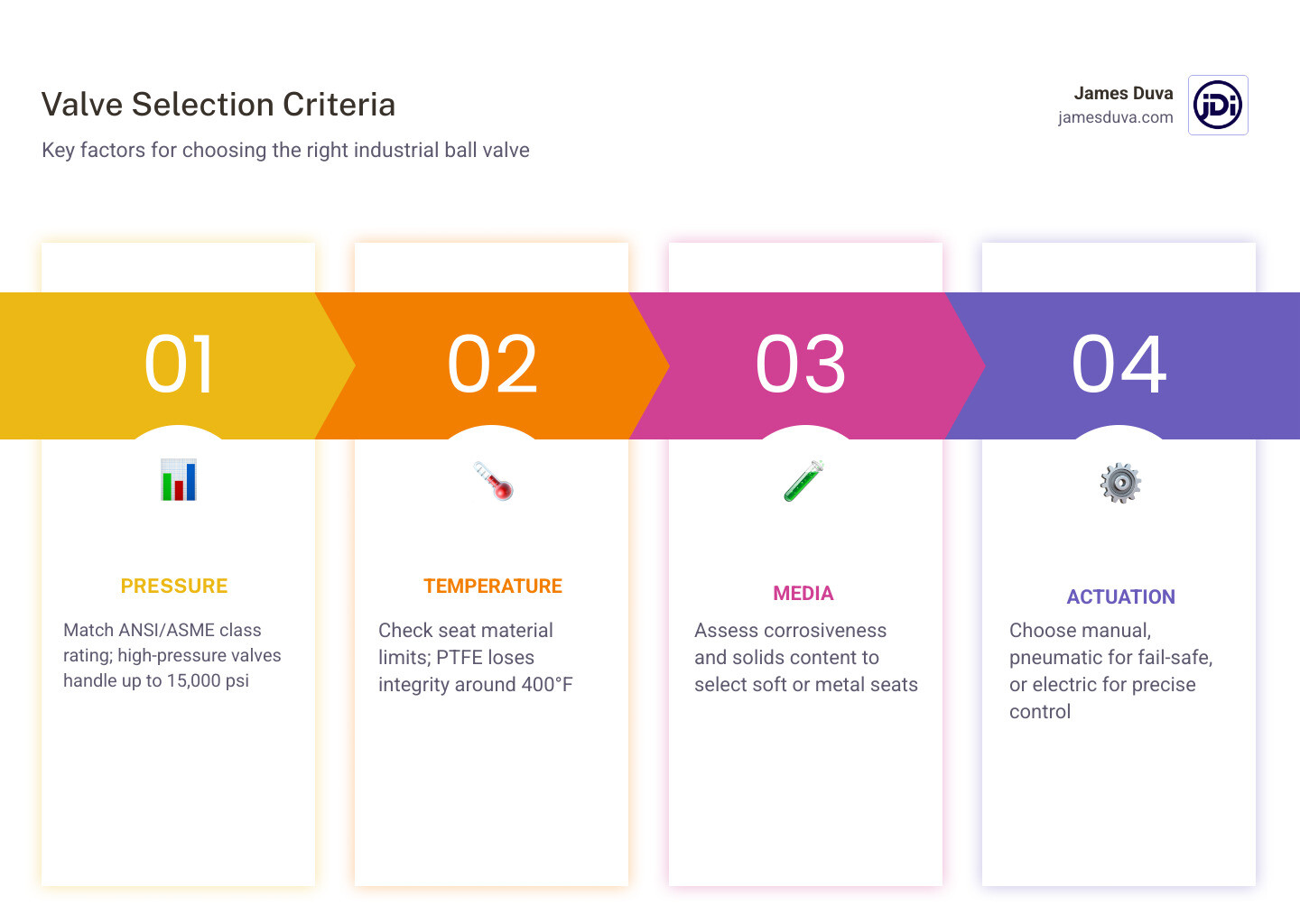
- Pressure Rating: Does the valve meet the ANSI/ASME class required? High-pressure ball valves can withstand up to 15,000 psi (1,000 bar).
- Temperature: Will the seats melt? PTFE starts to lose integrity around 400°F.
- Media Compatibility: Is the fluid corrosive? Does it contain solids?
- Actuation: Do you need a manual lever, or will this be part of an automated system? Pneumatic actuators are great for fast, “fail-safe” operation, while electric actuators are better for precise positioning.
- Standards: Does the application require Fire-Safe certification (API 607) or Sanitary standards (3-A/BPE)?
Frequently Asked Questions about Ball Valve Types
What is the difference between a full port and a reduced port ball valve?
A full port ball valve has a hole the same size as the pipe, resulting in zero flow restriction. A reduced port valve has a smaller hole, which causes a slight pressure drop but is more compact and cost-effective. You can find both configurations in our selection of Ball Valves.
When should I use a trunnion-mounted ball valve instead of a floating design?
Use a trunnion-mounted design for any application involving high pressures (typically 600# class and above) or large pipe diameters (usually 4 inches and larger). The mechanical anchoring makes them safer and easier to turn under high load.
Can ball valves be used for throttling applications?
Standard ball valves are not recommended for throttling because the partially exposed seat can erode quickly. However, specialized V-port ball valves are specifically designed for this purpose and provide excellent flow control.
Conclusion
Choosing the right ball valve types is about balancing performance, maintenance needs, and budget. Whether you need a simple two-piece brass valve for a water line or a trunnion-mounted, metal-seated nickel alloy valve for a high-pressure refinery pipeline, understanding these classifications is the first step to a reliable system.
Since 1978, James Duva Inc. has been a trusted one-stop shop for high-grade stainless steel and nickel alloy industrial products. Based in Branchburg, NJ, we pride ourselves on our technical expertise and our ability to source even the most difficult-to-find components for the chemical, oil, gas, and power industries.
If you’re unsure which of the many ball valve types is right for your specific project, don’t guess. Our team is here to help you navigate the specifications and ensure you get a valve that performs exactly as needed.
Ready to find the perfect valve? Explore our full range of Ball Valves or contact us today to discuss your custom sourcing needs.
About James Duva Inc.
Since 1978, James Duva Inc. has been your trusted source for stainless steel and high-nickel alloy industrial products. Whether you’re in the water treatment, process or power industry, we pride ourselves on always having what you need. Say goodbye to your sourcing problems with just one call to James Duva.