
A Simplified Guide to Duplex and Super Duplex Piping
Apr 24, 2026
What Is Duplex Stainless Steel Pipe — and Why Does It Matter?
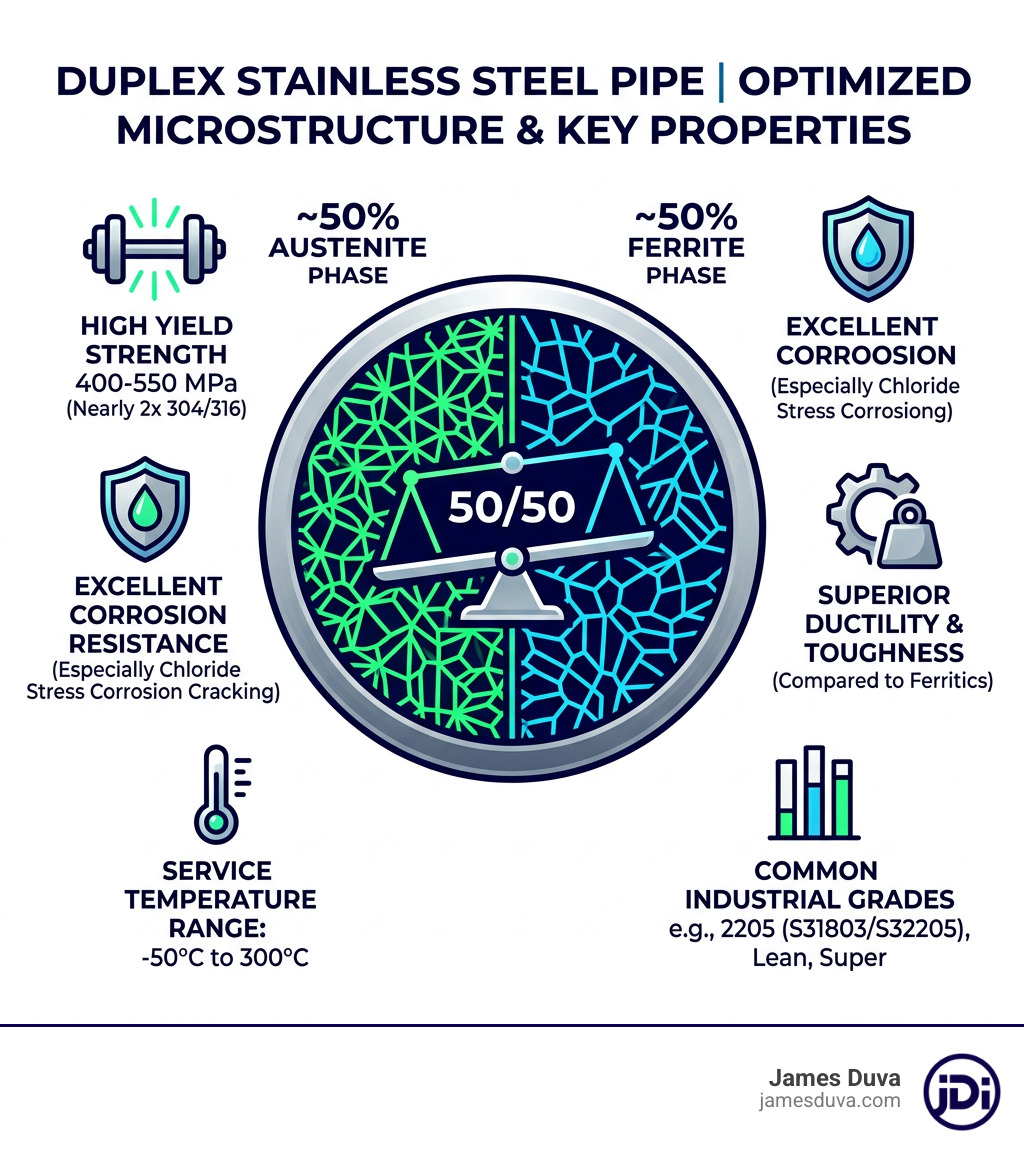
Duplex stainless steel pipe is a high-strength, corrosion-resistant piping material built from a two-phase microstructure of roughly equal parts austenite and ferrite. Here’s what you need to know at a glance:
| Property | Duplex Stainless Steel Pipe |
|---|---|
| Microstructure | ~50% austenite + ~50% ferrite |
| Yield Strength | 400–550 MPa (nearly 2x standard austenitic grades) |
| Key Grades | 2205 (S31803/S32205), 2507 (S32750), Lean (2101, 2304) |
| Top Industries | Oil & Gas, Chemical Processing, Desalination, Pulp & Paper |
| Temperature Range | -50°C to 300°C |
| Key Standards | ASTM A790, ASME SA790, ASTM A789 |
| Main Advantage | Higher strength + better corrosion resistance vs. 304/316 |
If you work in chemical processing, oil and gas, or water treatment, you’ve likely faced a familiar problem: standard austenitic stainless steels like 304 or 316 can fall short under aggressive conditions — whether that’s chloride-rich environments, high mechanical loads, or the constant threat of stress corrosion cracking. Duplex stainless steel pipe was developed specifically to address these limitations, combining the best traits of both austenitic and ferritic steels into a single, versatile material.
I’m Billy Walker, Vice President of James Duva Inc., where I’ve spent years helping engineers and procurement professionals source specialty piping components — including duplex stainless steel pipe — for their most critical industrial projects. In this guide, I’ll walk you through everything you need to confidently specify, select, and source duplex piping for demanding industrial applications.
Why Are Alloys So Valuable in Industry?
To understand why Duplex stainless steel pipe is such a game-changer, we first have to look at the basics of metallurgy. In their pure form, many metals just aren’t up to the task of modern industry. Pure iron, for example, is relatively soft and has a nasty habit of oxidizing—better known as rusting—the moment it meets oxygen and moisture.
This is where alloys come in. By mixing iron with elements like chromium, nickel, and molybdenum, we create “steel” and its many variations. These combinations offer superior durability, hardness, and resistance to environmental decay. In Understanding Duplex 2205 Properties Advantages and Applications, we see how these specifically engineered mixtures allow infrastructure to last for decades rather than years.
Alloys are the backbone of almost every major sector:
- Construction: High-strength alloys are used in structural beams and specialized piping for coastal buildings where salt air would eat through standard carbon steel.
- Oil & Gas: This industry relies heavily on high-performance fittings, flanges, and Ball Valves to handle high-pressure, corrosive fluids.
- Automotive & Aerospace: Engine frames and exhaust systems require alloys that can withstand extreme heat without losing structural integrity.
- Medical & Consumer Goods: From surgical implants that must be biocompatible to high-end kitchenware, alloys provide the safety and longevity we take for granted.
Understanding the Microstructure of Duplex Stainless Steel Pipe
The “Duplex” name isn’t just marketing—it refers to the physical DNA of the metal. If you were to look at a cross-section of a Duplex stainless steel pipe under a high-powered microscope, you wouldn’t see a uniform texture. Instead, you’d see a “duplex” or dual-phase structure consisting of grains of austenite (the structure found in 300-series stainless) and ferrite (the structure found in 400-series stainless).
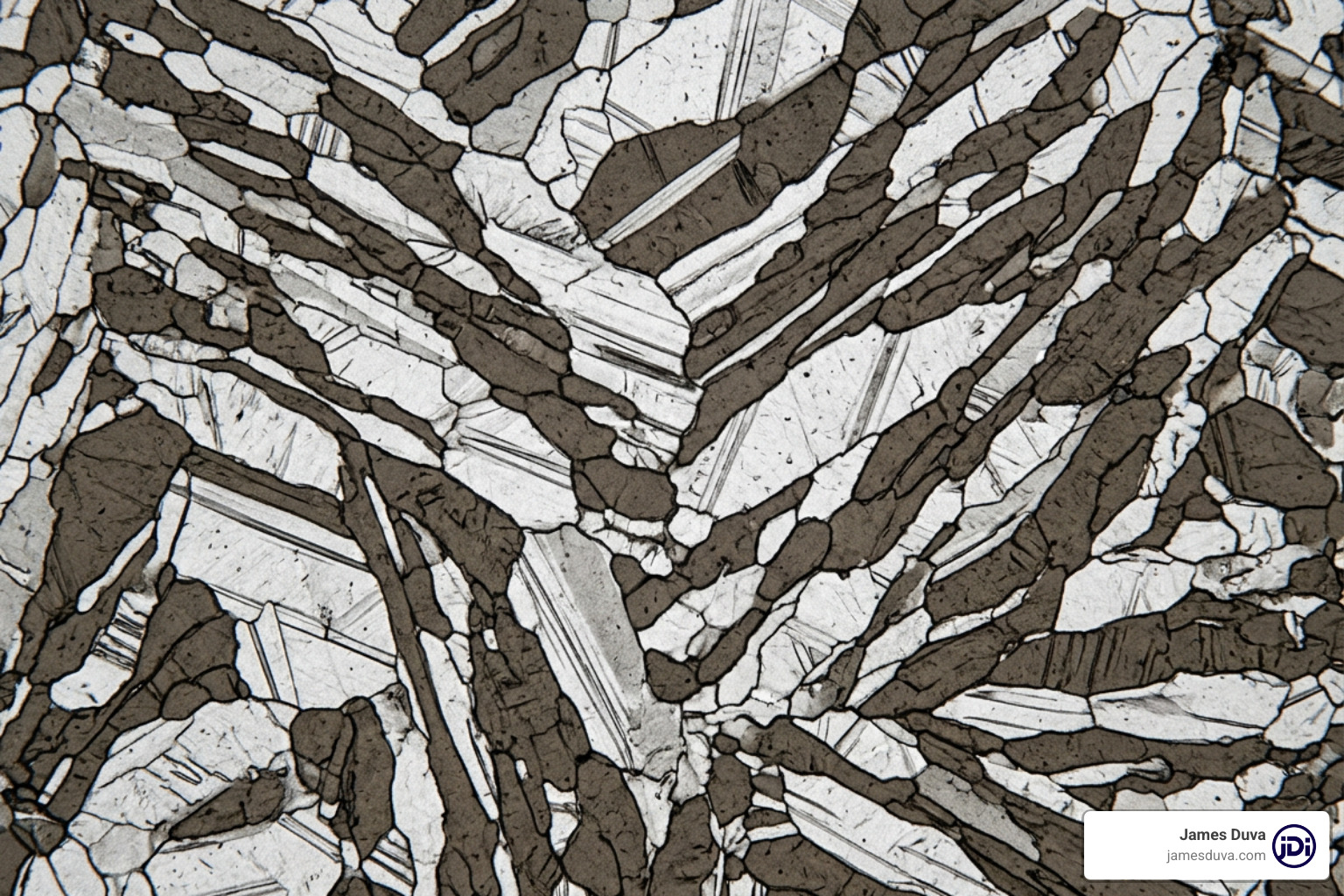
The magic happens when we achieve a roughly 50/50 balance between these two phases. This balance is achieved by carefully controlling the chemical composition—typically 19% to 28% chromium, up to 5% molybdenum, and lower nickel content than your standard austenitic steels. According to Duplex steels characteristics and composition, this specific chemistry provides several key technical advantages:
- Stress Corrosion Cracking (SCC) Resistance: Ferritic steels are naturally resistant to SCC, a common failure mode in 304 and 316 stainless when exposed to chlorides and heat. Duplex inherits this “superpower.”
- High Yield Strength: Duplex grades typically have nearly twice the yield strength of SUS304 or SUS316. This means you can often use thinner pipe walls to handle the same pressure, leading to significant weight and cost savings.
- Pitting Resistance: The addition of molybdenum and nitrogen gives these pipes excellent resistance to localized “pitting” corrosion, which is vital in seawater applications.
- Thermal Efficiency: Duplex steels have higher heat conductivity and lower thermal expansion than austenitic steels, making them excellent for heat exchangers.
- Price Stability: Because they use less nickel (which is a volatile-priced commodity) than the 300-series, Duplex alloys often offer more stable pricing for large-scale projects.
Key Grades and Specifications of Duplex Stainless Steel Pipe
When sourcing Duplex stainless steel pipe, you’ll encounter several industry standards. The most common are ASTM A790 and ASME SA790, which cover seamless and welded ferritic/austenitic stainless steel pipe. For larger diameter welded pipe, ASTM A928 is often the go-to specification.
We generally categorize these pipes into three “families” based on their corrosion resistance, which is often measured by the Pitting Resistance Equivalent Number (PREN).
Standard and Lean Duplex Stainless Steel Pipe Grades
The workhorse of the industry is 2205 (UNS S31803 and the higher-spec S32205). Most modern piping is produced as a dual-grade S31803/S32205 to ensure it meets the most stringent requirements. As noted in A Comprehensive Guide to Duplex 2205 Properties, this grade contains roughly 22% chromium, 5% nickel, and 3% molybdenum. It is the most widely used because it offers a perfect balance of cost and performance.
On the other end of the spectrum are Lean Duplex grades like 2101 and 2304. These are designed to be “nickel-saving” alloys. They offer the high strength of the duplex family but reduce the molybdenum and nickel content. This makes them incredibly cost-effective for structural applications or mildly corrosive environments where standard 304 or 316 might be on the edge of their performance limits.
Super Duplex Stainless Steel Pipe Performance
For the most extreme environments—think deep-sea oil wells or aggressive chemical reactors—we turn to Super Duplex grades like 2507 (UNS S32750) and S32760. These alloys contain 25% chromium and 7% nickel, along with higher levels of molybdenum and nitrogen.
The Mastering the Strength of Super Duplex 2507 A Comprehensive Guide highlights that these grades have a PREN value of over 40. This makes them virtually immune to chloride-induced pitting in most ambient seawater conditions. They also boast a yield strength of 550 MPa or higher, which is staggering compared to the 205 MPa typically seen in 316L.
Industrial Applications and Mechanical Properties
Because of its unique blend of strength and durability, Duplex stainless steel pipe has found a home in the world’s most demanding sectors. At James Duva Inc., we’ve supplied these materials for everything from small-scale chemical skids to massive offshore infrastructure.
Real-World Use Cases
- Oil & Gas: Used extensively in offshore rigs and subsea pipelines where high pressure and salt-water corrosion are constant threats.
- Chemical Processing: Handling corrosive organic acids and chloride-contaminated fluids. Exploring the Versatility of Duplex 2205 Stainless Steel and Industrial Products shows how these pipes manage aggressive bleaching chemicals in the pulp and paper industry.
- Desalination: Reverse osmosis plants use Duplex for high-pressure seawater piping because standard stainless would pit and fail within months.
- Pulp & Paper: Specifically in digesters and bleaching equipment where the combination of heat and chemicals is particularly “angry.”
Temperature Limitations and Mechanical Behavior
While Duplex stainless steel pipe is incredibly strong, it does have a “Goldilocks” zone for temperature.
- The 300°C Threshold: Duplex alloys are susceptible to embrittlement if exposed to temperatures above 300°C (572°F) for prolonged periods. This is often called “475°C embrittlement” because the effect is most rapid at that temperature.
- Cryogenic Performance: While better than many ferritic steels, Duplex does lose its toughness as temperatures drop. Most standards limit its use to a minimum of -50°C (-58°F). If you need something for liquid nitrogen service, you’ll likely need to stick with austenitic grades.
For those looking to push the boundaries of what’s possible, Unlocking the Potential of Duplex 2205 UNS S32205 provides deeper insights into how to maximize the lifespan of these alloys in your specific system.
Frequently Asked Questions about Duplex Piping
What is the difference between Duplex 2205 and Super Duplex 2507?
The primary difference lies in the alloy content and the resulting corrosion resistance. 2205 is the “standard” version with about 22% chromium. Super Duplex 2507 increases that to 25% and boosts molybdenum and nitrogen. This higher alloy content gives 2507 a much higher PREN (Pitting Resistance Equivalent Number), allowing it to survive in much more aggressive chloride environments. You can find a detailed breakdown in our guide on Deciphering the Duel Duplex 2205 vs Super Duplex 2507 for Industrial Applications.
Why is duplex steel stronger than 300-series stainless steel?
It comes down to that 50/50 microstructure. The ferritic phase is naturally much stronger than the austenitic phase. By combining them, the duplex structure acts like a composite material. This results in a yield strength that is roughly double that of 316L. For a deeper dive into the physics, check out Duplex 2205 vs Other Stainless Steels A Comparative Analysis.
What are the temperature limits for duplex alloys?
As a rule of thumb, keep your operating window between -50°C and 300°C. Going above 300°C risks “embrittlement,” where the metal becomes brittle and loses its impact toughness. If your application involves high-heat solution annealing, the process must be done carefully to restore the 50/50 phase balance. We discuss these nuances in Selecting the Right Duplex Stainless Steel 2205 or 2507.
Conclusion
Choosing the right Duplex stainless steel pipe isn’t just about picking a grade; it’s about understanding the environment, the pressure requirements, and the long-term maintenance goals of your project. Whether you need the cost-efficiency of Lean Duplex or the “bulletproof” nature of Super Duplex, these alloys offer a path to safer, lighter, and more durable industrial systems.
At James Duva Inc., based in Branchburg, NJ, we have been the trusted partner for high-grade stainless steel and nickel alloy products since 1978. We don’t just ship pipe; we provide the technical expertise to ensure you’re getting the right material for the job. If you’re ready to upgrade your piping system or need a quote for an upcoming project, we’re here to help.
For More info about duplex pipe products, or to discuss your specific requirements, reach out to our team today. We’re your one-stop shop for everything from pipe and fittings to specialized valves and flanges.
About James Duva Inc.
Since 1978, James Duva Inc. has been your trusted source for stainless steel and high-nickel alloy industrial products. Whether you’re in the water treatment, process or power industry, we pride ourselves on always having what you need. Say goodbye to your sourcing problems with just one call to James Duva.