
The Definitive Guide to Welded Pipeline
Apr 23, 2026
The Backbone of Modern Industry
A welded pipeline is a continuous, leak-proof system created by permanently joining pipe sections through welding. This method is essential for transporting fluids and gases under high pressure in applications ranging from refineries and chemical plants to power generation and water treatment facilities.
Key Characteristics:
- Continuous System: Fused joints eliminate gaps and minimize leak paths.
- High-Pressure Capability: Welded joints withstand significant internal pressure.
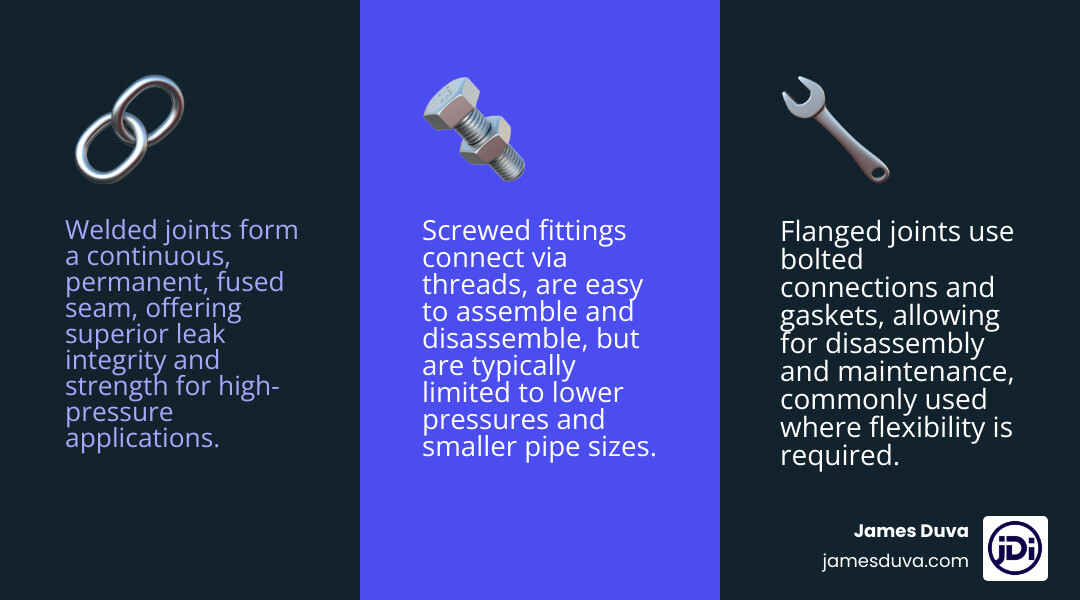
- Permanent Connections: Joints cannot be easily disassembled like threaded or flanged systems.
- Versatile Applications: Used for oil, gas, water, and chemicals.
- Various Welding Methods: Includes ERW, LSAW, and field welding.
Welded pipelines are the critical infrastructure moving resources through processing plants and into our communities. They handle everything from crude oil to corrosive chemicals under extreme conditions.
The choice to weld is strategic. Welded pipe can use thinner walls than screwed connections, saving costs on large projects. It also offers superior vibration resistance and is less prone to leaks. For pipes over 4 inches in diameter, many codes require welding.
Creating a reliable welded pipeline requires skilled welders, strict quality control, and adherence to standards like API 1104 and ASME Section IX. Proper technique and material selection are critical for system integrity and performance. Selecting the right alloys and product forms is equally important, which is why many engineers and buyers rely on comprehensive suppliers such as James Duva Inc. for project support.
I’m Billy Walker, Vice President of James Duva Inc. Since 1978, we’ve supplied high-grade stainless steel and nickel alloy materials for welded pipeline applications in the power, process, and water treatment industries. Our expertise ensures you get the right components for your critical projects, from pipe and fittings to flanges.
Understanding Welded Pipe: Construction and Key Differences
This section explores the fundamental aspects of welded pipes, how they are made, and how they compare to alternatives like seamless pipes.
What is a Welded Pipeline and How is it Made?
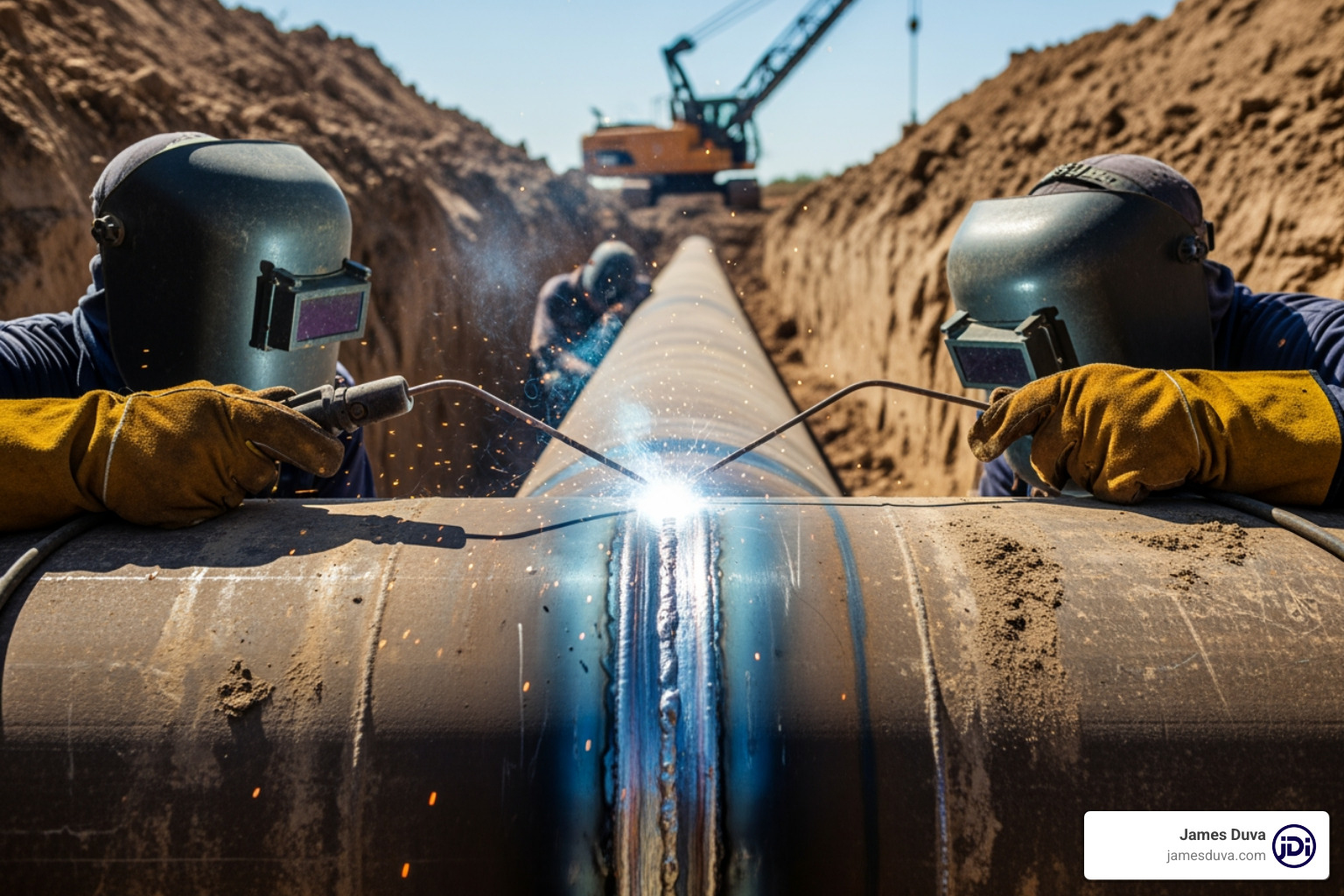
A welded pipeline is a continuous structure formed by joining pipe segments with a metallurgical bond. This strong, leak-proof connection is vital for high-pressure transport. The two most common manufacturing methods are Electric Resistance Welded (ERW) and Longitudinal Submerged Arc Welded (LSAW).
Electric Resistance Welded (ERW) Pipe: ERW pipes are made from a steel ribbon, or skelp, which is cold-formed into a cylinder. A high-frequency electrical current heats and fuses the edges together without filler metal, creating a longitudinal weld seam. Modern high-frequency ERW methods have greatly improved weld quality and reliability.
Longitudinal Submerged Arc Welded (LSAW) Pipe: LSAW pipes are made from steel plates bent into a cylindrical shape. The seam is welded using a submerged arc process, where the arc is shielded by granular flux. This produces a high-quality weld, making LSAW pipes ideal for large-diameter, heavy-wall, and high-pressure applications.
Both methods offer precise wall thicknesses. The choice between ERW and LSAW depends on the project’s required diameter, wall thickness, and pressure rating. For many of these applications, corrosion-resistant alloys such as the stainless steel pipe and nickel alloy products supplied by James Duva Inc. provide the performance and reliability needed in demanding environments.
To dig deeper into how these manufacturing methods differentiate pipe types, you can find More on the differences between pipe types in our resources.
Welded vs. Seamless Pipe
The choice between welded and seamless steel pipe is a key decision in many projects. Understanding their differences is crucial for proper material selection.
Here’s a comparison of the two pipe types:
| Attribute | Welded Pipe (e.g., ERW, LSAW) | Seamless Pipe |
|---|---|---|
| Manufacturing Process | Formed from steel strip/plate and welded along the seam. | Made from a solid steel billet, pierced and rolled into a tube. |
| Wall Thickness Consistency | More precise and uniform. | Can be inconsistent due to the manufacturing process. |
| Cost | Generally cheaper and more available. | Higher cost due to a more complex process. |
| Strength/Pressure Capacity | Good, with LSAW suited for high pressure. | Highest strength and pressure capacity. |
| Typical Applications | General utility, structural, large-diameter pipelines (LSAW). | High-pressure, high-temperature applications (Oil & Gas, Power). |
While seamless pipe was once considered superior due to the lack of a weld seam, modern manufacturing and quality control have made high-quality welded pipe a reliable and cost-effective alternative for many applications. In structural uses, performance is often identical. However, for the most demanding high-pressure, high-temperature environments in industries like oil & gas and power generation, seamless pipe characteristics often lead to it being the required choice due to its inherent integrity.
When specifying either welded or seamless options, pairing the right product form (pipe, tubing, fittings, and flanges) from a single source like James Duva Inc. helps maintain consistency across the entire system.
Key Advantages of Welded Construction
The widespread adoption of welded pipeline systems is driven by clear advantages over mechanical connections like screwed or flanged joints.
- Cost and Labor Efficiency: Welded construction is often more cost-effective for large projects. It allows for thinner-walled pipes, reducing material costs. On large jobs, welding is also more labor-efficient than assembling numerous mechanical joints.
- Superior Integrity and Performance: A welded joint creates a continuous, monolithic structure. This makes the system highly resistant to vibration and less prone to leaks over time—a critical factor for hazardous or high-pressure fluids.
- Improved Flow Characteristics: The smooth internal surface of a welded joint minimizes turbulence and pressure drop, improving flow efficiency and reducing pumping costs.
- Simplified Design and Maintenance: Welding reduces the need for fittings, which simplifies the design and eliminates potential leak points. The smooth exterior also makes insulation easier and more effective.
These benefits make welded tubing solutions a robust and reliable choice for fluid transport. When combined with corrosion-resistant alloys and properly matched industrial fittings, welded systems can offer long service life and predictable performance.
Mastering the Craft: Pipe Welding Processes and Techniques
A deep dive into the methods, positions, and skills required to create strong, reliable welds that ensure pipeline integrity.
Primary Pipe Welding Methods
The integrity of a welded pipeline hinges on the welding method chosen. At James Duva Inc., we know that matching the right method to the right material is crucial.
- Shielded Metal Arc Welding (SMAW): Known as “stick welding,” this versatile and low-cost process uses a flux-coated electrode. It’s excellent for outdoor conditions but has slower travel speeds.
- Gas Tungsten Arc Welding (GTAW / TIG): TIG welding uses a non-consumable tungsten electrode and shielding gas to produce exceptionally high-quality, precise welds. It’s ideal for critical applications and thinner materials like the high-grade stainless steel and nickel alloys we supply, but it is slower and requires high skill.
- Gas Metal Arc Welding (GMAW / MIG): MIG welding is a productive process using a continuously fed wire and shielding gas. It offers high deposition rates and is popular for fabrication, but requires significant skill to ensure quality on pipe.
- Flux-Cored Arc Welding (FCAW): Similar to MIG, FCAW uses a tubular wire filled with flux. The self-shielded version is excellent for outdoor use, while the gas-shielded version offers high productivity.
- Submerged Arc Welding (SAW): This highly efficient, often automated process uses an arc “submerged” under granular flux. It allows for high deposition rates and deep penetration, making it common for large-diameter pipes and for fabricating heavy-wall industrial tubing.
The best process depends on pipe material, thickness, required quality, and project economics. For critical systems, these choices are often documented in Welding Procedure Specifications (WPS) that must be compatible with the alloy grades and product forms sourced from trusted suppliers such as James Duva Inc..
The Significance of Welding Positions
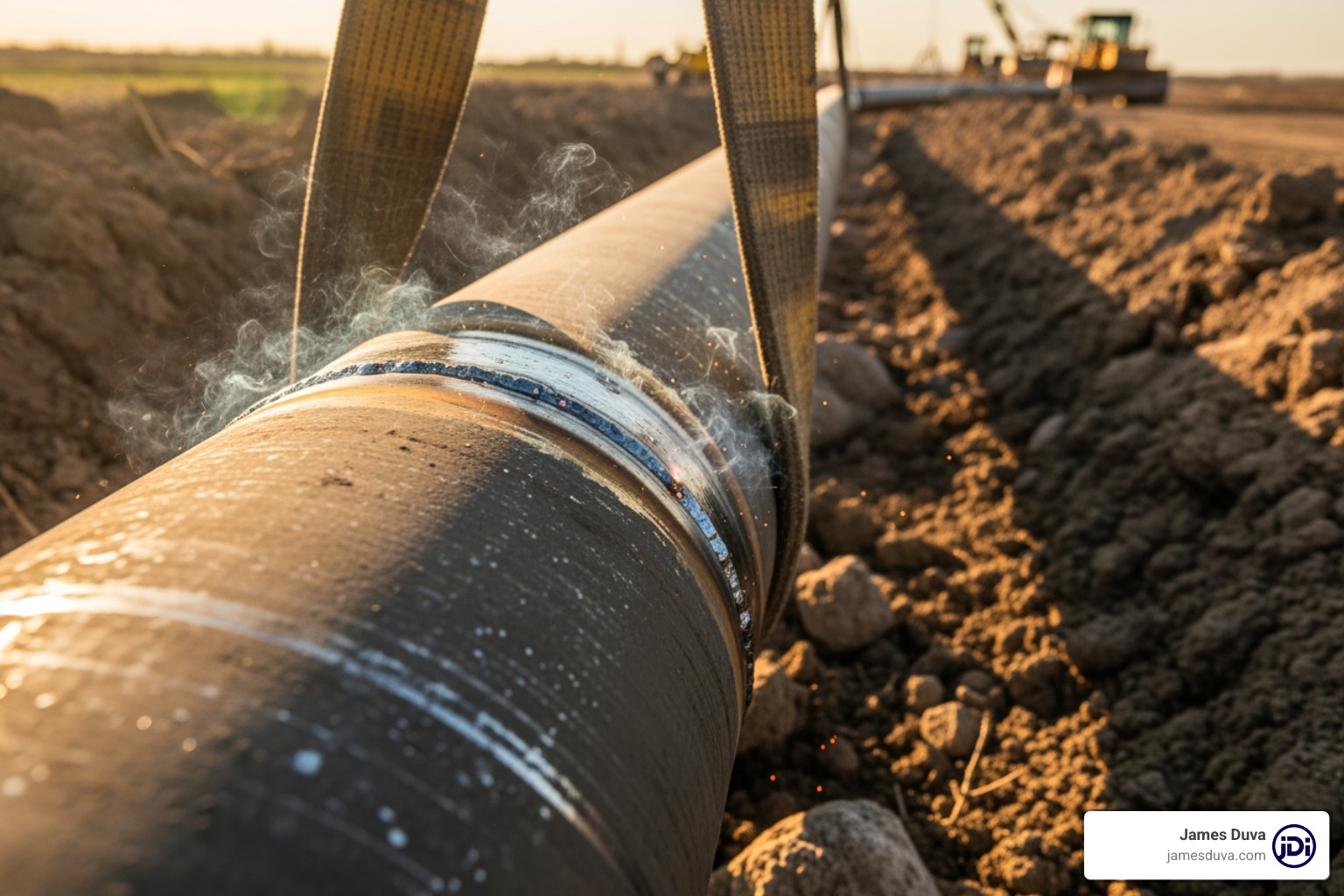
In welded pipeline construction, a welder’s skill is often defined by their ability to master various welding positions. These positions classify the pipe’s orientation and present unique challenges.
- 1G (Rotated, Flat): The easiest position. The pipe rotates horizontally, so the welder always works on the top surface.
- 2G (Fixed Vertical): The pipe is fixed vertically, and the welder performs a horizontal weld around it, fighting gravity to prevent sagging.
- 5G (Fixed Horizontal): The pipe is fixed horizontally. The welder moves around it, welding in vertical (uphill or downhill) and flat positions.
- 6G (Fixed 45° Incline): The most difficult position. The pipe is fixed at a 45° angle, requiring the welder to work in all positions (flat, vertical, overhead) on a single joint. A 6G certification is the mark of a highly proficient pipe welder.
The direction of vertical welding also matters. Downhill welding is faster and used for high-production work, while uphill welding is slower but provides deeper penetration and a stronger weld, ideal for thicker materials.
Understanding Weld Passes and Integrity
A strong weld is built in a sequence of “passes,” each with a specific purpose to ensure the integrity of the welded pipeline.
- Root Pass: The first and most critical pass, it establishes the initial connection at the bottom of the joint and ensures full penetration.
- Hot Pass: Applied after the root, this pass refines the root weld, burns out impurities, and prepares the joint for fill passes.
- Fill Passes: These subsequent passes build up weld metal to fill the joint groove to the required thickness.
- Cap Pass: The final pass, which creates the weld’s surface profile and protects the joint from corrosion.
Properly executing this multi-pass process with controlled heat input is essential for achieving a mechanically sound, defect-free weld with maximum strength and corrosion resistance. This is especially true when working with specialty materials, as detailed in our guide to industrial tubing solutions. Coordinating welding procedures with the specific grades of stainless steel pipe and tube used in a project helps ensure consistent performance from mill to finished system.
Applications and Material Selection for a Welded Pipeline
Welded pipelines are critical across numerous sectors. This section covers their main uses and the importance of choosing the right materials.
Industries and Typical Applications
The reliability of welded pipeline systems makes them essential across many industries. At James Duva Inc., we support these critical sectors with high-performance materials.
- Oil & Gas: Welded pipes are used for upstream, midstream, and downstream operations, transporting crude oil and natural gas over long distances.
- Chemical Processing: Our high-grade stainless steel and nickel alloy products are vital for safely transporting corrosive chemicals at high temperatures and pressures.
- Power Generation: Power plants use welded pipes to convey high-pressure steam and water.
- Water and Wastewater: Municipalities rely on leak-proof welded pipes for water distribution and wastewater collection.
- Pharmaceutical: Welded stainless steel pipes ensure purity when transporting ultra-pure water and sensitive ingredients.
- Structural and Construction: Welded pipes are used for structural supports and frameworks where strength is key.
- Mineral Processing and Industrial Plants: Abrasive slurries and harsh process environments often demand robust welded systems combined with corrosion-resistant alloys.
This diverse range of uses highlights why industrial tubing is the backbone of modern infrastructure. For many of these sectors, sourcing compatible pipes, fittings, and flanges from a single supplier streamlines specification and procurement.
Choosing the Right Pipe Material
The performance of a welded pipeline depends heavily on the pipe material. The choice involves balancing fluid compatibility, operating conditions, and cost.
- Carbon Steel: The most common and economical choice, offering good strength for general applications. Its corrosion resistance is limited without coatings.
- Stainless Steel: The go-to material for corrosion resistance. We supply various grades, including Austenitic (304, 316) for general corrosion resistance and Duplex for higher strength and stress corrosion cracking resistance.
- Nickel Alloys: For the most extreme environments—highly corrosive, high-temperature, or sour gas—nickel alloys provide maximum corrosion resistance and mechanical strength. They are indispensable for critical applications.
- Alloy Steel: These contain elements like chromium and molybdenum to improve strength and high-temperature resistance, used for components like drill pipes and valves.
A material’s properties also dictate its weldability, requiring specific procedures to maintain its integrity. Working with a supplier experienced in specialty alloys, like James Duva Inc., can help ensure that selected materials, wall thicknesses, and product forms align with both process conditions and welding procedures.
How Size and Environment Impact Welding
The welding process for a welded pipeline is also influenced by pipe dimensions and the work environment.
- Pipe Size and Wall Thickness: Specified by Nominal Pipe Size (NPS) and Schedule (wall thickness), these dimensions determine the complexity of the weld. Larger, thicker pipes require more weld passes, different techniques (like SAW), and careful heat control to prevent defects.
- Environmental Conditions: Outdoor welding must account for the elements. Wind can disrupt shielding gas, leading to porosity. Rain, snow, and extreme temperatures can compromise weld quality and require protective measures like shelters and pre-heating the pipe. Site contaminants like dust and moisture must also be controlled to prevent weld defects.
These factors demand careful planning and skilled welders to ensure a reliable final joint. Properly matched piping components, combined with appropriate field procedures, help maintain consistency from fabrication in Branchburg, NJ, to installation on site.
Ensuring Integrity: Quality, Safety, and Regulatory Standards
Adherence to strict standards is non-negotiable for pipeline safety and reliability. This section covers the essential rules, challenges, and safety protocols.
Regulatory Codes and Standards
Adherence to regulatory standards is mandatory for any welded pipeline project to ensure safety and reliability. Key codes include:
- Federal Pipeline Welding Regulations (49 CFR Part 192): This U.S. federal regulation sets minimum safety standards for welding on natural gas pipelines. It covers everything from welder qualification and procedures to inspection and repair. You can review the Federal pipeline welding regulations for specifics.
- API Standard 1104 (API Std 1104): A globally recognized standard from the American Petroleum Institute, API 1104 provides detailed guidelines for welding procedures, welder qualification, and inspection for steel pipelines.
- ASME Section IX: Published by the American Society of Mechanical Engineers, this code provides broad rules for qualifying welding procedures and personnel across many industries, including process piping and pressure vessels.
- CSA B149.1 and Related Regional Standards: In some jurisdictions, additional codes govern gas and process piping systems and may reference or supplement the standards above.
These standards ensure that all welding is performed by qualified professionals using proven procedures. In parallel, material traceability and documentation for pipes and fittings supplied to a project help support code compliance and long-term asset management.
Common Challenges in Welded Pipeline Projects
Even with skilled welders, welded pipeline projects face challenges, primarily in preventing weld defects. Common issues include:
- Porosity (gas pockets)
- Undercutting (grooves at the weld edge)
- Incomplete Fusion (poor bonding)
- Cracks (the most serious defect)
- Slag Inclusions (trapped contaminants)
To ensure weld integrity, rigorous inspection is performed. This starts with visual inspection and is followed by Non-Destructive Testing (NDT) methods, which examine the weld without damaging it. Common NDT techniques include:
- Radiographic Testing (RT): Uses X-rays to see internal flaws.
- Ultrasonic Testing (UT): Uses sound waves to detect internal defects.
- Magnetic Particle (MT) and Liquid Penetrant (PT) Testing: Used to find surface and near-surface cracks.
If unacceptable defects are found, regulations require they be repaired or removed. You can find more information on welded pipes and their quality control in our resources.
Essential Safety Precautions
Safety is paramount in any welded pipeline project. Welders face numerous hazards, and strict precautions are essential to protect the workforce.
- Fumes and Gases: Welding produces harmful fumes. Proper ventilation and respiratory protection are critical, especially in confined spaces.
- Arc Flash and Radiation: The intense light from the arc can cause severe eye and skin burns. Welders must use helmets with appropriate shade lenses and wear flame-retardant Personal Protective Equipment (PPE).
- Heat and Fire: The high temperatures create burn and fire risks. Flame-retardant clothing, gloves, and a clean work area are necessary, along with fire extinguishers.
- Electrical Shock: Contact with live electrical parts can be fatal. Equipment must be properly grounded, and welders should wear dry gear and avoid wet conditions.
- Job Hazard Analysis (JHA): Before work begins, a JHA should be performed to identify all potential risks and establish control measures to ensure a safe operation.
Integrating these safety measures with robust material selection and specification, such as choosing appropriate stainless steel and nickel alloy components, helps ensure that both people and assets remain protected throughout the life of the pipeline.
Frequently Asked Questions about Welded Pipelines
Is pipe welding difficult?
Yes, pipe welding is considered one of the most technically demanding forms of welding. It requires a high level of skill due to:
- Challenging Conditions: Work is often performed outdoors, in trenches, or in confined spaces.
- Complex Geometry: Welding on a curved surface requires constant adjustment of angle and travel speed, especially in fixed positions.
- Difficult Positions: Mastering the 1G through 6G positions, particularly the all-position 6G test, requires extensive practice and control.
Because of this difficulty, skilled pipe welders are highly valued craftsmen who are frequently called on to work with specialty alloys such as the stainless steels and nickel alloys used in many industrial pipelines.
How long does it take to weld a pipe?
The time required to weld a pipe varies greatly depending on:
- Pipe Dimensions: Larger diameters and thicker walls (requiring more passes) take longer.
- Welding Process: Faster processes like SAW contrast with slower, high-precision methods like TIG.
- Welder Skill: Experienced welders are significantly more efficient.
- Conditions: Difficult access, poor weather, and complex joint preparation can all add time.
Because of these variables, there is no single answer; each joint in a welded pipeline project has its own timeline. Coordinating joint design, weld process, and material choice, such as schedule and alloy grade of the pipe, can help optimize productivity.
What is the difference between pipe welding and pipeline welding?
While the terms are often used interchangeably, they can refer to different contexts:
- Pipe Welding: This term often describes welding in a controlled environment like a fabrication shop or processing plant. The work may involve smaller pipes, rotated positions (1G), and a focus on precision for process piping, often using materials like the high-grade pipe and industrial tubing we supply.
- Pipeline Welding: This typically refers to the large-scale, outdoor construction of long-distance transport lines for oil, gas, or water. It involves large-diameter pipes, fixed-position welding (5G, 6G), and an emphasis on speed and efficiency in challenging field conditions.
In short, “pipe welding” is the general craft, while “pipeline welding” specifies large-scale, cross-country projects. Both rely on quality materials and consistent specifications from trusted suppliers such as James Duva Inc..
Conclusion: Building Stronger, More Reliable Connections
The welded pipeline is the backbone of modern industry, chosen for its strength, reliability, and cost-effectiveness. From manufacturing methods like ERW and LSAW to the key advantages over mechanical joints, welded construction provides a superior solution for critical infrastructure.
Success depends on mastering the craft—understanding welding processes, positions, and passes—and selecting the right material for the job, whether carbon steel or the high-performance stainless steel and nickel alloys we specialize in at James Duva Inc. The entire process is governed by strict adherence to regulatory codes like API 1104, rigorous quality inspection, and an unwavering commitment to safety.
At James Duva Inc., we have been a trusted partner since 1978, providing the highest quality materials for demanding welded pipeline applications across industries such as chemical processing, oil & gas, and power generation. From our Branchburg, NJ base, we support projects nationwide with responsive service and deep product knowledge.
Our expertise ensures your projects are built with components that meet the most stringent standards. For all your high-performance piping needs, explore our extensive product category for pipes, along with complementary fittings, flanges, and nickel alloy products.
About James Duva Inc.
Since 1978, James Duva Inc. has been your trusted source for stainless steel and high-nickel alloy industrial products. Whether you’re in the water treatment, process or power industry, we pride ourselves on always having what you need. Say goodbye to your sourcing problems with just one call to James Duva.