
Hastelloy C-276 101: Key Alloy Properties Compared
Jul 17, 2026
What Is Hastelloy C-276 and Why Does It Matter for Corrosive Environments?
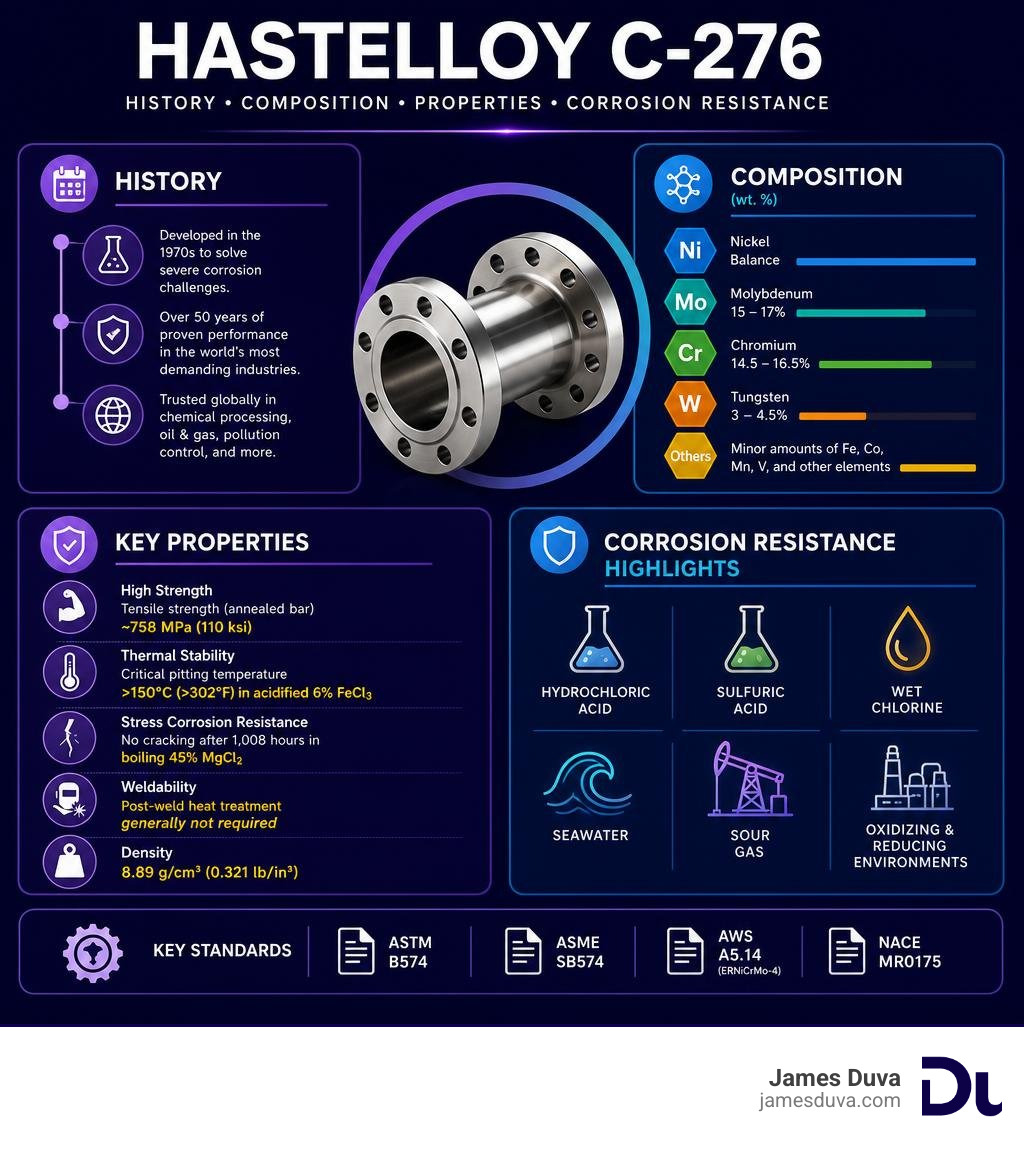
Hastelloy C-276 (UNS N10276) is a nickel-molybdenum-chromium alloy with added tungsten, engineered specifically to withstand some of the harshest chemical environments known to industry. It has over 50 years of proven performance across chemical processing, oil and gas, pollution control, and dozens of other demanding applications.
Here is a quick snapshot of what makes C-276 stand out:
| Property | C-276 Value |
|---|---|
| Primary elements | Ni (balance), Mo 15–17%, Cr 14.5–16.5%, W 3–4.5% |
| Tensile strength (annealed bar) | ~758 MPa (110 ksi) |
| Density | 8.89 g/cm³ (0.321 lb/in³) |
| Critical pitting temperature | >150°C (>302°F) in acidified 6% FeCl₃ |
| Stress corrosion cracking | No cracking after 1,008 hours in boiling 45% MgCl₂ |
| Resists | Hydrochloric acid, sulfuric acid, wet chlorine, seawater, sour gas |
| Post-weld heat treatment | Generally not required |
| Key standards | ASTM B574, ASME SB574, AWS A5.14 (ERNiCrMo-4), NACE MR0175 |
What makes C-276 unique is its dual resistance — it performs in both oxidizing and reducing environments, something most single alloys cannot reliably do. Its extremely low carbon and silicon content also means welded components can often be used as-welded, without the costly and time-consuming post-weld annealing steps required by older nickel alloys.
I’m Billy Walker, Vice President of James Duva Inc., where I’ve spent years helping engineers and procurement teams in chemical processing and oil and gas source Hastelloy C-276 and other high-nickel alloys for critical piping and process applications. In this guide, I’ll walk you through everything you need to know — from chemistry and mechanical properties to fabrication, corrosion resistance, and sourcing.
Why Are Alloys So Valuable in Industry?
To appreciate why a superalloy like Hastelloy C-276 exists, we first have to ask a more fundamental question: Why do we use alloys at all?
Pure metals, while chemically simple, rarely have the right physical resume for demanding industrial jobs. Take pure iron, for example. In its unalloyed state, iron is surprisingly soft and highly prone to rust when exposed to moisture and oxygen. By mixing iron with carbon and other elements, we create alloy steel, which offers vastly superior strength, durability, and resistance to environmental degradation.
Alloys are the backbone of modern infrastructure because they allow us to fine-tune physical and mechanical characteristics. For a deeper look at these mechanisms, you can read our guide on Hastelloy Material Properties, Applications and Benefits.
Across different sectors, engineered alloys are matched to specific challenges:
- Construction: Heavy structural steel beams and specialized piping systems rely on alloying elements to support massive loads and resist atmospheric corrosion.
- Oil & Gas: Downhole environments are notoriously brutal. High-performance alloy fittings, flanges, and valves prevent catastrophic failures under extreme pressures and sour gas exposures.
- Automotive & Aerospace: Engine blocks, exhaust systems, and structural frames require lightweight yet incredibly strong materials that won’t degrade under cyclic thermal stress.
- Medical & Consumer Goods: Biocompatible titanium and cobalt alloys are used for joint implants, while durable stainless steels make up the sterile kitchenware and surgical tools we use every day.
When standard steels and stainless steels reach their chemical limits—especially in highly acidic or chlorinated environments—we turn to nickel-based superalloys like C-276.
Understanding the Chemistry of Hastelloy C-276
At its core, Hastelloy C-276 (designated as UNS N10276 and Werkstoff Nummer 2.4819) is a nickel-molybdenum-chromium-tungsten solid-solution strengthened superalloy. Its remarkable chemical resistance is a direct result of the precise synergy between its primary alloying elements.
Let’s break down the nominal chemical composition of this alloy:
- Nickel (Ni – Balance, approx. 57%): The nickel base provides excellent ductility, high-temperature strength, and outstanding resistance to chloride-induced stress corrosion cracking (SCC), a common failure mode in lower-alloy stainless steels.
- Molybdenum (Mo – 15.0% to 17.0%): Molybdenum is the primary defender against reducing acids (such as hydrochloric and sulfuric acids). It also significantly boosts resistance to localized attacks like pitting and crevice corrosion.
- Chromium (Cr – 14.5% to 16.5%): Chromium provides resistance to oxidizing environments, such as nitric acid, wet chlorine gas, and ferric chlorides. It forms a highly stable, protective passive oxide film on the alloy’s surface.
- Iron (Fe – 4.0% to 7.0%): Iron is added to balance structural economics and thermal expansion properties without degrading corrosion performance.
- Tungsten (W – 3.0% to 4.5%): Tungsten works hand-in-hand with molybdenum to further suppress pitting and crevice corrosion in highly acidic chloride solutions.
- Cobalt (Co – 2.5% max): Provides high-temperature stability.
- Carbon (C – 0.01% max) and Silicon (Si – 0.08% max): Kept at exceptionally low levels to prevent the formation of grain-boundary precipitates during welding.
By keeping carbon and silicon levels to an absolute minimum, C-276 prevents the precipitation of grain boundary carbides in the weld heat-affected zone (HAZ). This allows fabricators to use the material in the as-welded condition for most chemical process operations, a massive time and cost saver. For more details on sourcing this alloy, check out Hastelloy C276 UNS N10276: Your Guide to Superior Alloy Solutions and review the official manufacturer’s data on the HASTELLOY® C-276 – Haynes International profile.
Key Mechanical and Physical Properties of Hastelloy C-276
While C-276 is primarily selected for its chemical resistance, it also possesses excellent mechanical and physical properties. It maintains its ductility and strength from cryogenic temperatures up to elevated service temperatures of 1038°C (1900°F).
Here is how the mechanical properties of Hastelloy C-276 behave under different cold-working conditions, showcasing its high work-hardening rate:
| Cold Work Level | Yield Strength (0.2% Offset) | Ultimate Tensile Strength | Elongation in 2 inches (50mm) |
|---|---|---|---|
| 0% (Annealed) | 455 MPa (66 ksi) | 842 MPa (122 ksi) | 40% to 60% |
| 40% Cold Worked | 1310 MPa (190 ksi) | 1531 MPa (222 ksi) | 3.8% |
| 55% Cold Worked | 1531 MPa (222 ksi) | 1758 MPa (255 ksi) | 3.4% |
| Fully Cold Drawn | 1724 MPa (250 ksi) | 1999 MPa (290 ksi) | 3.9% |
In its annealed state, the alloy has an average Olsen cup depth of 0.48 inches (for a 0.044-inch thick sheet), demonstrating its excellent formability.
Its key physical properties include:
- Density: 8.89 g/cm³ (0.321 lb/in³)
- Melting Range: 1323°C to 1371°C (2415°F to 2500°F)
- Modulus of Elasticity: 205 GPa (29.8 × 10³ ksi)
- Electrical Resistivity: 130 µohm-cm (51 µohm-in) at room temperature
- Thermal Conductivity: 9.8 W/m·K (67.9 BTU-in/hr-ft²-°F) at room temperature
For highly detailed structural and thermal data, you can consult the Hastelloy® C-276 alloy, solution heat treated sheet, 4.8-25.4 mm thick technical datasheet.
Standards and Specifications for Alloy C-276 Products
To ensure safety and performance in high-pressure, highly corrosive applications, C-276 products are manufactured to strict international standards. Whether you are ordering seamless pipe, plate, or wire, specifying the correct standard is critical:
- ASTM B574 / ASME SB574: Covers low-carbon nickel-chromium-molybdenum alloy rods, bars, and wire.
- ASTM B575 / ASME SB575: Applies to plate, sheet, and strip products.
- ASTM B619 / B622: Standard specifications for welded and seamless nickel-alloy pipes.
- AWS A5.14: Specifies requirements for bare solid welding electrodes and rods, specifically designating ERNiCrMo-4 as the matching filler metal for C-276.
- NACE MR0175 / ISO 15156-3: Pre-qualifies C-276 for downhole equipment in sour (H2S-bearing) oil and gas environments.
When purchasing C-276, always request an EN 10204 3.1 Mill Test Certificate (MTR). This document provides chemical trace analysis, heat numbers, and verified mechanical test results to guarantee you are receiving genuine, high-quality material.
Corrosion Resistance in Oxidizing vs. Reducing Environments
What makes Hastelloy C-276 the “Corrosion King” is its balanced chemistry. Most alloys excel in either oxidizing environments or reducing environments, but struggle when those conditions alternate or mix.
- Reducing Environments: In solutions like hydrochloric, sulfuric, or phosphoric acids, there is a lack of oxygen. Under these conditions, the high molybdenum content (15–17%) of C-276 prevents general corrosion and dissolution.
- Oxidizing Environments: In media containing dissolved oxygen, ferric ions, or chlorine compounds, the chromium content (14.5–16.5%) forms a protective passive film.
This dual-nature resistance makes C-276 incredibly effective in complex chemical process streams where both types of media are present.
Localized Corrosion and Stress Corrosion Cracking
Beyond general corrosion, C-276 excels at resisting localized attacks:
- Pitting and Crevice Corrosion: In acidified 6% ferric chloride (FeCl₃) tests, C-276 has a Critical Pitting Temperature (CPT) exceeding 150°C (302°F) and a Critical Crevice Temperature (CCT) of 55°C (131°F). For comparison, standard 316L stainless steel has a CPT of just 15°C (59°F).
- Stress Corrosion Cracking (SCC): Chloride-induced SCC is the bane of austenitic stainless steels. In boiling 45% magnesium chloride (MgCl₂) tests, C-276 shows no cracking after 1,008 hours (six weeks) of exposure, whereas standard stainless steels fail within hours.
- Marine Performance: In quiescent seawater testing, C-276 exhibited only one minor attack site with a maximum depth of just 0.13 mm over a 180-day period.
For a deeper dive into how this alloy stacks up against other high-performance materials in acidic environments, read Is Hastelloy Better than Inconel for Acid Environments and explore our comparative analysis on Inconel vs Hastelloy: Which is Better for Corrosive Environments.
Comparing C-276 with C-22 and Alloy 625
When selecting a nickel-chromium-molybdenum alloy, engineers often compare C-276 to alternative options like Hastelloy C-22 and Alloy 625.
Here is how they compare:
- Hastelloy C-22 (UNS N06022): Often considered an upgrade to C-276 in highly oxidizing environments. C-22 contains 22% chromium and 13% molybdenum. The higher chromium content gives C-22 a slight edge in oxidizing media (like wet chlorine and nitric acid), while C-276 performs better in strong reducing acids (like hydrochloric acid) due to its higher molybdenum content. Additionally, C-22 is slightly less dense, which can sometimes offer a minor pricing advantage per square foot.
- Alloy 625 (UNS N06625): A highly versatile nickel-chromium-molybdenum alloy, but with lower molybdenum (9%) and no tungsten. While Alloy 625 is excellent for high-temperature strength and moderate corrosion resistance, it cannot match the pitting and crevice corrosion resistance of C-276 in severe chemical environments.
- Cost and Availability: C-276 is the most widely specified and readily available of the “C” family alloys. This widespread availability often makes it more cost-effective and easier to source quickly than C-22.
To explore these material differences further, check out our detailed comparison Inconel vs Hastelloy: Key Differences, Applications and Benefits.
Fabrication, Welding, and Heat-Treatment Guidelines

Fabricating with Hastelloy C-276 requires an understanding of its physical behavior. Because of its high work-hardening rate, standard machining and forming techniques must be adjusted.
Welding Best Practices
C-276 is highly weldable using Gas Tungsten-Arc (GTAW/TIG), Gas Metal-Arc (GMAW/MIG), and Shielded Metal-Arc (SMAW/Stick) welding.
- Filler Metal: Always use matching ERNiCrMo-4 bare wire or ENiCrMo-4 covered electrodes. This ensures the weld chemistry matches the parent metal’s corrosion resistance.
- Avoid Hot Cracking: Keep heat input to a minimum. Avoid oxyacetylene and submerged arc welding (SAW) processes, as they introduce excessive heat and increase the risk of hot cracking and dilution.
- Interpass Temperature: Keep interpass temperatures low (below 100°C / 212°F) to prevent microstructural issues.
Heat Treatment
Because of its low carbon content, C-276 usually does not require post-weld solution annealing. However, if severe cold-working (resulting in more than 7% outer fiber elongation) or hot-forming has occurred, a full solution anneal is recommended to restore optimum corrosion resistance:
- Temperature: Heat to 1121°C (2050°F).
- Hold Time: Hold for 10 to 30 minutes depending on section thickness.
- Quench: Rapidly quench with water to prevent the precipitation of secondary phases.
Machining Recommendations
C-276 can be tough on tooling. To achieve clean cuts and prolong tool life:
- Use rigid, overpowered machines to minimize vibration.
- Use positive rake angle tools to slice through the material rather than pushing it.
- Maintain heavy, constant feeds to ensure the tool stays ahead of the work-hardened zone created by the previous pass.
- Use high-quality lubricants, particularly soluble oils, to dissipate heat.
For ongoing operational advice, review our Maintenance Tips for Hastelloy C-276: Ensuring Longevity and Performance guide.
Industrial Applications and Sourcing of Hastelloy C-276
Thanks to its versatility, C-276 is used across a wide range of industrial applications:
- Chemical Processing: Reactors, heat exchangers, columns, and piping handling hot contaminated mineral acids, organic acids, and chloride compounds.
- Flue Gas Desulfurization (FGD): Scrubbers, dampers, and ductwork in power plants that must withstand highly acidic, sulfur-rich flue gases.
- Pulp and Paper: Digesters and bleach plants utilizing chlorine dioxide and hypochlorite solutions.
- Oil and Gas: Downhole tubing, valves, and wellhead components exposed to sour gas (H2S), carbon dioxide, and high-salinity brines.
- Valves and Instrumentation: High-performance Ball Valves and instrumentation lines that require absolute reliability in corrosive environments.
For a deeper look into these industries, read Exploring the Applications of Hastelloy C-276: Versatility in Industrial Solutions.
Sourcing and Sizing
At James Duva Inc., we supply Hastelloy C-276 in a variety of product forms to meet your project specifications:
- Form Factors: Sheet, plate, round bar, pipe, tubing, fittings, and wire.
- Sizing: Wire diameters typically range from 0.15 mm to 10.0 mm. Sheet thicknesses from 0.025 to 0.120 inches, and heavy plates up to 3 inches thick.
- Lead Times & Pricing: Global pricing for C-276 wire fluctuates based on the market costs of nickel, molybdenum, and tungsten. In 2026, factory-direct pricing generally ranges from $30 to $60 per kg, while domestic distributor pricing ranges from $70 to $140 per kg depending on processing and diameter requirements.
Frequently Asked Questions about Alloy C-276
What is the difference between Hastelloy C-276 and C-22?
The primary difference lies in their chromium and molybdenum content. Hastelloy C-276 contains 16% chromium and 16% molybdenum, making it highly resistant to strong reducing acids like hydrochloric and sulfuric acids. Hastelloy C-22 contains 22% chromium and 13% molybdenum, which gives it superior resistance to highly oxidizing environments (such as nitric acid and wet chlorine gas). C-22 is also frequently used as a weld filler material due to its over-alloyed chemistry, which helps maintain corrosion resistance in weld zones.
Why does Hastelloy C-276 not require post-weld heat treatment?
C-276 is manufactured with extremely low carbon (maximum 0.01%) and silicon (maximum 0.08%) content. This chemistry prevents the formation of grain-boundary carbide precipitates in the weld heat-affected zone (HAZ) during welding. As a result, the alloy retains its full corrosion resistance and mechanical ductility adjacent to the weld bead without the need for post-weld solution annealing.
What are the standard quality tests required when purchasing C-276?
When sourcing C-276, buyers should request:
- An EN 10204 3.1 Mill Test Certificate confirming chemical composition and mechanical properties.
- Positive Material Identification (PMI) testing to verify the alloy’s chemistry.
- ASTM-compliant testing (such as ASTM B574/B575) to verify grain size and structural integrity.
- For sour service applications, documentation verifying compliance with NACE MR0175 / ISO 15156-3.
Conclusion
When standard stainless steels aren’t enough to handle highly corrosive environments, Hastelloy C-276 remains an industry benchmark. Its balanced nickel-chromium-molybdenum-tungsten chemistry provides reliable protection against both oxidizing and reducing media, while its low carbon content makes fabrication and welding straightforward.
At James Duva Inc., based in Branchburg, NJ, we have been helping companies navigate complex material selections since 1978. As a trusted one-stop shop, we stock and distribute high-grade stainless steel and nickel alloy products—including pipes, fittings, flanges, valves, and wire—to support the chemical processing, oil and gas, and waste treatment industries.
If you are planning your next project or need a quote on Hastelloy C-276 products, contact our team today. For more information, read our comprehensive guide on Hastelloy C276 UNS N10276: Your Guide to Superior Alloy Solutions.
About James Duva Inc.
Since 1978, James Duva Inc. has been your trusted source for stainless steel and high-nickel alloy industrial products. Whether you’re in the water treatment, process or power industry, we pride ourselves on always having what you need. Say goodbye to your sourcing problems with just one call to James Duva.