
How to Ace Your Flange Hydrostatic Test Without the Stress

Jun 3, 2026
Why Flange Hydrostatic Test Procedures Matter Before You Pressurize Anything
Flange hydrostatic test procedures are the industry-standard method for verifying that a piping system can safely hold pressure before it goes into service. The process involves filling the system with water, pressurizing it to a multiple of the maximum allowable working pressure (MAWP), and inspecting every joint for leaks.
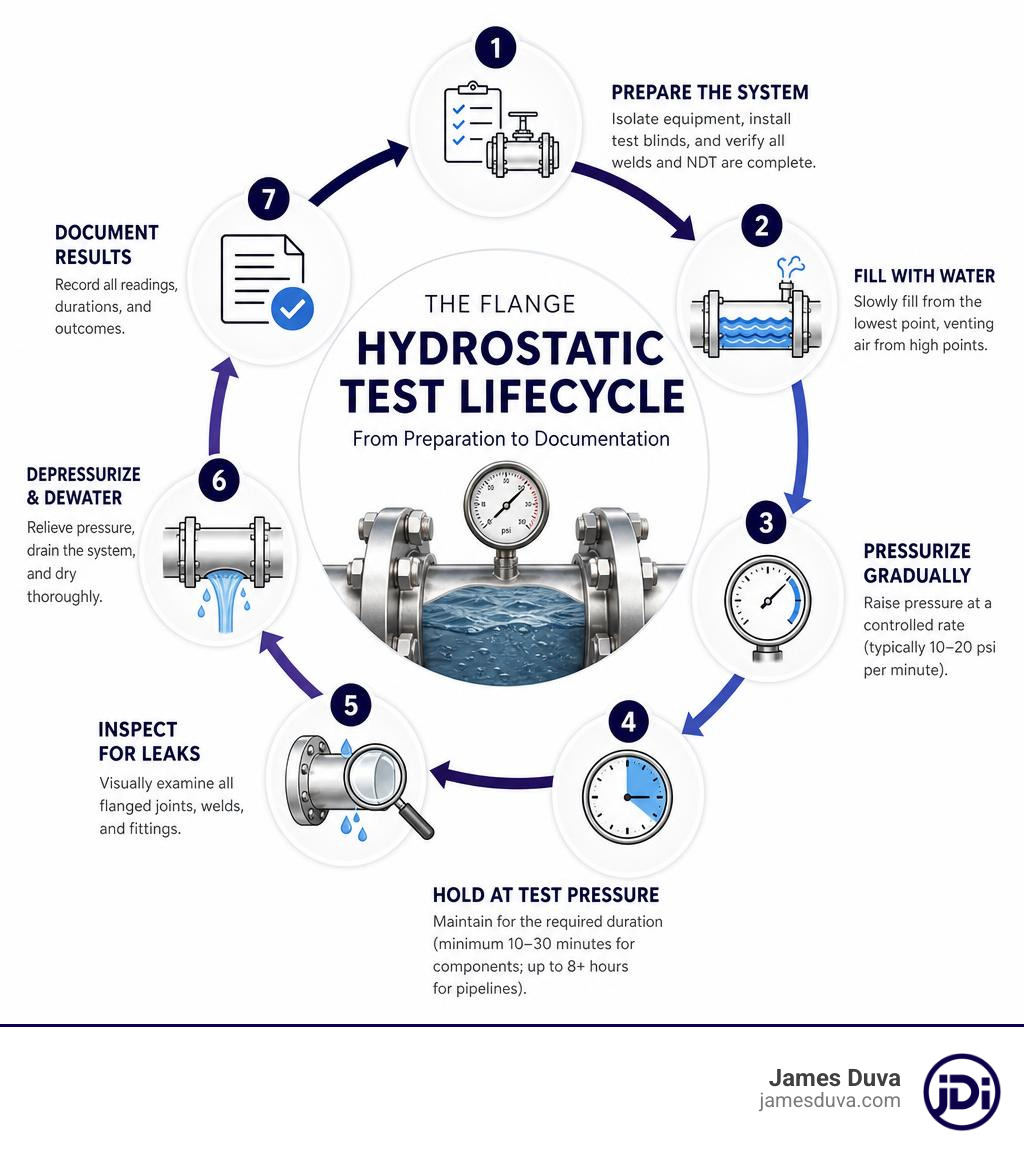
Here is a quick overview of the core steps:
- Prepare the system – Isolate equipment, install test blinds, and verify all welds and NDT are complete
- Fill with water – Slowly fill from the lowest point, venting air from high points
- Pressurize gradually – Raise pressure at a controlled rate (typically 10-20 psi per minute)
- Hold at test pressure – Maintain for the required duration (minimum 10-30 minutes for components; up to 8+ hours for pipelines)
- Inspect for leaks – Visually examine all flanged joints, welds, and fittings
- Depressurize and dewater – Relieve pressure, drain the system, and dry thoroughly
- Document results – Record all readings, durations, and outcomes
Test pressure is typically 1.5× MAWP. For a Class 150 flange, that works out to roughly 450 psig. For Class 300, it is approximately 1,125 psig, per ASME B16.5.
Flanges are critical connection points in any piping system. A failed joint under operating conditions is not just a maintenance problem — it is a safety and regulatory risk. That is why getting the test procedure right matters from the start.
I’m Billy Walker, Vice President of James Duva Inc., where I’ve spent years helping engineers and contractors in the power, process, and water treatment industries source the high-grade stainless steel and specialty alloy components that hold up under exactly these kinds of flange hydrostatic test procedures. In the guide below, I’ll walk you through everything you need to know to run a compliant, safe, and stress-free hydrotest.
Why Are Alloys So Valuable in Industry?
Before we dive into the mechanics of pressure testing, it helps to understand why we use high-grade materials in pressure systems. Pure metals, such as pure iron, are rarely suitable for industrial piping. In their unalloyed states, pure metals are often too soft, structurally weak, or highly prone to rust and chemical oxidation.
To overcome these physical limitations, we turn to alloys. An alloy is created by combining a primary metal with other metallic or non-metallic elements to fundamentally enhance its properties. For example, adding chromium and nickel to iron creates stainless steel, which offers vastly superior tensile strength, durability, and corrosion resistance.
These enhanced properties make specialty alloys irreplaceable across major industries:
- Construction: Heavy structural beams, high-load supports, and foundational piping systems rely on alloy steel to handle massive physical stresses.
- Oil & Gas: High-pressure fittings, heavy-duty valves, and specialized flanges require robust alloys to resist aggressive chemicals, sour gas, and deep-sea pressures.
- Automotive & Aerospace: Engine blocks, structural frames, and exhaust components use advanced alloys to maintain structural integrity under extreme thermal cycling and vibrations.
- Medical & Consumer Goods: Surgical implants require biocompatible titanium alloys, while commercial kitchenware and food processing plants rely on sanitary stainless steel to resist corrosion from acidic ingredients and harsh cleaning agents.
Choosing the right alloy is the first step in ensuring your piping system can withstand the extreme pressures of a hydrostatic test. To learn more about selecting the right materials for your project, take a look at our guide on Flanges Fittings and Pipes The Advantages of Premium Stainless Steel Materials.
The Core Purpose of Flange Hydrostatic Test Procedures
At its core, a hydrostatic test is a non-destructive verification process. It serves two main purposes: proving the structural integrity of the pressure-retaining walls and confirming that the mechanical joints (like flanged connections) will not leak under operating conditions.
Because water is virtually incompressible, it is the ideal medium for this test. If a component fails or a gasket blows during a water-filled test, the pressure drops instantly without the violent release of stored energy that occurs with compressed gases.
Hydrostatic testing is essential for evaluating:
- Sealing Performance: Ensuring the gasket, flange faces, and bolts work in harmony to prevent any fluid bypass.
- Pressure Resistance: Verifying that the flange body and neck can handle stresses well above their standard working limits.
- Leak Detection: Revealing microscopic paths, casting pinholes, or assembly errors that are invisible to the naked eye.
Different flange configurations require careful attention during this process. For a detailed breakdown of how different flanges are constructed and sealed, see The Definitive Guide to Flange Types and our overview on Understanding Industrial Flanges Types Applications and Benefits.
Industry Standards and Codes for Flange Hydrostatic Test Procedures
Hydrostatic testing is highly regulated to ensure safety and consistency. The primary codes governing these procedures include:
- ASME B16.5: This standard covers pipe flanges and flanged fittings (NPS 1/2 through NPS 24). Section 2.5 of ASME B16.5 outlines the requirements for hydrostatic testing of flanged joints, specifying that the test must be conducted at a pressure no less than 1.5 times the 38°C (100°F) pressure rating, rounded up to the next 25 psi increment.
- ASME B31.3 (Process Piping): This code dictates the testing of complete process piping systems. It generally mandates a hydrostatic test pressure of 1.3 times the design pressure, adjusted for temperature variations if the design temperature exceeds the test temperature.
- API 610 / ISO 13709: These standards govern centrifugal pumps for petroleum, petrochemical, and natural gas industries, specifying strict hydrostatic testing categories and hold times for pump casings and integrated flanged nozzles.
For a deeper dive into the engineering specifications governing these piping systems, you can review the HYDROSTATIC PRESSURE TESTING OF PIPING (PROJECT STANDARDS AND SPECIFICATIONS) manual.
Determining Test Pressure and MAWP Relationships
To safely test a flange, you must understand the relationship between its Maximum Allowable Working Pressure (MAWP), its material group, and its pressure class.
The MAWP of a flange is not a static number; it decreases as the operating temperature increases. However, hydrostatic tests are almost always performed at ambient temperature (typically calculated at 38°C or 100°F per ASME B16.5). Therefore, the test pressure is based on the ambient rating of the flange, not its elevated operating limit.
Let’s look at a practical example using an ASME B16.5 A182 F304 (Material Group 2.1) Class 150 flange:
- At an operating temperature of 300°C, the MAWP of this flange drops to approximately 10.2 bar (148 psi).
- At an ambient temperature of 38°C (100°F), the MAWP of the same flange is 19.0 bar (285 psi).
- Under ASME B16.5, the maximum hydrostatic test pressure is calculated as $1.5 times text{ambient MAWP}$: $$1.5 times 285 text{ psi} = 427.5 text{ psi}$$
- Section 2.5 allows this value to be rounded up to the next 25 psi increment, resulting in a standard test pressure of 450 psig (approx. 30 bar).
For a Class 300 flange in the same material group, the ambient MAWP is 740 psi. Multiplying this by 1.5 yields 1,110 psi, which is rounded to 1,125 psig for the test.
To cross-reference dimensions and pressure classes for your specific piping configuration, refer to our Industrial Flange Dimensions Charts Sizes and Everything in Between resource.
Pre-Test Preparation and Step-by-Step Execution
A successful hydrostatic test is won or lost in the preparation phase. Rushing into pressurization without isolating sensitive equipment or checking bolt torques is a recipe for damaged components and failed tests.
System Isolation and Safety Requirements
Before introducing water to the system, you must isolate components that cannot handle the high test pressures or could be damaged by water exposure.
- Exclude Sensitive Equipment: Rotary equipment (pumps, compressors), safety relief valves, rupture discs, flame arresters, steam traps, filters, and delicate instrumentation must be physically isolated.
- Isolate with Blinds: Use temporary test blinds, paddle blinds, or spectacle blinds to seal off the test section. For details on choosing the right temporary isolation tools, see our guide on Slip Blind Flanges What They Are and Why They Matter.
- Verify Blinds: Ensure all temporary blinds are rated for the maximum test pressure and are clearly marked. You can find technical calculations for blind thickness in the Hydrotest Blind – PDFCOFFEE.COM reference.
- Inspect Flange Assemblies: Before filling, inspect all flanged connections to ensure the correct gaskets are installed and the bolts are tightened in a standard star pattern. Use our Flange Inspection Checklist Template and Assembly Guide to verify joint readiness.
- Line Up Valves: Ensure that inline valves within the test limit, such as high-performance Ball Valves, are placed in the partially open position to protect their seats from differential pressure damage and to ensure the entire valve body is pressurized and tested.
Step-by-Step Execution of Flange Hydrostatic Test Procedures
Once isolation is complete and safety barriers are in place, you can proceed with the test execution:
- Fill the System: Introduce clean test water from the lowest point in the piping system. This forces air upward and out of the line.
- Vent the Air: Open all high-point vents during the filling process. Leave them open until a steady stream of water, free of air bubbles, flows out. Trapped air pockets compress under pressure and pose a severe safety hazard if a component fails.
- Control Water Quality: For systems constructed from austenitic or duplex stainless steels, the test water must have a controlled chloride content (typically less than 50 ppm) to prevent stress corrosion cracking.
- Raise Pressure Gradually: Increase the pressure slowly, at a rate of 10 to 20 psi per minute. Apply the pressure in steps: raise to 50% of the target pressure, hold for a brief check, then increase in 10% increments until reaching the target test pressure.
- Stabilize and Hold: Once the target pressure is reached, isolate the pressure source (pump) and allow the system to stabilize. Hold times vary by application:
- Shop testing/pump components: Typically 10 to 30 minutes per Sulzer Technical Procedures.
- Standard piping joints: Minimum 10 minutes per Fluid Sealing Association guidelines.
- Cross-country pipelines: Often require up to 8 continuous hours of stabilization and testing.
- Perform Visual Inspection: Walk the entire line, examining every flange joint, weld, and valve bonnet for signs of weeping, spraying, or pressure loss.
Handling Leaks, Pressure Variations, and Dewatering
Even with meticulous preparation, issues can arise during a test. Here is how to handle them professionally:
- Managing Flange Leaks: If you detect a leak at a flanged connection, never attempt to tighten the bolts while the system is under full pressure. You must first reduce the test pressure to at least 70% of the test limit (or completely depressurize the system) before carefully adjusting the bolts.
- Accounting for Temperature: Ambient temperature fluctuations will cause pressure changes. A rise in temperature causes water to expand, increasing system pressure; a drop in temperature causes a pressure decrease. Keep detailed logs of both metal temperature and fluid pressure to distinguish thermal changes from actual leaks.
- Dewatering and Drying: After a successful test, gradually relieve the pressure through a controlled drain valve. Open all high-point vents to prevent a vacuum from collapsing the piping. Use foam drying pigs propelled by dry compressed air to sweep out remaining water, preventing stagnant water corrosion.
For more tips on setting up your drainage and drying equipment, see the guide on How to Successfully Prepare and Complete a Hydrostatic Test .
Frequently Asked Questions About Pressure Testing
Hydrostatic vs. Pneumatic Testing Comparison
| Characteristic | Hydrostatic Testing | Pneumatic Testing |
|---|---|---|
| Test Medium | Liquid (typically water) | Gas (air or inert gas like Nitrogen) |
| Safety Risk Level | Low (liquid is virtually incompressible) | High (compressed gas stores immense energy) |
| Leak Detection | Excellent (visible liquid weeping or spraying) | Moderate (requires bubble solutions or ultrasonic sensors) |
| Standard Pressure Multiplier | 1.5× MAWP (ASME B16.5) | 1.1× to 1.25× Design Pressure |
| Setup Complexity | High (requires water supply, venting, and disposal) | Low (clean gas source, minimal cleanup) |
| Safety Boundary | Minimal | Large calculated exclusion zone |
What is the standard test pressure for Class 150 and Class 300 flanges?
According to ASME B16.5, the standard hydrostatic test pressure is calculated at 1.5 times the ambient pressure rating (at 38°C / 100°F). For standard carbon steel and common stainless steel groups:
- Class 150 Flanges: Tested at 450 psig.
- Class 300 Flanges: Tested at 1,125 psig.
These values are standardized based on the material’s maximum pressure capability at room temperature, ensuring the flange is structurally sound before being insulated or put into service.
How long must a hydrostatic test pressure be maintained?
The required hold time depends entirely on the governing code and the system volume:
- Component and Valve Shop Tests: Typically 10 to 30 minutes of stable pressure with zero allowable leakage.
- Standard Process Piping (ASME B31.3): A minimum of 10 minutes is required to allow for a thorough visual inspection of all joints.
- Transmission Pipelines: For natural gas or liquid propane lines, federal regulations often require a continuous 8-hour test to verify long-term integrity, especially in areas that cannot be easily inspected visually.
What is the difference between hydrostatic and pneumatic testing?
The fundamental difference lies in the compressibility of the testing medium. Hydrostatic testing uses water, which does not store energy when compressed. If a pipe ruptures, the water simply spills out, and the pressure drops instantly.
Pneumatic testing uses compressed air or nitrogen. Compressed gas stores a massive amount of potential energy. If a component fails during a pneumatic test, the gas expands violently, resulting in an explosive release of energy that can propel metal fragments over long distances. Because of this hazard, pneumatic testing is strictly restricted to systems where water contamination cannot be tolerated, or where the piping system is physically incapable of supporting the weight of water.
To explore specialized testing services and advanced leak detection technologies, check out the resources provided by Hydrostatic Testing – INTEGRA Technologies .
Conclusion
Executing a flawless flange hydrostatic test procedure requires the right combination of technical knowledge, careful preparation, and high-quality materials. By understanding your system’s MAWP, following proper isolation protocols, and utilizing reliable testing standards, you can ensure your piping systems operate safely and efficiently for years to come.
At James Duva Inc., based in Branchburg, NJ, we have been providing high-grade stainless steel and nickel alloy industrial products since 1978. Whether you are working in chemical processing, power generation, or municipal water treatment, our team has the expertise to help you select the exact flanges, fittings, and piping components needed to withstand rigorous hydrostatic testing.
Ready to source the highest quality materials for your next high-pressure project? Explore our range of products and technical guides by reading our comprehensive overview on Understanding Industrial Flanges Types Applications and Benefits or contact our Branchburg office today to speak with one of our alloy experts.
About James Duva Inc.
Since 1978, James Duva Inc. has been your trusted source for stainless steel and high-nickel alloy industrial products. Whether you’re in the water treatment, process or power industry, we pride ourselves on always having what you need. Say goodbye to your sourcing problems with just one call to James Duva.