
The Ultimate Guide to Alloy 20 Bars: Properties, Uses, and More

Feb 13, 2026
Why Alloy 20 Bars Are the Gold Standard for Corrosive Environments
Alloy 20 bars are high-performance nickel-iron-chromium alloy bars designed specifically to resist corrosive environments, especially those containing sulfuric acid. Here’s what you need to know:
- Composition: 32-38% Nickel, 19-21% Chromium, 3-4% Copper, 2-3% Molybdenum
- Key Strength: Practical immunity to chloride stress corrosion cracking
- Primary Use: Chemical processing equipment, sulfuric acid tanks, heat exchangers
- Mechanical Properties: 80-90 ksi tensile strength, 35-45 ksi yield strength
- Specifications: ASTM B473, UNS N08020, W.Nr. 2.4660
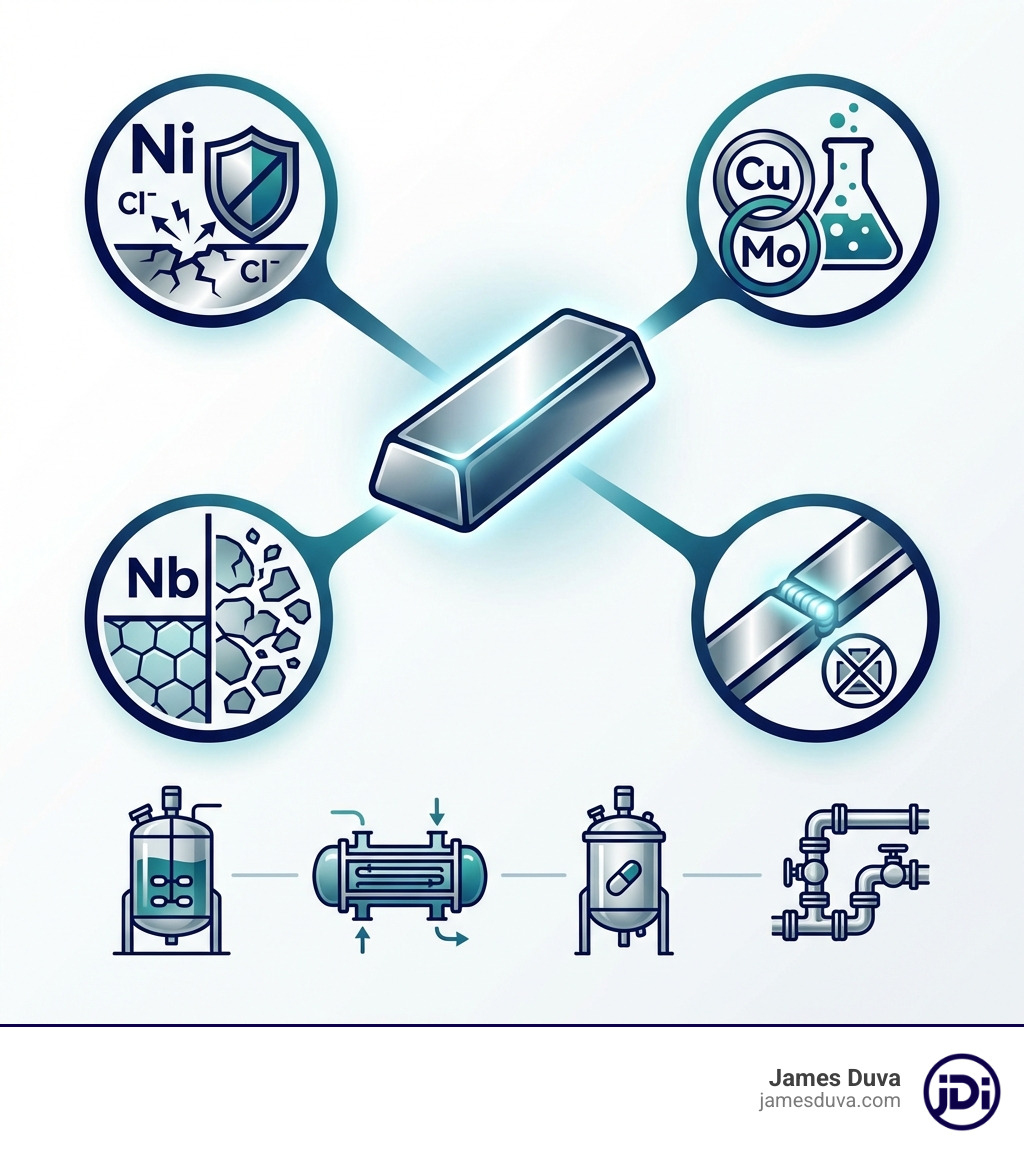
When standard stainless steels like 316L fail in acidic or chloride-rich environments, Alloy 20 bars step in as the reliable solution. Originally developed for maximum resistance to sulfuric acid attack, this austenitic alloy combines the corrosion resistance of nickel alloys with excellent mechanical properties and fabricability. The addition of niobium stabilizes the material against sensitization, meaning welded fabrications can often be used as-welded without post-weld heat treatment—a significant advantage in chemical processing applications.
If you want a broader context on how specialty alloys evolved for these demanding duties, the general background on stainless steel is a useful neutral reference alongside our in-depth resources like What is Alloy Metal and Its Many Uses and Learn more about alloy materials.
Industries from pharmaceuticals to petrochemicals rely on Alloy 20 bars for critical components like process piping, mixing tanks, and pump parts. The alloy’s unique composition provides superior resistance to pitting, crevice corrosion, and the dreaded stress corrosion cracking that plagues other materials in chloride environments.
I’m Billy Walker, Vice President of James Duva Inc., where we’ve been supplying high-quality Alloy 20 bars and other specialty materials to the power, process, and water treatment industries since 1978. Our decades of experience help engineers and procurement professionals source the right materials for even the most demanding corrosive applications.
What is Alloy 20? An Overview of its Characteristics and Composition
When we talk about high-performance materials for challenging industrial environments, Alloy 20 bars invariably come up. But what exactly is this material, and what makes it such a powerhouse? At its core, Alloy 20 is a nickel-iron-chromium austenitic alloy, a true “super alloy” designed with a singular purpose: to stand strong where other metals falter. Its development was a direct response to the industrial need for superior resistance to aggressive acids, particularly sulfuric acid.
A key characteristic that sets Alloy 20 apart is the addition of niobium (also known as columbium) to its composition. This clever inclusion stabilizes the alloy against a phenomenon called sensitization, which can lead to intergranular corrosion. Essentially, this means that even after welding, Alloy 20 bars maintain their robust corrosion resistance, often without needing post-weld heat treatment. This is a huge benefit for complex fabrications, saving time and simplifying manufacturing processes.
For those eager to dive deeper into specialized metals, understanding the fundamentals of alloys is crucial. We have comprehensive resources like What is an Alloy that can help illuminate these fascinating materials. And if you’re looking for resilient industrial solutions, our insights into Exploring Alloy 20 UNS N08020 for Resilient Industrial Solutions provide even more context.
Defining Alloy 20: A Nickel-Iron-Chromium Super Alloy
Let’s get down to the specifics. Alloy 20 is formally recognized by several designations, including UNS N08020 and W.Nr. 2.4660. While it is sometimes known by various trade names, these designations all refer to the same high-performing material that we at James Duva Inc. proudly supply.
Now, there’s a fun little debate in the metallurgical community: Is Alloy 20 a stainless steel or a nickel alloy? Given its significant iron content, some might initially categorize it as a stainless steel. However, with a nickel content typically ranging from 32% to 38%, it often crosses into the field of nickel alloys. What truly matters isn’t the label, but its exceptional performance. This alloy combines the best of both worlds, offering the strength and workability often associated with stainless steels, coupled with the superior corrosion resistance characteristic of many nickel-based alloys. It’s a fantastic example of how specialized alloys can be engineered to meet incredibly demanding applications, a topic we explore further in Deciphering the Power of Alloy Materials Stainless Steel Inconel and Monel.
Chemical Makeup and the Role of Each Element
The secret to Alloy 20 bars‘ incredible resilience lies in its precisely balanced chemical composition. Each element plays a crucial role, contributing to the material’s overall strength, fabricability, and, most importantly, its resistance to aggressive corrosive media.
Let’s break down the key players:
- Nickel (Ni): This is the star of the show, making up 32.0% to 38.0% of the alloy. Its high concentration is primarily responsible for Alloy 20’s exceptional resistance to general corrosion and, critically, its practical immunity to chloride stress corrosion cracking (SCC). At around 33% nickel, it stands head and shoulders above many other alloys in chloride-rich environments.
- Chromium (Cr): Present at 19.0% to 21.0%, chromium forms a passive oxide layer on the surface, providing excellent resistance to oxidizing environments, such as those involving nitric acids.
- Molybdenum (Mo): Ranging from 2.0% to 3.0%, molybdenum significantly improves resistance to pitting and crevice corrosion, especially in hostile environments containing chlorides.
- Copper (Cu): With 3.0% to 4.0%, copper is a vital component for Alloy 20 bars‘ outstanding resistance to sulfuric acid, which was its original design purpose.
- Niobium (Cb) / Columbium: This element, typically 8 times the carbon content up to 1.0% maximum, is the key to stabilization. It prevents the formation of harmful chromium carbides during welding, which could otherwise lead to intergranular corrosion. This means we can often use Alloy 20 in the as-welded condition, without needing further heat treatment.
- Iron (Fe): This makes up the balance of the alloy, providing structural integrity and contributing to its overall properties.
- Carbon (C): Kept at a maximum of 0.07%, a low carbon content further minimizes the risk of carbide precipitation, working hand-in-hand with niobium for weldability.
- Manganese (Mn), Silicon (Si), Phosphorus (P), Sulfur (S): These elements are present in smaller, controlled amounts (typically 2.0% max Mn, 1.0% max Si, 0.045% max P, 0.035% max S) and contribute to various aspects of the alloy’s processing and properties.
Understanding how these elements interact to create a superior material is fascinating and essential for selecting the right alloy for your needs. For more on how these individual components make a difference, check out How Different Alloys Change Steels Properties.
Here’s a quick look at the typical percentage ranges for key elements in Alloy 20:
| Element | Percentage Range (Weight %) |
|---|---|
| Nickel (Ni) | 32.00 – 38.00 |
| Chromium (Cr) | 19.00 – 21.00 |
| Copper (Cu) | 3.00 – 4.00 |
| Molybdenum (Mo) | 2.00 – 3.00 |
| Carbon (C) | 0.07 max |
| Niobium*+Tantalum (Nb+Ta) | 8 x C – 1.00 max |
| Iron (Fe) | Balance |
The Performance Edge: Mechanical Properties and Corrosion Resistance
When specifying materials for critical industrial applications, performance is paramount. Alloy 20 bars truly shine here, offering a remarkable combination of mechanical strength and unparalleled corrosion resistance, particularly in the most hostile environments. This material isn’t just about surviving; it’s about thriving where others fail.
Its robust properties ensure reliable operation not just at ambient temperatures, but also at liftd temperatures, maintaining good mechanical integrity up to approximately 930 F (500 C). This makes it a versatile choice for a wide array of thermal processes. When we compare it to standard stainless steels, the difference in performance, especially in acidic and chloride-rich conditions, is often night and day.
At James Duva Inc., we understand that sourcing the right materials can make or break a project. That’s why we focus on providing solutions like Alloy 20 bars that offer this kind of performance edge. Explore our approach to One Stop Solution Sourcing Stainless Steel and Nickel Alloy Products Made Easy.
Understanding the Mechanical and Physical Strength of Alloy 20 Bars
Beyond its impressive corrosion resistance, Alloy 20 bars boast excellent mechanical properties that contribute to its reliability and longevity in demanding applications. We’re talking about a material that can take a beating and keep on performing.
Here are the typical mechanical properties for annealed Alloy 20 bars:
- Tensile Strength: Minimum of 80,000 psi (551 MPa), often reaching up to 90,000 psi (620 MPa). This indicates the maximum stress the material can withstand before breaking.
- Yield Strength (0.2% Offset): Minimum of 35,000 psi (241 MPa), with some sources indicating up to 45,000 psi (300 MPa). This is the point at which the material begins to deform permanently.
- Elongation: A minimum of 30%, often observed at 40%. This measures the material’s ductility, or its ability to deform under tensile stress without fracturing.
- Reduction of Area: Typically a minimum of 50%, especially for bar forms. This signifies the material’s ability to neck down before fracture.
In terms of physical properties, Alloy 20 bars are also quite impressive:
- Density: Approximately 0.292 lbs/in³ (or 8.08 g/cm³).
- Melting Point: Around 1443 C (2430 F).
- Modulus of Elasticity: Roughly 29.3 x 10^6 psi. This indicates the material’s stiffness or resistance to elastic deformation.
These properties ensure that Alloy 20 bars can withstand significant mechanical stresses while resisting corrosive attack, making them ideal for structural components in harsh industrial settings. For a broader understanding of how different metal alloys achieve their unique blend of properties, you might find our guide on Metal Alloys Properties Types and Uses quite insightful.
Superior Resistance to Sulfuric Acid and Stress Corrosion Cracking
This is where Alloy 20 bars truly earn their stripes. The material was literally born to conquer sulfuric acid. Its unique blend of nickel, chromium, molybdenum, and copper provides outstanding resistance to this highly corrosive chemical across a wide range of concentrations and temperatures.
But the benefits don’t stop there:
- Practical Immunity to Chloride Stress Corrosion Cracking (SCC): With its high nickel content (around 33%), Alloy 20 bars offer practical immunity to chloride SCC. This is a game-changer, as SCC is a common failure mode for many stainless steels, including 316L, in environments containing chlorides. We often recommend Alloy 20 as a reliable solution when SCC is a persistent problem.
- Resistance to Pitting and Crevice Corrosion: The molybdenum and copper content in Alloy 20 significantly improves its resistance to localized corrosion forms like pitting and crevice corrosion, which can be insidious and lead to premature component failure.
- Versatility in Other Acids: While sulfuric acid is its forte, Alloy 20 bars also demonstrate good resistance to phosphoric acid, nitric acid, and various aqueous salt solutions. This broad spectrum of resistance makes it an incredibly versatile material for diverse chemical processing applications.
However, it’s always wise to exercise caution in extremely high chloride ion environments, as even the toughest alloys can experience increased corrosion rates under certain conditions. For specific applications, our team at James Duva Inc. can help you assess the best material choice.
Practical Applications and Industries Utilizing Alloy 20 Bars
Given their exceptional properties, it’s no surprise that Alloy 20 bars are indispensable across a multitude of industries where corrosion resistance is not just a preference, but a critical necessity. From the hum of chemical plants to the intricate processes of pharmaceutical manufacturing, this alloy provides the reliability and longevity that engineers demand.
At James Duva Inc., we’ve seen Alloy 20 bars specified for everything from large-scale industrial infrastructure to precision components. They are a staple in our offerings for their proven track record in tough environments. Find more about our Alloy Industrial Products.
Here are some of the key applications and industries that commonly use Alloy 20 bars:
- Chemical Process Equipment: This is the bread and butter for Alloy 20. Think reactor vessels, storage tanks, mixing tanks, and agitators designed to handle aggressive chemical concoctions.
- Sulfuric Acid Pickling Tanks, Racks, and Heating Coils: As the alloy was specifically designed for sulfuric acid resistance, these applications are a natural fit, providing durability where other materials would quickly degrade.
- Heat Exchangers and Process Piping: In systems where hot, corrosive fluids need to be transferred or their temperature regulated, Alloy 20 bars are formed into pipes and tubing to ensure efficient and safe operation.
- Pharmaceutical and Food Processing Equipment: The clean, corrosion-resistant nature of Alloy 20 makes it suitable for equipment used in processing pharmaceuticals, as well as in food and dye production, where purity and hygiene are paramount.
- Pumps, Valves, and Fasteners: Critical components that control fluid flow or secure structures in corrosive environments, such as our fittings and flanges, benefit immensely from the robustness of Alloy 20.
- Bubble Caps in Distillation Columns: These specialized components, vital for separation processes, often operate in highly corrosive conditions, making Alloy 20 an ideal material choice.
- SO2 Scrubbers: Used in environmental control systems to remove sulfur dioxide, these devices handle corrosive flue gases, where Alloy 20’s resistance is invaluable.
- Synthetic Rubber Manufacturing Equipment: The processes involved in synthetic rubber production can be highly corrosive, and Alloy 20 helps ensure the longevity of the machinery.
- Phosphate Coating Drums and Racks: In metal finishing, where acidic solutions are used for phosphate coating, Alloy 20 provides the necessary resistance.
- Petrochemical Process Equipment: Refineries and petrochemical plants deal with a variety of aggressive chemicals and high temperatures, making Alloy 20 a go-to for reliability, and we supply a wide range of products for these applications.
- Explosives Manufacturing: The production of explosives often involves highly corrosive agents, requiring materials that can withstand extreme conditions.
These examples illustrate the versatility and critical importance of Alloy 20 bars across modern industry.
A Practical Guide to Fabricating and Sourcing Alloy 20
Working with high-performance alloys like Alloy 20 requires specific knowledge and expertise, not just in selecting the material, but also in fabricating it correctly. While Alloy 20 bars are known for their good fabricability, understanding the nuances of welding, forming, and machining is crucial to open up their full potential and ensure the longevity of your components. At James Duva Inc., we believe in empowering our clients with knowledge, helping them steer the complexities of specialized materials. Our expertise, honed since 1978, is detailed in Unraveling the World of Alloy Metals A Deep Dive into James Duva’s Expertise.
Sourcing high-quality materials is the first step toward a successful project. We pride ourselves on being a trusted one-stop shop for a wide array of industrial products, ensuring that you receive materials that meet stringent specifications.
Key Fabrication Guidelines for Alloy 20 Bars
Fabricating Alloy 20 bars and other forms involves specific considerations to maintain their integrity and corrosion resistance.
- Weldability: Good news! Most common welding methods can be successfully used with Alloy 20, with the exception of oxyacetylene. Techniques like Gas Tungsten Arc Welding (GTAW or TIG), Gas Metal Arc Welding (GMAW or MIG), and Submerged Arc Welding (SAW) are typically recommended. The presence of niobium is a blessing here, as it minimizes carbide precipitation in the heat-affected zone. This means that welded fabrications can often be used in the as-welded condition, without the need for post-weld heat treatment, saving time and resources. When welding Alloy 20 to itself, matching filler metals like ER320LR (for TIG/MIG) and E320LR (for SAW) are ideal. If you’re joining Alloy 20 to dissimilar alloys (like 316 or C276), AWS ERNiCrMo-3 (TIG/MIG) or ENiCrMo-3 (SAW) are often suitable choices.
- Heat Treatment: Unlike some alloys, Alloy 20 cannot be hardened by heat treatment. Its primary heat treatment is stabilized-annealing, which is performed by heating the material to between 1750 F and 1850 F for a minimum of 30 minutes per inch of thickness, followed by a rapid water quench. This process ensures optimal corrosion resistance. Stress relieving, if needed, can be done at temperatures below 1000 F, also followed by a water quench.
- Hot Forming: For hot working, Alloy 20 bars should be heated uniformly to a starting temperature between 2100 F and 2225 F. It’s crucial to complete the forming operations before the material temperature drops below 1800 F. After hot working, it’s recommended to reheat the material at 1750-1850 F for stabilization and water quench.
- Cold Forming: Alloy 20 generally exhibits good cold formability and can be press brake bent, typically over a radius twice the material’s thickness. However, for cold reductions exceeding 15%, a final stabilizing anneal is often required to restore optimal properties.
- Machining Challenges: Now for the “fun” part – machining Alloy 20 can be a bit tricky. Due to its high work-hardening rate, it tends to become harder as you machine it, which can quickly dull tools. It’s known for being difficult to machine, often compared to other nickel and cobalt-based alloys.
- Machining Best Practices: To overcome these challenges, we recommend:
- Using rigid and overpowered machinery to prevent chatter and deflection.
- Keeping tools exceptionally sharp and replacing them regularly.
- Employing positive rake angle tools for most operations, and sometimes negative rake angles for heavy stock removal.
- Using heavy, constant feeds to ensure the tool gets under the work-hardened layer, rather than riding on top of it.
- Operating at low surface-cutting speeds.
- Utilizing effective lubricants, such as soluble oils, especially with carbide tooling.
Common Forms, Specifications, and Sourcing
Alloy 20 bars are just one of the many forms in which this versatile material is available. At James Duva Inc. in Branchburg, NJ, we supply Alloy 20 in various product forms to meet diverse industrial needs:
- Bar: This includes round bars, flat bars, hex bars, and square bars, which are the focus of this guide. We offer Alloy 20 bars in a range of sizes, diameters (from 0.1 mm to 500 mm), and lengths (from 100 mm to 6000 mm), with various finishes and tolerances (e.g., H8, H9, H10, H11, H12, H13K9, K10, K11, K12).
- Plate and Sheet: For larger surface areas or custom fabrications.
- Pipe and Tubing: Available in both welded and seamless configurations for process lines. Explore our Pipe and Tubing selections.
- Fittings and Flanges: Essential for connecting piping systems, including elbows, tees, stub-ends, and reducers. See our Fittings category.
- Welding Wire: For joining Alloy 20 components.
When it comes to specifications, Alloy 20 bars and other products adhere to rigorous industry standards to ensure quality and consistency. Common ASTM and ASME specifications include:
- For Bar: ASTM B473 / ASME SB473
- For Sheet and Plate: ASTM B463 / ASME SB463
- For Pipe: ASTM B464 (welded), ASTM B729 (seamless) / ASME SB464, ASME SB729
- For Tubing: ASTM B751 / ASME SB751
- For Fittings: ASTM B366 / ASME SB366
- For Welded Pipe: ASTM B474 / ASME SB474
- For Forgings: ASTM B462 / ASME SB462
At James Duva Inc., we pride ourselves on being a trusted supplier of high-grade stainless steel and nickel alloy industrial products. Based in Branchburg, NJ, we offer a comprehensive inventory and the expertise to help you select and source the right Alloy 20 bars or other forms for your specific needs.
Need a specific size or custom requirement? Don’t hesitate to reach out. Our team is ready to assist with your inquiry. Contact us for Alloy 20 sourcing today!
Conclusion: The Premier Choice for Critical Applications
In the demanding world of industrial processing, choosing the right material is paramount to success, safety, and operational longevity. Alloy 20 bars consistently emerge as a premier choice for critical applications where aggressive corrosive media, particularly sulfuric acid and chlorides, pose a threat to lesser materials.
We’ve explored how its carefully engineered chemical composition, featuring high nickel, chromium, molybdenum, and copper, along with niobium stabilization, grants it a formidable defense against general corrosion, pitting, crevice corrosion, and crucially, chloride stress corrosion cracking. Its robust mechanical properties ensure that components made from Alloy 20 bars can withstand significant operational stresses, while its good fabricability allows for its integration into complex designs.
From chemical process equipment and heat exchangers to pharmaceutical and food production, the versatility and reliability of Alloy 20 bars make them an invaluable asset. When faced with environments that push other alloys to their limits, Alloy 20 stands as a testament to advanced metallurgical engineering.
At James Duva Inc., we are committed to providing you with the highest quality Alloy 20 bars and related products, backed by decades of expertise and a dedication to customer service. For all your high-performance material needs, explore our extensive range of nickel alloys. We invite you to browse Alloy 20 products and find how this exceptional material can lift the performance and reliability of your next project.
About James Duva Inc.
Since 1978, James Duva Inc. has been your trusted source for stainless steel and high-nickel alloy industrial products. Whether you’re in the water treatment, process or power industry, we pride ourselves on always having what you need. Say goodbye to your sourcing problems with just one call to James Duva.