
Why Nickel Alloy Fittings Are Essential for Demanding Environments

Apr 17, 2026
Why Nickel Alloy Fittings Are Essential for Demanding Environments
What Are Nickel Alloy Fittings and Why Do They Matter?
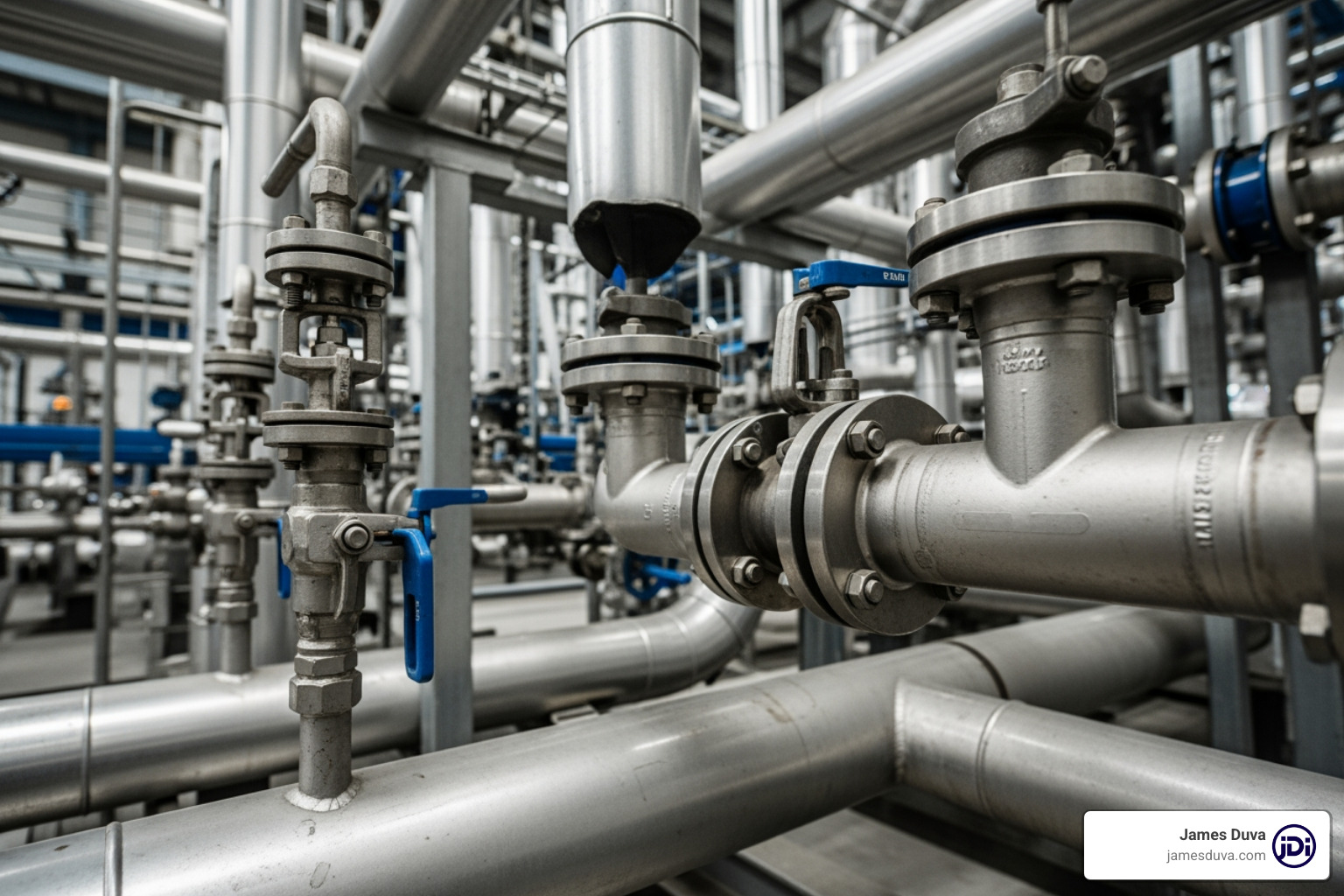
Nickel alloy fittings are pipe connection components made from nickel-based metals engineered to withstand extreme corrosion, high temperatures, and intense pressure — conditions that would quickly degrade standard carbon steel or even stainless steel.
Here’s a quick overview of what you need to know:
| Feature | Detail |
|---|---|
| What they are | Pipe fittings (elbows, tees, reducers, caps, etc.) made from nickel-based alloys |
| Common grades | Nickel 200, Monel 400, Inconel 625, Hastelloy C276, Alloy 20 |
| Key standards | ASTM B366, ASME B16.9, ASME B16.11 |
| Typical sizes | ½” up to 48″ depending on fitting type |
| Pressure ratings | 3000 lb, 6000 lb (forged); Sch 10S to XXS (butt weld) |
| Primary industries | Oil & gas, chemical processing, pharmaceuticals, marine, power generation |
| Main advantage | Superior resistance to corrosion, heat, and mechanical stress vs. steel alternatives |
Industries that deal with aggressive chemicals, high heat, or saltwater environments depend on these fittings because failure is simply not an option. A corroded fitting in a refinery or offshore platform doesn’t just mean downtime — it can mean catastrophic safety events.
The global demand for these components spans dozens of countries and thousands of industrial facilities, from petrochemical refineries to pharmaceutical plants. Sourcing the right grade, in the right size, with the right certifications — on time — is one of the biggest channels procurement and engineering teams face.
I’m Billy Walker, Vice President of James Duva Inc., where I’ve spent years helping power, process, and water treatment professionals source specialty nickel alloy fittings and high-performance piping components with confidence. In the sections below, I’ll break down everything you need to know to choose the right nickel alloy fittings for your application.
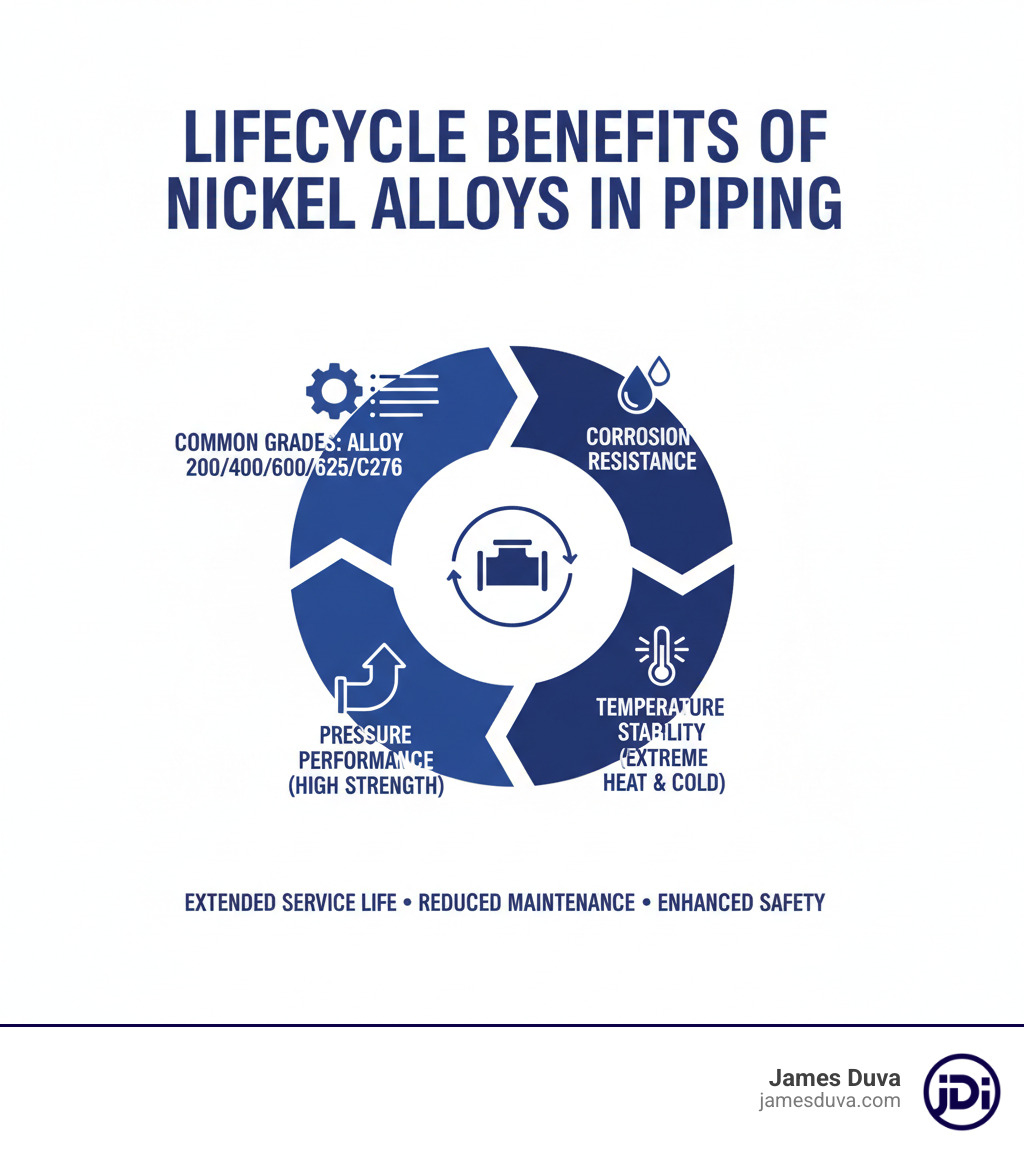
Why Are Alloys So Valuable in Industry?
To understand why Nickel alloy fittings are so critical, we first have to look at the limitations of pure metals. In their natural, unalloyed state, many pure metals just aren’t up to the task of modern industrial work. For example, pure iron is relatively soft and incredibly prone to rust. If we built a refinery out of pure iron, it wouldn’t last through the first rainy season, let alone handle the internal pressure of moving crude oil.
This is where alloys come in. An alloy is a mixture of two or more elements, where at least one is a metal. By adding elements like chromium, molybdenum, copper, or iron to a nickel base, we create a material that is far stronger and more durable than its individual parts.
Alloys are the backbone of global infrastructure:
- Construction: Large beams and piping systems rely on alloys for structural integrity.
- Oil & Gas: Fittings and flanges must withstand high-pressure reservoirs and corrosive saltwater.
- Automotive & Aerospace: Engines and frames require materials that won’t melt or warp under the intense heat of combustion or the stress of flight.
- Medical & Consumer Goods: Everything from orthopedic implants to your high-end kitchenware uses alloys to ensure they don’t react with the human body or corrode after a few washes.
When the environment gets truly nasty, think boiling sulfuric acid or high-pressure steam, you have to decide when to choose nickel alloys over stainless steel in industrial applications. While stainless steel is great for many things, nickel alloys provide that extra level of protection that keeps systems running safely for decades.
Key Advantages of Nickel Alloy Fittings
Why do engineers specify Nickel alloy fittings instead of cheaper alternatives? It usually comes down to three “superpowers”: oxidation resistance, thermal stability, and mechanical strength.
- Oxidation and Corrosion Resistance: Nickel alloys excel in environments where oxygen or aggressive chemicals would eat through other metals. Whether it’s the chloride stress corrosion cracking found in marine environments or the pitting caused by phosphoric acid, nickel alloys like Hastelloy and Monel hold their ground.
- Thermal Expansion and Creep Strength: Many materials expand significantly when heated or begin to “creep” (slowly deform) under constant stress at high temperatures. Nickel alloys have a low coefficient of thermal expansion and incredible creep-rupture strength, making them essential for high-energy piping systems.
- High-Pressure Performance: In forged configurations, these fittings are rated for 3000 lb and 6000 lb service, ensuring they can handle the intense pressures found in deep-sea drilling or power plant boilers.
To ensure these fittings meet the rigorous demands of industry, they are manufactured according to the Standard Specification for Factory-Made Wrought Nickel and Nickel Alloy Fittings. This standard covers everything from chemical composition to the dimensional accuracy required for a perfect fit.
Material Comparison Table
| Property | Carbon Steel | Stainless Steel (316) | Nickel Alloys (e.g., Inconel) |
|---|---|---|---|
| Corrosion Resistance | Low | Moderate | Excellent |
| Max Temp (Typical) | 750°F | 1500°F | 2000°F+ |
| Cost | Low | Moderate | High |
| Best Use | General utility | Food/General Chem | Extreme Heat/Acids |
If you are looking for specific components, you can browse our full range of fittings to see the variety of materials and configurations available.
Common Types and Popular Grades

Nickel alloy fittings come in two primary manufacturing styles: butt weld and forged.
- Butt Weld Fittings: These are usually used for larger diameter piping (typically 1/2″ up to 48″). They are welded directly to the pipe, providing a leak-proof, smooth-flow connection. Common shapes include 90° and 45° elbows, equal and reducing tees, concentric and eccentric reducers, caps, and stub ends. You can learn more about these in our butt weld fittings section.
- Forged Fittings: Used for smaller, high-pressure lines (usually up to 4″), these include socket weld and threaded connections. These are the heavy hitters—often rated for 3000# or 6000#—and include couplings, unions, bushings, and plugs.
Popular Grades for Nickel Alloy Fittings
Choosing the right grade is the most important part of the procurement process. Each “brand name” alloy has a unique personality:
- Nickel 200/201: Commercially pure nickel. It’s highly resistant to caustic alkalis and is often used in food processing and synthetic fiber production.
- Monel 400: A nickel-copper alloy. It is the “gold standard” for marine engineering because it resists corrosion by rapidly flowing seawater and hydrofluoric acid.
- Inconel 625: Known for its incredible strength and resistance to high temperatures. It’s a favorite in aerospace and offshore oil applications.
- Hastelloy C276: Perhaps the most versatile corrosion-resistant alloy available. It handles “wet” chlorine gas, hypochlorite, and chlorine dioxide with ease.
- Alloy 20: Often called “Carpenter 20,” it was specifically designed to handle sulfuric acid.
We often get asked, Is Hastelloy Better Than Inconel for Acid Environments? or Which is Better for Corrosive Environments?. Generally, Hastelloy is the king of chemical corrosion, while Inconel is the master of high-heat oxidation.
Standard Specifications for Nickel Alloy Fittings
When you order Nickel alloy fittings, they must comply with international standards to ensure safety:
- ASTM B366: The standard specification for factory-made wrought nickel and nickel alloy fittings.
- ASME B16.9: Covers dimensions and tolerances for factory-made wrought butt-welding fittings.
- ASME B16.11: The standard for forged fittings, including socket-welding and threaded types.
- MSS-SP-43: Standard for wrought and fabricated butt-welding fittings for low-pressure, corrosion-resistant applications.
Fittings are available in a wide range of wall thicknesses, from Schedule 10S (light wall) to XXS (double extra strong), ensuring they can be matched to the pipe they are connecting.
Critical Industries and Selection Criteria
Because of their unique properties, Nickel alloy fittings are the “first responders” for several high-stakes industries:
- Chemical Processing: Handling everything from acetic acid to vinyl chloride. Facilities here use nickel alloys to prevent leaks and equipment failure that could lead to environmental hazards.
- Oil & Gas: Especially in “sour gas” environments where hydrogen sulfide (H2S) is present. Nickel alloys prevent the brittle cracking that kills standard steel.
- Marine & Offshore: Saltwater is a metal killer. Monel 400 and Inconel 625 fittings are used on offshore platforms and in naval vessels for piping that must survive decades of salt spray.
- Pharmaceuticals: High-purity environments require materials that won’t leach into the product and can withstand aggressive cleaning cycles.
- Power Generation: High-temperature steam lines in nuclear and fossil fuel plants rely on the creep resistance of Incoloy 800H/HT.
When selecting a fitting, we always tell our clients to look at three things: Temperature, Media (what’s inside the pipe), and Pressure. If you’re dealing with high heat but low corrosion, Inconel 600 might be your best bet. If you’re dealing with sulfuric acid at room temperature, Alloy 20 is the winner.
Frequently Asked Questions about Nickel Alloy Fittings
How do I select the right alloy for high-temperature service?
For high-temperature service, you need to look at the alloy’s resistance to oxidation and its “creep” strength. Inconel 600 or 625 are excellent choices for temperatures exceeding 1000°F. If the environment is both hot and highly pressurized, Incoloy 800H/HT is often the industry standard because it is specifically treated to resist deformation over long periods.
What are the primary differences between Class S and Class W fittings?
These designations refer to how the fitting was made and tested under ASTM B366:
- Class S: Seamless construction. These are made from a single piece of material without any weld seams and generally don’t require non-destructive examination (NDE).
- Class W: Welded construction. These are made from plates or pipes that have been fusion-welded. They must undergo radiography (X-ray) or ultrasonic testing to ensure the weld is perfect.
- Class WX/WU: These are variations of welded fittings that require specific types of radiography or ultrasonic testing on all welds.
Why are nickel alloys preferred over stainless steel in sulfuric acid environments?
While some stainless steels (like 316L) can handle very dilute or very concentrated cold sulfuric acid, they fail miserably in the “middle” concentrations and at higher temperatures. Nickel alloys like Alloy 20 and Hastelloy C276 contain high levels of nickel, chromium, and molybdenum, which create a protective barrier that resists the aggressive “eating” action of sulfuric acid across a much wider range of temperatures and concentrations.
Conclusion
At James Duva Inc., we understand that when you’re looking for Nickel alloy fittings, you aren’t just buying a piece of metal—you’re buying the safety and reliability of your entire operation. Since 1978, we’ve served as a trusted one-stop shop for high-performance industrial products from our base in Branchburg, NJ.
Whether you need a standard 90° elbow in Monel 400 or a custom-fabricated reducer in Hastelloy C276, our team ensures every part meets ISO 9001 standards and the strict requirements of your project. We offer value-added services like custom fabrication, rapid delivery for emergency shutdowns, and comprehensive quality testing to give you total peace of mind.
Beyond fittings, we carry a full inventory of high-grade piping products, including Ball Valves, flanges, and tubing. If you’re ready to discuss your next project or need help navigating our nickel alloys catalog, give us a call. We’re here to make sure you get the right material, the first time.
About James Duva Inc.
Since 1978, James Duva Inc. has been your trusted source for stainless steel and high-nickel alloy industrial products. Whether you’re in the water treatment, process or power industry, we pride ourselves on always having what you need. Say goodbye to your sourcing problems with just one call to James Duva.