
What Makes a Fitting Food Grade? Your Guide to Sanitary Standards
Apr 17, 2026
When Contamination Is Not an Option: What Food Grade Sanitary Fittings Actually Mean
Food grade sanitary fittings are pipe connectors and components specifically engineered to meet strict hygiene standards for use in food, beverage, dairy, and pharmaceutical processing.
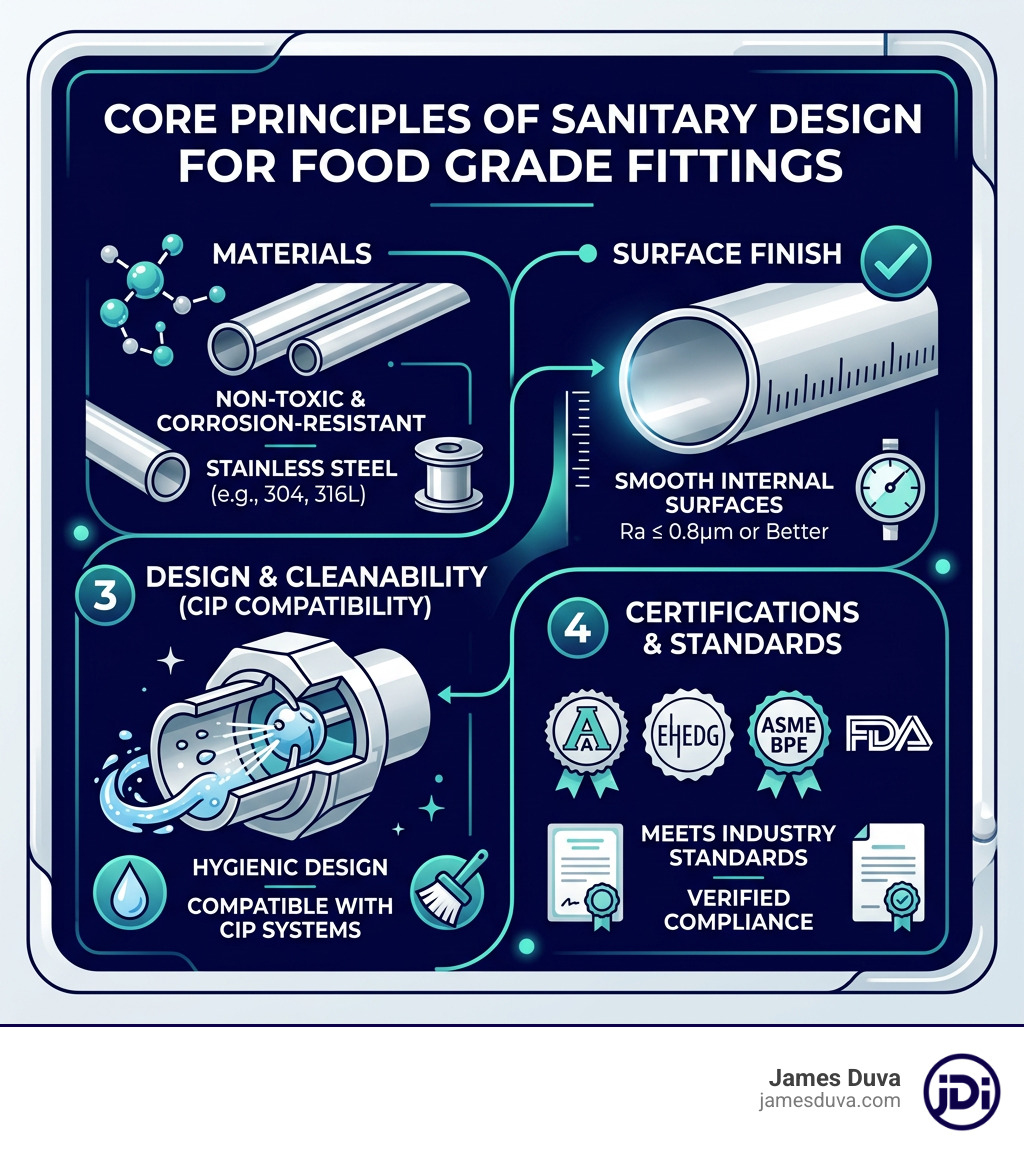
Here’s a quick breakdown of what makes a fitting truly “food grade”:
| Feature | What It Means |
|---|---|
| Material | Non-toxic, corrosion-resistant stainless steel (304 or 316L) |
| Surface finish | Smooth internal surfaces, Ra ≤ 0.8μm or better |
| Design | No crevices, dead zones, or hard-to-clean areas |
| Certification | Meets 3-A, EHEDG, ASME BPE, or FDA standards |
| Cleanability | Compatible with CIP and SIP cleaning systems |
A contaminated production run doesn’t just mean lost product. It can mean a full facility shutdown, regulatory action, and serious public health consequences. The fittings connecting your processing lines are often the last line of defense against that outcome — and not all fittings are built equal.
That’s why the term “food grade” isn’t just a label. It’s a set of measurable, enforceable engineering requirements that determine whether a fitting is safe to use in a hygienic processing environment.
I’m Billy Walker, Vice President of James Duva Inc., where I’ve spent years helping industrial professionals source the right specialty piping components, including food grade sanitary fittings, from trusted domestic manufacturers. In the sections below, I’ll walk you through everything you need to know to select, specify, and maintain the right fittings for your application.
Defining Food Grade Sanitary Fittings and Their Industrial Use
When we talk about what are sanitary fittings, we are describing a specialized class of hardware designed to join sections of tubing in a way that prevents the growth of bacteria and allows for easy, thorough cleaning. Unlike standard industrial fittings, which might have threads or internal pockets where liquid can sit and rot, food grade sanitary fittings are designed to be “hygienic.”
At James Duva Inc., we see these components used across a vast spectrum of “clean-tech” industries. While the food and beverage sectors are the most obvious users, the requirements for sterility extend much further:
- Dairy Processing: Milk is highly perishable and prone to bacterial growth. Fittings must be able to handle daily high-temperature washdowns.
- Beverage Production: From soft drinks to craft beer, maintaining flavor neutrality and preventing yeast contamination is vital.
- Pharmaceutical Manufacturing: This industry requires the highest level of sterility, often moving beyond standard food-grade to “ultra-pure” or aseptic standards.
- Biotechnology: Handling living cultures requires fittings that won’t leach chemicals or harbor microscopic contaminants.
- Cosmetic Industry: Lotions and creams must remain shelf-stable, requiring a production line free of microbial interference.
Navigating this world can be confusing, especially with all the jargon. If you find yourself overwhelmed by terms like “bevel seat” or “ferrule,” we recommend checking out our guide on sanitary fittings terms demystified to get up to speed.
Material Selection: The Role of 304 and 316L Stainless Steel
The foundation of any food-grade system is the material itself. While you might see various metals in a factory, food grade sanitary fittings are almost exclusively made from stainless steel—specifically the 300 series. These alloys are chosen because they are non-reactive, durable, and can be polished to a mirror-like finish.
The two heavyweights in this arena are 304 and 316L stainless steel. While they look identical to the naked eye, their chemical compositions lead to very different performance profiles.
| Property | 304 Stainless Steel | 316L Stainless Steel |
|---|---|---|
| Common Use | General food processing, water, milk | Acidic foods, high-salt brines, sauces |
| Corrosion Resistance | Excellent for standard environments | Superior resistance to chlorides and acids |
| Carbon Content | Standard | Low (“L” stands for low carbon to prevent weld decay) |
| Cost | More economical | Higher due to Molybdenum content |
| Industry Standard | Sanitary tubing ASTM A270 S2 | High-performance hygienic applications |
For most general applications, 304 stainless steel is more than sufficient. However, if your processing line involves tomato sauce (acidic) or salty soups, 316L is the safer bet. The addition of molybdenum in 316L provides a shield against “pitting” corrosion that can occur in high-chloride environments. At James Duva Inc., we ensure our sanitary tubing meets the rigorous ASTM A270 S2 specifications, which include 100% bore-scoping and polishing on both the internal and external diameters.
Why Are Alloys So Valuable in Industry?
You might wonder why we don’t just use pure metals. The reality is that pure metals, like iron, are often too soft for industrial use or incredibly prone to rust and oxidation. This is where alloys like stainless steel come into play. Alloys are engineered to combine the best properties of different elements, resulting in materials with enhanced corrosion resistance, heat tolerance, and mechanical strength.
This engineering makes them indispensable across various sectors:
- Construction: Alloys provide the structural integrity for beams and piping systems, ensuring they last for decades without failing.
- Oil & Gas: We supply durable fittings and flanges that must withstand extreme pressures and corrosive saltwater environments—tasks pure metals simply couldn’t handle.
- Automotive & Aerospace: These industries rely on alloys for lightweight yet incredibly strong frames and high-performance engine components that can survive extreme heat.
- Medical & Consumer Goods: From medical implants requiring biocompatibility to the kitchenware in your home, alloys provide the hygiene and wear resistance necessary for daily life.
Because we specialize in sanitary fittings and nickel alloys, we understand that the right material choice is the difference between a system that lasts thirty years and one that fails in three. This expertise extends to our selection of Ball Valves, which are critical for controlling flow in these high-stakes environments.
Engineering for Hygiene: Surface Finishes and Standards
A fitting isn’t “food grade” just because it’s made of steel. It must be engineered to prevent the “microscopic hide-and-seek” that bacteria play. This is where hygienic design comes in. The primary goal is a crevice-free design. If there is a tiny crack, a rough weld, or a sharp corner, organic matter will get stuck there, rot, and contaminate every subsequent batch of product.
To prevent this, several regulatory bodies have established standards:
- 3-A Sanitary Standards: Developed by regulators and manufacturers to ensure equipment can be mechanically cleaned or easily dismantled for manual inspection.
- EHEDG (European Hygienic Engineering & Design Group): Similar to 3-A but with a focus on European regulatory requirements.
- ASME BPE (Bioprocessing Equipment): The gold standard for pharmaceutical and high-purity applications.
- FDA Compliance: Ensures all materials (including gaskets) are safe for contact with food.
For a deeper dive into how these designs work in practice, read our article on sanitary tri-clamp fittings in food beverage industry use cases.
Surface Finish Requirements for Food Grade Sanitary Fittings
The most critical technical metric for a sanitary fitting is its Roughness Average (Ra). This is a measurement of the microscopic peaks and valleys on the metal’s surface. The smoother the surface, the harder it is for bacteria to stick to it.
Standard food-grade finishes include:
- Ra ≤ 0.8μm (180 grit): The standard for most food and dairy applications.
- Ra ≤ 0.5μm (320 grit): Common for high-quality sanitary tubing.
- Ra ≤ 0.4μm (420 grit): Often achieved through electropolishing, a chemical process that removes the “peaks” of the metal surface to create a mirror-like finish.
Common Connection Types for Food Grade Sanitary Fittings
How you connect your pipes matters just as much as the pipes themselves. We offer several types of connections, each with its own regional popularity and specific use case:
- Tri-Clamp (TC): The most popular in North America. It uses two symmetrical flanges, a gasket, and a clamp. It provides a smooth, undisturbed flow and is incredibly easy to assemble and disassemble.
- DIN 11851: A threaded “milk pipe” fitting popular in Europe. While it is robust, it is not interchangeable with other threaded standards like SMS.
- SMS 1145: A Swedish standard using a round slotted nut and a specific gasket shape. It’s widely used in global dairy applications.
- RJT (Ring Joint Threaded): Common in the UK food industry, though being slowly replaced by TC and DIN in some sectors.
- IDF (International Dairy Federation): A threaded connection specifically designed for the dairy industry to handle high pressures.
For a complete breakdown of these styles, see the ultimate guide to sanitary tube fittings.
Cleaning and Maintenance: CIP/SIP Systems and Gaskets
One of the biggest advantages of high-quality food grade sanitary fittings is their compatibility with Clean-In-Place (CIP) and Sterilize-In-Place (SIP) systems. These systems allow you to clean the entire interior of your piping network with high-velocity chemicals and steam without having to take everything apart.
To survive CIP/SIP, a fitting must withstand:
- Thermal Shock: Rapid changes from room temperature to 150°C (300°F+).
- Chemical Corrosion: Exposure to caustic sodas and phosphoric acids used to dissolve organic matter.
- High Pressure: Often reaching 10 to 16 bar depending on the fitting size.
This is also where sanitary valves for food processing play a starring role. If a valve has a “dead leg” (a spot where liquid doesn’t flow), the CIP chemicals won’t reach it, leaving a pocket of bacteria behind.
The Role of Gaskets and Seals
The metal parts of the fitting are only half the story. The gasket provides the actual seal, and it must be made of food-grade elastomers. Common materials include:
- EPDM: Great for hot water and steam; stays flexible from -40°C to +130°C.
- PTFE (Teflon): Virtually immune to chemicals and high heat, though less flexible than rubber.
- Silicone: Excellent for high temperatures and very flexible, though less resistant to harsh chemicals.
- Viton (FKM): High-end material for extreme temperatures and aggressive oils.
All these materials should ideally meet USP Class VI or FDA 21 CFR 177.2600 standards to ensure they don’t leach harmful substances into your food. To see why these small components are so vital, check out our piece on why sanitary fittings are the unsung heroes of clean tech.
Frequently Asked Questions about Food Grade Fittings
What is the difference between 304 and 316L stainless steel in food processing?
While both are food-grade, 316L contains molybdenum, which makes it significantly more resistant to corrosion from salts and acids. Use 304 for water, milk, and general beverage lines. Use 316L for tomato products, brines, citrus juices, and any application involving heavy chemical cleaning. For more details, see our full range of food grade sanitary fittings.
How do 3-A standards ensure food safety and prevent bacterial growth?
3-A standards dictate every aspect of the fitting’s geometry. They require smooth radii (no sharp corners), specific surface roughness (Ra values), and designs that ensure every surface can be touched by cleaning fluids. By eliminating “hiding spots,” they ensure that bacteria cannot take root in the system.
Are food grade fittings compatible with high-temperature sterilization?
Yes, most food grade sanitary fittings are rated for temperatures between -20°C and 150°C. The limiting factor is usually the gasket material rather than the steel itself. For example, EPDM is excellent for steam sterilization (SIP), while standard NBR might fail under extreme heat.
Conclusion
Choosing the right food grade sanitary fittings is about more than just checking a box for a health inspector. It is about protecting your brand, your customers, and the efficiency of your operation. At James Duva Inc., we’ve been the “one-stop shop” for high-grade stainless steel and nickel alloy products since 1978.
Based in Branchburg, NJ, our team has the technical expertise to help you navigate the complexities of 3-A standards and material selection. Whether you are building a new craft brewery or upgrading a pharmaceutical production line, we provide the quality assurance and industrial expertise you need to keep your lines running clean.
Ready to secure your processing line? Browse high-quality food grade sanitary fittings or contact us today to discuss your specific project requirements.
About James Duva Inc.
Since 1978, James Duva Inc. has been your trusted source for stainless steel and high-nickel alloy industrial products. Whether you’re in the water treatment, process or power industry, we pride ourselves on always having what you need. Say goodbye to your sourcing problems with just one call to James Duva.