
The Complete Guide to Valve Types

Jun 1, 2026
Why Knowing Your Valve Types Can Make or Break a Piping System
Understanding valve types is one of the most critical skills in industrial piping — and one of the most overlooked.
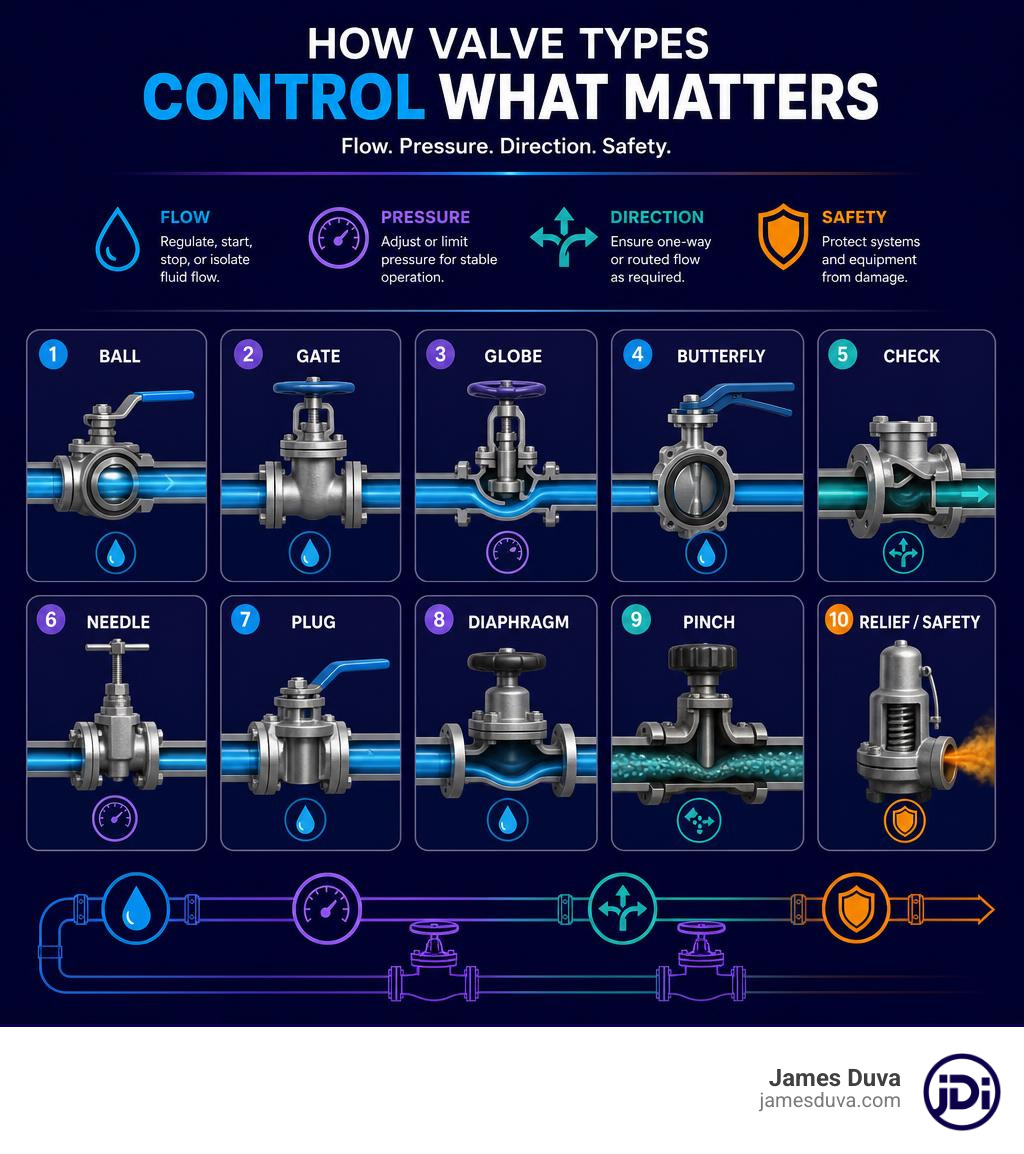
Here is a quick reference to the most common valve types and what they do:
| Valve Type | Primary Function | Best For |
|---|---|---|
| Ball | Quick on/off isolation | General shutoff, pipelines |
| Gate | Full-bore isolation | Large-diameter on/off service |
| Globe | Throttling and flow control | Precise regulation |
| Butterfly | On/off and moderate control | Large pipes, HVAC, water |
| Check | Backflow prevention | Pump discharge, one-way flow |
| Needle | Precise flow restriction | Small-bore, clean fluids |
| Plug | On/off, some throttling | Corrosive or toxic media |
| Diaphragm | Isolation from fluid | Sanitary, corrosive, slurry |
| Pinch | On/off for slurries | Solids, powders, abrasives |
| Relief/Safety | Overpressure protection | Last line of defense |
Valves are everywhere in industrial piping — yet they are often selected too quickly, sized for the wrong reason, or confused with one another. A poor choice can mean leaks, pressure failures, costly downtime, or even safety hazards.
Consider this: valves can account for up to 30% of the total piping cost in a plant. That makes them far too important to treat as an afterthought.
This guide covers every major valve type — how each one works, where it excels, where it falls short, and how to choose the right one for your application.
I’m Billy Walker, Vice President of James Duva Inc., where I’ve spent years helping engineers and procurement professionals in power, process, and water treatment industries source the right specialty piping components — including the full range of valve types covered here. If you work in a demanding environment like chemical processing, oil and gas, or nuclear service, this guide is written with your real-world challenges in mind.
What Valves Do and How Valve Types Are Classified
At its most basic level, a valve is a mechanical device that controls the flow of liquids, gases, or steam through a piping system. It does this by opening, closing, or partially obstructing a passage. The component that physically blocks or allows the flow is known as the closure member or obturator.
In industrial facilities, selecting the correct valve type on the Process and Instrumentation Diagram (P&ID) during the design stage is crucial. A mistake here can compromise system safety, reduce plant reliability, and drive up lifecycle costs. For a deeper look into how these components fit into broader systems, see our guide on Understanding the Vital Role of Industrial Valves in Fluid Control Systems.
Primary valve functions in piping systems
While we often think of valves as simple on-off switches, they perform several distinct functions in fluid systems:
- On-off service (Isolation): Starting or stopping flow completely.
- Flow throttling (Regulation): Controlling the rate of flow by partially obstructing the fluid path.
- Pressure regulation: Reducing incoming high pressure to a safe, consistent downstream level.
- Temperature regulation: Blending hot and cold streams to maintain a target temperature.
- Flow diversion: Redirecting fluid from one flow path to another.
- Backflow prevention: Ensuring fluid only travels in one direction.
- Pressure relief: Releasing excess pressure to protect downstream equipment from failure.
- Excess flow control: Shutting off flow automatically if a line ruptures.
- Sampling service: Allowing operator access to extract process fluid for testing.
Valve types by operating principle and motion
Valves are fundamentally classified by how their closure members move. This mechanical motion dictates how quickly they operate, how much space they require, and how they behave under pressure.
- Linear Motion Valves: These valves use a closure member that moves in a straight line to allow, restrict, or stop flow. They are typically multi-turn valves, meaning the handwheel must be turned multiple times to move the stem. Examples include gate, globe, needle, diaphragm, and pinch valves.
- Rotary Motion (Quarter-Turn) Valves: These valves rely on a closure member that rotates along an angular path. A simple 90-degree turn of the handle rotates the internal disc, ball, or plug from fully open to fully closed. Examples include ball, butterfly, and plug valves.
To explore the mechanical design principles behind these movements, refer to the Valve Design and Construction Fundamentals Guide.
Valve types by function and operation mode
Beyond their mechanical motion, valves are categorized by how they are operated:
- Manual Valves: Operated by hand using a handwheel, lever, or gear operator. These are cost-effective but require physical operator presence.
- Actuated Valves: Equipped with mechanical actuators that use outside power sources (pneumatic, electric, or hydraulic) to position the valve. These are ideal for automated processes, hazardous environments, or large valves requiring high torque.
- Automatic / Self-Actuated Valves: Driven entirely by the process fluid itself. Check valves open under forward pressure and close under backflow, while pressure relief valves open automatically when a preset pressure threshold is breached.
Key valve components and terminology
To talk about valves like an expert, you need to know the anatomy of a standard valve.
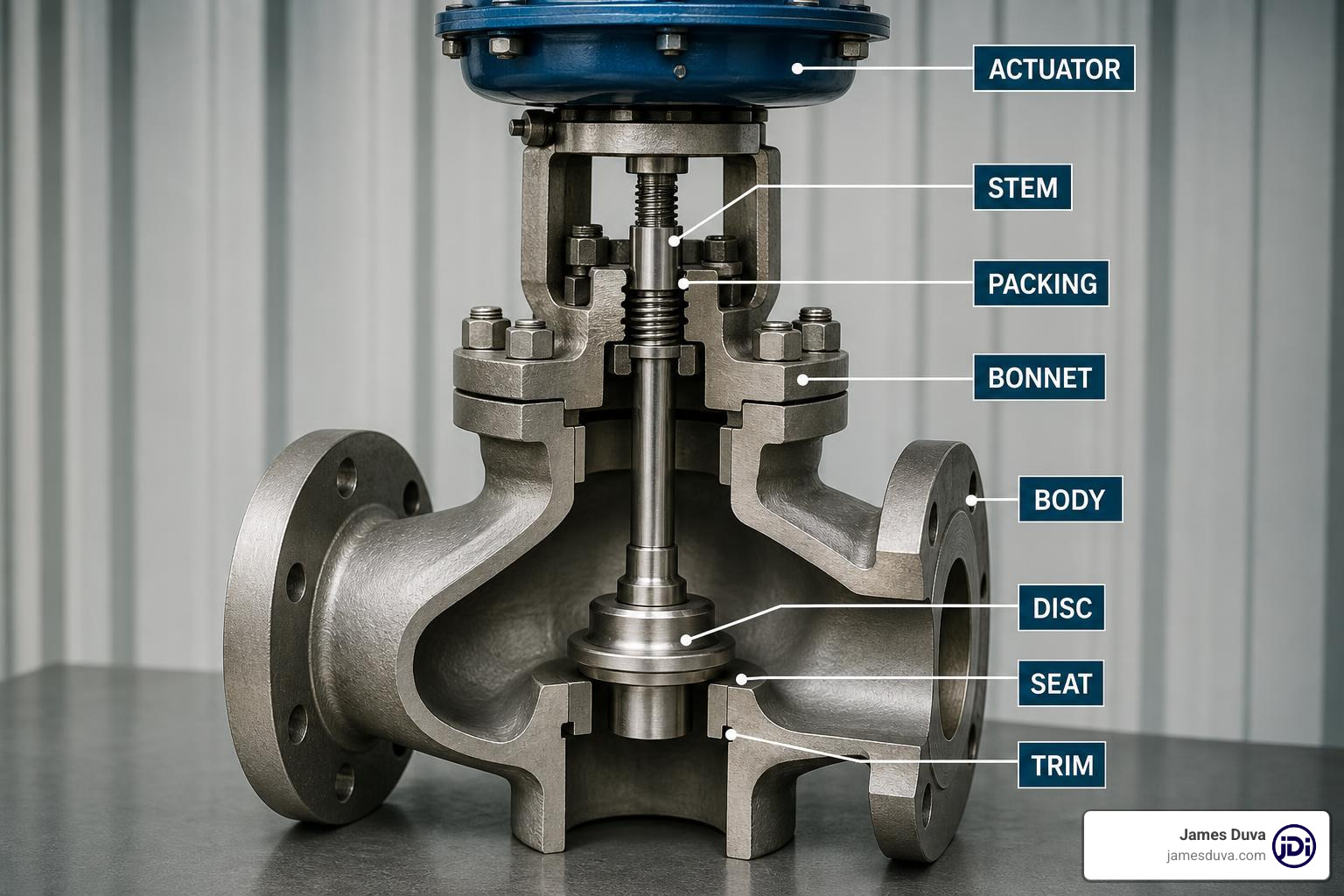
- Body: The primary pressure-retaining boundary that houses the internal parts and connects to the piping.
- Bonnet: The cover for the opening in the valve body. It provides access to internal components for maintenance and often houses the stem packing.
- Stem: The shaft that transmits motion from the handle or actuator to the internal disc.
- Disc / Obturator: The physical barrier that moves to block or allow flow.
- Seat: The sealing surface that the disc presses against to shut off flow.
- Trim: The collective term for the removable and replaceable internal parts that come into contact with the process fluid (typically the stem, disc, seating surfaces, and backseats).
- Packing: A deformable material placed around the stem to prevent process fluid from leaking out of the bonnet.
- Backseat: A secondary sealing arrangement that allows the stem packing to be replaced online while the valve is fully open and under pressure.
- Cv (Flow Coefficient): A measurement representing the volume of water (in gallons per minute) that will flow through a fully open valve with a pressure drop of 1 psi.
Understanding these terms helps prevent common system design issues like choked flow (where further decreases in downstream pressure no longer increase flow rate) and water hammer (a destructive pressure surge caused by closing a valve too quickly). For a broader look at how these elements interact, read about Industrial Valves: Types, Applications, and Importance in Manufacturing.
End connections and pressure-temperature ratings
The way a valve connects to your piping affects both installation cost and maintenance ease:
- Flanged Ends: Bolted connections that make valve removal and replacement simple, though they are heavier and bulkier.
- Threaded Ends: Screwed connections typically used on small-bore pipelines (under 2 inches) for low-pressure, non-hazardous service.
- Welded Ends (Socket Weld or Butt Weld): Permanent connections that offer leak-free performance in high-pressure, high-temperature systems, though they require cutting to remove.
- Wafer and Lug Style: Commonly used for butterfly valves, these fit between standard pipe flanges to save space and weight.
- Sanitary Clamps: Quick-disconnect fittings designed for food, beverage, and pharmaceutical lines where frequent cleaning is required.
Pressure and temperature limits are governed by standards like ASME B16.34. The choice between soft seats (like PTFE or elastomers) and metal seats is a major factor here: soft seats offer bubble-tight shutoff but are generally limited to temperatures below 200°C, while metal seats handle extreme temperatures (above 250°C) and abrasive media but may allow nominal leakage.
Common Industrial Valves: Designs, Uses, Pros, and Cons
No single valve type is perfect for every job. Each design involves a set of compromises between flow capacity, pressure drop, sealing capability, and cost.
For a high-level comparison of the most common industrial options, refer to the Common Valve Types Guide from the Valve Manufacturers Association.
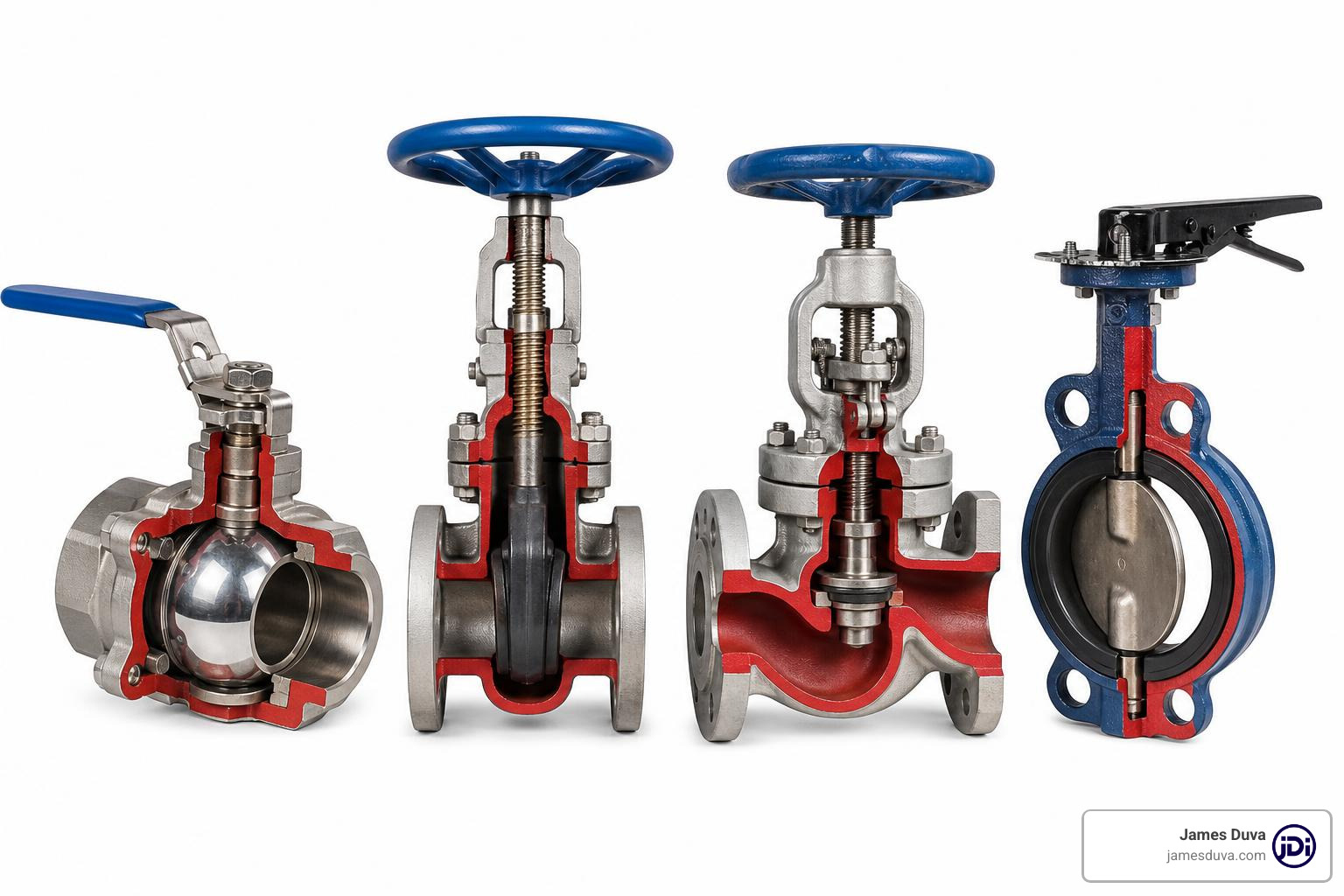
Ball, gate, globe, and butterfly valves
These four designs represent the workhorses of the modern process plant.
Ball Valves
Ball Valves utilize a rotating spherical ball with a hole through the center. When the hole aligns with the flow path, the valve is open; a 90-degree turn rotates the solid portion of the ball to block the flow.
- Pros: Fast quarter-turn operation, excellent bubble-tight sealing, low pressure drop, and compact design.
- Cons: Not recommended for continuous throttling because fluid rushing past a partially open ball can erode the soft seats.
- Design Variations: Floating ball valves are standard for smaller, lower-pressure lines, while trunnion-mounted ball valves support the ball on top and bottom bearings for high-pressure, large-diameter systems. For a detailed breakdown of these options, check out A Complete Breakdown of Different Ball Valve Types.
Gate Valves
Gate valves are the most common valves found in process plants. They use a flat, wedge-like disc that slides up and down vertically to clear or block the flow path.
- Pros: Straight-through flow path offers virtually zero resistance and minimal pressure drop when fully open. Excellent for high-pressure isolation.
- Cons: Require multiple turns of the handwheel to operate (a 6-inch gate valve can take 20 turns). They are strictly on-off devices; using them for throttling causes severe vibration, disc chatter, and seat erosion.
Globe Valves
Globe valves feature a spherical body with an internal baffle. A plug or disc is lowered vertically onto a horizontal seat to restrict or stop flow.
- Pros: Superb throttling and flow regulation capabilities. The short travel distance between open and closed makes them faster to operate than gate valves.
- Cons: The tortuous, S-shaped flow path creates a high pressure drop across the valve, which must be factored into pump sizing calculations.
Butterfly Valves
Butterfly valves consist of a circular disc mounted on a central rotating shaft. When turned 90 degrees, the disc sits perpendicular to the flow to block it, or parallel to allow it.
- Pros: Extremely lightweight, compact, and cost-effective—especially on larger pipe sizes where a ball or gate valve would become heavy and expensive.
- Cons: The disc remains in the flow stream even when fully open, creating a permanent pressure drop and preventing the use of line-cleaning pigs.
Check, plug, needle, diaphragm, and pinch valves
These designs solve specific process challenges, from preventing reverse flow to handling highly abrasive slurries.
- Check Valves (Non-Return): These self-acting safety valves prevent backflow. Common designs include swing checks (a hinged disc swings open), lift checks (a guided plug lifts up), and dual plate checks (preferred in high-velocity systems to minimize water hammer). They are generally small, simple, and inexpensive.
- Plug Valves: Similar to ball valves, plug valves use a rotating tapered plug with a center hole. They are highly valued in chemical plants because they lack internal cavities where corrosive media can settle and plug the valve.
- Needle Valves: Featuring a slender, tapered plunger on a finely threaded stem, needle valves allow incredibly precise flow restriction in small-bore lines (such as gas chromatography or sampling lines).
- Diaphragm Valves: These valves use a flexible elastomer diaphragm that is pressed down against a weir or flow path to seal the valve. Because the fluid is entirely isolated from the operating mechanism, they are ideal for corrosive chemicals and sanitary applications. You can view our range of specialized options under Product Categories: Sanitary Valves.
- Pinch Valves: Pinch valves use a flexible rubber sleeve that is pinched shut mechanically or pneumatically. Because there are no internal metal components or tight clearances, they are the absolute best choice for handling thick slurries, powders, or liquids with suspended solids.
Specialized and application-specific valves
Modern piping systems often require highly specialized control mechanisms.
- Solenoid Valves: Electromagnetically operated valves used for rapid, automated on-off control in small lines (like water supply lines in appliances).
- Coaxial and Angle Seat Valves: Fast-acting, high-flow alternatives to solenoids that handle viscous fluids and high pressures with ease.
- Choke Valves: Heavy-duty valves used in oil wellheads to control flow rate under extreme pressure drops.
- Knife Gate Valves: Specialized gate valves with a sharp, beveled blade designed to cut through thick pulp, paper stock, or coal slurry.
- Pressure Relief Valves / Safety Valves: Self-actuated safety devices that open automatically to relieve pressure when a system exceeds its safe limit.
- Rupture Discs: Single-use, pressure-sensitive membranes designed to burst at a specific pressure to prevent catastrophic vessel failure.
Advantages and limitations by service condition
When evaluating these designs, keep these critical trade-offs in mind:
- Viscous Slurries & Solids: Avoid gate, globe, and standard ball valves, which can trap solids in their seats. Instead, opt for pinch, diaphragm, or knife gate valves.
- High-Temperature Steam: Soft-seated valves will melt. Use metal-seated gate or globe valves with high-strength alloy bodies.
- Sanitary Processing: Avoid valves with internal dead legs or cavities (like ball or gate valves) where bacteria can grow. Use sanitary diaphragm or butterfly valves.
Selection, Installation, Troubleshooting, and Maintenance
Selecting a valve is a systematic process of engineering compromises. To guide this decision, engineers often use the STAMPED method:
- S – Size: The physical size of the pipe and the required flow capacity (Cv).
- T – Temperature: The maximum and minimum operating temperatures of the fluid.
- A – Application: The characteristics of the media (corrosive, abrasive, sanitary, gas, liquid).
- M – Material: The metallurgy required for the body, trim, and seals.
- P – Pressure: The maximum system pressure and required pressure drop.
- E – End Connection: How the valve joins the piping system.
- D – Delivery / Cost: Availability and total cost of ownership.
For a comprehensive checklist, download the Valve Selection Handbook Engineering Fundamentals.
Match the valve to the required function
The most common selection mistake is using a valve designed for isolation (like a gate valve) for throttling. When a gate valve is partially opened, the high-velocity fluid slams against the bottom of the wedge, causing severe vibration, rapid seat erosion, and eventual leak-through. Always match the valve type to its primary intended duty:
- Isolation only: Ball, Gate, Plug.
- Throttling/Regulation: Globe, Needle, Diaphragm.
- Backflow Prevention: Check.
- Overpressure Safety: Relief Valve.
For more on this topic, read our article on Understanding the Vital Role of Industrial Valves.
Size valves for flow, not just pipe diameter
Never assume a valve should be the exact same size as the pipe it is installed in. This is especially true for control and throttling valves.
If you install an oversized control valve, it will operate very close to its fully closed position. This leads to “hunting” (the actuator constantly adjusting), rapid seat wear, and poor control accuracy. Conversely, an undersized valve restricts flow too much, causing a high pressure drop, noise, and potential cavitation. Always calculate the required flow coefficient (Cv) based on your target flow rate and allowable pressure drop before choosing a valve size.
Choose materials for pressure, temperature, and media
The fluid running through your pipes dictates what materials your valves must be made of.
- Corrosive Chemicals: Require high-grade stainless steels or nickel alloys (like Monel or Inconel) to prevent corrosion and premature failure.
- Cryogenic Service: Requires specialized stainless steels that maintain their mechanical toughness at sub-zero temperatures.
- High-Pressure Steam: Demands heavy-duty forged steel bodies with hardened metal trim to resist erosion.
Avoid common installation and operating mistakes
Even the best valve will fail if installed incorrectly.
- Ignoring Flow Direction: Many valves (including globe, check, and some butterfly valves) are unidirectional. Always look for the cast-in flow arrow on the valve body and align it with the system flow.
- Improper Stem Orientation: Whenever possible, install valves with the stem pointing straight up. Installing a valve with the stem pointing down allows sediment to settle directly into the packing gland, causing rapid wear and leaks.
- Slamming Valves Closed: Closing manual quarter-turn valves too quickly creates a shockwave known as water hammer. This pressure surge can burst pipes, damage gaskets, and destroy instrumentation. Train operators to close valves smoothly and gradually.
Build a practical maintenance plan
A proactive maintenance program keeps your plant running smoothly and extends valve service life:
- Routine Inspections: Check for packing leaks, actuator alignment, and smooth operation.
- Packing Adjustments: Tighten packing glands slightly if minor stem leaks are detected, but avoid overtightening, which increases operating torque.
- Tag Systems: Use color-coded tags to clearly identify valve functions, normal operating positions, and maintenance histories.
- Critical Spare Parts: Always keep replacement seats, seals, and gaskets on hand for high-frequency or severe-service valves to minimize downtime during outages.
Why Are Alloys So Valuable in Industry?
In demanding industrial environments, pure metals like iron are rarely up to the task. Pure iron is relatively soft, mechanically weak, and highly prone to rust when exposed to moisture and oxygen. To survive high pressures, extreme temperatures, and corrosive fluids, industries rely heavily on alloys — mixtures of metals engineered for superior strength and durability.
Alloying elements like chromium, nickel, molybdenum, and manganese are added to base metals to transform their physical properties. The result is a family of materials that offers exceptional corrosion control, high-temperature heat resistance, and long-term mechanical toughness.
Construction applications
In the structural and construction sectors, alloys are the backbone of modern infrastructure.
- Structural Beams & Frames: High-strength structural steel alloys provide the load-bearing capacity required for high-rise buildings and industrial plant structures.
- Process Piping & Supports: Heavy-duty steel and stainless steel alloys are used to construct piping networks and supports that must withstand outdoor weather, wind loads, and internal fluid pressures.
- Fasteners & Hardware: High-tensile alloy bolts and fasteners ensure that structural connections remain secure under constant vibration and stress.
Oil and gas applications
The oil and gas industry operates under some of the most brutal conditions on earth, from deep-sea offshore platforms to high-temperature refineries.
- Fittings, Flanges, & Valves: High-grade nickel alloys (such as Monel, Inconel, and Hastelloy) and duplex stainless steels are essential for managing sour gas (containing highly corrosive hydrogen sulfide) and high-pressure wellhead fluids. Learn more about our high-performance valves designed for these demanding environments.
- Refinery Service: Piping and vessels in refining processes must resist high-temperature oxidation and chemical attack, making specialized chrome-moly alloys the standard.
- Offshore Corrosion Control: Marine environments expose equipment to constant saltwater spray. Nickel alloy components and super-duplex piping prevent seawater corrosion, ensuring long-term operational safety.
Automotive and aerospace applications
Weight reduction, heat resistance, and safety-critical reliability drive alloy selection in transportation.
- Vehicle Frames & Engine Parts: Advanced high-strength steels and aluminum-magnesium alloys are used in automotive frames to improve crash safety while reducing overall vehicle weight.
- Exhaust Systems: Stainless steel alloys containing chromium and nickel prevent rust and survive the extreme heat cycling of engine exhaust.
- Aerospace Turbines: Jet engine turbines operate at temperatures that would melt standard steels. They rely on advanced nickel-based superalloys that maintain their mechanical strength and resist creep at temperatures exceeding 1000°C.
Medical and consumer goods applications
In hygiene-sensitive and consumer-facing applications, cleanability and durability are paramount.
- Surgical Implants & Tools: Biocompatible titanium alloys and specialized cobalt-chrome alloys are used for joint replacements and surgical instruments because they do not react with human tissue.
- Sanitary Tubing & Processing: Food, beverage, and pharmaceutical plants use high-grade 316L stainless steel alloys to prevent product contamination and withstand aggressive clean-in-place (CIP) chemicals. For these applications, specialized sanitary valves are often required to maintain system hygiene.
- Kitchenware & Appliances: Consumer appliances and food preparation surfaces rely on stainless steel alloys for their rust resistance, aesthetic appeal, and easy sterilization.
Conclusion and FAQs
Selecting the right valve types is a fundamental step in designing a safe, efficient, and cost-effective piping system. By prioritizing function first, verifying pressure-temperature limits, and choosing the correct alloy materials, you can prevent premature failures and keep your operations running smoothly.
Since 1978, James Duva Inc. has been a trusted supplier of high-grade stainless steel and nickel alloy industrial products from our facility in Branchburg, NJ. Whether you are managing chemical processing lines, power plant steam systems, or sanitary food production, we are here to help you source the exact components you need.
Explore our full inventory under Product Categories: Valves to find the right fit for your next project.
Which valve is best for lowest pressure drop?
Full-bore ball valves and gate valves offer the lowest pressure drop. When fully open, these designs present a completely unobstructed, straight-through flow path that is identical to the inner diameter of the pipe. This minimizes resistance, protects pump efficiency, and prevents unnecessary energy loss.
Which valves are best for throttling?
Globe valves and needle valves are the premier choices for throttling and flow regulation. Their internal geometry is designed to handle the high velocities and turbulence associated with restricting flow without suffering rapid wear or seat damage. For sanitary or slurry applications, diaphragm and pinch valves also offer excellent throttling control.
How do I prevent backflow and water hammer?
To prevent backflow, install a check valve (such as a swing, lift, or dual plate check) on pump discharge lines and critical piping junctions. To prevent water hammer, avoid closing manual quarter-turn valves too quickly. In automated systems, use actuators with slow-closing speed controls or install water hammer arrestors and surge tanks to absorb pressure spikes.
About James Duva Inc.
Since 1978, James Duva Inc. has been your trusted source for stainless steel and high-nickel alloy industrial products. Whether you’re in the water treatment, process or power industry, we pride ourselves on always having what you need. Say goodbye to your sourcing problems with just one call to James Duva.