
An Essential Guide to 316L vs 316 Stainless Steel
Jun 9, 2026
The Key Difference Between 316L vs 316 Stainless Steel
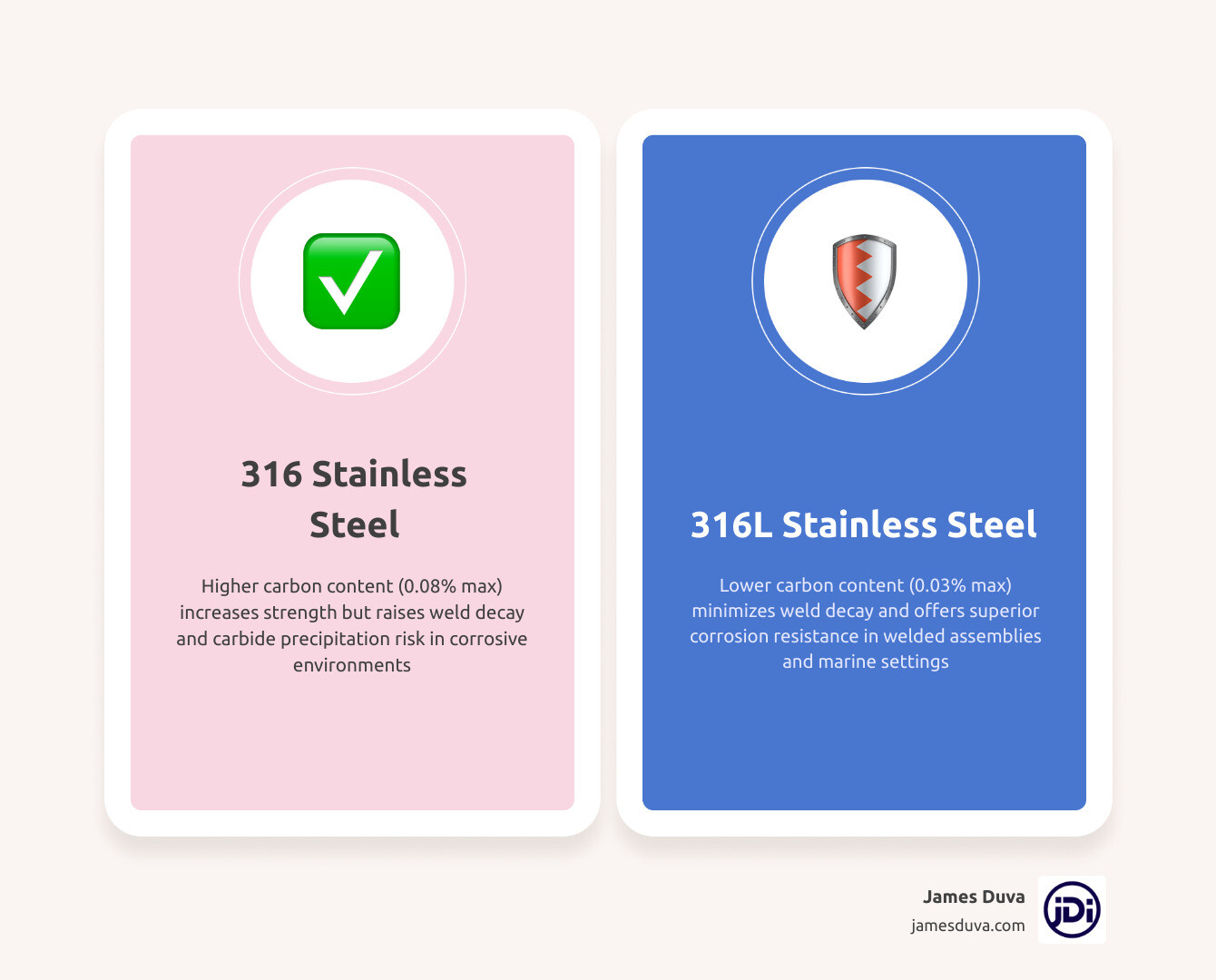
When it comes to 316L vs 316 stainless steel, the single most important difference is carbon content — and that one detail changes how each grade performs in welded assemblies and corrosive environments.
Here is a fast-reference summary:
| Property | 316 | 316L |
|---|---|---|
| Max carbon content | 0.08% | 0.03% |
| Tensile strength (min) | 515 MPa | 485 MPa |
| Yield strength (min) | 205 MPa | 170 MPa |
| Molybdenum content | 2–3% | 2–3% |
| Weld decay risk | Higher | Lower |
| Best for | Structural, high-strength parts | Welded assemblies, corrosive environments |
| Price | Similar | Similar |
Both grades are austenitic stainless steels in the 300 series. Both contain chromium, nickel, and molybdenum for strong corrosion resistance — including in chloride-heavy environments like marine or chemical processing settings. The “L” in 316L simply stands for low carbon.
That lower carbon content in 316L reduces a problem called carbide precipitation during welding, which can otherwise leave weld zones vulnerable to corrosion. For industrial professionals sourcing materials for welded piping systems, pharmaceutical vessels, or chemical plant equipment, that distinction matters a great deal.
I’m Billy Walker, Vice President of James Duva Inc., a specialty supplier of stainless steel and high-nickel alloy industrial products serving the power, process, and water treatment industries since 1978. Over decades of helping engineers and contractors select the right materials — including navigating the 316L vs 316 stainless steel decision — I’ve seen how the wrong grade choice can lead to premature failure and costly downtime. In this guide, I’ll break down everything you need to know to make the right call for your application.
Why Are Alloys So Valuable in Industry?
In industrial manufacturing, we rarely use pure metals. While a pure metal like iron is abundant, it has a significant Achilles’ heel: it loves to return to its natural state as iron oxide, better known as rust. Pure iron is also relatively soft and lacks the structural “backbone” required for heavy-duty applications. This is where the magic of alloys comes into play.
An alloy is created by combining two or more metallic elements to produce a material with enhanced properties. By adding chromium, nickel, and molybdenum to iron, we create stainless steel—a material that doesn’t just resist rust but offers superior strength and durability. Understanding How Different Alloys Change Steels Properties is fundamental to engineering. For instance, the addition of at least 10.5% chromium allows the steel to form a “passive layer” of chromium oxide that protects the underlying metal from the environment.
The value of these alloys is evident across every major sector. We see Stainless Steel Applications for Every Industry, from the massive beams and piping used in Construction to the high-pressure fittings and flanges essential for Oil & Gas infrastructure. In the Automotive & Aerospace sectors, alloys are selected for frames and engines that must withstand extreme heat and vibration. Even in Medical & Consumer Goods, alloys are vital for biocompatible implants and long-lasting kitchenware. If you’ve ever wondered What is Stainless Steel Made Of, it is this precise recipe of elements that ensures a bridge doesn’t collapse or a surgical tool doesn’t corrode.
The Primary Difference: 316L vs 316 Stainless Steel Composition
When we look at the chemical makeup of these two grades, they are nearly identical twins, with one major exception: the carbon. In the stainless steel world, “L” stands for “Low Carbon,” and that small shift has a massive impact on performance.
Chemical Composition Comparison
| Element | Grade 316 (%) | Grade 316L (%) |
|---|---|---|
| Carbon (C) | 0.08 max | 0.03 max |
| Manganese (Mn) | 2.00 max | 2.00 max |
| Silicon (Si) | 0.75 max | 0.75 max |
| Phosphorus (P) | 0.045 max | 0.045 max |
| Sulfur (S) | 0.03 max | 0.03 max |
| Chromium (Cr) | 16.0 – 18.0 | 16.0 – 18.0 |
| Molybdenum (Mo) | 2.0 – 3.0 | 2.0 – 3.0 |
| Nickel (Ni) | 10.0 – 14.0 | 10.0 – 14.0 |
| Nitrogen (N) | 0.10 max | 0.10 max |
As we can see in our In-Depth Guide to Stainless Steel Alloy Properties, both grades feature 2% to 3% molybdenum. This is the “secret sauce” that makes the 316 series superior to the 304 series when it comes to resisting chlorides (like salt or bleach).
However, the 0.05% difference in carbon content is the deciding factor for many projects. While standard 316 allows for up to 0.08% carbon, 316L is strictly capped at 0.03%. To compensate for the slight loss in strength that comes with lower carbon, nitrogen is often added to 316L to boost its mechanical properties.
Furthermore, you may encounter “dual-certified” material. Because 316L meets the requirements of 316 (but with lower carbon), and modern refining processes make it easy to hit these low carbon targets, many suppliers provide material marked as 316/316L. This gives you the high strength of 316 with the superior weldability of 316L.
Corrosion Resistance and Weldability Performance
The real-world reason we care about the 316L vs 316 stainless steel debate is “sensitization.” When you heat standard 316 stainless steel to temperatures between 800°F and 1500°F (425°C to 815°C)—which happens naturally during welding—the carbon in the steel reacts with the chromium. This forms chromium carbides at the grain boundaries.
This process, known as carbide precipitation, effectively “steals” the chromium that was supposed to protect the steel. This leaves the area next to the weld (the heat-affected zone) vulnerable to intergranular corrosion, also known as “weld decay.” Because 316L has so little carbon to begin with, this reaction is significantly minimized, making it the preferred choice for welded joints that cannot be annealed after the fact.
According to A Comprehensive Introduction to Stainless Steel Facts and Industry Insights, maintaining the integrity of these joints is paramount in high-pressure or high-contamination environments. If you use standard 316 for a welded tank, you might find that the tank is perfectly fine everywhere except right next to the welds, where it begins to pit and leak within months.
Choosing 316L vs 316 Stainless Steel for Marine Environments
In marine engineering, “corrosion” usually means “chloride pitting.” Saltwater is incredibly aggressive, and the molybdenum in both 316 and 316L is essential for resisting this. To quantify this resistance, we use the Pitting Resistance Equivalent Number (PREN).
The formula is generally: PREN = %Cr + 3.3(%Mo) + 16(%N).
Both 316 and 316L typically land in the 23 to 28 range, making them “marine grade.” However, for coastal infrastructure where components are welded—like railings, boat fittings, or underwater sensors—316L is the gold standard. It ensures that the salt spray doesn’t find a weak point in the weld’s heat-affected zone.
Mechanical Strength of 316L vs 316 Stainless Steel
If your application doesn’t involve welding and you need maximum strength, standard 316 has a slight edge. Carbon acts as a hardening agent in the steel matrix.
- Tensile Strength: 316 typically offers a minimum of 515 MPa (75 ksi), whereas 316L offers a minimum of 485 MPa (70 ksi).
- Yield Strength: 316 sits at roughly 205 MPa, while 316L is closer to 170 MPa.
In structural applications like heavy-duty fasteners or non-welded support beams, the higher tensile strength of 316 might be preferable. However, in most modern industrial piping applications, the difference is negligible enough that the corrosion benefits of 316L outweigh the slight strength advantage of 316.
Industrial Applications and Cost Analysis
Choosing between 316L vs 316 stainless steel often comes down to the specific hardware being used. For example, high-quality Ball Valves used in chemical processing are frequently specified in 316L to ensure that the internal welded components don’t succumb to corrosive fluids.

Common Applications
- 316 Stainless Steel: Heat exchangers, pump parts, architectural trim in non-coastal areas, and heavy-duty fasteners.
- 316L Stainless Steel: Pharmaceutical vessels, food processing equipment (where frequent chloride cleaning occurs), medical implants, and marine piping systems.
In terms of cost, the industry has shifted. In the past, 316L was significantly more expensive because removing carbon was a difficult process. Today, thanks to Argon Oxygen Decarburization (AOD) refining, the price difference is almost non-existent. At James Duva Inc., we often find that the lifecycle cost of 316L is actually lower because it requires less maintenance and eliminates the need for expensive post-weld annealing.
Frequently Asked Questions about 316 and 316L
Is 316 or 316L stainless steel magnetic?
Both 316 and 316L are austenitic stainless steels, meaning they have a Face-Centered Cubic (FCC) crystalline structure. In their annealed state, they are essentially non-magnetic. However, “cold working” (bending, drawing, or machining) can cause some of the austenite to transform into martensite, which is magnetic. If your application requires extremely low magnetic permeability (like in certain medical imaging equipment), you should specify “solution annealed” material.
How do 316 and 316L compare to 304 or 904L?
The primary difference between 304 and 316 is the molybdenum. 304 does not contain molybdenum, making it much more susceptible to pitting in the presence of salt or chlorides. On the other end of the spectrum, 904L contains even higher levels of nickel and molybdenum (plus copper), making it a “super-austenitic” grade used for extreme environments like dilute sulfuric acid. For most coastal or chemical applications, 316L is the “sweet spot” of performance and value.
Which grade is better for high-temperature environments?
Both grades perform exceptionally well at high temperatures, resisting scaling and maintaining structural integrity up to approximately 2000°F (1093°C). However, if the steel will be held in the “sensitization range” (800°F–1500°F) for long periods, 316L is safer to prevent intergranular corrosion. For even higher stability, some engineers choose 316Ti, which includes titanium to stabilize the carbon and prevent precipitation.
Conclusion
Choosing the right material is about more than just looking at a price tag; it’s about understanding the environment, the fabrication process, and the long-term goals of your project. Whether you need the high tensile strength of 316 for structural components or the superior weldability of 316L for a complex piping system, we are here to help.
At James Duva Inc., we’ve built our reputation on being more than just a supplier. Based in Branchburg, NJ, we serve as a partner to the industries that keep our world running. From the initial material selection to the final delivery of high-grade pipes, valves, and fittings, our expertise ensures your project is built to last.
For More info about stainless steel products or to discuss the specifics of your next project, reach out to our team today. We’ll help you navigate the nuances of 316L vs 316 stainless steel so you can move forward with confidence.
About James Duva Inc.
Since 1978, James Duva Inc. has been your trusted source for stainless steel and high-nickel alloy industrial products. Whether you’re in the water treatment, process or power industry, we pride ourselves on always having what you need. Say goodbye to your sourcing problems with just one call to James Duva.