
Beginner’s Guide to 304 Stainless Steel Bar
Jun 11, 2026
The Most Common Stainless Steel You Need to Know
304 stainless steel bar is the most widely used stainless steel alloy in the world — and for good reason. It combines strong corrosion resistance, reliable mechanical strength, and excellent workability at a competitive price point.
If you’re trying to identify which stainless steel bar variety fits your application, here’s a quick reference:
| Grade | Key Feature | Best For |
|---|---|---|
| 304 | 18% Cr, 8% Ni, low carbon | General fabrication, food, architecture |
| 304L | Ultra-low carbon (<0.035%) | Welded assemblies, chemical processing |
| 304H | Higher carbon (0.04–0.10%) | Elevated temperature service |
| 316 | Added molybdenum | Marine, chloride-heavy environments |
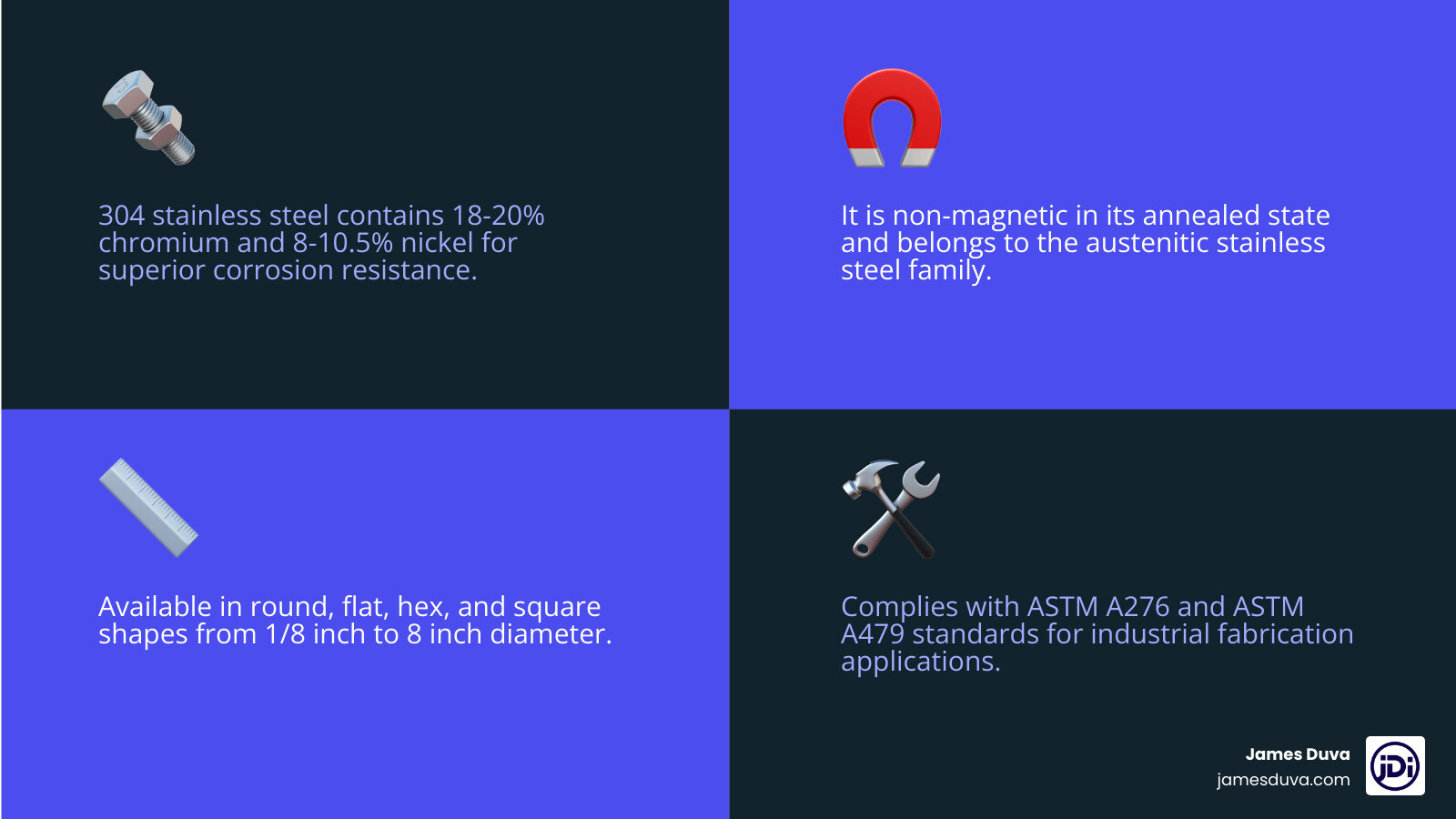
304 is also known as 18-8 stainless steel — a nickname that refers directly to its chromium and nickel content. It belongs to the austenitic family, meaning it’s non-magnetic in its annealed state and cannot be hardened through heat treatment. Its strength comes from cold working instead.
This grade meets key industry standards including ASTM A276 and ASTM A479, and it’s available in round, flat, hex, and square bar forms — from 1/8 inch all the way up to 8 inch diameter.
I’m Billy Walker, Vice President of James Duva Inc., where I’ve spent years helping engineers and procurement professionals in the power, process, and water treatment industries source the right 304 stainless steel bar and specialty alloy products. In the sections below, I’ll walk you through everything you need to make a confident material selection.
Understanding the Versatility of 304 Stainless Steel Bar
When we talk about the versatility of 304 stainless steel bar, we are looking at the “workhorse” of the industry. Since its development in the 1920s, it has become the gold standard for applications that require a balance of durability and cost-effectiveness. It is an austenitic grade, which means it has a specific crystalline structure (face-centered cubic) that provides excellent toughness, even at cryogenic temperatures.
One of the most defining characteristics of the 304 stainless steel bar is its chromium and nickel content. These elements work together to create a “passive” layer on the surface of the metal. This invisible film is what prevents the bar from rusting when exposed to water or air. Because it is non-magnetic in the annealed condition, it is also highly valued for use in instruments that measure electrical or magnetic properties where interference must be kept to a minimum.
For a deeper dive into how this material fits into the broader world of metals, you can read A Comprehensive Introduction to Stainless Steel Facts and Industry Insights.

Chemical Composition of 304 Stainless Steel Bar
The secret sauce of 304 stainless steel bar lies in its chemistry. To be classified as 304, the alloy must fall within specific ranges defined by international standards. The primary ingredients are:
- Chromium (18-20%): This is the magic ingredient for corrosion resistance.
- Nickel (8-10.5%): Nickel stabilizes the austenitic structure and improves ductility.
- Carbon (0.08% max): Keeping carbon low helps with weldability, though even lower levels are found in the “L” variant.
- Manganese (2.0% max): Used to improve hot working properties and increase strength.
- Silicon, Phosphorus, and Sulfur: Present in trace amounts to assist in the melting and machining processes.
Understanding these components is vital because they dictate how the metal will behave when you cut, weld, or bend it. You can learn more about these “ingredients” in our guide: What is Stainless Steel Made Of.
Standard Sizes for 304 Stainless Steel Bar
At James Duva, we know that no two projects are identical. That is why 304 stainless steel bar is manufactured in a massive range of sizes and shapes. Whether you are building a massive industrial support or a small precision instrument, there is a size that fits.
- Diameters: Round bars typically range from as small as 1/8 inch for delicate pins and fasteners up to 8 inches or more for heavy-duty shafting.
- Shapes: While round bar is the most common, we also see high demand for flat bar (often called “flat stock”), hexagonal (hex) bar for nuts and bolts, and square bar for framework.
- Finishes: Most industrial bar comes with a “mill finish” (durable and dull), but it can also be provided as “cold finished” or “centerless ground” for applications requiring tighter tolerances and a smoother surface.
If you are ready to see what we have in stock, you can Explore 304 Stainless Steel Bar Inventory.
Why Are Alloys So Valuable in Industry?
In the early days of metallurgy, builders relied heavily on pure iron. While iron is abundant, it has two major flaws: it is relatively soft and it has a voracious appetite for oxygen, leading to rapid rust. This is where alloys come in. An alloy is essentially a “recipe” where we mix iron with other elements to create a material that is stronger, tougher, and more resistant to the elements.
304 stainless steel bar is the perfect example of why alloys are so valuable. By adding chromium and nickel to iron, we create a material that offers superior structural integrity and can survive decades of environmental degradation without failing. To understand the science behind these mixtures, check out How Different Alloys Change Steels Properties.
Construction and Oil & Gas Applications
In the heavy industries we serve in New Jersey and beyond, 304 stainless steel bar is a staple. In construction, it is used for structural beams, braces, and supports where aesthetics and longevity are both required. It is also a favorite for concrete footings that might be exposed to groundwater.
In the Oil & Gas sector, the reliability of the material is paramount. You will find 304 used in:
- Process piping supports.
- High-pressure fittings and flanges.
- Internal components for Ball Valves.
The high tensile strength (typically around 75,000 psi) ensures that these components can handle the stresses of industrial fluid handling without deforming.
Automotive, Aerospace, and Medical Goods
The reach of 304 stainless steel bar extends far beyond the factory floor. In the automotive world, it’s used for exhaust manifolds and trim. In aerospace, its ability to maintain strength at various temperatures makes it useful for engine frames and fasteners.
Perhaps most importantly, its hygienic properties make it the top choice for:
- Medical Goods: Surgical implants and dental tools.
- Consumer Goods: High-end kitchenware, sinks, and appliances.
- Food Processing: Equipment for brewing beer, processing milk, and winemaking.
For a broader look at where you might find these materials, visit Stainless Steel Applications for Every Industry.
Technical Specifications and Mechanical Properties
To the uninitiated, a steel bar is just a piece of metal. To an engineer, it’s a collection of data points. When we specify 304 stainless steel bar, we are looking at mechanical properties that ensure the safety of a structure.
| Property | 304 Value (Typical) | 304L Value (Typical) |
|---|---|---|
| Tensile Strength (Ultimate) | 75,000 – 85,000 psi | 70,000 – 75,000 psi |
| Yield Strength (0.2% Offset) | 30,000 – 34,000 psi | 25,000 – 30,000 psi |
| Elongation at Break | 40% – 70% | 40% – 60% |
| Hardness (Brinell) | 160 – 170 | 150 – 160 |
As you can see, 304 is slightly stronger than its low-carbon cousin, 304L. However, 304L offers better protection against corrosion after welding. For more technical data, see our In-Depth Guide to Stainless Steel Alloy Properties.
Physical Properties and Density
Beyond strength, the physical footprint of the material matters for logistics and design.
- Density: 0.289 lb/in³ (or 7.9 g/cm³). This is roughly the same as carbon steel, so it won’t save you weight, but it will save you from maintenance.
- Melting Point: 2,550°F to 2,651°F (1,400°C to 1,455°C). This high melting point makes it excellent for fire-resistant architectural features.
- Poisson’s Ratio: 0.29, which describes how the material thins when stretched.
- Modulus of Elasticity: 28,000 ksi, indicating its stiffness.
Comparing 304 vs. 304L and 316 Grades
Choosing the right grade is often the most confusing part for beginners. At James Duva, we often see customers debating between 304 and 316.

304 vs. 304L: The “L” stands for “Low Carbon.” Standard 304 has up to 0.08% carbon. During welding, this carbon can react with chromium to form chromium carbides, which “robs” the steel of its corrosion resistance at the weld site (a process called sensitization). 304L keeps carbon below 0.03%, preventing this issue and making it the preferred choice for welded assemblies that won’t be heat-treated afterward.
For more on these distinctions, visit James Duva Technical Resources.
Key Differences Between 304 and 316
If 304 is the “workhorse,” then 316 is the “marine specialist.” The primary difference is that 316 contains 2-3% Molybdenum.
- Chloride Resistance: 316 is much better at resisting “pitting” caused by salt water and de-icing salts.
- Marine Environments: If your project is within a few miles of the Jersey Shore or involves salt-water processing, 316 is usually worth the extra cost.
- General Use: For indoor use, freshwater applications, or most food-grade settings, 304 stainless steel bar is usually more than sufficient and more economical.
Manufacturing and Finishing Standards
To ensure quality, 304 stainless steel bar must be manufactured to strict standards. The most common is ASTM A276, which covers hot-finished or cold-finished bars. Another common one is ASTM A479, which is often required for bars used in boilers and pressure vessels.
- Hot Rolled: The bar is shaped at high temperatures. It usually has a darker, scaly finish and slightly looser tolerances.
- Cold Finished: The bar is processed at room temperature. This results in a much smoother, “bright” finish, better dimensional accuracy, and increased strength due to cold working.
At James Duva, quality is our cornerstone. You can read about our commitment to these standards on our About Us page.
Cutting and Fabrication Techniques
One reason 304 stainless steel bar is so popular is that it is relatively easy to work with:
- Welding: It has excellent weldability using all standard fusion methods. As mentioned, use 304L if you are worried about corrosion at the weld.
- Machining: It has “fair” to “good” machining characteristics. It tends to work-harden, so we recommend using sharp tools, heavy feeds, and plenty of lubricant.
- Cutting: At James Duva, we offer cut-to-size services. Whether you need a 2-foot piece for a repair or a 12-foot length for a production run, we can handle the precision cutting for you.
If you have a specialized fabrication need, don’t hesitate to Contact James Duva for Specialized Material Needs.
Frequently Asked Questions about 304 Stainless Steel
Is 304 stainless steel bar magnetic?
In its standard, annealed form, 304 stainless steel bar is non-magnetic. However, it can become slightly magnetic if it has been heavily cold-worked (for example, if it was drawn into a very thin wire or flattened). If your application requires zero magnetism, you should test the specific pieces after fabrication.
What is the difference between 304 and 304L for welding?
The “L” in 304L stands for Low Carbon. While standard 304 can be welded, the high heat can cause “carbide precipitation,” which makes the area around the weld prone to rusting. 304L eliminates this risk by having less carbon, making it the safer choice for heavy welding projects.
Can 304 stainless steel bar be used in marine environments?
It depends on the exposure. 304 is excellent for “freshwater” marine use (like on lakes or rivers). However, it is susceptible to pitting and crevice corrosion when exposed to salt water or salt spray. For components that will be submerged in the ocean or used on the coast, we generally recommend stepping up to 316 stainless steel.
Conclusion
Whether you are building a new chemical processing line or just need a reliable support for an architectural project, 304 stainless steel bar is a material you can trust. Its balance of strength, corrosion resistance, and ease of fabrication makes it a staple in modern industry.
At James Duva Inc., we’ve been the premier industrial supply experts in Branchburg, New Jersey, since 1978. We don’t just sell metal; we provide the technical expertise to ensure you get the right alloy for your specific environment. If you’re ready to start your next project, we invite you to Explore 304 Stainless Steel Bar Inventory and see how we can help you succeed.
About James Duva Inc.
Since 1978, James Duva Inc. has been your trusted source for stainless steel and high-nickel alloy industrial products. Whether you’re in the water treatment, process or power industry, we pride ourselves on always having what you need. Say goodbye to your sourcing problems with just one call to James Duva.