
Nickel 200 Properties: Step-by-Step Guide to Terms Demystified
Jul 10, 2026
What Is Nickel 200 and Why Does It Matter for Industrial Applications?
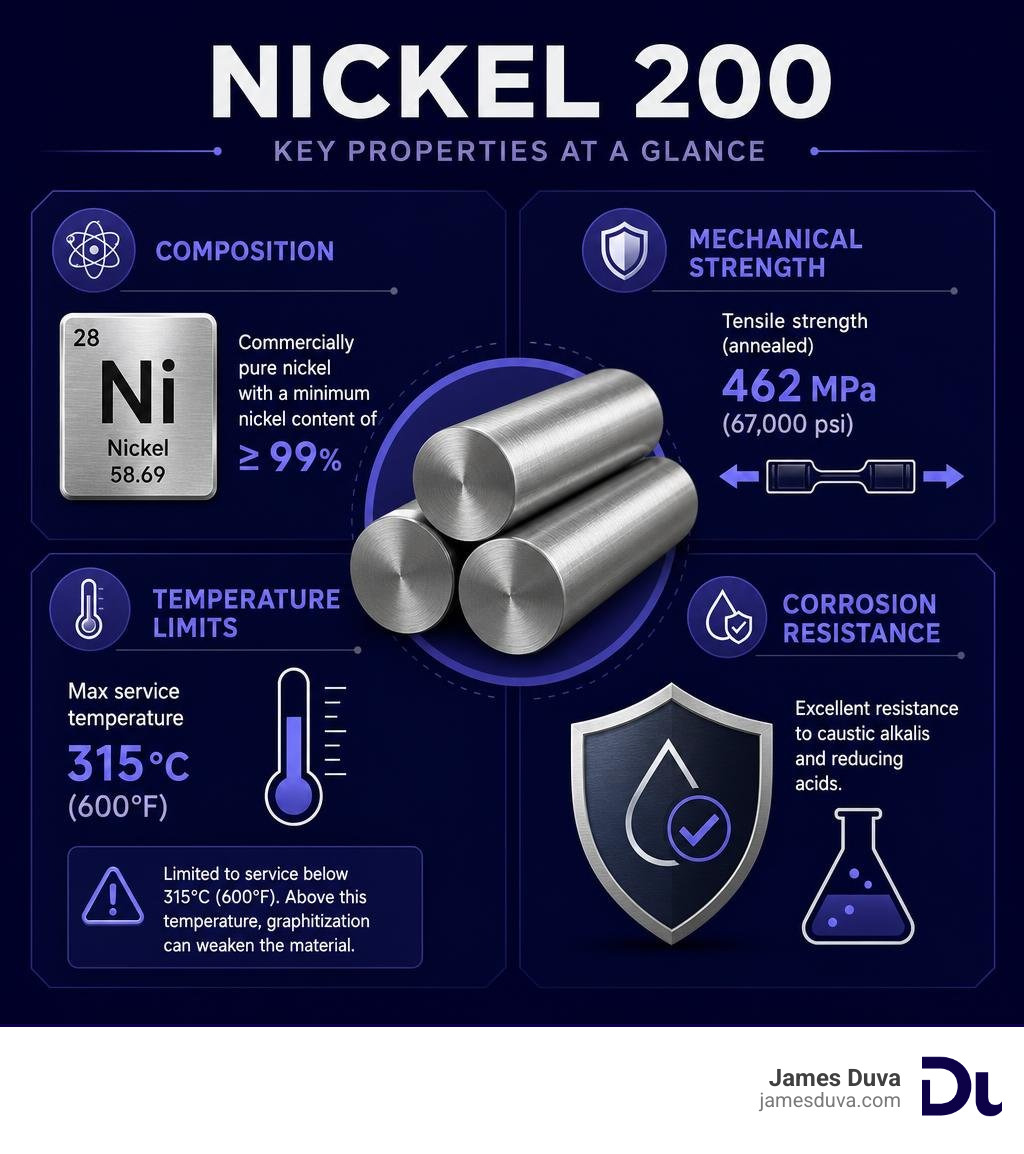
Nickel 200 is a commercially pure wrought nickel alloy (UNS N02200) with a minimum nickel content of 99%. Here is a quick summary of what makes it stand out:
| Property | Value |
|---|---|
| Nickel content | ≥ 99% |
| Density | 8.89 g/cm³ |
| Melting point | 1435–1446°C (2615–2635°F) |
| Tensile strength (annealed) | 462 MPa (67,000 psi) |
| Max service temperature | 315°C (600°F) |
| Key strength | Corrosion resistance to caustic alkalis and reducing acids |
It offers an excellent combination of mechanical strength, thermal conductivity, and corrosion resistance — especially in caustic and reducing environments. That makes it a go-to material in chemical processing, food handling, aerospace, and electronics.
One important distinction: Nickel 200 is limited to service below 315°C (600°F). Above that, its carbon content can cause graphitization, which weakens the material. For higher temperatures, Nickel 201 is the better choice.
I’m Billy Walker, Vice President of James Duva Inc., where I’ve spent years helping engineers and procurement professionals source specialty high-nickel alloys — including Nickel 200 — for demanding process and industrial applications. In this guide, I’ll break down every key property and term so you can make confident material decisions.
Why Are Alloys So Valuable in Industry?
To understand why a highly specialized material like nickel 200 is so critical, it helps to take a step back and look at the nature of metals themselves.
In their absolute pure states, elemental metals like iron are often too soft, highly malleable, and extremely prone to rust and environmental degradation. For instance, pure iron exposed to oxygen and moisture quickly breaks down into iron oxide (rust), compromising its structural integrity.
To solve these physical limitations, material scientists and engineers create alloys. An alloy is a mixture of chemical elements where at least one is a metal. By combining different elements, we can alter the atomic structure of the host metal, drastically improving its structural strength, durability, and resistance to environmental hazards. Steel, for example, is an alloy of iron and carbon that offers superior strength and durability compared to pure iron.
In demanding industrial fields, alloys are the backbone of modern infrastructure:
- Construction: Heavy-duty beams, structural supports, and industrial piping rely on high-strength alloys to withstand immense mechanical loads.
- Oil & Gas: High-performance fittings, flanges, and piping systems must endure high pressures and corrosive fluids. In these severe applications, choosing the right alloy is vital, which is Why Nickel Alloy Fittings Are Essential for Demanding Environments.
- Automotive & Aerospace: Structural frames, turbine engines, and exhaust systems must maintain their shape and strength under extreme heat and stress. For a deeper look at these flight-critical applications, see our guide on Nickel Based Alloys in the Aerospace Industry.
- Medical & Consumer Goods: Biocompatible joint implants, surgical tools, and durable consumer kitchenware require alloys that resist corrosion and clean easily.
Commercially pure metals like nickel 200 sit in a unique category. While technically a “pure” metal because it contains at least 99% nickel, it is technically treated as a wrought alloy because the remaining 1% of controlled trace elements (like iron, manganese, silicon, and carbon) are carefully balanced to optimize its physical performance and ease of fabrication.
Understanding the Core Properties of Nickel 200

Nickel 200 is a solid solution strengthened, commercially pure wrought material. This means its strength is derived from the solid solution of trace elements within its nickel matrix, rather than through heat-treatment precipitation.
Let’s demystify the core physical properties of this versatile material:
- Density: It has a density of 8.89 g/cm³ (0.321 lb/in³), which is slightly heavier than standard carbon steel.
- Melting Point Range: It melts between 1435°C and 1446°C (2615–2635°F), allowing it to maintain its structure up to its chemical limits.
- Thermal Conductivity: At 70.2 W/mK (487 BTU·in/hr·ft²·°F) between 20–100°C, it transfers heat exceptionally well. This makes it a popular choice for specialized heat exchangers.
- Electrical Resistivity: It exhibits low electrical resistance (approximately 9.5 μΩ·cm), making it highly useful for electrical and electronic connections.
- Curie Temperature: The temperature at which the material loses its permanent magnetic properties is 360°C (680°F).
- Magnetic Behavior: Below its Curie temperature, nickel 200 exhibits strong ferromagnetic behavior, a property widely utilized in electronic and magnetostrictive devices.
Chemical Composition of Nickel 200
The exceptional corrosion resistance and physical properties of nickel 200 are a direct result of its high purity. Industry standards like ASTM B162 regulate the maximum limits of minor elements to ensure reliable performance.
The table below outlines the limiting chemical composition of nickel 200 compared to its low-carbon sibling, Nickel 201:
| Element | Nickel 200 (UNS N02200) | Nickel 201 (UNS N02201) |
|---|---|---|
| Nickel (Ni) | 99.0% min. | 99.0% min. |
| Iron (Fe) | 0.40% max. | 0.40% max. |
| Manganese (Mn) | 0.35% max. | 0.35% max. |
| Silicon (Si) | 0.35% max. | 0.35% max. |
| Copper (Cu) | 0.25% max. | 0.25% max. |
| Carbon (C) | 0.15% max. | 0.02% max. |
| Sulfur (S) | 0.010% max. | 0.010% max. |
As shown, the primary difference lies in the carbon content. The higher carbon limit in nickel 200 (0.15% max) provides slightly higher mechanical strength but restricts its use to lower temperatures to prevent graphite precipitation.
Mechanical and Thermal Performance
In its annealed state, nickel 200 possesses moderate mechanical strength combined with high ductility:
- Tensile Strength: 462 MPa (67,000 psi)
- Yield Strength (0.2% offset): 148 MPa (21,500 psi)
- Elongation at Break: 45% (demonstrating outstanding formability)
- Modulus of Elasticity: 207 kN/mm² (30 x 10⁶ psi)
- Thermal Expansion Coefficient: 13.3 µm/m°C (7.39 µin/in°F) between 20–100°C.
One of the standout mechanical traits of nickel 200 is its cryogenic performance. Unlike carbon steels, which become brittle and prone to sudden fracturing at sub-zero temperatures, nickel 200 retains excellent ductility, toughness, and mechanical strength at cryogenic temperatures.
Conversely, at elevated temperatures, its mechanical properties are limited. If heated above 315°C (600°F) for extended periods, carbon precipitates out of the solid solution as graphite. This graphite accumulates along the grain boundaries, causing severe embrittlement and a drastic loss of ductility.
Corrosion Resistance and Environmental Performance
Where nickel 200 truly shines is in its chemical compatibility. It forms a highly stable, protective passive film when exposed to corrosive environments.
- Caustic Alkalis: It is virtually immune to corrosion by caustic alkalis, such as sodium hydroxide (NaOH) and potassium hydroxide (KOH), across all concentrations and temperatures. It is the gold standard material for chlor-alkali production and caustic processing.
- Reducing Chemicals: It performs exceptionally well in reducing environments.
- Mineral Acids: It offers good resistance to non-oxidizing mineral acids. For instance, because its corrosion byproduct (nickel chloride) has low solubility in the acid itself, it can handle hydrochloric acid (HCl) up to 30% concentration at room temperature. It also resists hydrofluoric acid (HF) well, provided the solution is free of dissolved oxygen.
- De-aerated vs. Aerated Environments: Its performance in acids improves significantly in de-aerated conditions. The presence of oxygen or oxidizing agents accelerates the breakdown of its protective surface film.
- Dry Gases: It is highly resistant to all dry gases at room temperature. It can safely handle dry chlorine and dry hydrogen chloride gas at temperatures up to 550°C (1022°F).
- Oxidizing Salts and Acids: This is its primary weakness. Nickel 200 is rapidly attacked by oxidizing acid solutions (like nitric acid) and oxidizing salt solutions (such as ferric chloride, cupric chloride, and wet chlorine).
Fabrication, Forming, and Heat Treatment Guidelines
Nickel 200 can be fabricated using all standard commercial methods, but its high purity requires attention to specific temperature and tooling parameters.
Hot and Cold Forming
- Hot Working Range: Hot working should be performed between 649°C (1200°F) and 1232°C (2250°F). Heavy forming and major shaping must occur above 871°C (1600°F) to prevent cracking.
- Cold Working: Because of its high ductility, it is easily cold formed by drawing, spinning, stamping, or bending. However, it has a high work-hardening rate, meaning it becomes stiffer and stronger as it is deformed.
Heat Treatment
- Annealing: To restore ductility during or after cold working, the metal should be annealed between 704°C (1300°F) and 871°C (1600°F).
- Stress Relieving: If you need to relieve internal stresses without recrystallizing the grain structure, a thermal treatment at 550°C to 650°C (1022–1202°F) is recommended.
Welding and Joining
Nickel 200 exhibits excellent weldability using standard processes like Gas Tungsten Arc Welding (GTAW/TIG), Gas Metal Arc Welding (GMAW/MIG), and Shielded Metal Arc Welding (SMAW).
- Filler Metals: We recommend using Nickel Welding Electrode 141 (for SMAW) or Nickel Filler Metal 61 (for GTAW/GMAW) to maintain consistent corrosion resistance across the weld joint.
- Preheating: Preheating is not required. However, ensuring the joint area is completely clean and free of sulfur, grease, or low-melting-point contaminants is critical to avoid hot cracking.
Machining Recommendations
Pure nickel is soft and gummy, which can lead to tool gumming and rapid work hardening. To achieve clean finishes:
- Use heavy, rigid machines with minimal tool overhang.
- Use tools with positive rake angles to shear the metal rather than push it.
- Maintain constant, heavy feeds to keep the tool cutting below the work-hardened layer.
- Utilize high-quality soluble oil lubricants to dissipate heat quickly.
Sourcing and Industrial Applications
Thanks to its unique physical and chemical profile, nickel 200 is widely utilized across several key industries:
- Chemical Processing: Production and transport of sodium hydroxide, synthetic fibers (like viscose rayon), and soaps.
- Food Processing: Handling of highly corrosive cooling brines, organic acids, and natural food juices where keeping the product free of metal contamination is essential.
- Aerospace & Defense: Structural rocket motor casings and fuel-handling components.
- Electronics: Battery connections, terminals, electrical lead wires, and vacuum tube components due to its high electrical conductivity.
- Marine Engineering: Piping systems, valves, and components handling distilled or natural fresh waters.
Sourcing High-Quality Nickel 200 Products
When sourcing nickel 200, you will find it in a wide variety of product forms, including round bar, sheet, plate, seamless pipe, and wire.
In our current market of June 2026, quality control and material verification are more critical than ever. When purchasing high-value alloys, always ensure your supplier provides:
- Full Material Test Reports (MTRs): To verify the chemical limits and mechanical properties.
- Heat Lot Traceability: Ensuring every piece of metal can be traced back to its original melt batch for absolute consistency.
- Standard Specification Compliance: Verifying the product meets standard specifications like ASTM B160 (for bar), ASTM B161 (for pipe), or ASTM B162 (for plate and sheet).
To learn more about finding reliable material partners, check out our guide on 5 Ways to Find Nickel Alloy Suppliers Like a Pro.
Frequently Asked Questions about Nickel Alloys
What is the difference between Nickel 200 and Nickel 201?
The primary difference is their carbon content. Nickel 200 contains up to 0.15% carbon, while Nickel 201 is limited to a maximum of 0.02% carbon. This minor chemical change has major temperature implications: at temperatures above 315°C (600°F), the carbon in nickel 200 precipitates out as graphite, causing severe embrittlement. Nickel 201, with its low carbon limit, remains thermally stable and resistant to graphitization up to 1250°F. For more detailed technical specifications, you can reference the Special Metals Nickel 200 & 201 Technical Bulletin or the Matthey Nickel Technical Sheet.
Why is Nickel 200 limited to temperatures below 315°C (600°F)?
When nickel 200 is exposed to temperatures exceeding 315°C (600°F) for extended periods, the carbon dissolved in the solid solution begins to migrate and precipitate out as elemental graphite along the metal’s grain boundaries. This microstructural change compromises the cohesive strength between the grains, resulting in severe intergranular embrittlement and a complete loss of the material’s signature ductility.
Can Nickel 200 be welded to other metals?
Yes. Nickel 200 has excellent weldability and can be successfully joined to other metals, such as carbon steel, stainless steel, and copper-nickel alloys. To prevent cracking and ensure structural integrity, it is vital to select the correct filler metals (such as Nickel Filler Metal 61) and employ proper joint designs that account for differences in thermal expansion between the dissimilar metals.
Conclusion
Whether you are designing a caustic soda processing plant, building high-performance aerospace components, or looking for reliable electrical hardware, understanding the precise properties of nickel 200 is key to making the right material choice. Its unmatched resistance to alkalis, high electrical and thermal conductivity, and excellent low-temperature ductility make it an indispensable asset in modern industry.
At James Duva Inc., based in Branchburg, NJ, we have been delivering expertise and high-grade stainless steel and nickel alloy industrial products since 1978. We serve as a trusted, one-stop shop for demanding industries like chemical processing, power generation, and oil & gas.
If you are looking to source high-quality components, explore our comprehensive Nickel Alloys Category or browse our selection of industrial Ball Valves. Have a technical question or need a quote? Contact our team of experts in Branchburg, New Jersey today — we are here to help you get the exact materials you need, built to last.
About James Duva Inc.
Since 1978, James Duva Inc. has been your trusted source for stainless steel and high-nickel alloy industrial products. Whether you’re in the water treatment, process or power industry, we pride ourselves on always having what you need. Say goodbye to your sourcing problems with just one call to James Duva.