
Double the Strength: Why Duplex Beats Standard Austenitic Steel
Jul 8, 2026
Duplex vs Austenitic Stainless Steel: Which Should You Specify?
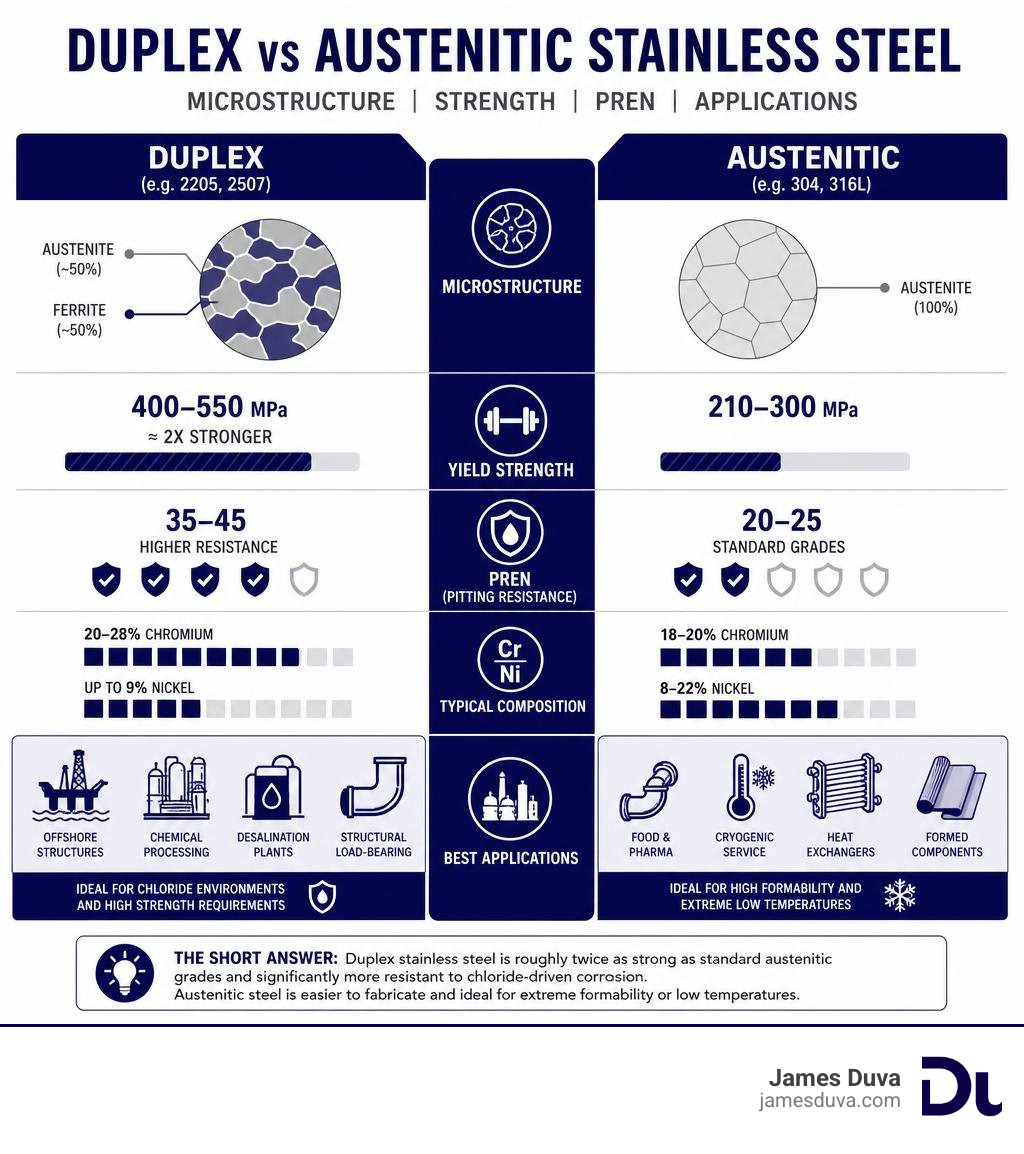
When comparing duplex vs austenitic stainless steel, the core differences come down to microstructure, strength, and corrosion resistance:
| Property | Austenitic (e.g. 304, 316L) | Duplex (e.g. 2205, 2507) |
|---|---|---|
| Microstructure | Single-phase (austenite, FCC) | Dual-phase (50% austenite + 50% ferrite) |
| Yield Strength | 210-300 MPa | 400-550 MPa |
| PREN (pitting resistance) | 20-25 (standard grades) | 35-45 |
| Chromium content | 18-20% | 20-28% |
| Nickel content | 8-22% | Up to 9% |
| Weldability | Easier | Requires tighter controls |
| Best for | Formability, cryogenic use, food/pharma | Chloride environments, structural load-bearing |
| Temperature range | Cryogenic to ~870°C | -50°C to +250-300°C |
The short answer: Duplex stainless steel is roughly twice as strong as standard austenitic grades and significantly more resistant to chloride-driven corrosion. Austenitic steel is easier to fabricate, more widely available, and the better choice where extreme formability or low temperatures are required.
Choosing the wrong grade can mean premature failure, unplanned downtime, or unnecessary cost. In aggressive service environments — offshore platforms, chemical reactors, desalination plants — that decision carries real consequences.
The duplex stainless steel market is projected to grow from USD 3.6 billion in 2024 to USD 4.6 billion by 2030. Austenitic grades remain the dominant category at USD 20 billion, but duplex adoption is accelerating as engineers seek stronger, more corrosion-resistant materials without the full cost premium of high-nickel alloys. In 2026, understanding exactly where each grade outperforms the other is no longer a niche concern — it’s a core competency for anyone specifying materials in demanding industries.
I’m Billy Walker, Vice President of James Duva Inc., where we’ve been supplying stainless steel and high-nickel alloy products to the power, process, and water treatment industries since 1978. My team works daily with engineers and procurement professionals navigating duplex vs austenitic stainless steel decisions across nuclear, chemical, and industrial applications. In the sections below, I’ll walk you through exactly how these two families of steel differ — and how to choose the right one for your project.
Why Are Alloys So Valuable in Industry?
Before comparing specific families of steel, it is important to understand why alloys are so valuable in industrial applications. Pure metals, such as pure iron, are often too soft, structurally weak, or highly prone to rust and oxidation when exposed to moisture and oxygen.
To overcome these physical limitations, metallurgists combine pure metals with other elements to create alloys. Alloys like stainless steel offer vastly superior strength, durability, and resistance to environmental degradation. By carefully adjusting the chemical recipe, we can engineer materials that maintain their structural integrity under extreme pressures, high temperatures, and highly corrosive chemical environments.
These enhanced physical properties make alloys indispensable across a wide range of critical industries:
- Construction: Heavy infrastructure relies on alloy steel for high-strength structural beams, long-lasting concrete reinforcement, and highly durable piping systems that must resist atmospheric corrosion for decades.
- Oil & Gas: Extracting and processing hydrocarbons requires robust piping networks, heavy-duty fittings, high-pressure flanges, and reliable Ball Valves that can withstand sour gas, high pressures, and corrosive marine conditions.
- Automotive & Aerospace: High-performance alloys are used to construct lightweight vehicle frames, durable aircraft structural components, and heat-resistant engine parts that operate under intense mechanical stress.
- Medical & Consumer Goods: Alloys are engineered to be highly biocompatible for medical implants and surgical instruments, while standard consumer products like kitchenware and food processing equipment utilize corrosion-resistant alloys to maintain strict hygiene standards.
Duplex vs Austenitic Stainless Steel: Microstructural and Compositional Differences
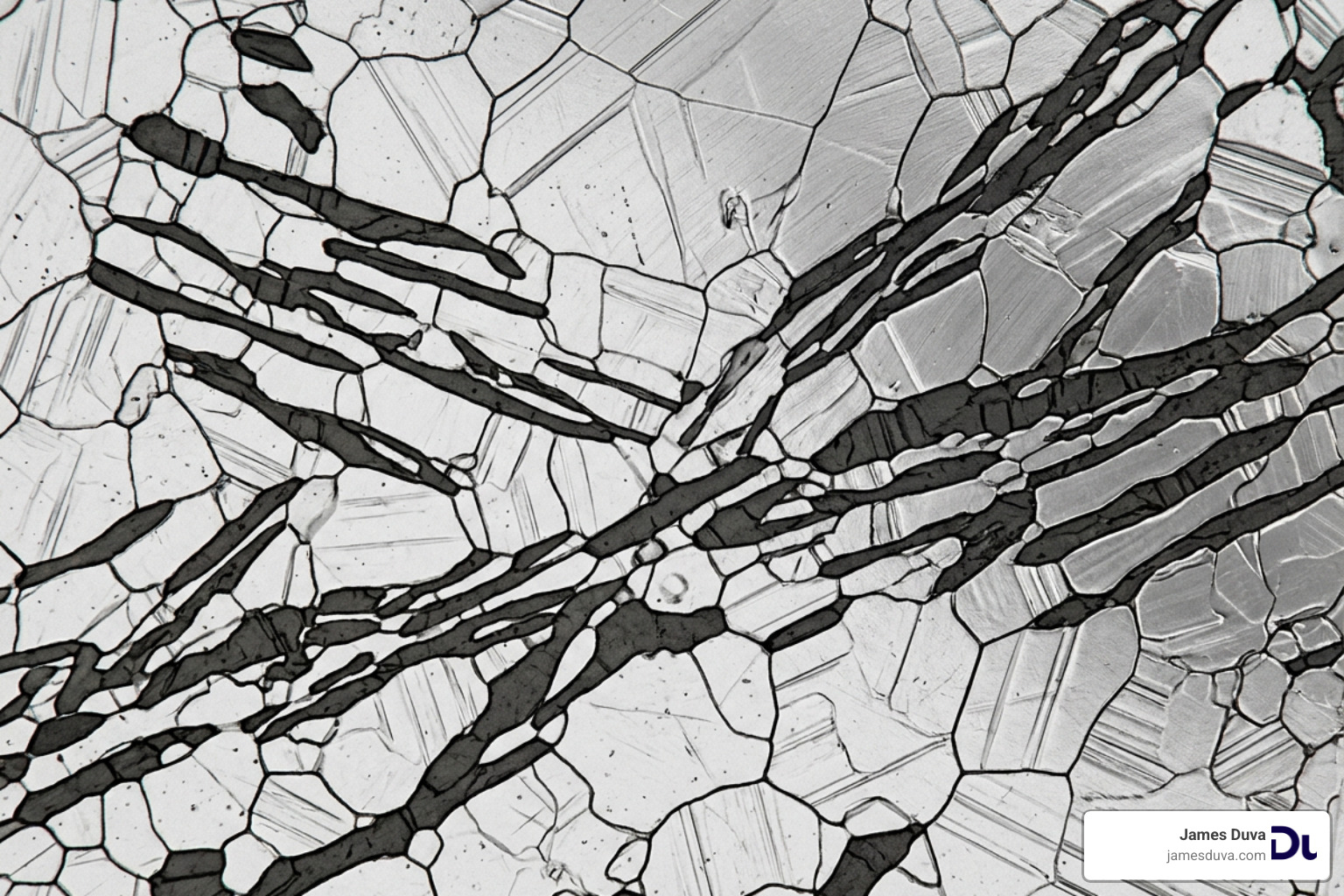
To understand why these alloys behave so differently, we must look at their microscopic crystalline structures. As explained in our Detailed Guide to Stainless Steel Types, the performance of any stainless steel is directly dictated by its metallurgical phases.
Austenitic stainless steels, such as the ubiquitous 300 series (including 304 and 316L), feature a single-phase microstructure consisting entirely of austenite. This face-centered cubic (FCC) crystal structure is stabilized by high concentrations of nickel.
In contrast, duplex stainless steels are engineered as a dual-phase hybrid. Their microstructure consists of a balanced, roughly 50/50 mixture of austenite (FCC) and ferrite (body-centered cubic, or BCC). This unique dual-phase structure is achieved by optimizing the balance between chromium (which promotes ferrite formation) and nickel (which promotes austenite formation), often supplemented with nitrogen additions. For a deep dive into these compositional variations, you can consult Duplex vs Austenitic Stainless Steel: What’s the Difference? – MFG Shop .
The chemical compositions of these steels directly dictate their physical and mechanical characteristics:
| Element / Property | Standard Austenitic (Type 316L) | Standard Duplex (UNS S32205 / 2205) | Super Duplex (UNS S32750 / 2507) |
|---|---|---|---|
| Chromium (Cr) | 16.0 – 18.0% | 22.0 – 23.0% | 24.0 – 26.0% |
| Nickel (Ni) | 10.0 – 14.0% | 4.5 – 6.5% | 6.0 – 8.0% |
| Molybdenum (Mo) | 2.0 – 3.0% | 3.0 – 3.5% | 3.0 – 5.0% |
| Nitrogen (N) | Max 0.10% | 0.14 – 0.20% | 0.24 – 0.32% |
| Density (g/cm³) | 8.0 | 7.8 | 7.8 |
| Thermal Cond. (W/m·K) | 15 | 19 | 14 |
| Electrical Resistivity | 0.74 | 0.80 | 0.80 |
By substituting expensive nickel with nitrogen and higher levels of chromium, duplex grades achieve superior properties while minimizing exposure to volatile nickel markets.
Comparing Corrosion Resistance: Duplex vs Austenitic Stainless Steel in Chloride Environments
When evaluating corrosion resistance, particularly in marine or chloride-rich environments, the difference between duplex and austenitic grades becomes stark. Standard austenitic steels like 316L can perform poorly in warm, chloride-rich waters, often failing due to localized attack.
The three primary threats in these environments are:
- Chloride Pitting: Localized chemical attack that creates tiny, deep holes in the protective passive oxide layer.
- Crevice Corrosion: Accelerated corrosion occurring in shielded, low-oxygen spaces such as gaskets, fasteners, and thread joints.
- Chloride Stress Corrosion Cracking (CSCC): Sudden, brittle cracking that occurs under the combined influence of tensile stress, elevated temperatures (typically above 60 °C), and chlorides. CSCC accounts for approximately one-third of all stainless steel failures in industrial processing plants.
To compare the localized corrosion resistance of different alloys, metallurgists use the Pitting Resistance Equivalent Number (PREN) formula:
PREN = %Cr + 3.3(%Mo + 0.5%W) + 16%N
While standard 316L has a PREN of approximately 23 to 25, standard duplex 2205 reaches a PREN of 34 to 35, and super duplex 2507 exceeds 40. This higher value translates directly to superior resistance to pitting and crevice corrosion.
Crucially, the dual-phase microstructure of duplex steel provides exceptional resistance to CSCC. Because cracks struggle to propagate through the alternating ferrite and austenite boundaries, duplex alloys can easily survive in warm chloride environments where standard austenitic steels crack within weeks. For a comprehensive look at how these materials perform under aggressive chemical exposure, read Duplex vs Austenitic Stainless Steel: Which Performs Better in Corrosive Environments? . To see how standard duplex stacks up against other options, check out our analysis on Duplex 2205 vs Other Stainless Steels: A Comparative Analysis.
Mechanical Properties: Duplex vs Austenitic Stainless Steel Strength and Ductility
The mechanical contrast between these two families is highly beneficial for structural designers. Duplex stainless steels offer approximately twice the yield strength (0.2% proof stress) of standard austenitic steels. While Type 316L typically exhibits a yield strength of 210 to 280 MPa, standard duplex 2205 boasts a yield strength of 450 to 550 MPa, and super duplex 2507 can reach up to 550 to 650 MPa.
This massive strength advantage allows engineers to design equipment with much thinner walls, leading to significant weight and material savings in structural applications. You can explore this further in the Duplex stainless steel technical reference.
However, this strength comes with a trade-off in ductility:
- Austenitic grades exhibit outstanding elongation values of 40% to 60%, making them incredibly easy to cold-form, press, and shape into complex geometries. They also maintain incredible impact toughness at cryogenic temperatures.
- Duplex grades have lower elongation values (typically 20% to 30%), requiring significantly more force to bend or form.
For a detailed look at how this unique balance of properties functions, read Why Duplex Stainless Steel is the Ultimate Hybrid. For practical discussions on how this affects piping design and system engineering, you can read What are the benefits of a duplex stainless vs austenitic … .
Fabrication, Weldability, and Temperature Limitations
Fabricating and welding duplex stainless steel requires a higher level of technical discipline than working with standard austenitic grades. While austenitic steels are highly forgiving during welding, duplex alloys require strict adherence to qualified procedures to maintain their critical 50/50 phase balance.
If duplex steel is welded incorrectly, the heat-affected zone (HAZ) can cool too slowly or too quickly, resulting in an excess of ferrite or the precipitation of brittle intermetallic phases (such as sigma phase). This degradation severely reduces both corrosion resistance and impact toughness.
To prevent these issues, fabricators must follow strict guidelines:
- Heat Input Control: Heat input must be kept within a strict window (typically 0.5 to 2.5 kJ/mm) to control the cooling rate.
- Interpass Temperature: Keep the interpass temperature below 150 °C for standard duplex (and below 100 °C for super duplex) to prevent intermetallic precipitation.
- Filler Metals: Always use over-alloyed filler metals (typically enriched with 2% to 3% extra nickel) to ensure sufficient austenite forms in the weld metal during cooling.
- Shielding Gases: Utilize high-purity argon shielding gas, often blended with small percentages of nitrogen, to prevent the loss of nitrogen from the weld pool.
For an in-depth reference on these fabrication parameters, consult the NiDi Technical Series No. 10 044 guidelines.
Limitations and Temperature Thresholds of Duplex Alloys
While duplex stainless steels are highly versatile, they have clear temperature limitations that do not apply to austenitic grades:
- High-Temperature Limits (475°C Embrittlement): Duplex steels cannot be used for continuous service at elevated temperatures. When exposed to temperatures above 250 °C to 300 °C for extended periods, the ferritic phase undergoes spinodal decomposition into iron-rich and chromium-rich nanophases. This phenomenon, known as 475°C embrittlement, causes severe loss of toughness and ductility.
- Low-Temperature Limits (Ductile-Brittle Transition): Unlike austenitic stainless steels, which retain high ductility and toughness down to cryogenic temperatures, duplex steels exhibit a ductile-to-brittle transition. They typically lose their impact toughness at temperatures below -40 °C to -50 °C, making them unsuitable for cryogenic liquid storage.
Economic Analysis: Cost, Availability, and Lifecycle Value
From a purchasing perspective, evaluating duplex vs austenitic stainless steel requires looking beyond the initial price per pound.
Standard austenitic grades like 316L contain relatively high concentrations of nickel (10% to 14%). Because nickel is a highly volatile commodity traded on global metal exchanges, the price of austenitic steel is prone to frequent, unpredictable surcharges. Duplex stainless steels contain significantly less nickel (typically 1.5% to 8% depending on the grade), which stabilizes their material cost and reduces exposure to market volatility.
More importantly, the high yield strength of duplex steel allows for substantial material thickness reduction. In pressure vessels, storage tanks, and structural piping, specifying duplex instead of austenitic can reduce the required wall thickness by up to 30% to 50%. This reduction yields immediate savings in:
- Raw material purchasing weight
- Shipping and logistics costs
- Structural support requirements
- Welding consumables and labor hours
When you calculate the total lifecycle cost — factoring in the reduced material weight, simpler maintenance schedules, and a significantly longer service life in corrosive environments — duplex often proves to be the highly economical choice. For assistance with sourcing these materials, you can consult our Sourcing Duplex 2205: A Comprehensive Supplier Directory. To compare the economic variables of your specific project, read Duplex vs Austenitic Stainless Steel: Which One to Choose? .
Structural Design Standards and EN 1993-1-4 Compliance
When designing load-bearing structures with stainless steel, structural engineers must follow established international design codes. In Europe and many global markets, the governing standard is EN 1993-1-4 (Eurocode 3: Design of steel structures – Part 1-4: General rules – Supplementary rules for stainless steels).
This standard explicitly addresses the mechanical differences between duplex and austenitic grades. Because duplex steels have nearly double the yield strength of austenitic options, EN 1993-1-4 allows for much higher design strength values when calculating the load-bearing capacity of structural profiles, hollow sections, and welded connections.
By utilizing duplex steel in compliance with EN 1993-1-4, structural engineers can specify lighter, more slender structural members. This is particularly beneficial for coastal bridges, sea walls, and marine structures where reducing structural dead-weight and maximizing corrosion resistance are primary engineering goals. For a deeper analysis of how these design codes treat both material classes, see What is the difference between austenitic and duplex … and What is the difference between austenitic and duplex stainless steel … .
Industrial Applications: Where Each Grade Excels
Given their different performance profiles, each family of stainless steel has established clear dominance in specific industrial sectors:
Where Duplex Stainless Steel Excels
- Desalination Plants: High operating temperatures and extreme chloride levels make super duplex 2507 the standard choice for high-pressure piping, evaporators, and intake manifolds.
- Offshore Oil & Gas platforms: Duplex alloys are widely specified for subsea pipelines, risers, manifolds, and process equipment exposed to seawater and sour hydrocarbons.
- Chemical Processing: Reactors, heat exchangers, and storage vessels handling hot organic acids, chlorides, and mixed-acid solutions rely on duplex to prevent stress corrosion cracking.
To learn more about selecting the appropriate duplex grade for these environments, consult our guides on Duplex 2205 vs Super Duplex: Key Differences, Uses & Benefits and Exploring the Versatility of Duplex 2205 Stainless Steel and Industrial Products. You can also review detailed material data in A Comprehensive Guide to Duplex 2205 Properties, Selecting the Right Duplex Stainless Steel: 2205 or 2507, Deciphering the Duel: Duplex 2205 vs Super Duplex 2507 for Industrial Applications, Unlocking the Potential of Duplex 2205 UNS S32205 with James Duva, and A Simplified Guide to Duplex and Super Duplex Piping.
Where Austenitic Stainless Steel Excels
- Food & Beverage Processing: Standard grades like 304 and 316L provide excellent hygiene, are easy to clean, resist organic acids, and are highly formable for complex tank geometries.
- Pharmaceutical Equipment: High-purity systems, cleanrooms, and sterile process lines utilize low-carbon austenitic grades (such as 316L) due to their smooth surface finishes and ease of electropolishing.
- Cryogenic Applications: Liquefied natural gas (LNG) storage tanks and piping networks operating at temperatures below -150 °C rely on the face-centered cubic structure of austenitic steel to prevent brittle fractures.
Frequently Asked Questions about Duplex and Austenitic Steels
What is the main difference between duplex and austenitic stainless steel?
The primary difference lies in their microstructure and strength. Austenitic stainless steel has a single-phase crystal structure (100% austenite) that provides excellent formability and ductility but moderate strength. Duplex stainless steel has a dual-phase microstructure (roughly 50% austenite and 50% ferrite) that provides twice the yield strength and vastly superior resistance to chloride stress corrosion cracking.
Is duplex stainless steel harder to weld than austenitic grades?
Yes, duplex stainless steel requires tighter fabrication controls than austenitic grades. To prevent the loss of corrosion resistance and toughness, welders must carefully control the heat input, limit interpass temperatures to under 150 °C, use specially over-alloyed filler metals, and utilize appropriate shielding gas mixtures to maintain the delicate 50/50 phase balance.
Does duplex stainless steel cost more than austenitic steel?
While duplex stainless steel may have a slightly higher or comparable raw material cost per pound, it is often more cost-effective overall. Its high yield strength allows engineers to design systems with thinner walls, reducing the total weight of the material required. Additionally, its low nickel content makes it less susceptible to market price volatility, and its superior durability reduces long-term maintenance and replacement costs.
Conclusion
Choosing between duplex vs austenitic stainless steel is a critical decision that directly impacts the safety, longevity, and cost-effectiveness of your industrial system. By understanding the microstructural, chemical, and mechanical differences between these two families of steel, you can select the optimal material for your specific operational parameters.
At James Duva Inc., based in Branchburg, New Jersey, we have been helping our customers navigate complex material selection decisions for nearly five decades. Whether you are designing a high-pressure piping network for an offshore platform or sourcing robust components for a local chemical plant, our team has the deep industry expertise and extensive inventory to support your project.
For personalized guidance on selecting the right stainless steel or high-nickel alloy for your application, check out our resource on Understanding Duplex 2205 Properties, Advantages and Applications or contact our team of material experts today.
About James Duva Inc.
Since 1978, James Duva Inc. has been your trusted source for stainless steel and high-nickel alloy industrial products. Whether you’re in the water treatment, process or power industry, we pride ourselves on always having what you need. Say goodbye to your sourcing problems with just one call to James Duva.