
Ultimate Checklist for 304 Stainless Steel Flange

Oct 29, 2026
The 304 Stainless Steel Flange: What You Need to Know Before You Buy
A 304 stainless steel flange is one of the most widely used pipe connection components in industrial piping systems — and for good reason. It combines strong corrosion resistance, broad temperature tolerance, and reliable mechanical performance at a competitive price point.
Quick answer for sourcing professionals:
| Feature | 304 Stainless Steel Flange |
|---|---|
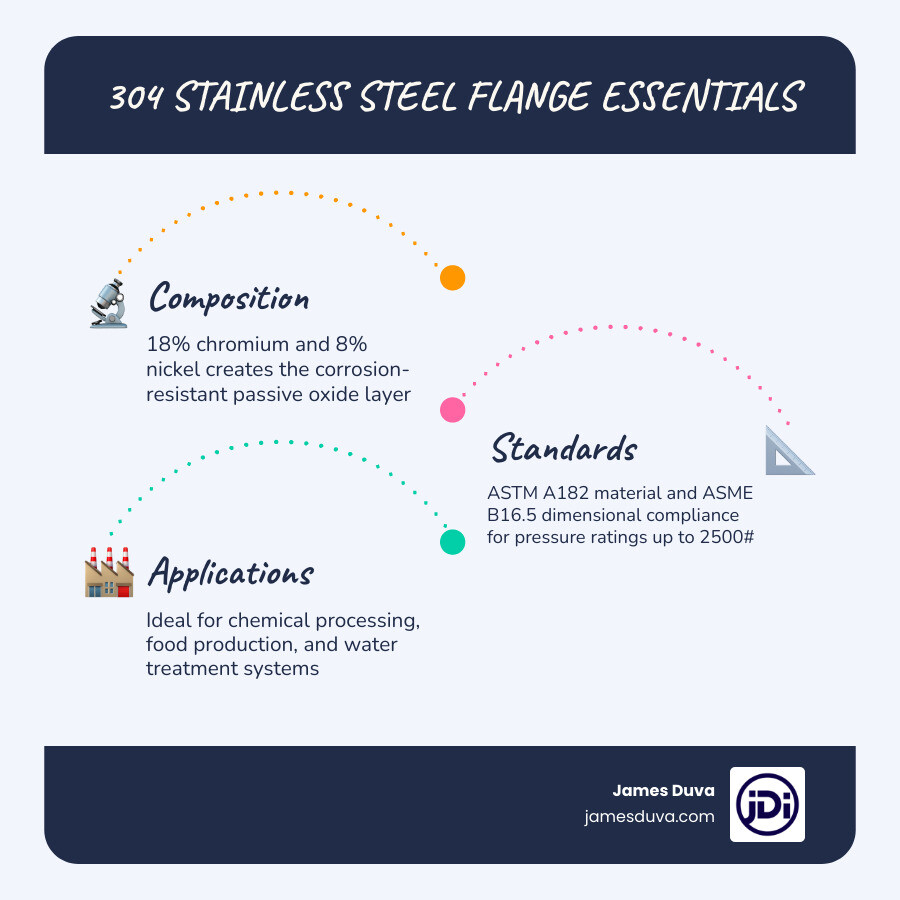
| Base composition | 18% chromium, 8% nickel (18/8) |
| Material standard | ASTM A182 |
| Dimensional standard | ASME B16.5 |
| Size range | 1/2″ to 48″ |
| Pressure ratings | 150# to 2500# |
| Common types | Slip-on, weld neck, threaded, blind, socket weld |
| Key advantage | Excellent corrosion resistance in most non-chloride environments |
| Market share | ~50% of all stainless steel flange applications |
304 stainless steel sits in the austenitic family of stainless alloys. That means it has a face-centered cubic crystal structure that stays stable across a wide range of temperatures — from cryogenic conditions all the way up to elevated process heat. Its 18/8 chromium-nickel composition forms a passive oxide layer on the surface that resists rust, oxidation, and many corrosive media without any coating or plating.
For engineers and procurement professionals in chemical processing, oil and gas, food production, or water treatment, choosing the right flange grade matters. A wrong material call can mean early corrosion failure, leaks, or costly downtime.
I’m Billy Walker, Vice President of James Duva Inc., and I’ve spent years helping engineers and contractors source specialty piping components — including 304 stainless steel flanges — from trusted domestic manufacturers. In this guide, I’ll walk you through everything you need to make a confident, informed purchasing decision.
Why Are Alloys So Valuable in Industry?
When we look at the history of metallurgy, pure metals like iron were the starting point, but they rarely met the rigorous demands of modern industry. Pure iron is relatively soft and, as we all know, highly prone to oxidation (rust). If we built a chemical plant using pure iron, the structures would degrade almost immediately upon contact with moisture or oxygen.
This is where alloys come into play. By combining a base metal with other elements, we create a material that is far superior to its individual parts. Alloys like stainless steel offer the structural integrity and durability required for high-stakes environments.
In A Comprehensive Introduction to Stainless Steel Facts and Industry Insights, we see alloys being utilized across virtually every sector:
- Construction: Giant beams and structural supports rely on alloys for weight-bearing strength.
- Oil & Gas: Fittings and flanges must withstand immense pressure and corrosive crude products.
- Automotive & Aerospace: Engines and frames require alloys that can handle extreme heat and vibration without cracking.
- Medical & Consumer Goods: From surgical implants to the kitchenware in your home, alloys provide the necessary sanitization and longevity.
At James Duva Inc., we specialize in these high-performance materials because we know that the safety of your facility depends on the chemical stability of the alloys you install.
Key Properties and Advantages of the 304 Stainless Steel Flange
The 304 stainless steel flange is the workhorse of the piping world. Its dominance in the market—accounting for approximately 50% of all stainless steel flange applications—stems from its balanced chemical profile.
Chemical Composition and Strength
The “18/8” designation refers to its roughly 18% chromium and 8% nickel content. The chromium is the secret sauce; it reacts with oxygen to form an invisible, protective layer of chromium oxide. If the surface is scratched, the layer actually “heals” itself in the presence of oxygen.
The mechanical properties are equally impressive:
- Tensile Strength: Approximately 75,000 psi (515 MPa).
- Yield Strength: Approximately 30,000 psi (205 MPa).
- Density: 8.0 g/cm3.
- Melting Point: 2550 °F (1400 °C).
Non-Magnetic and Cryogenic Excellence
Unlike carbon steel, 304 stainless steel is non-magnetic in the annealed condition. This is critical for applications involving sensitive electronic equipment or specialized medical imaging. Furthermore, it possesses incredible cryogenic toughness. While some metals become brittle and shatter like glass at sub-zero temperatures, the 304 stainless steel flange maintains its ductility.
For a deeper dive into these technical specs, you can check out our In-Depth Guide to Stainless Steel Alloy Properties or browse our specific Stainless Steel Flanges documentation.
Comparing Material Grades: 304 vs. 316 vs. 304L
One of the most common questions we get at our Branchburg, NJ headquarters is: “Do I really need 316, or will 304 suffice?” To answer that, we have to look at the chemistry.
| Property | Grade 304 | Grade 304L | Grade 316 |
|---|---|---|---|
| Carbon Content | Max 0.08% | Max 0.03% | Max 0.08% |
| Nickel Content | 8% – 11% | 8% – 13% | 10% – 14% |
| Molybdenum | None | None | 2.0% – 3.0% |
| Corrosion Resistance | High | High (Better for welding) | Superior (Chloride resistance) |
The Molybdenum Difference
Grade 316 contains molybdenum, which provides a massive boost in resistance to chlorides (like salt water) and marine environments. If your project is located near the coast or involves heavy brine, 316 is the way to go. However, for most inland industrial applications, the 304 stainless steel flange offers more than enough protection at a lower cost.
The “L” stands for Low Carbon
Grade 304L is the low-carbon version of 304. When you weld standard 304, high temperatures can cause “carbon precipitation,” where carbon and chromium bind together at the grain boundaries. This leaves the surrounding area depleted of chromium and vulnerable to intergranular corrosion. 304L prevents this, making it the preferred choice for heavy-gauge welded components.
For more help on this selection process, see our guide on How to Select the Right Stainless Steel Grade for Chemical Processing Plants.
Performance of 304 Stainless Steel Flange in Chemical Processing
In chemical processing, 304 is highly effective against oxidizing acids (like nitric acid) and is widely used for food-grade environments. Because it can withstand harsh sanitization protocols—including steam cleaning and strong detergents—it is a staple in dairy, beverage, and pharmaceutical plants.
304 stainless steel threaded flanges are frequently utilized in agricultural chemical handling and other demanding environments due to this versatility.
Selecting the Right 304 Stainless Steel Flange Type
The “type” of flange refers to how it attaches to the pipe. Here are the most common configurations we supply:
- Slip-on (SORF): These slide over the pipe and are welded both inside and out. They are excellent for low-pressure applications and are easy to align.
- Weld Neck (WNRF): These have a long tapered hub that is butt-welded to the pipe. They are the “gold standard” for high-pressure or extreme temperature fluctuations.
- Threaded: Also known as “screwed” flanges, these are used for low-pressure systems where welding isn’t possible or safe.
- Blind: Used to seal the end of a piping system or a vessel opening.
- Socket Weld: Similar to slip-ons but have a recessed “socket” for the pipe to sit in, allowing for a smoother flow of fluid.
- Lap Joint: Used in systems that require frequent dismantling for inspection or cleaning.
You can find technical specifications for these types through our own Definitive Guide to Flange Types.
Manufacturing, Standards, and Installation Checklist
Quality is non-negotiable in piping. A single failed flange can lead to environmental hazards or catastrophic system failure.
Standards to Watch For
- ASTM A182: This is the standard specification for forged or rolled alloy and stainless steel pipe flanges, forged fittings, and valves for high-temperature service.
- ASME B16.5: This governs the dimensions, pressure-temperature ratings, tolerances, marking, and testing of pipe flanges from NPS 1/2 through NPS 24.
- Pressure Ratings: Flanges are categorized by “Class” (e.g., 150#, 300#, 600#, etc.). A standard 4-inch 304 slip-on flange is often rated for 150 PSI but can go up to 2500# for specialized forged versions.
Installation Best Practices
When installing a 304 stainless steel flange, follow this checklist:
- Alignment: Ensure the bolt holes are perfectly aligned. Forcing a bolt through a misaligned hole creates stress on the flange.
- Face Type: Determine if you need a Raised Face (RF) for better gasket seating or a Flat Face (FF) for lower pressure applications where you might be connecting to cast iron.
- Gasket Selection: Use a gasket material that matches the chemical compatibility of the fluid.
- Torque Sequence: Always use a “star” or “criss-cross” pattern when tightening bolts to ensure even pressure across the gasket.
For detailed measurements, consult our Industrial Flange Dimensions Charts, Sizes and Everything in Between and our guide on Understanding Industrial Flanges: Types, Applications and Benefits.
Maintenance and Industry Applications
The beauty of the 304 stainless steel flange is its low maintenance requirements. However, “low maintenance” doesn’t mean “no maintenance.”
Cleaning and Inspection
In industries like pulp and paper or municipal water, periodic inspection for “pitting” is necessary. Pitting is a localized form of corrosion that can occur if debris or stagnant fluid sits on the surface for too long. We recommend regular cleaning with warm water and mild detergents to maintain the passive oxide layer.
Where You’ll Find Them
- HVAC Systems: Due to their ability to handle temperature changes without losing structural integrity.
- Municipal Water: For long-lasting, rust-free transport of potable water.
- Light Manufacturing: In auxiliary pipelines for compressed air or cooling water.
- Food & Beverage: Essential for maintaining sanitary conditions.
Explore more about these uses in our article on Stainless Steel Applications for Every Industry.
Frequently Asked Questions about 304 Stainless Steel Flanges
What is the standard pressure rating for a 4-inch 304 flange?
The most common pressure rating for a 4-inch 304 stainless steel flange in commercial and light industrial use is Class 150#. This typically weighs around 13 lbs and is suitable for 150 PSI applications. However, forged 304 flanges are available in ratings up to 2500# for high-pressure steam or chemical lines.
Can 304 stainless steel flanges be used in high-temperature applications?
Yes, 304 stainless steel has excellent oxidation resistance in intermittent service up to 1600°F (870°C) and in continuous service to 1700°F (925°C). However, for continuous use between 800°F and 1580°F, we often recommend 304L to avoid carbide precipitation.
What is the difference between 304 and 304L for welding?
As mentioned earlier, 304L has a lower carbon content (0.03% vs 0.08%). This lower carbon helps prevent “weld decay,” a form of corrosion that happens in the heat-affected zone of a weld. If your flange requires heavy welding, 304L is the safer bet to ensure the longevity of the joint. For more guidance on material selection, contact our team at James Duva Inc.
Conclusion
Choosing the right 304 stainless steel flange doesn’t have to be a headache. By understanding the chemical advantages of the 18/8 composition, selecting the correct flange type for your installation, and adhering to ASME standards, you can ensure a piping system that lasts for decades.
At James Duva Inc., we’ve been the trusted one-stop shop for industrial alloys since 1978. Based in Branchburg, NJ, we pride ourselves on our deep technical expertise and our ability to source exactly what our customers need—from the simplest slip-on flange to high-performance Ball Valves.
Whether you are working on a municipal water project or a complex chemical refinery, we have the inventory and the experience to help you succeed. Ready to find the perfect fit for your project? Browse our full range of Product Categories: Flanges or contact us today to speak with an expert.

About James Duva Inc.
Since 1978, James Duva Inc. has been your trusted source for stainless steel and high-nickel alloy industrial products. Whether you’re in the water treatment, process or power industry, we pride ourselves on always having what you need. Say goodbye to your sourcing problems with just one call to James Duva.