
Making Sense of Metal with a Detailed Stainless Steel Grades Comparison

Oct 28, 2026
Stainless Steel Grades Comparison: Which One Fits the Job?
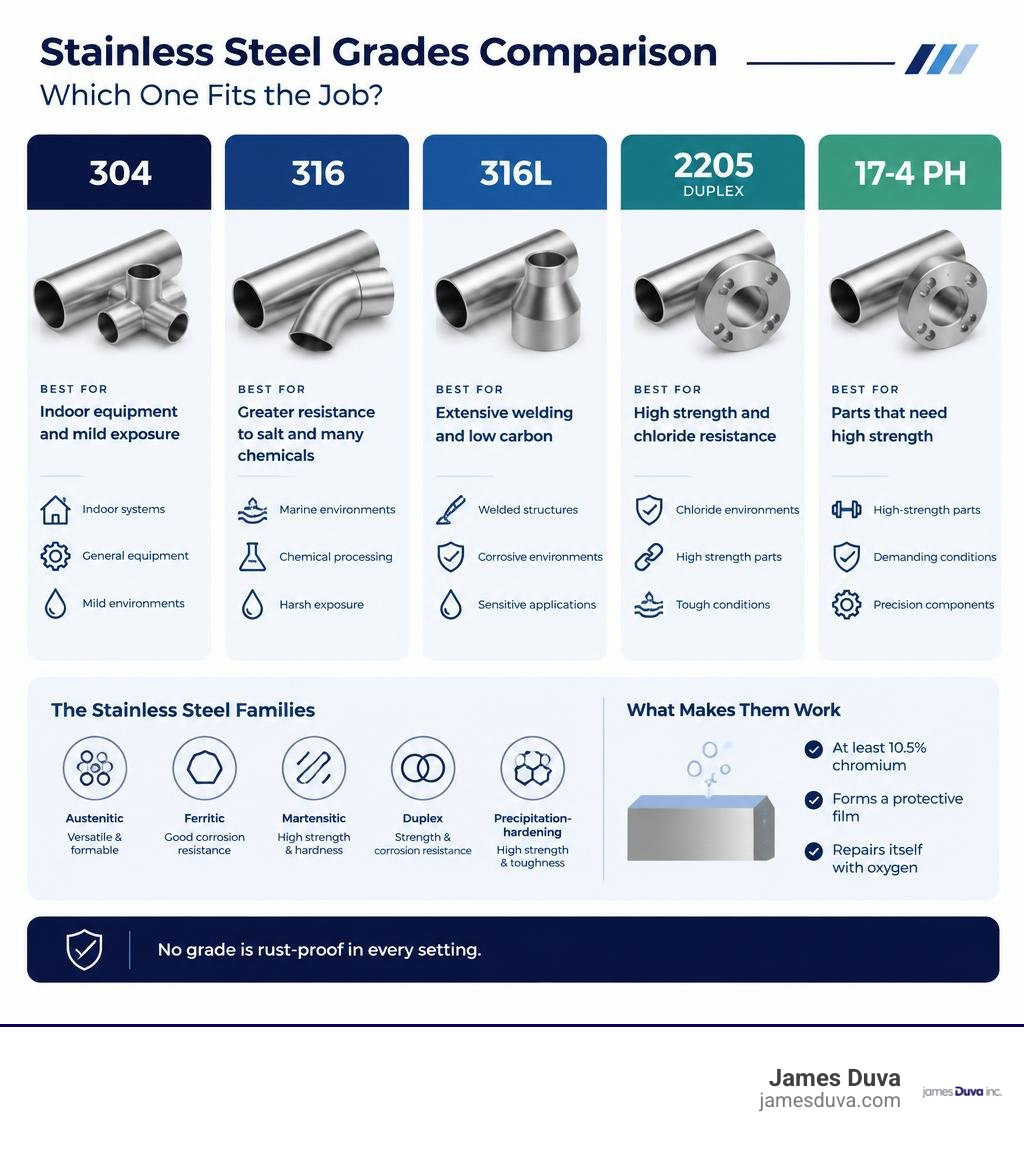
A stainless steel grades comparison starts with the service conditions. Choose 304 for indoor equipment and mild exposure; 316 for greater resistance to salt and many chemicals; 316L when extensive welding calls for low carbon; 2205 duplex when high strength and chloride resistance both matter; and 17-4 PH for parts that need high strength. No grade is rust-proof in every setting.
All stainless steels contain at least 10.5% chromium. It forms a thin protective film that can repair itself when oxygen is present. The grades fall into austenitic, ferritic, martensitic, duplex, and precipitation-hardening families, each with different strengths and limits.
I’m Billy Walker, Vice President of James Duva Inc., where I help industrial customers source stainless steel piping components for demanding service. This stainless steel grades comparison starts with the common choices, then shows how to narrow them down for your application.
Why Are Alloys So Valuable in Industry?
Pure metals possess distinct chemical identities, but on their own, they often fall short under heavy industrial demands. Elemental iron, for instance, is relatively soft, mechanically yielding, and exceptionally vulnerable to rapid oxidation when exposed to moisture and oxygen. Without modification, iron oxidizes into loose, flaky rust that continuously exposes fresh metal until structural integrity completely degrades.
Alloying transforms base metals into durable engineering materials. By melting iron alongside precise percentages of chromium, nickel, molybdenum, carbon, and nitrogen, metallurgists rearrange the metal’s internal crystal structure. These alloying elements enhance tensile strength, hardenability, thermal fatigue limits, and resistance to environmental attack.
Across modern enterprise, these engineered metals deliver vital durability across key sectors:
- Construction: Heavy-duty structural beams, architectural support columns, tension cables, and critical water infrastructure piping depend on high-yield stainless alloys to prevent premature degradation.
- Oil & Gas: Severe downhole and offshore environments rely on corrosion-resistant forged fittings, high-pressure flanges, and rugged Ball Valves to prevent catastrophic chemical leaks.
- Automotive & Aerospace: Exhaust manifolds, airframe structural members, jet engine fuel lines, and high-wear fasteners require specialized alloys that retain mechanical strength across intense thermal cycling.
- Medical & Consumer Goods: Biocompatible surgical implants, hospital sterilization equipment, commercial food processing lines, and everyday culinary tools rely on stable, non-leaching surfaces that resist biological and chemical breakdown.
Comprehensive Stainless Steel Grades Comparison by Microstructure Family
Stainless steels are categorized into distinct metallurgical families defined by their underlying crystalline arrangement. The atomic matrix dictates whether an alloy is ductile, magnetic, easily welded, or exceptionally strong. Understanding these inherent alloy properties allows engineers to select the exact microstructure for their operational requirements.
| Stainless Steel Family | Representative Grades | Crystal Structure | Typical Yield Strength (MPa) | Magnetic Response | Pitting Resistance (PREN Range) | Primary Industrial Characteristics |
|---|---|---|---|---|---|---|
| Austenitic | 304, 304L, 316, 316L, 310 | Face-Centered Cubic (FCC) | 200 – 240 | Non-magnetic (annealed) | 18 – 26 | Outstanding ductility, excellent weldability, superior cryogenic toughness. |
| Ferritic | 409, 430 | Body-Centered Cubic (BCC) | 280 – 350 | Strongly magnetic | 12 – 18 | Low nickel content, resistance to stress corrosion cracking, moderate cost. |
| Martensitic | 410, 420 | Body-Centered Tetragonal (BCT) | 400 – 1000+ (heat-treated) | Strongly magnetic | 12 – 16 | High carbon, hardenable via heat treatment, exceptional wear resistance. |
| Duplex | 2205, 2507 | 50/50 Ferrite + Austenite | 450 – 550 | Magnetic | 32 – 43+ | Roughly double the yield strength of austenitic grades, superior chloride pitting resistance. |
| Precipitation-Hardening | 17-4 PH, Custom 465 | Martensitic / Austenitic Matrix | 700 – 1730 (aged) | Magnetic | 15 – 20 | Extreme tensile and yield strength developed through low-temperature aging. |
Austenitic Grades (300 Series)
Austenitic stainless steels account for approximately 70% of global stainless steel output. Their face-centered cubic crystal lattice, stabilized primarily through the addition of nickel, gives them exceptional ductility, formability, and impact toughness from cryogenic temperatures up to elevated service environments.
Grade 304—frequently designated as 18/8 due to its nominal 18% chromium and 8% nickel formulation—serves as the backbone for structural and fluid-handling applications, including widespread 304 stainless steel tubing applications. In consumer and commercial food service, related standards define high-finish kitchenware, where understanding 18/10 vs 18/8 culinary standards helps balance lustrous surface retention against raw manufacturing cost. Austenitic grades cannot be hardened through heat treatment; instead, they gain mechanical strength via cold work.
Ferritic and Martensitic Grades (400 Series)
The 400 series encompasses alloys with a body-centered crystal structure that exhibit strong magnetic properties.
- Ferritic Alloys (e.g., 409, 430): These contain between 10.5% and 27% chromium with little to no nickel. They provide good thermal conductivity, low thermal expansion, and strong resistance to chloride-induced stress corrosion cracking. Because of their lower alloy cost, they are widely used in automotive exhaust systems, kitchen appliance trim, and architectural panels.
- Martensitic Alloys (e.g., 410, 420): Formulated with higher carbon levels and lower chromium ratios, martensitic steels can be austenitized, quenched, and tempered to achieve high hardness and wear resistance. As detailed in our review of martensitic grade 410 properties, these grades are chosen for turbine blades, valve trim, pump shafts, and cutlery, where mechanical wear resistance is prioritized over maximum corrosion protection.
Duplex and Precipitation-Hardened Alloys
When standard austenitic or martensitic grades reach their mechanical or chemical limits, advanced metallurgical families step in.
Duplex stainless steels feature a balanced, two-phase microstructure consisting of roughly equal parts austenite and ferrite. This hybrid composition yields a material with roughly twice the yield strength of traditional 300-series alloys, coupled with high resistance to chloride stress corrosion cracking. Evaluating duplex 2205 alloy properties reveals an optimal alloy for high-pressure chemical lines, offshore oil platforms, and desalination equipment.
Precipitation-hardening (PH) grades, such as 17-4 PH (UNS S17400), achieve remarkable tensile yield strengths—up to 1,730 MPa in specialized alloys—through low-temperature thermal aging. Copper, aluminum, or niobium precipitates form within the matrix, blocking dislocation movement and generating extreme load-bearing capacity without distorting the finished component.
304 vs. 316: The Core Industry Benchmarks

In industrial piping, fluid handling, and general fabrication, Type 304 and Type 316 are the two most frequently specified austenitic alloys. While they share identical aesthetic qualities and similar mechanical yield strengths in their annealed states (around 210 MPa or 30,000 psi), their behavior in harsh chemical or coastal environments diverges sharply.
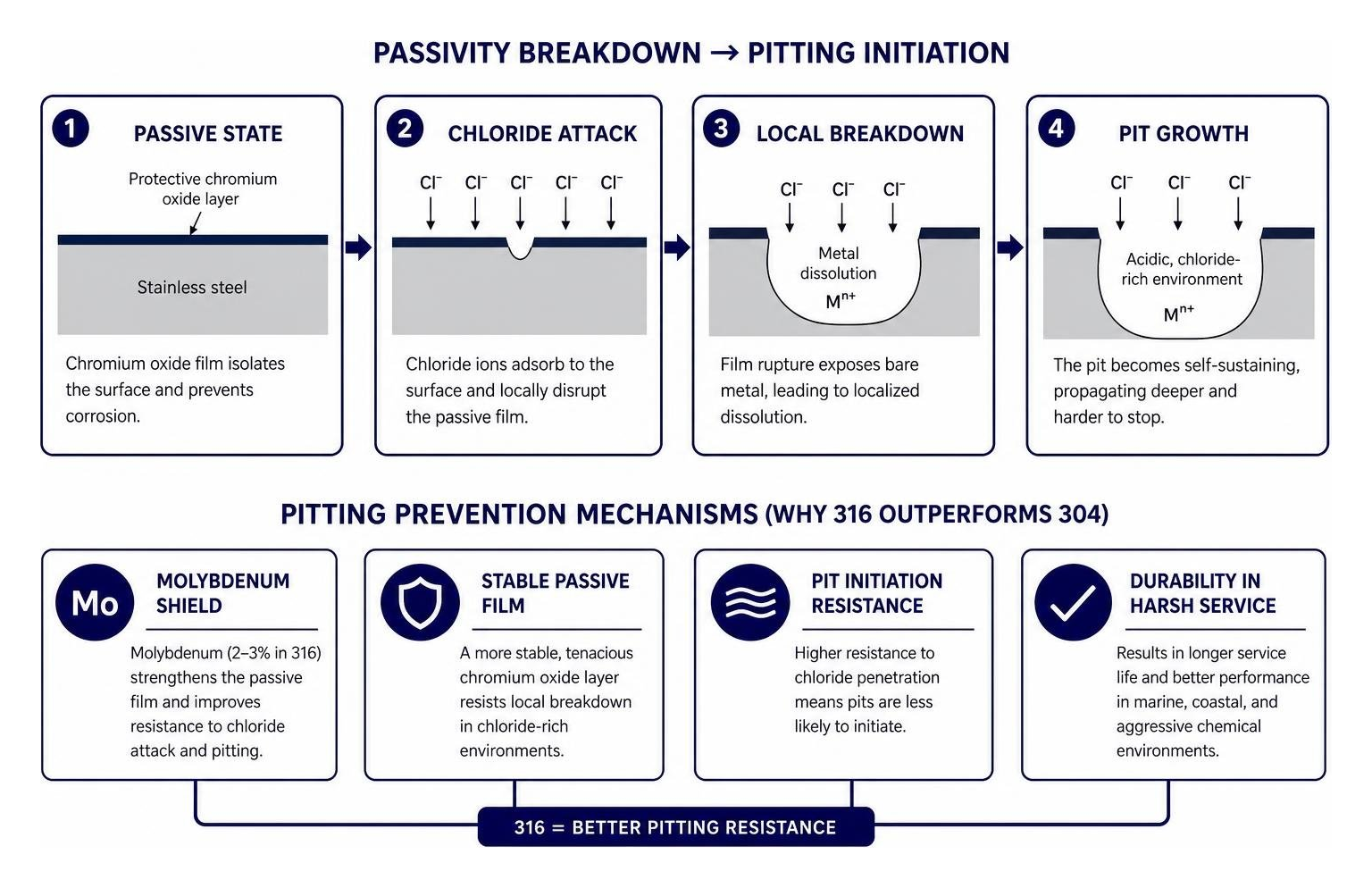
The fundamental distinction lies in alloy chemistry: Type 316 incorporates 2.0% to 3.0% molybdenum, an element that markedly reinforces the passivating chromium oxide layer against localized breakdown. When engineers evaluate strategies for preventing pitting corrosion, molybdenum addition serves as the first line of defense against aggressive halide ions.
Grade 304: Versatility, Limits, and Best-Use Cases
Representing approximately 50% of all stainless steel used globally, Grade 304 provides an economical baseline for non-marine, non-acidic environments. It resists atmospheric oxidation, washdown chemicals, and high-temperature scaling up to approximately 870 °C (1,600 °F).
However, Grade 304 remains vulnerable to localized attack when exposed to concentrated chlorides, stagnant brines, or warm saline solutions. In coastal atmospheres, 304 frequently develops unsightly surface staining (“tea-staining”) and microscopic pitting. Furthermore, standard 304 (with up to 0.08% carbon) can undergo chromium carbide precipitation along its grain boundaries when welded, leaving heat-affected zones prone to intergranular attack unless post-weld solution annealing is performed. Where raw tensile rigidity and machinability are needed in unexposed structural framing, standard 304 stainless bar specifications remain an efficient choice.
Grade 316 and 316L: Enhanced Marine and Chemical Performance
Type 316 overcomes chloride vulnerability through its molybdenum content, providing reliable defense against localized pitting, crevice corrosion, and acidic process streams. It is widely specified in pharmaceutical synthesis, marine hardware, wastewater treatment, and offshore processing units.
In active processing lines, evaluating chemical processing grade 316 demands helps verify its compatibility with sulfuric, acetic, and formic acid solutions.
When heavy fabrication and welded joints are required without subsequent furnace heat-treatment, specifying the low-carbon variant is essential. Reviewing a low-carbon 316L comparison shows that capping carbon at 0.03% prevents carbide sensitization during welding, keeping piping spools resistant to boundary corrosion.
Specialty and High-Performance Stainless Steel Alloys
Standard 300-series alloys handle the bulk of everyday commercial demands, but severe chemical processing, extreme heat, and subsea production lines often demand specialized metallurgy. When conditions exceed the performance ceiling of standard stainless steel, industrial operators must decide whether specialized stainless grades or upgrading to nickel alloys will offer the longest operational lifecycle.
A Stainless Steel Grades Comparison for High-Temperature Demands
Continuous thermal service above 500 °C rapidly diminishes the tensile strength of standard 304 and 316 alloys, making them vulnerable to structural creep and heavy oxide scaling.
Specialty high-temperature austenitic grades, such as Grade 310 (UNS S31000), contain up to 25% chromium and 20% nickel. This rich formulation allows the alloy to maintain a dense, stable oxide skin that resists thermal fatigue and intermittent oxidation up to 1,150 °C (2,100 °F). Examining grade 310 high-temperature performance highlights its reliability for industrial furnace fixtures, heat treatment baskets, flare stacks, and thermal cracker tubes.
Advanced Duplex and Super Duplex Engineering
For harsh offshore and chemical environments, super duplex alloys (such as 2507 / UNS S32750) provide even greater corrosion resistance, offering Pitting Resistance Equivalent Numbers (PREN) above 40.
Pitting resistance is calculated using the established industry relationship:
PREN = %Cr + (3.3 × %Mo) + (16 × %N)
By balancing 25% chromium, 4% molybdenum, and 0.28% nitrogen, super duplex alloys resist severe crevice attack in stagnant seawater, sour gas wells, and bleaching towers. Selecting super duplex alloy applications allows engineers to combine extreme chemical resistance with the notable duplex strength advantages, reducing piping wall thickness by up to 25% to 30% compared to conventional austenitic lines.
Engineering Selection Criteria and Global Standards
Selecting an appropriate alloy involves balancing service chemistry, mechanical loads, thermal profiles, and international material specifications. Global supply chains often require cross-referencing international stainless steel standards to map familiar American standards (ASTM / AISI / UNS) to their direct European (EN / DIN), Japanese (JIS), and international (ISO) equivalents:
- Type 304: UNS S30400 | EN 1.4301 (X5CrNi18-10) | JIS SUS 304
- Type 304L: UNS S30403 | EN 1.4307 (X2CrNi18-9) | JIS SUS 304L
- Type 316: UNS S31600 | EN 1.4401 (X5CrNi17-12-2) | JIS SUS 316
- Type 316L: UNS S31603 | EN 1.4404 (X2CrNi17-12-2) | JIS SUS 316L
- Duplex 2205: UNS S32205 / S31803 | EN 1.4462 (X2CrNiMoN22-5-3) | JIS SUS 329J3L
Material selection must also account for total cost of ownership. A comprehensive evaluation of lifecycle cost and material selection shows that while higher-alloyed metals carry larger initial purchase costs—316 is typically 20% to 30% more expensive than 304—they eliminate premature piping replacements, emergency shutdowns, and product contamination over multi-decade operating lifespans.
Furthermore, stainless steel supports long-term industrial sustainability. The alloy is 100% recyclable, with average new production containing roughly 60% recycled scrap. In building and infrastructure, its capture-and-recycle rate reaches 92%, substantially lowering the embodied carbon footprint of large facilities.
Practical Selection Framework: A Targeted Stainless Steel Grades Comparison
When designing industrial piping or specifying components, use this practical framework to evaluate material requirements:
- Assess Halide and Chloride Exposure: If operating in inland, climate-controlled, or non-saline process streams, specify 304/304L. If chloride concentrations exceed 200 ppm, or the system operates near ocean spray, step up to 316/316L. For chlorinated seawater, brines, or sour oil streams, select 2205 Duplex or Super Duplex 2507.
- Evaluate Welding Requirements: When components are fabricated via multi-pass welding without post-weld solution annealing, always specify low-carbon variants (304L or 316L) to avoid sensitization.
- Determine Mechanical Loading vs. Weight Constraints: If standard piping schedules result in excessive structural weight under high pressure, evaluate 2205 Duplex to reduce wall thickness while doubling yield strength.
- Account for Operating Temperatures: For cryogenic service down to -196 °C, select stable 300-series austenitic steels. For oxidizing thermal service from 500 °C to 1,150 °C, specify high-nickel/chromium grades like 310S.
Frequently Asked Questions About Stainless Steel Grades
What gives stainless steel its corrosion-resistant properties?
Stainless steel gains its corrosion resistance from a minimum of 10.5% chromium content by weight. When exposed to oxygen, the chromium reacts to form an ultra-thin, continuous, chemically stable layer of chromium oxide across the metal’s surface. This passive film is imperceptible to the eye and acts as an impermeable barrier against moisture and corrosive agents. If the surface is scratched or mechanically abraded, the film naturally re-forms—provided oxygen is available in the surrounding environment.
Why is 316 stainless steel significantly more expensive than 304?
Grade 316 costs roughly 20% to 30% more than Grade 304 primarily due to raw material additions. Type 316 contains 2% to 3% molybdenum, along with slightly higher nickel content (10% to 14% compared to 304’s 8% to 10.5%). Molybdenum and nickel trade on volatile global metal markets and carry high extraction and refining costs. The performance benefits of molybdenum in resisting chloride pitting justify this cost difference in harsh chemical and marine environments.
How does duplex stainless steel achieve double the strength of standard austenitic steel?
Duplex stainless steel achieves roughly twice the yield strength of austenitic grades through its engineered dual-phase microstructure, which consists of roughly equal parts austenite and ferrite. This fine grain structure provides grain-boundary strengthening (the Hall-Petch effect). Additionally, duplex grades are alloyed with interstitial nitrogen, which strengthens the austenitic phase, yielding tensile yield strengths between 450 and 550 MPa without sacrificing toughness or weldability.
Conclusion
Material selection determines whether an industrial fluid system functions smoothly for decades or suffers premature downtime and corrosion failures. Navigating this landscape requires balancing chemistry, mechanical forces, and long-term operating costs.
At James Duva Inc., we have supplied high-grade stainless steel pipes, valves, flanges, and fittings to demanding industries since 1978. Operating from our central facility in Branchburg, NJ, our technical sales team helps engineers match the right materials to challenging service environments. To evaluate all metallurgical options for your next project, explore our detailed guide to stainless steel types or reach out to our team for custom project guidance.
About James Duva Inc.
Since 1978, James Duva Inc. has been your trusted source for stainless steel and high-nickel alloy industrial products. Whether you’re in the water treatment, process or power industry, we pride ourselves on always having what you need. Say goodbye to your sourcing problems with just one call to James Duva.