
The Definitive Guide to Alloy Selection for Chemical Processing
Sep 4, 2026
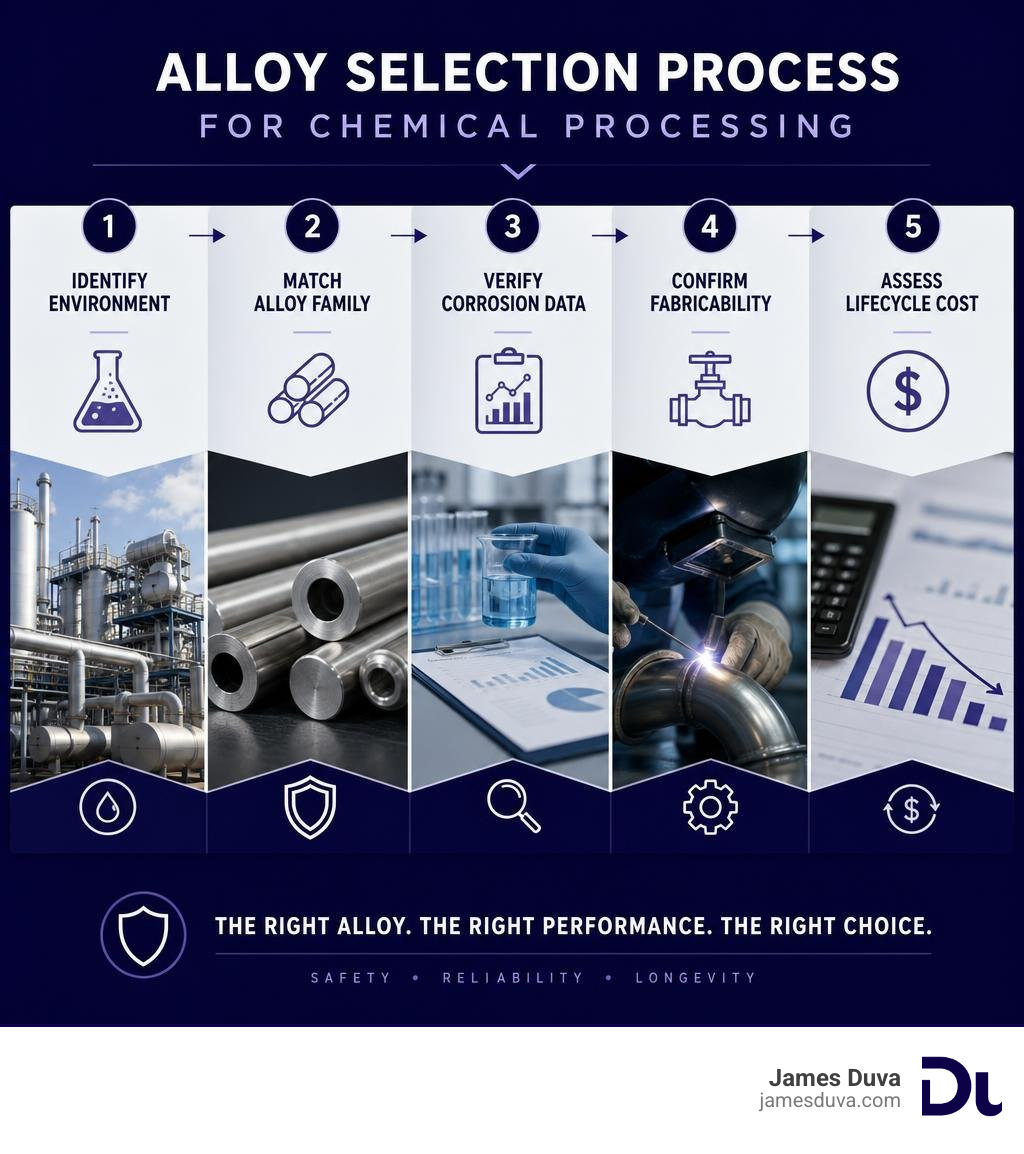
Why Getting Alloy Selection for Chemical Processing Right Can Make or Break Your Operation
Alloy selection in chemical processing is one of the most consequential decisions an engineer or procurement professional will make — the wrong material can mean catastrophic failure, unplanned downtime, or costly replacement within months.
Here’s a quick reference for the most commonly specified alloys in chemical processing:
| Alloy | Best For | Key Strength |
|---|---|---|
| Hastelloy C-276 | HCl, wet chlorine, mixed acids | Superior pitting and crevice corrosion resistance |
| Inconel 625 | High-temperature acid service, seawater | High strength + corrosion resistance |
| Monel 400 | Sulfuric acid, marine environments | Excellent in reducing media |
| Titanium Grade 2/7 | Oxidizing acids, chlorine environments | Lightweight, high strength, low corrosion |
| 316L Stainless Steel | Mild acids, lower chloride environments | Cost-effective general service |
| Alloy 20 (UNS N08020) | Sulfuric acid service | Balanced acid + chloride resistance |
| Tantalum | Highly aggressive acids | Near-universal acid resistance |
Chemical processing plants handle some of the most aggressive substances on earth — concentrated acids, hot alkalis, chloride-laden streams, and high-pressure reactive gases. Every piece of equipment, from reactors to piping to valves, is only as reliable as the material it’s made from.
The stakes are high. A stainless steel component that works perfectly in mild service can fail within weeks when exposed to chloride-contaminated phosphoric acid. A carbon steel vessel rated for ambient conditions can suffer hydrogen embrittlement under elevated temperature and pressure. Getting the material match right from the start is not just good engineering — it’s a safety and cost imperative.
I’m Billy Walker, Vice President of James Duva Inc., where I’ve spent years helping engineers and procurement teams navigate alloy selection for chemical processing — sourcing specialty stainless steel and high-nickel alloy piping components from trusted domestic manufacturers. This guide distills what I’ve learned into a practical, no-nonsense framework you can use today.
Why Are Alloys So Valuable in Industry?
To understand why custom alloy selection chemical processing is so critical, we must first look at why pure metals are rarely up to the task of modern industrial manufacturing.
In their pure chemical states, metals like iron are often too soft, excessively heavy, or highly prone to rust and oxidation. For example, iron reacts readily with oxygen and moisture to form iron oxide (rust), which flakes away and structurally degrades the material.
By contrast, alloys—which are engineered mixtures of a base metal with other metallic or non-metallic elements—are structurally and chemically optimized. Steel, for instance, is an alloy of iron and carbon that provides immensely superior strength and durability compared to pure iron.
By adjusting the recipe of these elements, metallurgists can create materials designed to withstand specific environmental demands. This versatility makes alloys indispensable across a wide range of critical industries:
- Construction: Large-scale structural beams, concrete reinforcements, and high-strength piping networks rely on structural carbon steels and low-alloy steels to carry immense loads safely.
- Oil & Gas: Heavy-duty fittings, flanges, and high-pressure lines must resist localized corrosion and sulfide stress cracking in sour service environments.
- Automotive & Aerospace: Lightweight aluminum and titanium alloys form high-integrity structural frames, while nickel-based superalloys are used in jet engines to withstand extreme heat and mechanical stress.
- Medical & Consumer Goods: Biocompatible titanium and cobalt-chromium alloys are used for surgical implants, while standard austenitic stainless steel alloys form clean, corrosion-resistant kitchenware and pharmaceutical equipment.
In the demanding world of chemical plants, we take these alloying concepts a step further. We utilize highly specialized combinations of nickel, chromium, molybdenum, copper, and other elements to build components that can withstand aggressive chemical reagents.
To learn more about how these material structures differ, read our detailed guide on Deciphering the Power of Alloy Materials: Stainless Steel, Inconel and Monel.
Primary Challenges and Metallurgical Elements in Alloy Selection Chemical Processing
When we evaluate materials for chemical process equipment, we are constantly balancing several destructive forces. The primary challenges in these environments include:
- Uniform and Localized Corrosion: Acidic or alkaline process streams can rapidly eat away at metal surfaces, leading to uniform wall thinning. Even more dangerous is localized attack, such as pitting and crevice corrosion, which can cause sudden, localized breaches in otherwise intact piping.
- High Operating Pressures: Process vessels and piping must maintain structural integrity under extreme pressures without bursting or undergoing plastic deformation.
- Extreme Temperatures: Chemical reactions often run at elevated temperatures. Materials must resist thermal degradation and scaling at high temperatures, while avoiding low-temperature embrittlement.
- Mechanical Wear and Erosion: Slurries, suspended solids, and high-velocity fluids can mechanically erode protective oxide films, accelerating chemical attack (erosion-corrosion).
- Thermal Fatigue: Repeated heating and cooling cycles generate cyclic thermal stresses. If the material lacks sufficient ductility and thermal stability, it will eventually crack.
To combat these forces, we rely on specific alloying elements that form a protective, self-healing “passive layer” on the metal’s surface. The primary tool we use to quantify an alloy’s resistance to localized pitting and crevice attack in chloride environments is the Pitting Resistance Equivalent Number (PREN). The standard formula is:
$$text{PREN} = % text{Cr} + 3.3(% text{Mo} + 0.5% text{W}) + 30(% text{N})$$
A higher PREN indicates superior resistance to localized chloride attack. For a deeper dive into metallic choices, consult Part 1: Material Selection for Chemical Process Equipment – Metals and our practical advice on How to Select the Right Stainless Steel Grade for Chemical Processing Plants.
The Role of Chromium, Molybdenum, and Nickel in Corrosion Resistance
Each element added to an alloy recipe serves a distinct metallurgical purpose:
- Chromium (Cr): This is the foundation of corrosion resistance. Chromium reacts with oxygen to form a thin, transparent, and highly stable chromium-rich oxide passive film. A minimum of 12 wt.% chromium is required to establish this passivity. Chromium is highly effective at protecting alloys in oxidizing media like nitric acid.
- Molybdenum (Mo): Molybdenum dramatically increases an alloy’s resistance to pitting and crevice corrosion, particularly in wet chloride and halide-containing environments. It also provides vital stability in reducing media like hydrochloric and sulfuric acids.
- Nickel (Ni): Nickel stabilizes the face-centered cubic (FCC) austenitic crystal structure of the alloy down to room temperature. This metallurgical structure provides excellent ductility, toughness, and weldability. Crucially, high nickel content provides near-immunity to chloride-induced stress corrosion cracking (SCC), which frequently plagues standard stainless steels.
In specialized applications, such as wet-process phosphoric acid production, impurities like fluorides, chlorides, and sulfuric acid can dramatically accelerate corrosion. Choosing an alloy with the correct balance of chromium, molybdenum, and copper is vital to preventing rapid equipment failure.
To explore this chemistry further, see the technical paper on Alloy selection in wet-process phosphoric acid and our comprehensive guide, Metals That Can Take the Heat and the Rust: A Comprehensive Guide.
High-Temperature Stability and Thermal Fatigue in Alloy Selection Chemical Processing
At elevated temperatures, standard stainless steels lose their load-bearing capacity rapidly. High-performance nickel alloys, however, maintain exceptional yield strength and creep-rupture resistance.
Key Statistic: At 1,500°F, high-performance nickel alloys retain 40% to 75% of their room-temperature yield strength, whereas standard stainless steels keep only 20% to 35% of their strength.
This strength retention is due to the solid-solution strengthening of the nickel-chromium matrix and, in some superalloys, the precipitation of secondary phases that lock slip planes in place. Furthermore, nickel alloys exhibit excellent microstructural stability, resisting the precipitation of embrittling phases (like sigma phase) during prolonged exposure to high heat. This prevents thermal fatigue cracking during repeated startup and shutdown cycles.
For more details on when to upgrade, read When to Choose Nickel Alloys Over Stainless Steel in Industrial Applications.
Comparing High-Performance Alloys for Chemical Service

When standard stainless steels fall short, we turn to high-performance alloys. Below is a direct comparison of three of the most widely specified materials in high-hazard chemical environments:
| Property / Feature | Inconel 625 | Hastelloy C-276 | Monel 400 |
|---|---|---|---|
| Primary Composition | Ni-Cr-Mo-Nb (min 58% Ni, 20-23% Cr, 8-10% Mo) | Ni-Cr-Mo-W (approx. 56% Ni, 15-17% Cr, 15-17% Mo, 3-4% W) | Ni-Cu (approx. 63% Ni, 28-34% Cu) |
| Corrosion Resistance | Excellent in oxidizing and organic acid environments; highly resistant to seawater. | Exceptional in highly reducing acids (HCl, H2SO4), wet chlorine, and ferric chlorides. | Outstanding in hydrofluoric acid, non-oxidizing mineral acids, and marine environments. |
| High-Temp Limit | Highly stable up to 1800°F (982°C) with superb creep strength. | Good up to 1900°F (1038°C) in non-stress applications; typically lower in pressure service. | Limited to approx. 1000°F (538°C); prone to sulfur embrittlement above this. |
| Yield Strength (ksi) | ~55 ksi | ~41 ksi | ~40 ksi |
| Ultimate Tensile (ksi) | ~110 ksi | ~100 ksi | ~80 ksi |
- Inconel 625 utilizes columbium (niobium) and molybdenum to stiffen its alloy matrix, providing extremely high strength without requiring heat treatment. It is an excellent choice for organic chlorination reactions and high-temperature waste heat recovery systems.
- Hastelloy C-276 is the industry workhorse for severe acid service. Its high molybdenum and tungsten content makes it incredibly resilient against pitting and crevice corrosion in boiling hydrochloric and sulfuric acids.
- Monel 400 is a unique nickel-copper alloy. It handles reducing acids and halogen gases (like dry chlorine and fluorine) exceptionally well, making it a staple in hydrofluoric acid alkylation units.
To learn more about how to choose between these options, read our detailed analyses: Inconel vs Hastelloy: Key Differences, Applications and Benefits and Inconel vs Hastelloy: Which is Better for Corrosive Environments.
Nickel, Tantalum, and Titanium Alloys in Chemical Processing
For environments where even top-tier nickel alloys face limitations, we evaluate highly specialized metal groups:
- Unalloyed Nickel (UNS N02200): Pure nickel offers outstanding resistance to caustic alkalis, such as sodium hydroxide (caustic soda), even at high temperatures and in molten states. It is widely used in chlor-alkali membrane cells.
- Tantalum Linings: Tantalum is almost completely inert to mineral acids at temperatures below 300°F (150°C), behaving similarly to glass. Because tantalum is extremely expensive, it is typically applied as a thin cladding or lining over steel structures for reactors and thermowells handling hot, concentrated nitric or hydrochloric acids.
- Titanium Grade 7: Titanium naturally forms a highly protective, tenacious oxide film in oxidizing environments. However, in reducing acids, this film can break down. Titanium Grade 7 contains a small addition of palladium (0.12% to 0.25%), which drastically improves its corrosion resistance in reducing acids and acid-halide mixtures.
For a deeper look at these specialized metals, see Chemical Processing Alloys: Nickel, Tantalum & Titanium.
Traditional vs. Emerging Alloys: UNS N06058 and UNS N08034
Metallurgical science continues to evolve, bringing forward newer alloys designed to overcome the limitations of traditional choices:
- UNS N06058: This modern nickel-chromium-molybdenum-nitrogen alloy represents a major leap over traditional Hastelloy C-276. By optimizing the chromium and molybdenum levels and adding nitrogen, UNS N06058 achieves an incredibly high PREN of approximately 86 (compared to C-276’s PREN of ~69). This makes it virtually immune to localized pitting in severe flue gas desulfurization (FGD) systems and hot hydrochloric acid heat exchangers.
- UNS N08034: Developed as an improvement over the super-austenitic alloy UNS N08031, UNS N08034 offers enhanced thermal stability. This allows for longer, safer fabrication and welding windows without the risk of precipitating detrimental intergranular phases. It is highly effective for salt industry evaporators and waste acid recovery systems.
To understand how these materials compare to standard options in acid environments, read Is Hastelloy Better than Inconel for Acid Environments.
Engineering Considerations for Pressure Vessels and Piping

Designing pressure vessels and piping for chemical processes requires strict adherence to safety codes, primarily ASME Section VIII (for pressure vessels) and ASME B31.3 (for process piping).
Beyond corrosion resistance, engineers must design for physical and mechanical compatibility:
- Toughness: Alloys must possess sufficient impact toughness to absorb sudden energy loads without fracturing, especially at low temperatures where carbon steels can become brittle.
- Thermal Expansion: Dissimilar metals welded together can experience severe stress due to different rates of thermal expansion. For example, austenitic stainless steels expand about 40% more than carbon steel when heated, which can lead to joint failures. Nickel alloys, conversely, have thermal expansion rates much closer to carbon steel, reducing cyclic thermal stresses.
- Alloy 20 (UNS N08020): Often referred to as “sulfuric acid stainless steel,” Alloy 20 bridges the gap between standard stainless steels and expensive nickel alloys. It contains columbium to prevent intergranular corrosion during welding.
To explore this resilient material, read our article Exploring Alloy 20 UNS N08020 for Resilient Industrial Solutions.
Critical Factors for Pressure Vessel Alloy Selection Chemical Processing
In high-pressure, high-temperature operations, chemical reactions can introduce hydrogen gas into the metal structure. At elevated temperatures, atomic hydrogen can diffuse into the steel, reacting with carbon to form methane gas. This causes internal fissuring, decarburization, and catastrophic cracking—a process known as high-temperature hydrogen attack (HTHA).
To prevent this, engineers must consult the Nelson Chart (API 941), which defines the safe operating limits for steels based on temperature and hydrogen partial pressure. For severe hydrogen service, upgrading from carbon steel to low-alloy Cr-Mo steels or high-performance nickel alloys is mandatory.
Additionally, stress corrosion cracking (SCC) must be mitigated by choosing alloys with high nickel content and ensuring proper thermal stress relief of welded components. For more on these process challenges, see Chemical and Petrochemical Processing.
Fabrication, Welding, and Maintenance Best Practices
Even the best alloy will fail if it is fabricated poorly. When working with high-performance nickel alloys, keep these best practices in mind:
- Manage Sluggish Weld Puddles: Molten nickel alloys do not flow as easily as carbon or stainless steels. Welders must modify joint designs (using wider joint angles) and use specific torch techniques to ensure complete joint penetration.
- Specify Low Carbon Grades: Always use low-carbon versions (such as 316L or Hastelloy C-276) for welded components to prevent chromium carbide precipitation in the heat-affected zone, which leads to intergranular corrosion.
- Post-Weld Heat Treatment (PWHT): For critical services, performing thermal stress relief (typically at 625°C to 650°C for carbon steels in caustic service) is the single most effective way to prevent stress corrosion cracking.
- Positive Material Identification (PMI): Given the high cost of specialty alloys, counterfeiting and material mix-ups are real industrial risks. Always perform PMI testing on all incoming piping, fittings, and valves to verify chemical composition before installation.
For more information on these material properties, read Hastelloy Material Properties, Applications and Benefits.
Economic Analysis: Lifecycle Cost vs. Initial Investment
It is no secret that high-performance nickel alloys carry a premium.
Key Statistic: Nickel-Chromium-Molybdenum alloys are typically 5 times more expensive than standard 18Cr-8Ni (304) stainless steels, and 2 times more expensive than super-austenitic stainless steels.
However, focusing solely on the initial material cost is a common procurement pitfall. When you evaluate the lifecycle cost, the economics shift dramatically:
- Fabrication Cost Parity: While raw nickel alloy plate is much costlier, the actual fabrication and welding labor costs do not vary extensively between stainless steels and nickel superalloys.
- Reduced Downtime: A 316L stainless steel heat exchanger that costs $20,000 but must be replaced every 18 months due to chloride pitting is far more expensive over a 10-year span than a Hastelloy C-276 exchanger that costs $60,000 but lasts the entire decade.
- Energy and Environmental Savings: High-performance alloys allow chemical plants to run processes at higher temperatures and pressures, which dramatically improves reaction efficiency.
Key Statistic: Implementing optimized alloy selection across just 10 percent of U.S. chemical plants would result in energy savings of 10 trillion Btu per year due to improved process efficiency and reduced steam leaks.
For detailed chemical resistance curves and lifecycle performance data, refer to the Nitric Acid Guide.
Testing and Validating Alloy Performance
Before deploying a costly alloy into a full-scale chemical plant, rigorous testing is necessary to validate its performance under simulated process conditions. Standard laboratory and field testing methods include:
- Huey Test (ASTM A262 Practice C): This test involves exposing alloy samples to boiling 65% nitric acid for five 48-hour periods. It is the gold standard for measuring an alloy’s resistance to intergranular attack, particularly for materials destined for nitric acid service or nuclear fuel recycling.
- Simulated Corrosion Testing: Because real-world process streams contain complex mixtures of acids, bases, and contaminants (like chlorides and fluorides), laboratory tests are customized to replicate the exact temperature, pressure, flow velocity, and chemical concentration of the plant environment.
- Electrochemical Testing: Techniques like cyclic potentiodynamic polarization allow engineers to rapidly determine an alloy’s pitting potential and passive behavior in a fraction of the time required for exposure testing.
Frequently Asked Questions about Alloy Selection
Why are nickel alloys preferred over stainless steel at high temperatures?
Nickel alloys possess a stable austenitic (FCC) crystal structure that resists thermal degradation and maintains high yield strength at temperatures up to 1500°F and beyond. While stainless steels lose up to 80% of their strength and can suffer from embrittling phase precipitation at these temperatures, nickel alloys retain 40% to 75% of their room-temperature mechanical properties and offer superior creep-rupture resistance.
How do impurities like chlorides affect alloy selection in acid environments?
Impurities can completely change the corrosivity of an acid. For example, pure phosphoric acid is relatively mild, and standard 316L stainless steel can handle it at low temperatures. However, “wet-process” phosphoric acid contains trace chlorides and fluorides. These halides penetrate and destroy the chromium oxide passive film, causing severe pitting and crevice corrosion. In these contaminated environments, upgrading to high-molybdenum nickel alloys (like the Hastelloy or G-type families) is required.
What is the significance of PREN in chemical processing?
The Pitting Resistance Equivalent Number (PREN) is a theoretical guide used to compare the localized corrosion resistance of different stainless steels and nickel alloys. Calculated based on the weight percentages of chromium, molybdenum, tungsten, and nitrogen, a higher PREN indicates that the alloy is less susceptible to localized pitting and crevice corrosion in warm, chloride-rich environments.
Conclusion
Selecting the right alloy for chemical processing is a balancing act of metallurgical science, mechanical design, and long-term economic planning. No single metal is a silver bullet for every chemical environment, but understanding how elements like chromium, nickel, and molybdenum interact with your process chemistry allows you to design systems that are safe, efficient, and built to last.
Since 1978, James Duva Inc. has served as a trusted, one-stop shop for high-grade stainless steel and nickel alloy industrial piping products. Operating out of our extensive inventory in Branchburg, New Jersey, we specialize in helping chemical processing, refining, and industrial plants select and source the exact materials they need to keep their operations running smoothly.
Whether you need high-performance Ball Valves for severe service or specialty Stainless Steel Products for corrosive environments, our team has the expertise to guide you to the right material choice. Contact us today to discuss your project’s alloy requirements.
About James Duva Inc.
Since 1978, James Duva Inc. has been your trusted source for stainless steel and high-nickel alloy industrial products. Whether you’re in the water treatment, process or power industry, we pride ourselves on always having what you need. Say goodbye to your sourcing problems with just one call to James Duva.