
Unlocking the High-Temperature Power of HAYNES Alloy 25

Jun 8, 2026
What Is HAYNES Alloy 25 — and Why Does It Matter for High-Temperature Applications?
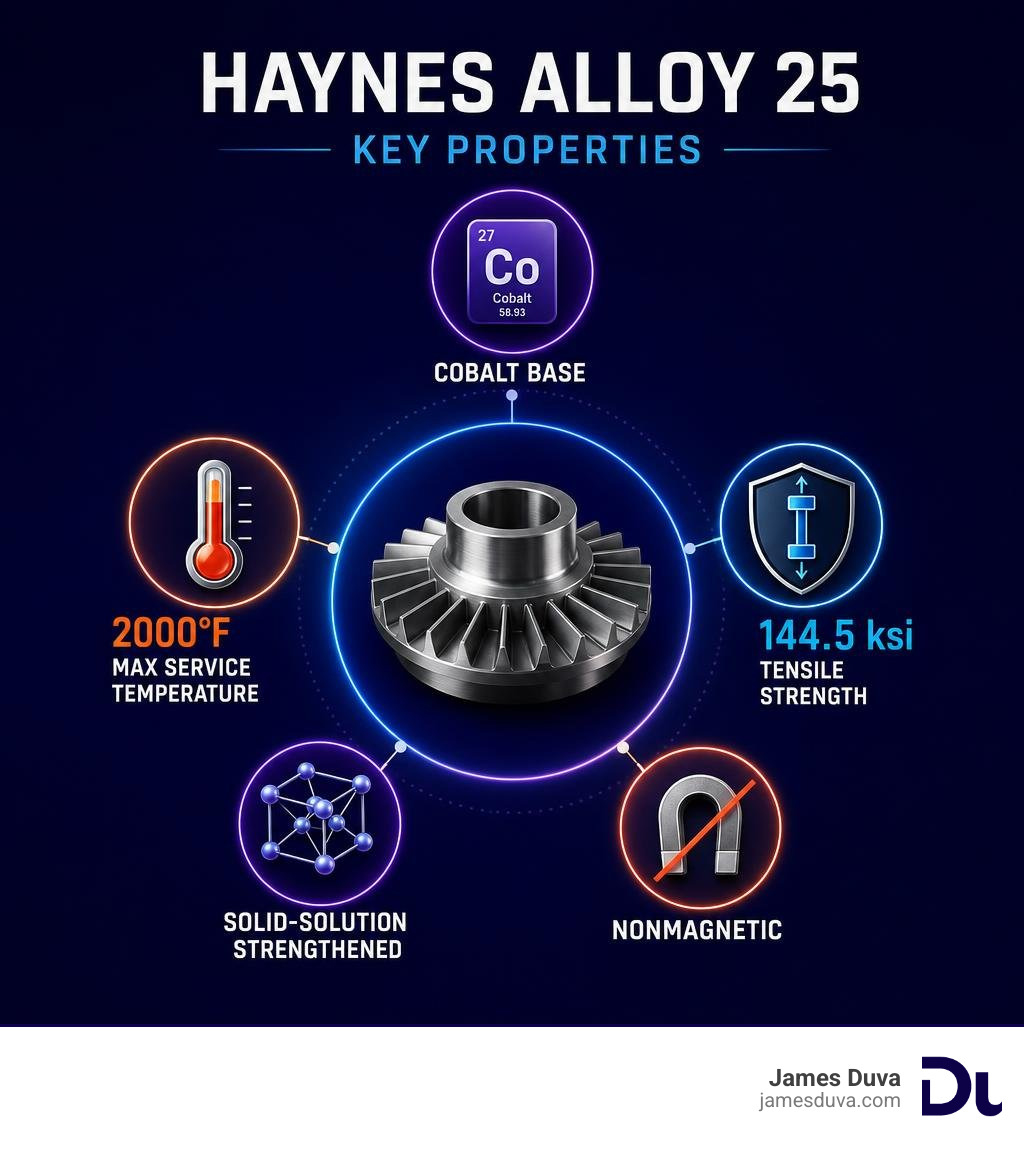
Haynes alloy 25 (also called L-605, UNS R30605) is a cobalt-nickel-chromium-tungsten superalloy engineered for extreme heat, oxidizing environments, and high mechanical stress.
Here’s a quick summary of what it is and what it does:
| Property | Value |
|---|---|
| Base element | Cobalt (~51%) |
| Key alloying elements | Cr (20%), W (15%), Ni (10%) |
| Density | 0.327 lb/in³ (9.07 g/cm³) |
| Melting range | 2,425–2,570°F (1,330–1,410°C) |
| Max continuous service temp (oxidizing) | 2,000°F (1,093°C) |
| Room-temp ultimate tensile strength | 144.5 ksi (996 MPa) |
| 100-hr stress-rupture strength at 1,800°F | 7,000 psi |
| Magnetic? | No — even when cold-worked |
It is the strongest of all fabricable cobalt alloys and has a long track record in aerospace gas turbines, industrial furnaces, high-temperature bearings, and even medical devices.
Unlike many high-temperature alloys, Haynes 25 achieves its strength primarily through solid-solution hardening — not precipitation hardening — which gives it excellent formability alongside impressive heat resistance.
I’m Billy Walker, Vice President of James Duva Inc., where I’ve spent years sourcing and supplying specialty high-nickel and cobalt alloys — including haynes alloy 25 — to engineers and procurement teams in the power, process, and chemical industries. If you’re evaluating this material for a demanding application, this guide covers everything you need to make a confident decision.
Why Are Alloys So Valuable in Industry?
To appreciate why a superalloy like haynes alloy 25 is so highly regarded, it helps to understand why we use alloys in the first place. In their pure states, many elemental metals simply lack the physical properties required for modern industrial applications.
For instance, pure iron is relatively soft and highly susceptible to rust and atmospheric corrosion. By combining iron with carbon and other elements, we create steel, which offers vastly superior strength and durability. However, even standard stainless steels have their limits when subjected to extreme temperatures, high pressures, or aggressive chemical environments.
This is where advanced nickel and cobalt-based alloys become indispensable. They are specifically formulated to withstand environments that would cause standard steels to deform, oxidize, or fail entirely.
Across different industries, alloys serve vital roles:
- Construction: Large-scale structural beams and heavy-duty piping systems require alloys that can support massive loads and resist environmental degradation over decades.
- Oil & Gas: High-pressure fittings, connectors, and heavy flanges must endure sour gas, saltwater, and corrosive drilling fluids.
- Automotive & Aerospace: Critical structural frames, exhaust systems, and combustion engines demand materials that maintain mechanical integrity under rapid thermal cycling.
- Medical & Consumer Goods: Everything from orthopedic implants and heart valves to high-end kitchenware relies on alloys that are completely biocompatible and resistant to wear.
When selecting materials for these demanding situations, engineers often face a choice between different classes of high-performance metals. To understand these choices in more detail, you can read our guide on When to Choose Nickel Alloys Over Stainless Steel in Industrial Applications.
Understanding the Composition and Physical Properties of haynes alloy 25
The outstanding performance of haynes alloy 25 is a direct result of its precise chemical formulation. As a cobalt-based superalloy, its matrix is inherently stable at elevated temperatures. The addition of specific alloying elements enhances its strength, oxidation resistance, and fabricability.
The nominal composition of haynes alloy 25 includes:
- Cobalt (Co): Balance (approximately 51%). Cobalt provides the stable, high-melting-point FCC (face-centered cubic) matrix that serves as the foundation for the alloy’s high-temperature strength.
- Chromium (Cr): 19.0% – 21.0%. Chromium is crucial for high-temperature oxidation resistance, forming a protective oxide scale on the surface of the metal.
- Tungsten (W): 14.0% – 16.0%. Tungsten acts as a heavy solid-solution strengthener, distorting the crystal lattice to impede dislocation movement and increase high-temperature creep strength.
- Nickel (Ni): 9.0% – 11.0%. Nickel stabilizes the ductile FCC structure, ensuring the alloy remains workable and resistant to thermal shock.
- Manganese (Mn): 1.0% – 2.0%. Manganese aids in deoxidation during melting and improves hot workability.
- Iron (Fe): Maximum 3.0%. Kept low to maintain the integrity of the cobalt-nickel matrix.
- Silicon (Si): Maximum 0.4%. Silicon improves oxidation resistance but must be controlled to prevent embrittlement.
- Carbon (C): 0.05% – 0.15%. Carbon combines with chromium and tungsten to form stable carbides, which help control grain size and add wear resistance.
To see how Haynes 25 compares to other common high-temperature alloys, consider the following chemical composition comparison:
| Alloy | Cobalt (Co) | Nickel (Ni) | Chromium (Cr) | Tungsten (W) | Molybdenum (Mo) | Iron (Fe) |
|---|---|---|---|---|---|---|
| Haynes 25 | Bal (~51%) | 10.0% | 20.0% | 15.0% | — | 3.0% max |
| Haynes 188 | Bal (~39%) | 22.0% | 22.0% | 14.0% | — | 3.0% max |
| Inconel 625 | — | Bal (~61%) | 21.5% | — | 9.0% | 5.0% max |
| Hastelloy C-276 | 2.5% max | Bal (~57%) | 16.0% | 4.0% | 16.0% | 5.0% |
Physically, Haynes 25 exhibits a density of 0.327 lb/in³ (9.07 g/cm³) at room temperature, making it slightly heavier than typical nickel-based alloys. It has a melting range of 2,425°F to 2,570°F (1,330°C to 1,410°C).
One of its most unique physical characteristics is its nonmagnetic nature. Unlike many iron-bearing or nickel-bearing alloys, Haynes 25 remains completely nonmagnetic even after severe cold working. For more details on the material’s properties, you can consult the official HAYNES® 25 – Haynes International documentation.
Mechanical Performance and High-Temperature Strength

What truly sets haynes alloy 25 apart from standard high-temperature steels is its mechanical performance under extreme thermal and physical stress. At temperatures where standard stainless steels soften and deform, Haynes 25 retains a remarkable level of its room-temperature strength.
At room temperature, the alloy provides a dynamic modulus of elasticity of 32.6 × 10⁶ psi (225 GPa), which reflects its rigid atomic structure. As temperatures climb, this modulus decreases gradually, ensuring the material retains structural stiffness at high operating temperatures.
For comparison, let’s look at how its stress-rupture capabilities hold up. Haynes 25 maintains a 100-hour stress-rupture strength of 7,000 psi at 1,800°F (982°C). This level of load-bearing capability at near-melting temperatures makes it a premier choice for structural components in gas turbines and industrial furnaces. To learn more about how other high-temperature alloys perform in similar environments, read our analysis on Nickel Alloy 800H Properties, Applications and Benefits in High Temperature Environments.
Key Mechanical Properties of haynes alloy 25
In its solution-annealed state, Haynes 25 sheet exhibits excellent ductility alongside high tensile properties:
- Ultimate Tensile Strength (UTS): 144.5 ksi (996 MPa)
- 0.2% Yield Strength: 69.0 ksi (476 MPa)
- Elongation at Break: 54.7%
- Charpy V-Notch Impact Resistance: 193 ft-lbs (262 J) at room temperature
This high level of room-temperature ductility is highly beneficial during the fabrication process. It allows the alloy to be bent, formed, and spun into complex shapes before being put into service. For a complete breakdown of the mechanical limits under various heat treatment conditions, you can reference the ASM Material Data Sheet.
Creep Resistance and Thermal Stability of haynes alloy 25
Creep is the gradual deformation of a material subjected to constant mechanical stress over time at elevated temperatures. Because Haynes 25 is solid-solution strengthened by tungsten, its resistance to creep is exceptional. At 1,800°F (982°C), the approximate stress required to produce a 0.5% creep deformation in 1,000 hours is 2.6 ksi (18 MPa).
However, when designing components for long-term service, engineers must consider the alloy’s thermal stability. When exposed to intermediate temperatures—specifically between 1,200°F and 1,600°F (649°C and 871°C)—for prolonged periods, Haynes 25 undergoes a metallurgical change.
During this exposure, a secondary phase known as the $Co_2W$ Laves phase precipitates within the grain boundaries. While this precipitation does not significantly hurt high-temperature strength, it does cause a noticeable loss of room-temperature ductility once the component cools down.
To mitigate this, parts that undergo long-term service in this intermediate temperature range must be handled carefully during maintenance to prevent impact damage. Additionally, strain aging the alloy at temperatures between 700°F and 1,100°F (371°C and 593°C) can be utilized to intentionally improve creep and rupture strength for applications operating below 1,300°F (704°C).
Environmental Resistance: Oxidation, Sulfidation, and Corrosion

High-temperature alloys must do more than just carry loads; they must also survive the highly corrosive atmospheres generated by combustion and chemical processes. Haynes alloy 25 excels in these environments.
- Oxidation Resistance: The high chromium content allows Haynes 25 to maintain oxidation resistance for continuous service up to 2,000°F (1,093°C) and intermittent service up to 1,600°F (871°C). It resists scaling and spalling, ensuring that oxide flakes do not contaminate delicate turbine or furnace systems.
- Sulfidation Resistance: In industrial environments containing sulfur compounds (such as fossil fuel combustion), sulfidation can rapidly destroy nickel-base alloys. Because of its cobalt base, Haynes 25 exhibits very good resistance to gaseous sulfidation environments at temperatures up to 1,400°F (760°C).
- Metal Galling and Wear Resistance: Cobalt-based alloys are famous for their resistance to wear. Haynes 25 offers excellent resistance to metal-to-metal galling and cavitation erosion. Under heavy mechanical loads, it exhibits minimal wear, making it a preferred material for high-temperature valve stems, guide bushes, and bearing assemblies.
- Aqueous Corrosion Resistance: While primarily designed for high temperatures, Haynes 25 also demonstrates impressive resistance to chemical agents. It is highly resistant to marine environments, salt spray, and various concentrations of nitric and hydrochloric acids.
For applications where wet corrosion is the primary threat rather than high-temperature creep, other specialized alloys might be more appropriate. You can read more about how nickel and cobalt alloys compare in highly corrosive environments in our article on Inconel vs Hastelloy: Which is Better for Corrosive Environments?.
Fabrication, Machining, and Welding Guidelines
Fabricating haynes alloy 25 requires an understanding of its rapid work-hardening characteristics. While it is highly formable, it behaves differently than standard stainless steels.
- Hot Working: Haynes 25 can be hot forged or formed, typically between 1,900°F and 2,300°F (1,038°C to 1,260°C). It is critical to hold the material at 2,200°F (1,204°C) for a sufficient amount of time before working to ensure a uniform temperature throughout the piece.
- Cold Working: Due to its excellent ductility, the alloy can be cold formed by bending, spinning, or drawing. However, because it work hardens very rapidly, frequent intermediate annealing is required during complex forming operations to restore ductility and prevent cracking.
- Solution Annealing: To restore optimal properties after hot or cold working, the alloy should be solution annealed. The recommended temperature range is 2,150°F to 2,250°F (1,177°C to 1,230°C), followed by rapid air cooling or a water quench. For sheet material 0.025 inches thick or less, annealing at 2,150°F is standard, while thicker plates and bars are typically annealed at 2,200°F to 2,250°F.
Selecting the right fittings and components made from these fabricated alloys is essential for system integrity. Learn why high-quality fittings are so critical by reading Why Nickel Alloy Fittings Are Essential for Demanding Environments.
Machining and Welding Best Practices
When machining Haynes 25, rigidity is key. The machine setup must be incredibly sturdy, and tools must remain sharp to prevent work hardening the surface of the workpiece.
- Machining Tools: Use cobalt grades of high-speed steel or carbide-tipped tools. High-speed steel is often preferred for milling, drilling, and tapping operations.
- Speeds and Feeds: Run the machinery at lower speeds, lower feeds, and deeper cuts compared to what you would use for standard austenitic stainless steels. This keeps the tool cutting beneath the work-hardened layer.
- Welding Methods: Haynes 25 is highly weldable using conventional methods, including Gas Tungsten Arc Welding (GTAW/TIG), Gas Metal Arc Welding (GMAW/MIG), Shielded Metal Arc Welding (SMAW/Stick), electron beam, and resistance welding.
- Welding Precautions: Do not use submerged-arc welding. This method introduces excessive heat input and results in slow cooling rates, which can significantly lower weld ductility. Keep interpass temperatures below 200°F (93°C) to prevent cracking.
- Surface Preparation: Before welding, clean all joint surfaces down to bright metal. Use a solvent like trichlorethylene to remove all traces of grease, oil, paint, sulfur compounds, and copper-bearing materials. Any leftover hydrocarbons can cause weld contamination and hot cracking.
For additional machining and welding parameters, you can review the Haynes 25 Tech Data sheet.
Key Applications and Industry Specifications
Because of its unique blend of strength, wear resistance, and high-temperature oxidation resistance, haynes alloy 25 is used in several critical industries:
- Aerospace: It is widely used in military and commercial gas turbine engines for combustor liners, turbine blades, combustion chambers, afterburner parts, and turbine rings. To learn more about how superalloys are utilized in flight, see our guide on Nickel-Based Alloys in the Aerospace Industry.
- Industrial Furnaces: Used for furnace muffles, structural liners, and structural parts in high-temperature kilns where continuous exposure to oxidizing atmospheres is common.
- Bearings: Highly valued as a bearing material for both balls and races operating at high temperatures or in corrosive environments.
- Medical: Because it is resistant to body fluids and highly biocompatible, Haynes 25 has been used to manufacture critical medical components, such as artificial heart valves and specialized springs.
Industry Standards and Equivalent Materials
When sourcing Haynes 25, it is important to ensure compliance with relevant industry standards. Common specifications include:
- UNS Number: R30605
- Werkstoff Numbers: 2.4964 and 2.4967
- AMS Specifications: AMS 5537 (Sheet, Strip, and Plate), AMS 5796 (Wire), AMS 5759 (Bar and Forgings)
- Other Codes: Rolls Royce MSRR 7053, NACE MR0175, and ISO 15156 (for sour gas environments)
To verify sourcing details and format availability, you can review the Haynes 25™ Alloy L605 – Magellan Metals specifications.
Frequently Asked Questions about L-605 Alloy
Is it possible to remove material from Haynes 25 using EDM machining?
Yes. Because Haynes 25 is a conductive cobalt-base alloy, Electrical Discharge Machining (EDM) is a highly effective method for material removal, especially when creating complex geometries that are difficult to machine conventionally. However, EDM will leave a thin “recast layer” on the cut surface. If the component is intended for high-fatigue applications (like turbine blades), this recast layer must be mechanically removed (by grinding or polishing) to prevent micro-cracking.
Why has Haynes 25 been partially replaced by newer alloys in modern engines?
While Haynes 25 remains an excellent superalloy, modern gas turbine engines operate at higher temperatures than older designs. In these advanced engines, Haynes 25 has been partially replaced by newer materials like Haynes 188 and Haynes 230. These newer alloys offer improved oxidation resistance at temperatures above 1,800°F and superior long-term thermal stability, avoiding the room-temperature ductility loss caused by Laves phase precipitation.
How does cold working affect the yield strength of this alloy?
Cold working has a dramatic effect on Haynes 25 due to its rapid work hardening. For example, applying a 20% cold reduction to a solution-annealed sheet will more than double its yield strength, raising it from approximately 69 ksi (476 MPa) to 141 ksi (970 MPa). While this is highly useful for manufacturing high-strength springs or fasteners, it also means that intermediate annealing is required during complex forming to prevent the metal from becoming too brittle to work.
Conclusion
Haynes alloy 25 remains one of the most reliable and versatile cobalt-based superalloys available for extreme high-temperature and high-wear environments. Whether you are fabricating combustor components for an aerospace engine or sourcing durable liners for an industrial kiln, understanding its physical properties, fabrication limits, and thermal characteristics is the key to ensuring long-term performance.
At James Duva Inc., we supply high-grade stainless steel and nickel alloy industrial products to help you complete your most challenging projects. Based in Branchburg, New Jersey, we have been a trusted one-stop shop with specialized material expertise since 1978. We proudly serve diverse industries, including chemical processing, power generation, and oil & gas.
If you are looking for high-pressure piping, specialized fittings, or heavy-duty Ball Valves for your next project, we are here to help. To learn more about selecting the right metals for your industrial needs, read our comprehensive guide on Navigating the World of Steel Alloys.
About James Duva Inc.
Since 1978, James Duva Inc. has been your trusted source for stainless steel and high-nickel alloy industrial products. Whether you’re in the water treatment, process or power industry, we pride ourselves on always having what you need. Say goodbye to your sourcing problems with just one call to James Duva.