
Bar and Plate 101
May 22, 2026
What Is Bar and Plate? A Quick Answer for Industrial Professionals
Bar and plate is a category of metal stock supplied in elongated bar forms or flat plate forms, used across industrial applications that demand strength, corrosion resistance, and dimensional precision.
Quick reference — what you need to know:
| Form | Description | Common Use |
|---|---|---|
| Round Bar | Cylindrical rod stock | Shafts, fasteners, machined parts |
| Flat Bar | Rectangular cross-section | Structural supports, brackets |
| Square Bar | Equal-sided rod stock | Frames, tooling, fittings |
| Plate | Thick flat sheet stock | Pressure vessels, flanges, fabrication |
These forms are available in a wide range of alloys — including stainless steel and high-nickel alloys — making them critical materials in industries like oil and gas, chemical processing, and power generation.
For industrial buyers, the right bar and plate specification can mean the difference between a component that lasts decades and one that fails under pressure, heat, or corrosive media.
I’m Billy Walker, Vice President of James Duva Inc., where I’ve spent years helping engineers and procurement professionals source specialty bar and plate materials in stainless steel and high-nickel alloys for demanding industrial environments. That hands-on sourcing experience is the foundation of everything covered in this guide.
Quick look at bar and plate:
Understanding Industrial Bar and Plate Metal Stock
When we talk about bar and plate in an industrial context, we aren’t talking about weightlifting equipment or restaurant menus—though those certainly exist! In our world of heavy-duty manufacturing and chemical processing, bar and plate refers to the foundational raw materials used to build the world’s infrastructure.
At James Duva Inc., we specialize in high-performance materials. While a standard carbon steel bar might work for a backyard fence, the industries we serve—like oil, gas, and pharmaceutical manufacturing—require something much more robust. We focus on stainless steel and nickel alloys because they offer the “superpowers” of the metal world: the ability to withstand extreme heat and resist eating away by corrosive acids.
Whether you need a massive slab of alloy plate to fabricate a pressure vessel or a precise length of round bar to machine into a high-pressure valve stem, understanding the nuances of these forms is essential. You can Explore James Duva’s Bar and Plate Products to see the breadth of inventory we maintain to keep these industries running.
Forms and Finishes of Bar and Plate Stock
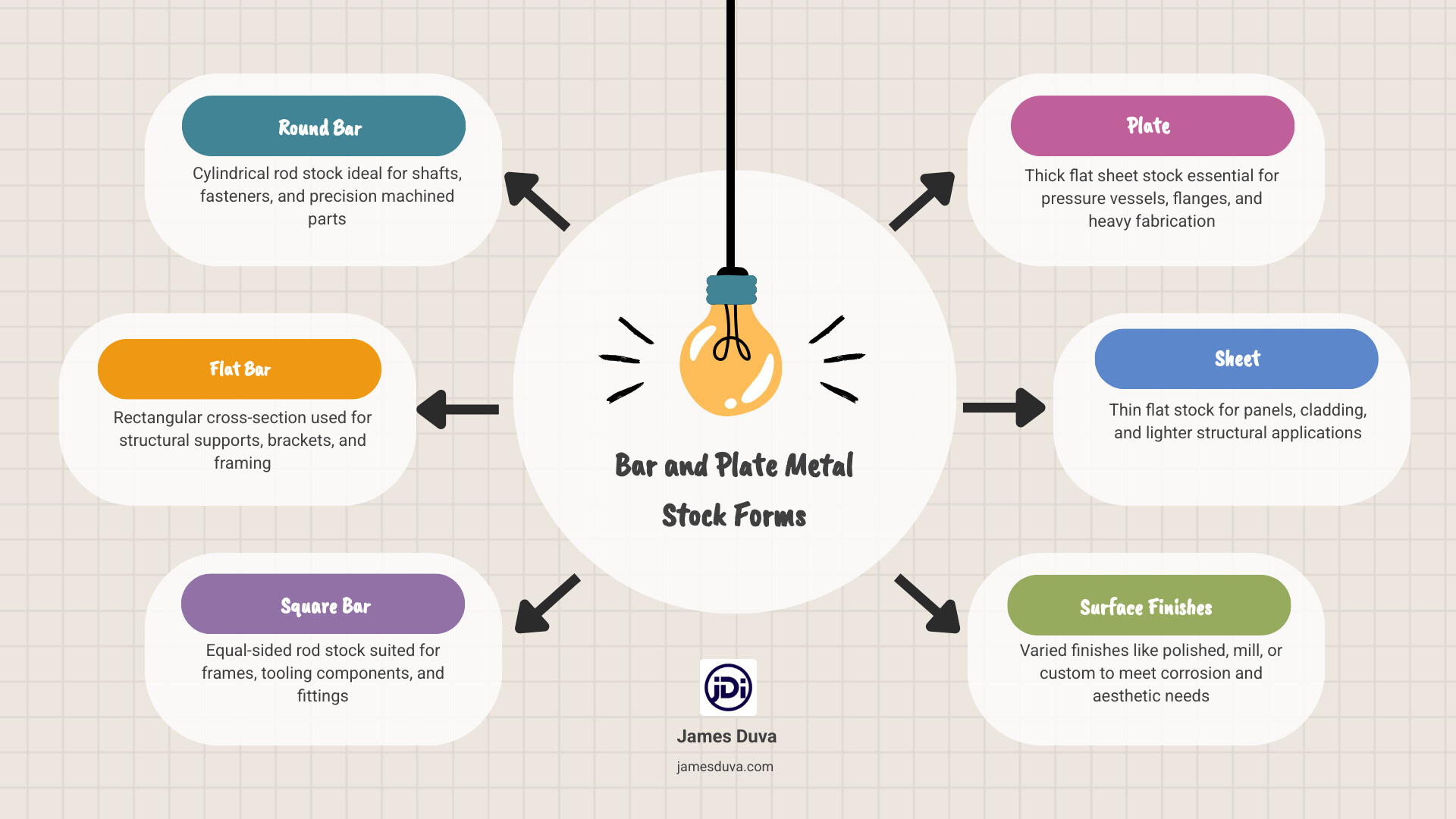
The “shape” of the metal often dictates its destiny. Here’s a breakdown of the common geometries we handle every day:
- Round Bar: This is the workhorse of the machining world. It’s a solid cylindrical rod used for everything from pump shafts to bolts.
- Flat Bar: Rectangular in cross-section, these are often used for bracing, brackets, and base plates.
- Square Bar: These provide excellent structural stability and are frequently used in framing and specialized tooling.
- Plate: Generally defined as flat stock thicker than 3/16 of an inch. Plate is the “heavy lifter,” used to create the walls of large tanks or the heavy flanges that connect massive piping systems.
- Sheet: Thinner than plate, the sheet is often used for cladding, ductwork, or smaller fabricated components.
Surface finishes also play a huge role. Depending on the application, you might need a “Hot Rolled Annealed and Pickled” (HRAP) finish for industrial utility, or a “Cold Finished” surface for tighter dimensional tolerances and a smoother look.
Key Characteristics of Quality Metal Stock
In our industry, “good enough” usually isn’t. When we source bar and plate, we look for three critical pillars of quality:
- Dimensional Accuracy: If a round bar is supposed to be 2 inches, it needs to be exactly that (within specific tolerances). If it’s out of round, your CNC machine won’t be happy, and neither will your bottom line.
- Material Integrity: We ensure the internal structure of the metal is sound—no cracks, inclusions, or “voids” that could cause a catastrophic failure under pressure.
- Traceability and Certification: This is the paperwork side of the business. Every piece of metal we sell comes with a Mill Test Report (MTR). This is the “birth certificate” of the metal, proving exactly what chemicals are in it and how strong it is. In high-stakes environments like a nuclear power plant or an offshore oil rig, traceability isn’t just a preference—it’s a legal requirement.
Why Are Alloys So Valuable in Industry?
You might wonder why we don’t just use pure iron for everything. The truth is, pure metals are often quite boring—and physically weak. Pure iron, for instance, is relatively soft and has a nasty habit of turning into a pile of rust the moment it sees a drop of water. For a general materials overview, the stainless steel article on Wikipedia offers helpful background on how alloying improves performance.
This is where alloys come in. An alloy is essentially a “metal cocktail.” By taking a base metal and mixing in small amounts of other elements like chromium, nickel, or molybdenum, we create a material that is far superior to its individual parts.
Alloys like stainless steel offer:
- Enhanced Strength: They can handle much higher loads without bending or breaking.
- Superior Corrosion Resistance: Chromium creates an invisible passive layer that helps prevent rust from forming.
- Extreme Temperature Durability: Some nickel alloys can sit in a furnace at 2,000 degrees Fahrenheit and still maintain their structural shape.
For those looking to dive deeper into specific high-performance options, you might find The ultimate guide to alloy 20 bars properties uses and more or our resources on the Tag alloy 825 bar particularly helpful for understanding how these “cocktails” perform in the real world.
Applications in Construction, Oil & Gas, and Chemical Processing
In construction, steel bar and plate are the bones of the building. We’re talking about massive beams, structural plates, and piping components that help support critical infrastructure. However, in the Oil & Gas and Chemical Processing sectors, the requirements get even more intense.
Here, bar and plate are used to manufacture:
- Fittings and Flanges: The connectors that hold high-pressure pipelines together.
- Piping Components: Specialized alloy plates are rolled and welded to create pipes that carry corrosive crude oil, high-pressure steam, or volatile chemicals.
- Structural Integrity: Offshore platforms and chemical reactors rely on high-strength alloy plates to withstand the constant pounding of saltwater or the internal pressure of chemical reactions.
Automotive, Aerospace, Medical, and Power Generation Uses
The versatility of bar and plate extends far beyond the oil field.
- Automotive: High-strength bars are used for axles, frames, and engine components, while plates are used for heavy-duty truck structures.
- Aerospace: This is where nickel alloys shine. Engine frames and turbine components must survive incredible heat and stress—failure is not an option at 30,000 feet. You can learn more about these high-performance materials by checking out our Tag alloy 317l bar section.
- Medical: Believe it or not, stainless steel bars are often machined into surgical implants and tools. Because they don’t react with the human body and can be sterilized easily, they are a trusted choice for healthcare applications.
- Power Generation: High-performance alloys are used in turbines and heat exchangers to ensure reliable energy production under extreme thermal conditions.
- Consumer Goods: From the kitchen sink to high-end kitchenware, the “18/10” stainless steel you see is just a specific alloy of bar and plate stock.
Industrial Applications of Bar and Plate Components
While we’ve touched on the materials themselves, it’s fascinating to see how they are transformed into functional components. In many industrial sectors, bar and plate construction is used to create heat exchangers, oil coolers, and intercoolers.
These units are built by stacking layers of plates and bars—hence the name—to create a rugged, compact cooling system. Unlike “tube and fin” designs (which you might find in a car radiator), bar and plate designs are incredibly tough. They can handle “extreme abuse,” which makes them the go-to choice for:
- Mobile Equipment: Think of the massive hydraulic systems in a bulldozer or a crane.
- Agriculture and Forestry: Equipment that operates in dusty, vibrating, and harsh outdoor environments.
- Mining: Where machines operate deep underground and must be virtually indestructible.
- Power Generation: Cooling large engines or turbines that run 24/7.
Demanding Environments and High-Performance Uses
Why choose a bar and plate design over other options? It usually comes down to durability. These designs are “hand-built” and often vacuum-brazed to create a single, unified piece of metal. This makes them highly resistant to:
- Vibration: They won’t shake apart on a bumpy construction site.
- High Pressure: They can handle internal pressures that would cause thinner metals to burst.
- Thermal Shock: They can handle rapid changes in temperature without cracking.
While they are heavier—often weighing about 30% more than a comparable tube and fin unit—that weight translates directly into strength. For example, a heavy-duty oil cooler might use an 88mm core structure to ensure maximum heat exchange even when the machine is working at its absolute limit.
Customization for OEM Requirements
Every Original Equipment Manufacturer (OEM) has different needs. We understand that a “one size fits all” approach doesn’t work when you’re building a custom chemical reactor or a specialized cooling system.
Common customization options include:
- Custom Alloy Grades: Mixing the right “cocktail” (like Alloy 20 or 317L) for a specific chemical environment.
- Specific Dimensions: Cutting plate or bar to the exact millimeter to reduce waste.
- Machining Services: Providing “near-net-shape” pieces that require less work on your end.
- Combi-coolers: Designing units that can cool multiple fluids (like engine oil and hydraulic fluid) in a single brazed unit.
If you are looking for specific material categories, our Product categories bar plate page is a great place to start.
Selecting the Right Bar and Plate Specifications
Choosing the right material is a bit like being a detective. You have to look at all the clues of your environment to find the perfect match. If you pick a material that’s too weak, it breaks. If you pick one that’s “over-engineered,” you waste money.
For instance, if you’re looking at The skinny on 14 inch stainless steel round bar, you aren’t just looking at the size; you’re looking at the weight capacity and how it will react to the fluids it touches.
Factors Influencing Material Performance
When we help customers select bar and plate, we walk through these five factors:
- Corrosion Resistance: Will it be submerged in saltwater? Touching sulfuric acid? This dictates whether you need a 300-series stainless or a high-nickel alloy.
- Mechanical Properties: How much “pull” (tensile strength) or “push” (yield strength) can it take?
- Weldability: If you’re building a large tank, you need a material that takes a weld easily without becoming brittle.
- Machinability: If you are making thousands of small parts, you want a “free-machining” grade that won’t break your drill bits.
- Cost-effectiveness: We aim to find the most affordable material that safely meets all your technical requirements.
Sizing for Specific Use Cases
The “size” of your bar and plate depends entirely on the job:
- Structural Components: Usually require thick plate and heavy square bars.
- Pressure Vessels: Require specific thicknesses of plate that have been certified for high-pressure use.
- Fasteners: Usually machined from high-strength round bar.
- Custom Fabrication: We often provide sheets and plates for “manifolds” or manifolds that are fitted in the field to existing systems.
Frequently Asked Questions about Industrial Bar and Plate
What are the primary types of bar and plate materials James Duva offers?
We specialize in the “tough stuff.” This includes a wide variety of stainless steels (like 304, 316, and 317L) and high-performance nickel alloys (like Alloy 20, 825, and 625). We provide these in round, flat, and square bars, as well as various plate thicknesses. You can explore our full inventory in the James Duva product catalog.
How do I choose the correct alloy for my application?
It starts with a conversation. We’ll ask about your operating temperature, the chemicals involved, the pressure requirements, and your budget. Our goal is to provide a material that offers the best “life cycle cost”—meaning it might cost a bit more upfront but will last five times longer than a cheaper alternative.
Can James Duva provide custom dimensions or finishes?
Absolutely. We aren’t just “order takers”; we are a one-stop shop. Whether you need a specific length of round bar or a plate cut to custom dimensions, we have the processing capabilities to get it done. We also offer various finishes depending on whether your priority is aesthetics or industrial utility.
Conclusion
At James Duva Inc., we believe that the foundation of a great project is great material. Since 1978, we’ve been more than just a supplier; we’ve been a partner to industries that can’t afford to fail. From our home base in Branchburg, NJ, we serve the global market with the expertise and inventory needed to solve the toughest material challenges.
Whether you are looking for high-grade Ball Valves to control your flow or need to stock up on various Product categories bar plate, we are here to help. We take pride in our deep expertise, our commitment to “Made in the USA” quality where possible, and our ability to find those “hard-to-find” items that keep your operations moving.
When it comes to bar and plate, don’t leave it to chance. Work with a team that knows the difference between a standard metal and a high-performance solution. Give us a call or visit us in New Jersey—we’d love to help you build something that lasts.
About James Duva Inc.
Since 1978, James Duva Inc. has been your trusted source for stainless steel and high-nickel alloy industrial products. Whether you’re in the water treatment, process or power industry, we pride ourselves on always having what you need. Say goodbye to your sourcing problems with just one call to James Duva.