
Why Duplex Stainless Steel is the Ultimate Hybrid

May 20, 2026
What Is Duplex Stainless Steel? The Hybrid Alloy Redefining Industrial Performance
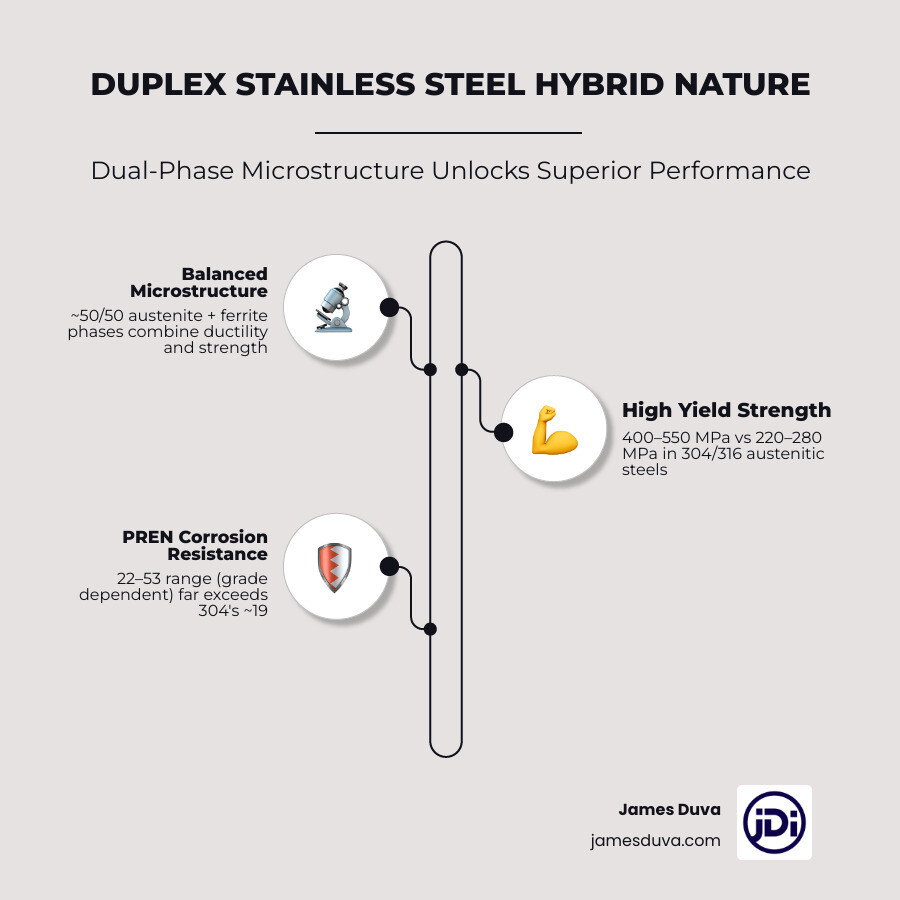
Duplex stainless steel is a two-phase alloy that combines roughly equal amounts of austenite and ferrite in its microstructure — giving it the best traits of both phases in a single material.
Here’s what makes it stand out at a glance:
| Property | Duplex Stainless Steel | Standard 304/316 Austenitic |
|---|---|---|
| Microstructure | Austenite + Ferrite (~50/50) | Austenite only |
| Yield Strength | 400–550 MPa | ~220–280 MPa |
| Stress Corrosion Cracking Resistance | Excellent | Poor to moderate |
| Nickel Content | Low (1.5–9%) | High (8–12%) |
| Magnetic | Yes | No |
| Max Service Temperature | ~315°C (600°F) | Higher |
| Typical PREN Range | 22–53 (grade dependent) | ~19 (304) |
That combination of high strength, corrosion resistance, and lower nickel content is why engineers in oil and gas, chemical processing, and water treatment consistently turn to duplex grades when standard stainless just isn’t enough.
Despite all that performance, duplex stainless steel accounts for only 1–3% of global stainless steel production. It’s a niche material — but for the right applications, it’s genuinely hard to beat.
I’m Billy Walker, Vice President of James Duva Inc., where I’ve spent years helping industrial clients source duplex stainless steel piping components for demanding environments across the power, process, and water treatment sectors. In this guide, I’ll break down everything you need to know — from the metallurgy to the grade selection to the real-world tradeoffs.
Why Are Alloys So Valuable in Industry?
To understand why duplex stainless steel is such a game-changer, we first have to look at why we use alloys at all. Pure metals, while useful in their own right, often fall short in industrial settings. Take pure iron, for example: it is relatively soft and has a notorious appetite for oxygen, leading to rapid rusting.
By creating alloys—mixing a base metal with other elements—we can “engineer” specific properties. Steel itself is an alloy of iron and carbon, but when we add chromium, nickel, and molybdenum, we create a material with superior strength and durability. In A Simplified Guide to Duplex and Super Duplex Piping, these alloys become the backbone of modern infrastructure.
Alloys are the unsung heroes across several sectors:
- Construction: Used in massive beams and complex piping systems where structural integrity is non-negotiable.
- Oil & Gas: Essential for high-pressure fittings, flanges, and subsea pipelines that must survive aggressive saltwater.
- Automotive & Aerospace: Found in high-performance frames and engines where every gram of weight matters, but strength cannot be sacrificed.
- Medical & Consumer Goods: From surgical implants that must be biocompatible to high-end kitchenware that resists staining.
The Metallurgy of Duplex Stainless Steel
The “secret sauce” of duplex stainless steel lies in its unique microstructure. Unlike standard stainless steels, which are either austenitic (like 304 or 316) or ferritic (like the 400 series), duplex is a hybrid. It consists of a roughly 50/50 balance of both austenite and ferrite grains.
This dual-phase structure is achieved by carefully balancing alloying elements. We use “ferritisers” like chromium and molybdenum to encourage the ferrite phase, and “austenitisers” like nickel and nitrogen to promote the austenite phase. This metallurgical “tug-of-war” results in a material that inherits the stress corrosion cracking resistance of ferrite and the general corrosion resistance and toughness of austenite. You can find a deeper dive in this Duplex stainless steel overview or our own guide on Understanding Duplex 2205 Properties Advantages and Applications.
Chemical Composition and the PREN Formula
When we talk about how “tough” a duplex grade is against corrosion, we use a mathematical shortcut called the Pitting Resistance Equivalent Number (PREN). The formula generally looks like this:
PREN = %Cr + 3.3(%Mo + 0.5%W) + 16(%N)
The higher the number, the better the steel resists localized pitting in chloride-rich environments (like seawater). While standard 304 stainless steel has a PREN of about 19, some hyper duplex grades soar above 45. Nitrogen control is especially vital here; it not only boosts corrosion resistance but also improves weldability and increases the yield strength of the alloy. For more technical data, the Duplex stainless steel technical data provides exhaustive breakdowns.
Achieving the Austenite-Ferrite Balance
Getting that perfect 50/50 (or commercially acceptable 40/60) balance isn’t an accident. It requires precise thermal management. During production, the steel is heated to a high temperature where the phases equilibrate and then rapidly quenched (cooled) to “freeze” that microstructure in place.
If the cooling is too slow, or if the chemical balance is off, you risk forming “third phases” like the sigma phase, which can make the metal brittle. We discuss these nuances further in A Comprehensive Guide to Duplex 2205 Properties.
Classifying Grades: From Lean to Hyper
Not all duplex stainless steel is created equal. The family is generally split into four categories based on their alloy content and corrosion resistance.
| Category | Typical Grades | PREN Range | Key Characteristic |
|---|---|---|---|
| Lean Duplex | S32101, S32304 | 22–27 | Low nickel, high strength, cost-effective replacement for 304/316. |
| Standard Duplex | S31803, S32205 | 28–38 | The “workhorse” grade (2205). Excellent all-rounder. |
| Super Duplex | S32750, S32760 | 38–45 | High Cr/Mo/N. Designed for aggressive acids and seawater. |
| Hyper Duplex | S32707, S33207 | >45 | Extreme performance, often limited to specialized tubing. |
Standard Duplex Stainless Steel: The 2205 Workhorse
If you encounter duplex stainless steel in the field, there is an 80% chance it is Grade 2205 (UNS S31803/S32205). With roughly 22% chromium and 5% nickel, it offers a yield strength more than double that of Type 316. It has become the go-to “Corrosion Resistant Alloy” (CRA) for the oil and gas industry because it provides a massive jump in performance without the “exotic” price tag of high-nickel alloys. We’ve spent decades Unlocking the Potential of Duplex 2205 UNS S32205 with James Duva for our clients in Branchburg and beyond.
Super and Hyper Duplex Stainless Steel Performance
When the environment gets truly nasty—think deep-sea oil wells or hot phosphoric acid—we step up to Super Duplex (like 2507). These alloys contain about 25% chromium and significant molybdenum. They are specifically engineered to fight off chloride stress corrosion cracking, a common “silent killer” of standard stainless steels. For those interested in the heavy-duty stuff, check out Mastering the Strength of Super Duplex 2507 A Comprehensive Guide.
Industrial Applications and Advantages
Why do we bother with the complexity of duplex stainless steel? It usually comes down to two things: money and weight. Because duplex is twice as strong as 316L, you can often use thinner walls for pipes and vessels. This “lightweighting” reduces the total tonnage of steel required, which can offset the higher cost per pound of the material itself.
Key industries include:
- Oil & Gas: Subsea pipelines, manifolds, and risers where high pressure and salt are constant.
- Chemical Processing: Pressure vessels and heat exchangers handling corrosive fluids.
- Desalination: Handling high-chloride brine that would eat through standard steel in months.
- Pulp & Paper: Digesters and bleach plant equipment.
In these environments, Ball Valves made of duplex alloys provide the longevity needed to avoid costly downtime. The academic review Duplex Stainless Steels—Alloys for the 21st Century highlights that these materials are becoming the standard for critical infrastructure.
Infrastructure and Architecture Case Studies
You might be surprised to find duplex stainless steel in high-end architecture. Because it requires very little maintenance and resists the “tea staining” common in coastal areas, it’s a favorite for landmark projects:
- The Helix Bridge (Singapore): Uses duplex for its high strength-to-weight ratio.
- Louvre Abu Dhabi: The intricate structure relies on the durability of these alloys in a marine environment.
- La Sagrada Familia (Spain): Duplex reinforcement bars are used to ensure the cathedral lasts for centuries.
Technical Limitations and Fabrication Challenges
It’s not all sunshine and high PREN numbers. Duplex stainless steel is a sensitive material that requires a “gentle touch” during fabrication.
One of the biggest hurdles is the temperature limit. Duplex is generally restricted to service temperatures below 315°C (600°F). If it stays too long in the 280°C to 500°C range, it suffers from 475°C embrittlement. This is a phenomenon where the ferrite phase undergoes spinodal decomposition, making the metal as brittle as glass. Similarly, slow cooling can lead to sigma phase formation, which ruins both toughness and corrosion resistance.

Welding and Fabrication Best Practices
Welding duplex is a balancing act. You need enough heat to ensure good fusion, but not so much that you grow massive ferrite grains or trigger intermetallic phases.
- Nitrogen Control: Using a filler metal with extra nickel and sometimes nitrogen helps maintain the phase balance in the weld pool.
- Cooling Rates: You want a “Goldilocks” cooling rate—fast enough to avoid sigma phase, but slow enough to allow austenite to reform.
- Interpass Temperature: Keeping the metal from getting too hot between weld passes is critical.
We often help customers navigate these hurdles when Deciphering the Duel Duplex 2205 vs Super Duplex 2507 for Industrial Applications.
Frequently Asked Questions about Duplex Stainless Steel
Is duplex stainless steel magnetic?
Yes! This is one of the easiest ways to tell it apart from 300-series stainless steels like 304 or 316. Because duplex contains a significant amount of ferrite (which is magnetic), the entire alloy is ferromagnetic. If a magnet sticks to your “stainless” pipe, and it isn’t a 400-series steel, you’re likely looking at a duplex grade.
How does duplex compare to 316L in terms of cost?
While the price per pound of duplex stainless steel can be higher than 316L, it is often more price-stable because it contains less nickel. Furthermore, the real savings come from weight reduction. If you can use a pipe that is 20% thinner because the material is twice as strong, your total project cost often drops. For a head-to-head look, see Duplex 2205 vs Other Stainless Steels A Comparative Analysis.
What is the maximum service temperature for duplex?
The hard ceiling is generally 315°C (600°F). Beyond this, the risk of alpha prime precipitation and mechanical degradation becomes too high. For high-heat applications, you’re better off sticking with traditional austenitic grades or high-nickel alloys.
Conclusion
Duplex stainless steel truly is the ultimate hybrid of the metallurgical world. It offers the strength of ferritic steels and the corrosion resistance of austenitic steels, all while providing a path toward lighter, more cost-effective industrial designs. While it requires expertise to fabricate and has clear temperature boundaries, its benefits in aggressive environments are unmatched.
At James Duva Inc., we’ve been the trusted one-stop shop for high-grade alloys since 1978. Based in Branchburg, NJ, we maintain a deep inventory of duplex products to serve the chemical, oil, gas, and water treatment industries. If you’re looking to upgrade your system’s reliability, we’re here to help you find the right grade for the job.
Ready to learn more? Start by Understanding Duplex 2205 Properties Advantages and Applications or reach out to our team today.
About James Duva Inc.
Since 1978, James Duva Inc. has been your trusted source for stainless steel and high-nickel alloy industrial products. Whether you’re in the water treatment, process or power industry, we pride ourselves on always having what you need. Say goodbye to your sourcing problems with just one call to James Duva.