
Detailed Guide to Stainless Steel Types
Jun 17, 2026
Introduction to Stainless Steel and Its Role in Modern Industry
The four main types of stainless steel are:
| Type | Crystal Structure | Magnetic? | Key Strength |
|---|---|---|---|
| Austenitic | Face-centered cubic (FCC) | No | Best corrosion resistance |
| Ferritic | Body-centered cubic (BCC) | Yes | Good heat resistance, lower cost |
| Martensitic | Body-centered tetragonal (BCT) | Yes | Highest hardness and strength |
| Duplex | Mixed FCC + BCC | Partially | Twice the yield strength of austenitic |
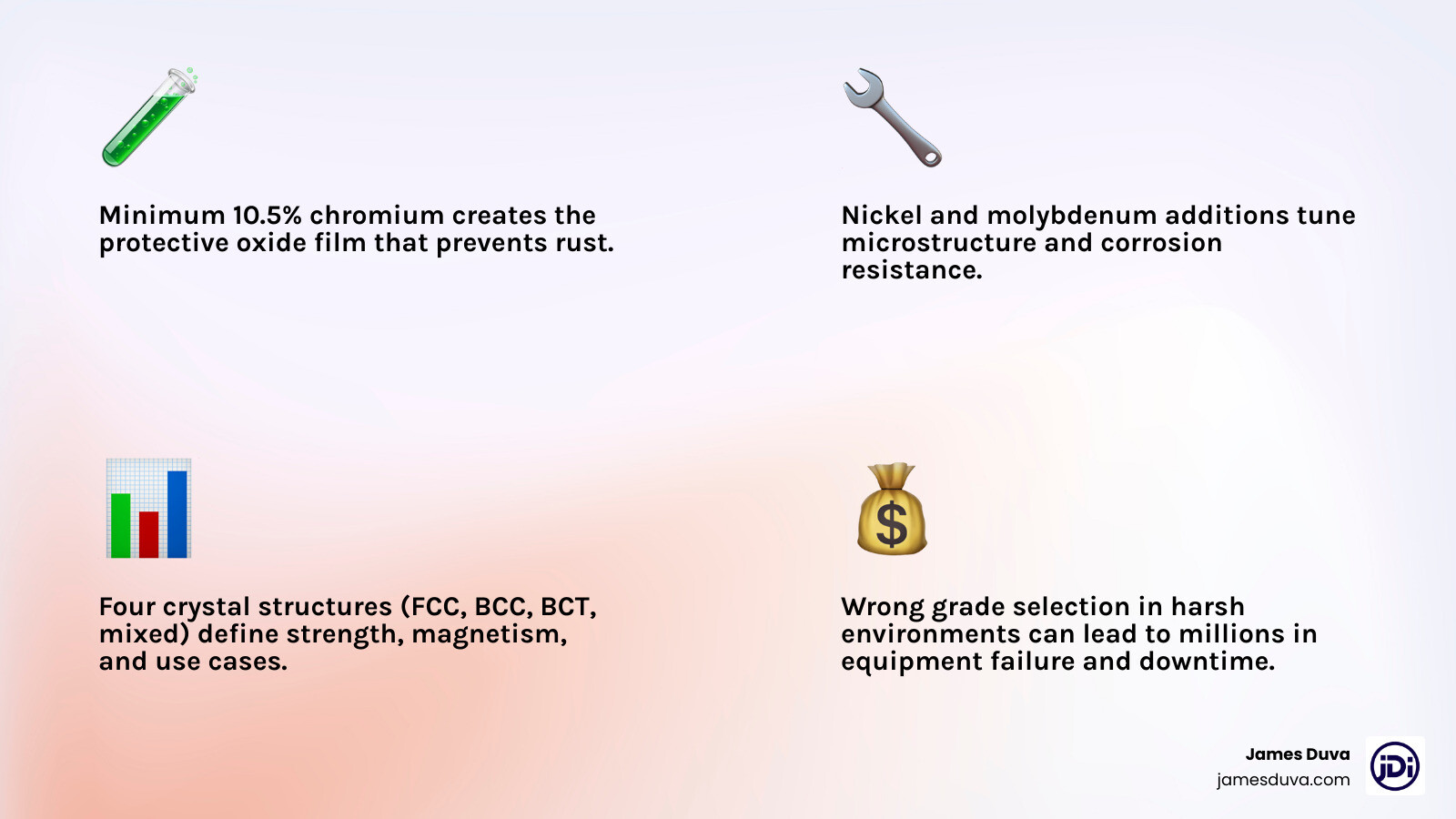
Whether you work in chemical processing, oil and gas, water treatment, or any other demanding industry, stainless steel shows up everywhere — in pipes, fittings, valves, vessels, and more. Choosing the wrong type can mean premature failure, costly downtime, or even catastrophic damage. One real-world example: a Midwest processing company lost $2.4 million after specifying the wrong grade for a brine processing line.
With over 150 grades falling into four main families, the choice is not always obvious. This guide breaks it all down clearly — from microstructure to application — so you can source the right material with confidence.
I’m Billy Walker, Vice President of James Duva Inc., where I’ve spent years helping engineers and procurement professionals in the power, process, and water treatment industries identify the right types of stainless steel and high-nickel alloy products for critical applications. As you read through this guide, you’ll find the practical, specification-level detail you need to make the right call.
What Is Stainless Steel and Why Are Alloys So Valuable in Industry?
At its core, stainless steel is an iron-based alloy. To be officially classified as “stainless,” the metal must contain a minimum of 10.5% chromium. This specific element is the magic ingredient that transforms ordinary, rust-prone iron into a durable, corrosion-resistant powerhouse. While iron is the foundation, we add other elements like nickel, molybdenum, nitrogen, and manganese to fine-tune the metal’s microstructure and performance.
These additions change how the atoms are arranged, which is why we have different families of steel. For more background on the industry, check out A Comprehensive Introduction to Stainless Steel Facts and Industry Insights.
Why Are Alloys So Valuable in Industry?
In the industrial world, pure metals are rarely the best tool for the job. Pure iron, for instance, is relatively soft and begins to oxidize (rust) the moment it meets moisture and oxygen. By creating an alloy—a mixture of two or more elements—we can engineer materials that are significantly stronger, harder, and more durable than their pure counterparts.
Alloys allow us to control specific properties. We can make a metal that survives the cryogenic temperatures of liquid nitrogen or the blistering heat of a jet engine. This versatility is why alloys are the backbone of modern infrastructure. You can learn more about this in our guide on How Different Alloys Change Steels Properties.
Common applications include:
- Construction: Massive beams and specialized piping systems.
- Oil & Gas: High-pressure Ball Valves, fittings, and flanges that must resist sour gas and salt water.
- Automotive & Aerospace: High-strength frames and engine components that withstand extreme vibration.
- Medical & Consumer Goods: Surgical implants that won’t react with the human body and kitchenware that stays hygienic.
How Stainless Steel Gets Its Corrosion Resistance
The secret to stainless steel’s longevity is a “passive film.” When chromium in the steel reacts with oxygen in the air or water, it forms an incredibly thin (only 2-3 nanometers thick!), transparent layer of chromium oxide on the surface.
This film is self-healing. If you scratch a stainless steel pipe, the exposed chromium immediately reacts with oxygen to reform the protective barrier. This prevents localized attacks and uniform corrosion from eating through the metal. It also makes the surface non-porous and incredibly easy to clean, which is vital for food and pharmaceutical safety.
A Brief History and How Stainless Steel Is Classified
The development of stainless steel took off in the early 1900s, with various scientists in England, Germany, and the U.S. discovering that adding chromium prevented rusting. By May 2026, the global industry has matured into a massive operation, with world production exceeding 58 million metric tons annually.
To keep things organized, we use several classification systems:
- AISI/SAE: Uses three-digit numbers (like 304 or 410).
- UNS (Unified Numbering System): A letter followed by five digits (e.g., S30400).
- EN 10088: The European standard.
Historically, the 400-series (ferritic and martensitic) were the first to be developed, followed by the highly versatile 300-series. For a deeper look at the timeline, see Power and Stainless Steel: A History.
The Four Main Types of Stainless Steel
When we talk about types of stainless steel, we are usually referring to their metallurgical “families.” These families are defined by their internal crystal structure, which dictates how the metal behaves when you weld it, bend it, or expose it to a magnet.
Austenitic Types of Stainless Steel
Austenitic steels are the most popular, representing about two-thirds of all global production. They primarily fall into the 200 and 300 series. These steels contain high levels of chromium and nickel (and sometimes manganese or nitrogen), which keeps the “austenite” crystal structure stable even at room temperature.
- Key Traits: Non-magnetic, excellent corrosion resistance, and highly formable.
- Common Grades: 304 (the “workhorse”) and 316 (the “marine grade”).
- Applications: Everything from kitchen sinks and Ball Valves to chemical tankers and aerospace tubing.
For a technical deep dive, see our In-Depth Guide to Stainless Steel Alloy Properties.
Ferritic Types of Stainless Steel
Ferritic steels are part of the 400-series. They contain chromium but very little to no nickel. This makes them more cost-effective but generally less corrosion-resistant than austenitic types.
- Key Traits: Magnetic, good thermal conductivity, and resistant to stress corrosion cracking.
- Common Grades: 430 and 409.
- Applications: Automotive exhaust systems, appliance panels (like the front of your dishwasher), and indoor architectural trim.
Martensitic Types of Stainless Steel
Also part of the 400-series, martensitic steels have higher carbon content. This allows them to be “quenched and tempered”—a heat treatment process that makes them incredibly hard and strong.
- Key Traits: Magnetic, extremely hard, but lower corrosion resistance than the other families.
- Common Grades: 410, 420, and 440C.
- Applications: Cutlery, surgical instruments, turbine blades, and heavy-duty fasteners.
Duplex Types of Stainless Steel
Duplex stainless steels are a modern marvel. They have a “mixed” microstructure that is roughly 50% austenitic and 50% ferritic. This gives you the best of both worlds: the corrosion resistance of the 300-series and the high strength of the 400-series.
- Key Traits: Twice the yield strength of standard austenitic grades and superior resistance to chloride-induced stress corrosion.
- Common Grades: 2205 and 2507 (Super Duplex).
- Applications: Offshore oil rigs, desalination plants, and chemical processing pressure vessels.
Explore the specifics in our Duplex 2205 vs Other Stainless Steels: A Comparative Analysis.
How the Types of Stainless Steel Differ in Performance
Understanding the differences between these types of stainless steel is essential for any engineering project. Performance varies wildly based on the crystal structure.
Microstructure, Strength, and Magnetism Across Types of Stainless Steel
- Austenitic (FCC): These are non-magnetic. They don’t have a high yield strength in their annealed state, but they “work-harden” rapidly when cold-worked.
- Ferritic (BCC): These are always magnetic. They have moderate strength and do not harden much with heat treatment.
- Martensitic (BCT): These are magnetic and can reach tensile strengths up to 1700 MPa through heat treatment.
- Duplex (Mixed): These are magnetic and offer roughly double the yield strength of 316L, allowing for thinner, lighter pipes and vessels.
Corrosion Resistance: Uniform, Pitting, Crevice, Stress, Galvanic, and High-Temperature
Not all corrosion is the same. While all stainless steels resist “uniform” rusting, they face different challenges:
- Pitting and Crevice Corrosion: Common in salty environments. Adding molybdenum (found in 316 and Duplex) is the best defense.
- Stress Corrosion Cracking (SCC): Austenitic steels like 304 can crack under tension in chloride environments. Ferritic and Duplex grades are much more resistant to this.
- High-Temperature Oxidation: Ferritic grades often perform better in cyclic heating because they expand less than austenitic steels.
Machinability, Formability, and Welding Considerations
- Machinability: Martensitic 416 is the “free-machining” king. Austenitic grades can be tricky because they harden as you cut them, requiring sharp tools and heavy cuts.
- Welding: Austenitic grades are generally the easiest to weld. Duplex requires a careful balance of heat to maintain the 50/50 structure. “L” grades (like 304L or 316L) have low carbon to prevent “sensitization,” a type of corrosion that happens after welding.
- Formability: If you need to deep-draw a kitchen sink, austenitic 304 is your best bet due to its high ductility.

Standard Finishes, Joining Methods, and Production Processes
Surface finish is about more than just looks; it affects corrosion resistance.
- 2B Finish: A smooth, moderately reflective mill finish used as a base for other finishes.
- No. 4 Finish: The “brushed” look seen on kitchen equipment.
- Sanitary Finish: High-polish finishes used in pharma to ensure no bacteria can hide in surface pits.
Joining methods include TIG/MIG welding, brazing, and mechanical bolting. In many process industries, high-quality Ball Valves are integrated into these systems to control flow reliably.
How to Choose the Right Types of Stainless Steel for Your Project
Choosing a grade is a balancing act between environment, mechanical needs, and budget.
Match the Grade to Temperature, Corrosion, Stress, and Weight
- Cryogenic: Stick with austenitic grades; they remain tough at ultra-low temperatures.
- Marine: Use 316L or Duplex 2205 to handle the chlorides in sea spray.
- High Load: If weight is an issue, the high strength of Duplex allows you to use thinner walls, saving money and total weight.
- High Heat: Grade 446 or specialized austenitic grades like 310 work best for furnace parts.
Choose Based on Machining, Welding, Surface Finish, and Budget
Budget is always a factor. Ferritic grades (400-series) are generally cheaper because they don’t contain expensive nickel. However, if your project requires extensive welding, the labor costs for welding ferritic steel might outweigh the material savings compared to an easy-to-weld 304L.
Common Grade Recommendations by Application
- Food Processing: 304 is the standard, but use 316 if you are processing salty brines.
- Oil & Gas: Duplex 2205 for flowlines and manifolds.
- Architecture: 304 for indoors, 316 for coastal exteriors.
- Fasteners: 410 for strength, 304 for general corrosion resistance.
For more examples, see Stainless Steel Applications for Every Industry.
Sustainability, Safety, and Health Considerations
Stainless steel is an incredibly “green” material. It is 100% recyclable, and the average new piece of stainless steel contains about 60% recycled content.

Sustainability and Lifecycle Benefits
The carbon footprint of stainless steel is approximately 2.90 kg of CO2 per kg produced. While this is significant, the lifecycle value is massive. Because stainless steel lasts decades with minimal maintenance, you don’t have to replace it frequently, which saves resources over time. You can read more about the global impact in The Facts on the Worlds Steel Industry.
Health Effects and Safe Handling When Working With Stainless Steel
Safety is paramount in the shop.
- Welding Fumes: Can contain hexavalent chromium; proper ventilation and PPE are mandatory.
- Metal Dust: Grinding stainless steel produces fine dust that should not be inhaled.
- Cross-Contamination: Never use the same tools on carbon steel and stainless steel. Carbon steel particles can “infect” the stainless and cause it to rust.
Maintenance and Cleaning Best Practices
To keep the passive layer healthy, avoid chloride-based cleaners (like bleach). Simple soap and water or specialized stainless steel cleaners work best. Regular inspection for “tea staining” or pitting can catch problems before they lead to leaks.
Frequently Asked Questions About Types of Stainless Steel
What are the four main types of stainless steel?
The four main types are austenitic (300 series), ferritic (400 series), martensitic (high-carbon 400 series), and duplex (mixed structure).
Which stainless steel type is best for corrosion resistance?
Austenitic 316 is generally the best for common corrosive environments like marine or chemical settings. For extreme chloride environments, Duplex or Super Duplex grades are superior.
How do I choose between 304, 316, 430, 410, and 2205?
- 304: General purpose, non-magnetic, good corrosion resistance.
- 316: Better for salt/chemicals.
- 430: Cheaper, magnetic, light-duty indoor use.
- 410: Hard and strong, magnetic, used for tools.
- 2205: High strength and elite corrosion resistance for industrial use.
Conclusion: Choosing the Best Stainless Steel with Confidence
Selecting the right types of stainless steel is about more than just picking a number out of a catalog. It’s about understanding the environment, the mechanical stresses, and the long-term maintenance requirements of your system.
At James Duva Inc., we’ve been the trusted one-stop shop for high-grade stainless steel and nickel alloys since 1978. Whether you need specialized piping, fittings, or Ball Valves, our team in Branchburg, NJ, has the expertise to ensure you get the exact specification your project demands.
For further reading, check out this An Introduction to Stainless Steels or browse our category page for more stainless steel insights. If you have questions about which grade is right for your next build, reach out to us—we’re here to help.
About James Duva Inc.
Since 1978, James Duva Inc. has been your trusted source for stainless steel and high-nickel alloy industrial products. Whether you’re in the water treatment, process or power industry, we pride ourselves on always having what you need. Say goodbye to your sourcing problems with just one call to James Duva.