
316 Stainless Steel Corrosion Resistance: In Depth Guide to Performance

Jun 15, 2026
Why 316 Stainless Steel Corrosion Resistance Matters in Demanding Industries
316 stainless steel corrosion resistance is what sets this alloy apart from nearly every other common grade of stainless steel — especially when chlorides, acids, or seawater are involved.
Here is a quick summary of what you need to know:
| Property | 316 Stainless Steel |
|---|---|
| Key alloying elements | 16-18% Cr, 10-14% Ni, 2-3% Mo |
| Pitting Resistance Equivalent (PREN) | 24.2 |
| Corrosion rate (marine splash zone) | 0.86 µm/year |
| Max chloride tolerance (ambient water) | ~2,000 ppm |
| Stress corrosion cracking risk | Above ~60°C |
| Preferred variant for welding | 316L (low carbon, max 0.03% C) |
The molybdenum content — 2 to 3% — is the critical difference. It gives 316 far better resistance to pitting and crevice corrosion than standard 304 stainless steel, particularly in chloride-rich or acidic environments.
This matters most in industries like chemical processing, oil and gas, pharmaceutical manufacturing, and marine applications, where corrosion failure is not just costly — it can be dangerous.
That said, 316 is not a universal solution. It has real limitations at high temperatures, in concentrated acids, and in full seawater immersion. Understanding exactly where it performs well — and where it doesn’t — is what this guide covers.
I’m Billy Walker, Vice President of James Duva Inc., a specialty supplier of stainless steel and high-nickel alloy piping products serving the power, process, and water treatment industries since 1978. My work sourcing and supplying materials for demanding process environments has given me a practical, ground-level understanding of 316 stainless steel corrosion resistance and where proper grade selection makes or breaks a project. Let’s get into the details.
Why Are Alloys So Valuable in Industry?
To understand why we rely so heavily on 316 stainless steel, we first have to look at why we use alloys at all. In their pure, elemental forms, metals are rarely suited for the harsh realities of industrial service. Pure iron, for instance, is relatively soft, mechanically weak, and notoriously prone to rust when exposed to oxygen and moisture.
By melting iron down and combining it with carbon and other elements, we create steel—a material with vastly superior strength and durability. When we introduce specific alloying elements like chromium, nickel, and molybdenum, we transform basic steel into corrosion-resistant stainless steel.
These tailored metallic mixtures are the backbone of modern infrastructure. In Construction, alloy steel forms the high-strength structural beams and heavy-duty utility piping that keep buildings standing and municipal water systems running. In the Oil & Gas sector, high-performance alloy fittings, flanges, and valves contain extreme pressures and block corrosive sour gases. The Automotive & Aerospace industries depend on specialized alloys to build lightweight, high-strength frames and heat-resistant engine components. Meanwhile, in the Medical & Consumer Goods fields, biocompatible alloys are used for orthopedic implants, surgical tools, and hygienic commercial kitchenware.
By strategically adjusting the recipe of these metals, metallurgists can control physical and chemical properties to match the exact demands of an application. To learn more about how these mixtures are formulated, read our guide on How Different Alloys Change Steel’s Properties or explore our In-Depth Guide to Stainless Steel Alloy Properties.
Understanding 316 Stainless Steel Corrosion Resistance
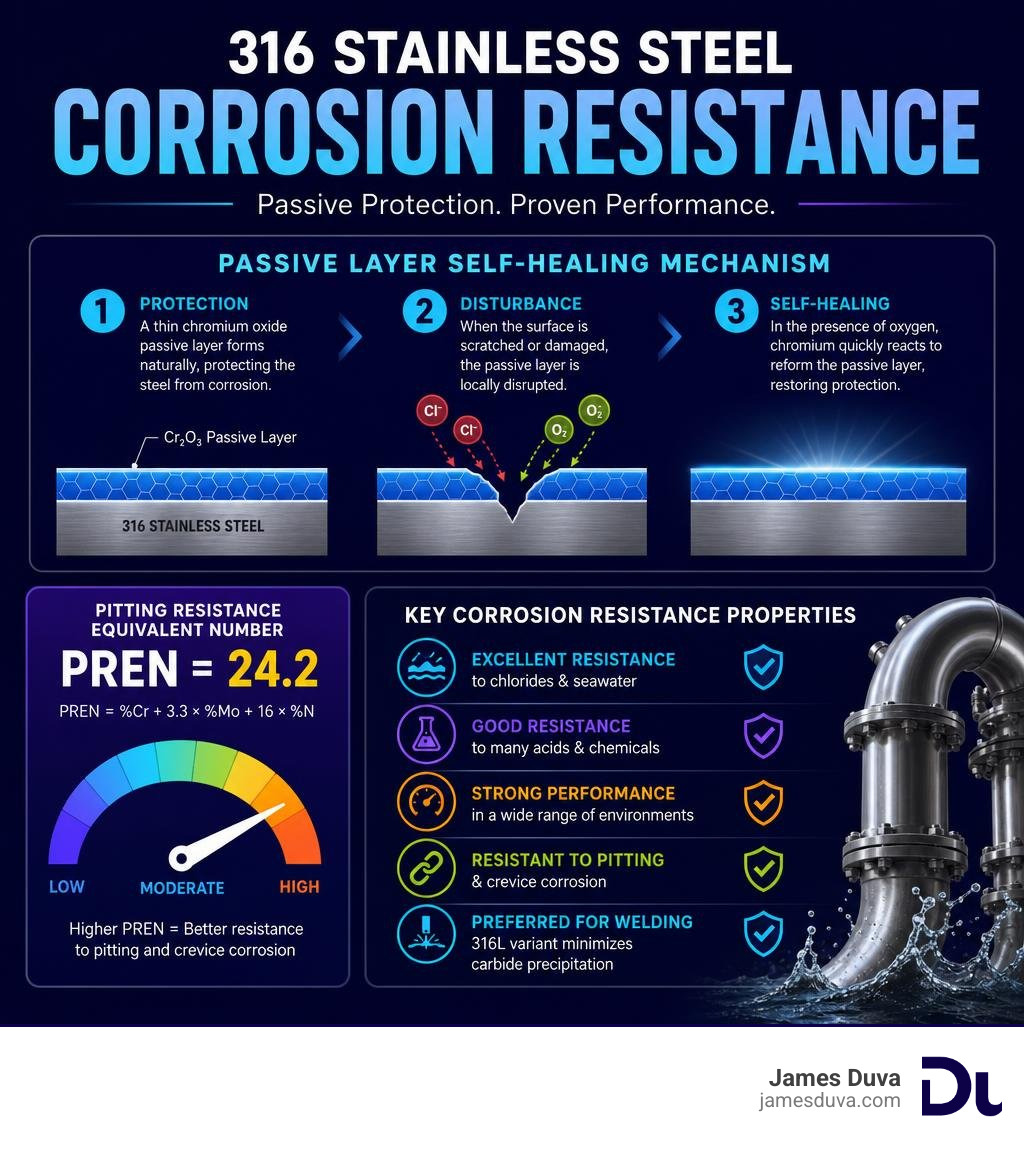
At the heart of 316 stainless steel corrosion resistance is a chemical phenomenon known as passivity. Unlike plain carbon steel, which oxidizes to form a loose, flaky layer of rust that accelerates decay, stainless steel contains a minimum of 10.5% chromium.
When chromium is exposed to oxygen, it instantly reacts to form an incredibly thin, invisible, and tightly adherent film of chromium oxide ($Cr2O3$) on the metal’s surface. This passive layer is self-healing. If the surface is scratched or mechanically damaged, the exposed chromium reacts with surrounding oxygen to rebuild the protective film in milliseconds.
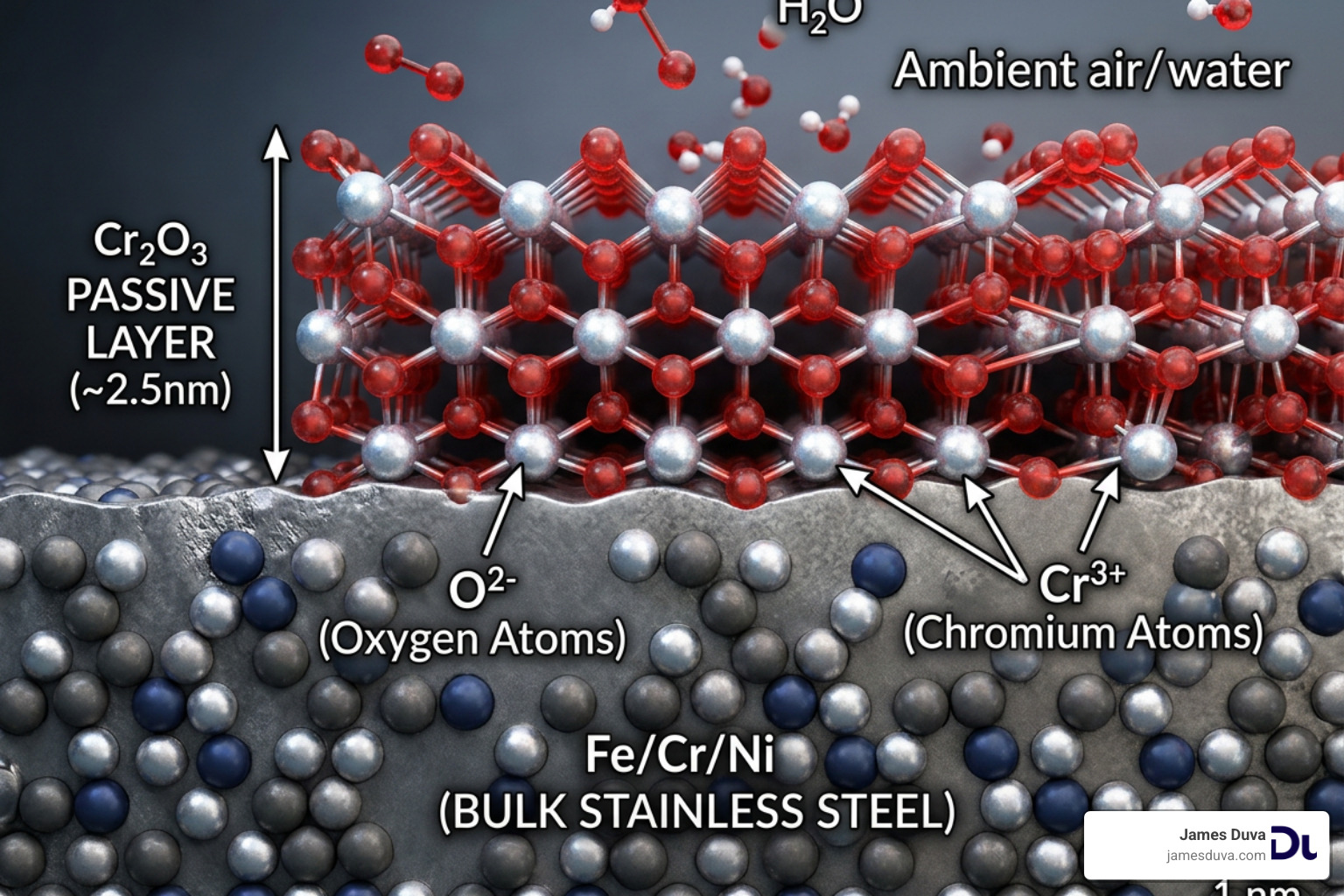
Grade 316 is an austenitic stainless steel, meaning it possesses a face-centered cubic crystal structure that remains stable from cryogenic temperatures up to high heat. Its standard chemical profile consists of:
- Chromium (16–18%): The primary engine for passivity and general oxidation resistance.
- Nickel (10–14%): Stabilizes the ductile austenitic structure and improves resistance to reducing acids and stress corrosion cracking.
- Molybdenum (2–3%): The defining addition that elevates 316 above standard 18-8 stainless steels.
To quantify how well a stainless steel alloy can resist localized pitting in chloride environments, engineers use the Pitting Resistance Equivalent Number (PREN) formula:
$$PREN = %Cr + 3.3(%Mo) + 16(%N)$$
For standard 316/316L stainless steel, this calculation yields a PREN value of approximately 24.2. By comparison, standard 304 stainless steel scores a 19.0. This gap represents a massive leap in real-world durability. For a complete look at how this composition translates to daily industrial use, read our Understanding 316 Grade Stainless Steel article and our Detailed Guide to 316L vs 316 Stainless Steel.
The Role of Molybdenum in 316 Stainless Steel Corrosion Resistance
What makes molybdenum so special? While chromium is excellent at forming the initial passive film, chloride ions ($Cl^-$)—found in salt, bleach, and coastal air—are incredibly small and highly aggressive. They can penetrate weak spots in the chromium oxide layer, initiating localized pitting.
Molybdenum changes the game. When molybdenum is added to the alloy at 2% to 3%, it concentrates within the passive film, strengthening its structure and making it far more resistant to chloride penetration. If a chloride ion does manage to break through, molybdenum acts to slow down the localized dissolution of the metal, preventing the pit from growing.
This shielding effect is also highly effective against crevice corrosion—the localized decay that occurs in stagnant, oxygen-depleted gaps, such as under gaskets, washers, or bolted joints. Furthermore, molybdenum improves the alloy’s resistance to reducing acids, such as moderate concentrations of sulfuric and phosphoric acids. To see the scientific analysis behind this behavior, check out the study on Revealing the Corrosion Resistance of 316 L Stainless Steel.
Comparing 304 vs 316 Stainless Steel Performance
For many design engineers, the ultimate decision comes down to 304 vs. 316. While 304 is the most widely produced stainless steel on earth, it often falls short in harsh chemical or coastal environments.
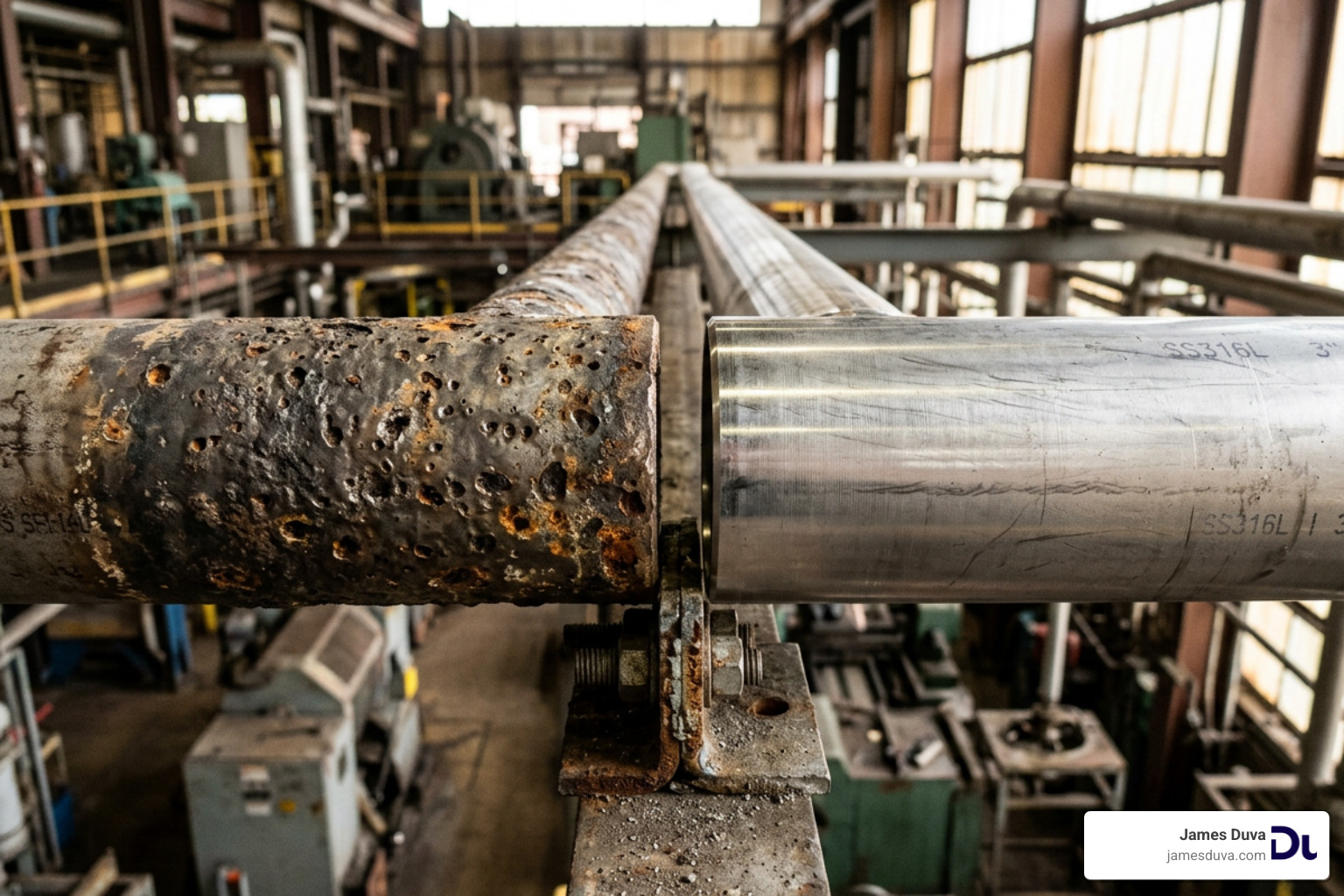
The performance gap is clear when looking at real-world exposure data. In marine splash zone testing over 15 months, 316 stainless steel exhibited a remarkably low corrosion rate of just 0.86 µm/year, whereas 304 stainless steel degraded at a rate of 1.13 µm/year. While those numbers seem small, over years of continuous service in a chemical plant or offshore platform, that difference determines whether a system runs smoothly or suffers a catastrophic leak.
| Parameter | Grade 304 | Grade 316 |
|---|---|---|
| Chromium (Cr) Content | 18.0 – 20.0% | 16.0 – 18.0% |
| Nickel (Ni) Content | 8.0 – 10.5% | 10.0 – 14.0% |
| Molybdenum (Mo) Content | 0% | 2.0 – 3.0% |
| PREN Value | 19.0 | 24.2 |
| Splash Zone Corrosion Rate | 1.13 µm/year | 0.86 µm/year |
| Max Ambient Chloride Limit | ~300 – 500 ppm | ~2,000 ppm |
This comparative performance is detailed extensively in the 304 vs 316 Stainless: Corrosion & CNC Guide which highlights how the presence of chlorides dictates material selection.
Marine and Chloride-Rich Environments: 304 vs 316 Stainless Steel Corrosion Resistance
In coastal areas and marine applications, salt spray and high humidity are constant threats. When standard 304 stainless steel is utilized in these environments, it often develops “tea staining”—a brown, unsightly surface rust—within months. This occurs because the airborne chlorides continually break down 304’s passive layer.
Grade 316, often referred to as “marine-grade stainless steel,” handles these conditions with ease. In controlled laboratory testing using a 0.1 M NaCl solution, 316 stainless steel shows no pitting initiation whatsoever. However, chemical environment details matter: if copper compounds are introduced (such as 0.1 M NaCl + 1 mM $CuCl_2$), pitting can be forced to initiate due to copper deposition on the surface.
This superior resistance makes 316 the absolute standard for marine fasteners, deck hardware, and coastal architectural installations. To understand how these environments affect different materials, you can read our In-Depth Guide to Stainless Steel Alloy Properties. For a deeper dive into how this grade holds up on ocean-going vessels, read The Corrosion Resistance of 316 Stainless Steel Fasteners.
Environmental Performance, Applications, and Vulnerabilities of Grade 316
While Grade 316 is highly versatile, it is not invincible. To design reliable systems, we must look at where it excels and where it is vulnerable.
- Chloride Limits: At ambient temperatures, 316 can safely handle potable water containing up to roughly 2,000 ppm of chlorides. However, if water temperatures rise to 60°C (140°F) or higher, this threshold drops significantly to around 300 ppm.
- Stress Corrosion Cracking (SCC): Like most austenitic stainless steels, 316 is susceptible to SCC in chloride-rich environments when subjected to tensile stress at temperatures above 60°C. Under these specific conditions, microscopic cracks can rapidly propagate through the metal, leading to sudden structural failure without warning.
- Carbide Precipitation and Intergranular Corrosion: When standard 316 is heated to temperatures between 800°F and 1500°F (427°C to 816°C)—which commonly occurs during welding—carbon reacts with chromium to form chromium carbides along the grain boundaries. This “sensitization” strips the surrounding areas of chromium, leaving the grain boundaries highly vulnerable to intergranular corrosion.
Despite these limitations, 316 is the premier choice across a vast array of critical fields. In chemical processing, it safely handles hot organic acids, fatty acids, and industrial solvents. Pharmaceutical manufacturing and medical device production rely on 316 because it can withstand aggressive sterilization chemicals and maintains clean, non-contaminating surfaces. In the food and beverage sector, it resists organic acids from tomatoes and meats while tolerating caustic clean-in-place (CIP) chemicals.
From a commercial standpoint, 316 carries a 20% to 35% cost premium over 304 due to the high cost of raw molybdenum and nickel. However, looking at the total cost of ownership, 316 often proves to be the far more economical choice by avoiding premature equipment failures, plant shutdowns, and costly replacements. For more application ideas, check out Metals That Can Take the Heat and the Rust: A Comprehensive Guide and our overview of Stainless Steel Applications for Every Industry.
Key Variants: 316L, 316H, and 317
To address the specific vulnerabilities of standard 316, metallurgists developed specialized variants:
- 316L (Low Carbon, UNS S31603): By limiting carbon content to a maximum of 0.03% (compared to 0.08% in standard 316), 316L prevents carbide precipitation during welding. This allows welded structures to be placed directly into highly corrosive services without the need for a post-weld solution annealing heat treatment.
- 316H (High Carbon, UNS S31609): Formulated with a carbon content of 0.04% to 0.10%, this grade provides increased tensile and creep strength at elevated temperatures (above 500°C), making it ideal for structural and boiler applications.
- 317/317L (UNS S31700/S31703): For environments where 316 is borderline, 317 increases the chromium (18–20%) and molybdenum (3–4%) content. This pushes the PREN up to 29.7, offering significantly better resistance to pitting and general chemical attack.
For detailed engineering limits and certified chemistry ranges of these variations, you can consult the T316 Blue Sheet Data.
Post-Processing and Surface Treatments to Prevent Corrosion
Even the best alloys can benefit from a helping hand. To maximize 316 stainless steel corrosion resistance, several post-processing and surface treatments can be applied:
- Passivation (ASTM A967): A chemical treatment using nitric or citric acid that strips free iron and surface contaminants left behind by machining or fabrication. This process leaves a clean, chromium-rich surface that quickly forms a robust passive oxide layer.
- Electropolishing: An electrochemical process that removes a microscopic layer of metal from the surface. It eliminates microscopic peaks and valleys, leaving an ultra-smooth, mirror-like finish that reduces bacterial adhesion and removes potential corrosion initiation sites.
- Laser Surface Melting: An advanced surface-engineering technique that uses a high-power laser to melt and rapidly solidify the surface layer. This refines the grain structure and can enrich the surface in molybdenum, dramatically reducing localized corrosion rates. In molten salt environments, such as Li2BeF4 salt used in advanced nuclear designs, laser-melted 316 demonstrates an incredibly low predicted corrosion attack depth of just 17.1 µm/year.
- Cathodic Protection and Coatings: In extreme environments, sacrificial anodes can be connected to the metal, or protective barrier coatings (like epoxy or polymer paints) can be applied to block direct contact with corrosive media.
Frequently Asked Questions about 316 Stainless Steel
Can 316 stainless steel rust in salt water?
Yes, under certain conditions. While 316 is highly resistant to seawater and is widely considered the standard marine grade, it is not completely immune. In stagnant seawater, oxygen levels can drop, preventing the passive oxide film from self-healing if damaged. This can lead to crevice corrosion, especially under marine growth or in tight joints. Rough surface finishes also trap salt crystals, which can cause localized brown staining (tea staining) over time.
What is the difference between 316 and 316L stainless steel?
The primary difference is carbon content. Standard 316 contains up to 0.08% carbon, while 316L is limited to a maximum of 0.03%. This lower carbon level in 316L prevents sensitization and carbide precipitation during the welding process, preserving the material’s corrosion resistance in the heat-affected zones of welded joints. For parts that do not require welding, their corrosion performance is virtually identical. For a deeper comparison of these grades, see our Detailed Guide to 316L vs 316 Stainless Steel.
Why is 316 stainless steel more expensive than 304?
The price difference is driven entirely by chemical composition. Grade 316 contains 2% to 3% molybdenum—an expensive alloying element that is completely absent in 304. Additionally, 316 contains a higher percentage of nickel (10–14% vs. 8–10.5% in 304). These raw material costs make 316 roughly 20% to 35% more expensive upfront, though it frequently saves money over time by lasting significantly longer in corrosive environments.
Conclusion
Selecting the right material for your piping system is a balancing act of chemistry, environment, and budget. While standard 304 is a fantastic general-purpose alloy, demanding applications involving chlorides, acids, and high humidity require the superior performance of 316 stainless steel corrosion resistance.
At James Duva Inc., we have spent nearly five decades helping engineers and procurement managers navigate these exact material decisions. Based in Branchburg, NJ, we have been a trusted, family-owned supplier of high-grade stainless steel and nickel alloy industrial products since 1978. Whether you are sourcing heavy-wall process pipe, custom flanges, or high-performance Ball Valves for chemical processing or oil and gas applications, our team has the deep technical expertise to ensure you get the exact alloy grade your project demands. Reach out to us today to discuss your piping requirements.
About James Duva Inc.
Since 1978, James Duva Inc. has been your trusted source for stainless steel and high-nickel alloy industrial products. Whether you’re in the water treatment, process or power industry, we pride ourselves on always having what you need. Say goodbye to your sourcing problems with just one call to James Duva.