
Duplex 2205 vs Super Duplex Stainless Steel Explained

Jul 27, 2026
What Is Duplex 2205 Stainless Steel — and How Does It Compare to Super Duplex?
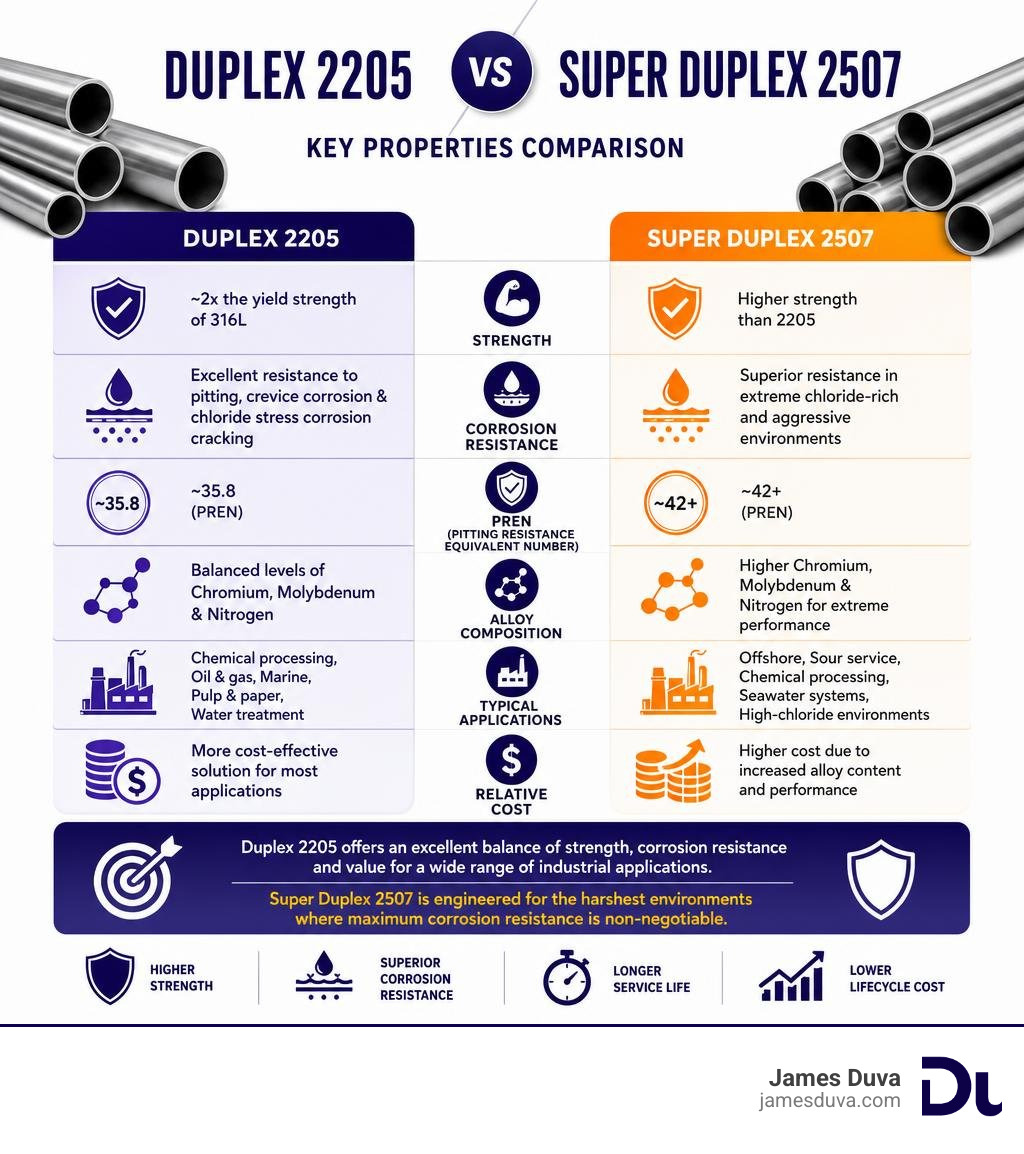
Duplex 2205 stainless steel is a two-phase alloy combining roughly equal parts of ferrite and austenite in its microstructure, giving it approximately twice the yield strength of standard austenitic grades like 316L — while also delivering superior resistance to pitting, crevice corrosion, and chloride stress corrosion cracking.
Here is a quick-reference summary of its most important characteristics:
| Property | Duplex 2205 | 316L (Austenitic) |
|---|---|---|
| Min. Yield Strength | 65 ksi (450 MPa) | ~30 ksi (205 MPa) |
| Min. Tensile Strength | 95 ksi (655 MPa) | ~75 ksi (515 MPa) |
| PREN | ~35.8 | ~24 |
| Max. Operating Temp. | 600°F (316°C) | ~870°C (continuous) |
| Microstructure | Ferrite + Austenite (~50/50) | Fully Austenitic |
| SCC Resistance | Excellent | Moderate |
| Magnetic | Yes (partially) | No |
Compared to super duplex 2507, which pushes chromium, molybdenum, and nitrogen even higher for extreme environments, 2205 hits a practical sweet spot — enough corrosion resistance and strength for most demanding industrial applications, at a significantly lower cost.
For engineers in chemical processing, oil and gas, or marine industries, choosing between these grades is a critical decision that affects safety, lifecycle cost, and fabrication complexity.
I’m Billy Walker, Vice President of James Duva Inc., where I’ve spent years helping industrial professionals source specialty alloys — including duplex 2205 stainless steel — for demanding piping and pressure applications across the process industries. In this guide, I’ll break down everything you need to know to make a confident material selection decision.
Glossary for duplex 2205 stainless steel:
Why Are Alloys So Valuable in Industry?
To understand why duplex 2205 stainless steel is such a breakthrough material, we first have to look at the broader picture of metallurgy. Why do we rely so heavily on alloys rather than pure metals?
Pure metals, such as pure iron, are rarely suitable for heavy industrial service. In their unalloyed states, pure metals are often too soft, structurally weak, and highly vulnerable to rust and environmental degradation. When iron is exposed to moisture and oxygen, it oxidizes rapidly, leading to structural failures.
Alloying is the process of combining a base metal with other elements to engineer superior material properties. By strategically adding elements like chromium, nickel, molybdenum, carbon, and nitrogen, metallurgists create materials with dramatically enhanced strength, hardness, and corrosion resistance.

These engineered alloys are the backbone of modern infrastructure and manufacturing, serving critical roles across multiple sectors:
- Construction: High-strength alloy steel beams support our skyscrapers, while corrosion-resistant alloy piping networks distribute water and utilities safely throughout municipal infrastructures.
- Oil & Gas: Severe environments require specialized fittings, flanges, and piping systems that can withstand extreme pressures, corrosive sour gases, and harsh marine environments without cracking.
- Automotive & Aerospace: Alloy frames provide the high strength-to-weight ratios needed for vehicle safety and fuel efficiency, while advanced superalloys are used in jet engines to withstand intense heat and mechanical stress.
- Medical & Consumer Goods: Biocompatible alloys are used for surgical implants and joint replacements, while durable, easy-to-clean alloys form the basis of commercial kitchenware and food processing equipment.
By tailoring the chemical recipe of these alloys, we can solve specific industrial challenges. Duplex 2205 stainless steel represents one of the most successful examples of this chemical engineering. To see how these advanced materials compare to traditional options, you can read our comparison of duplex vs austenitic stainless steel.
Understanding Duplex 2205 Stainless Steel and its Microstructure
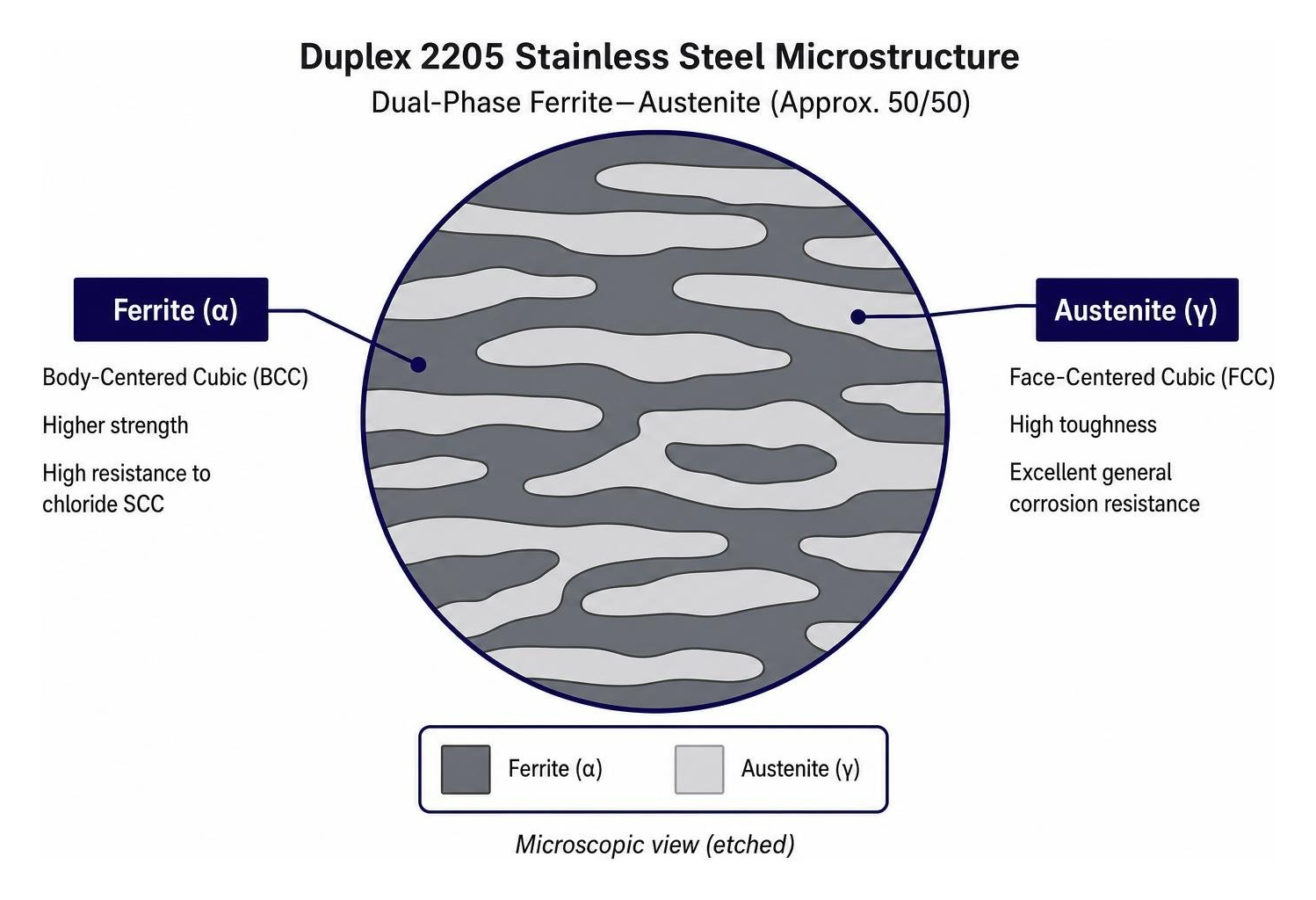
The secret to the performance of duplex 2205 stainless steel lies in its unique dual-phase microstructure. While standard stainless steels like 304 or 316L are fully austenitic (having a face-centered cubic crystal structure), and other specialty steels are fully ferritic (body-centered cubic), duplex steels are a hybrid.
Under a microscope, duplex 2205 stainless steel reveals a balanced, roughly 50/50 ratio of both ferrite and austenite phases. This dual-phase structure is not an accident; it is carefully achieved by optimizing the chemical composition and heat treatment.
This structural partnership provides the best of both metallurgical worlds:
- The ferrite phase contributes exceptional mechanical strength and a high resistance to chloride stress corrosion cracking (SCC).
- The austenite phase provides excellent toughness, ease of fabrication, and superb resistance to general corrosion.
A key factor in stabilizing this microstructure is nitrogen enhancement. Nitrogen is a powerful austenite stabilizer. Its addition to the alloy not only helps maintain the critical phase balance during cooling but also strengthens the austenite phase directly, raising the material’s overall yield strength and improving its resistance to localized pitting. To explore the exact phase stability and physical data of this alloy, you can review the ATI 2205™ Technical Datasheet.
Chemical Composition of Duplex 2205 Stainless Steel
The precise balancing of alloying elements is what allows duplex 2205 stainless steel to achieve its hybrid properties. The standard chemical composition (by weight percentage) of this alloy includes:
- Chromium (Cr): 22.0% – 23.0% (Provides primary corrosion resistance and promotes the ferrite phase)
- Nickel (Ni): 4.5% – 6.5% (Stabilizes the austenite phase and enhances toughness)
- Molybdenum (Mo): 3.0% – 3.5% (Greatly improves resistance to localized pitting and crevice corrosion)
- Nitrogen (N): 0.14% – 0.20% (Enhances strength, stabilizes austenite, and boosts pitting resistance)
- Manganese (Mn): 2.00% Maximum
- Silicon (Si): 1.00% Maximum
- Carbon (C): 0.030% Maximum (Kept low to prevent carbide precipitation during welding)
It is important to note the difference between the two common Unified Numbering System (UNS) designations associated with 2205: UNS S31803 and UNS S32205.
Originally, 2205 was specified as UNS S31803. However, in the late 1990s, the specification was modified to create the restricted-chemistry version, UNS S32205. This newer standard enforces higher minimum levels of chromium, molybdenum, and nitrogen. This tighter control prevents the loss of corrosion resistance and toughness in the heat-affected zone (HAZ) of welds, making UNS S32205 the preferred and most widely supplied version of 2205 today. For detailed research on how this chemical composition performs in sterile, high-purity environments, see the IMOA Study on 2205 in Pharmaceutical Applications.
Mechanical Properties of Duplex 2205 Stainless Steel
The mechanical strength of duplex 2205 stainless steel is one of its primary commercial advantages. Because it has roughly twice the yield strength of standard austenitic grades, engineers can often specify thinner wall thicknesses for piping, heat exchangers, and pressure vessels, leading to significant material weight and cost savings. For a deeper look at these mechanical advantages, see our guide on Sourcing Duplex 2205 Products.
- Yield Strength (0.2% Offset): Minimum 65 ksi (450 MPa)
- Tensile Strength: Minimum 95 ksi (655 MPa)
- Elongation at Break: Minimum 25% (indicating good ductility and formability)
- Hardness: Maximum Brinell hardness of 293 HB; Maximum Rockwell C hardness of 31 HRC
- Density: 0.283 lb/in³ (7.82 g/cc)
- Modulus of Elasticity: 27.5 x 10^6 psi (190 GPa) at room temperature
- Melting Range: 2525°F to 2630°F (1385°C to 1443°C)
These high-strength properties make the alloy highly resilient under mechanical stress, allowing for robust, lightweight structural designs in demanding industrial settings.
Corrosion Resistance and the Role of PREN
When selecting a stainless steel for corrosive service, engineers rely heavily on the Pitting Resistance Equivalent Number (PREN). The PREN is a mathematical formula that estimates an alloy’s relative resistance to localized pitting corrosion in chloride-rich environments based on its chemical composition.
The standard formula used for duplex stainless steels is:
$$text{PREN} = text{Cr} + 3.3(text{Mo}) + 16(text{N})$$
For duplex 2205 stainless steel, this calculation yields a PREN of approximately 35.8, which far exceeds standard marine-grade 316L.
In addition to pitting, 2205 provides outstanding resistance to other common corrosion mechanisms:
- Chloride Stress Corrosion Cracking (SCC): Standard austenitic steels like 304 and 316L are highly susceptible to sudden, catastrophic cracking in warm, chloride-bearing environments (often cracking at temperatures as low as 150°F / 60°C). Thanks to its ferritic phase, duplex 2205 resists SCC in simple salt solutions up to temperatures of at least 250°F (120°C).
- Crevice Corrosion: Localized attack in tight spaces (such as under gaskets or bolt heads) is mitigated by the high molybdenum and nitrogen content of 2205. The alloy has a Critical Crevice Corrosion Temperature (CCCT) that is significantly higher than that of 316L and 317L.
- General Acid Corrosion: Duplex 2205 performs exceptionally well in organic acids and caustic environments, making it a reliable choice for chemical storage and processing.
| Stainless Steel Grade | Min. Yield Strength | PREN | SCC Resistance | CCCT |
|---|---|---|---|---|
| 316L (Austenitic) | 30 ksi (205 MPa) | ~24 | Moderate / Low | Low |
| Duplex 2205 | 65 ksi (450 MPa) | ~35.8 | Excellent | High |
| Super Duplex 2507 | 80 ksi (550 MPa) | >40 | Outstanding | Extremely High |
Fabrication, Welding, and Thermal Limitations of 2205
To successfully utilize duplex 2205 stainless steel, fabricators must adhere to strict guidelines that preserve its delicate 50/50 phase balance. Improper thermal processing can cause the precipitation of brittle intermetallic phases, ruining both toughness and corrosion resistance.

- Welding: We recommend using filler metals such as AWS E2209 or ER2209. These consumables are over-alloyed with nickel (typically around 9%) to ensure that the weld pool retains a proper austenite-ferrite balance upon cooling. Autogenous welding (welding without filler metal) should be avoided, as it leads to an excessively ferritic weld structure with poor ductility.
- Interpass Temperature: Keep the weld interpass temperature below 300°F (150°C) to prevent the formation of detrimental intermetallic phases.
- Cold Forming: Due to its high yield strength, duplex 2205 requires more forming power and exhibits greater spring-back than 316L. When bending, keep a minimum bend radius of at least 2T (twice the material thickness) to prevent cracking over sharp dies.
- Hot Forming: Workpieces should be heated uniformly to a range of 2010°F to 2100°F (1100°C to 1150°C). Do not forge or form the material below 1740°F (950°C).
- Solution Annealing: If full stress relief is required, perform a solution anneal between 1870°F and 2010°F (1020°C to 1100°C), followed by an immediate rapid water quench. Avoid simple stress-relief heat treatments in the 600°F to 1700°F range, as they promote embrittlement.
- Thermal Limitations: Duplex 2205 is subject to 885°F (475°C) embrittlement when exposed to temperatures between 650°F and 980°F, which precipitates the brittle alpha prime phase. It also forms the highly brittle sigma phase rapidly at around 1485°F. Consequently, the ASME Boiler and Pressure Vessel Code limits the continuous operating temperature of duplex 2205 to a maximum of 600°F (316°C).
For detailed fabrication and machining insights, engineers should consult standard industry guidelines and work with experienced specialty alloy fabricators.
Duplex 2205 vs Super Duplex 2507 and Other Grades
For industrial procurement specialists, deciding where duplex 2205 stainless steel fits compared to other available grades is essential for optimizing cost and performance.
- vs. 304 and 316L: Standard 300-series stainless steels are highly versatile and easy to fabricate, but they lack the strength and SCC resistance of 2205. In chloride-rich or high-stress environments, transitioning to 2205 helps prevent premature failures and allows for thinner, lighter structural designs.
- vs. 317L: While 317L offers slightly better pitting resistance than 316L, it still cannot match the mechanical strength or stress-corrosion cracking resistance of duplex 2205.
- vs. 904L: Type 904L is a highly alloyed austenitic steel with excellent corrosion resistance, but its high nickel and copper content makes it incredibly expensive. Duplex 2205 offers comparable or superior corrosion resistance in many industrial environments at a fraction of the raw material cost.
- vs. Super Duplex 2507: Super duplex 2507 contains 25% chromium, 4% molybdenum, and 7% nickel, yielding a PREN greater than 40. While 2507 is the premier choice for extreme offshore oil platforms, highly acidic chemical plants, and deep-sea environments, it is more expensive and significantly harder to weld and machine than 2205. For the vast majority of corrosive applications, duplex 2205 represents the most practical, cost-effective “workhorse” choice.
At James Duva Inc., we supply a comprehensive inventory of these materials, including high-performance Ball Valves, pipes, fittings, and flanges tailored to your project’s specific chemical and mechanical requirements. Our extensive domestic supply chain ensures that you receive fully certified, high-quality duplex 2205 products when and where you need them.
Frequently Asked Questions about Duplex Stainless Steel
Is duplex 2205 stainless steel magnetic?
Yes. Unlike fully austenitic stainless steels (like 304 and 316L), which are non-magnetic, duplex 2205 is magnetic. This magnetic property is a direct result of its 50% ferritic crystal structure. However, this magnetism does not negatively impact its corrosion resistance or overall mechanical performance.
What is the maximum operating temperature for duplex 2205?
The maximum recommended continuous operating temperature for duplex 2205 is 600°F (316°C). Exposure to temperatures above this limit, even for short periods, initiates microstructural changes—specifically alpha prime precipitation (885°F embrittlement) and sigma phase formation—which severely reduce the material’s ductility and impact toughness.
Can duplex 2205 be electropolished for sanitary applications?
Yes, duplex 2205 can be electropolished to a surface smoothness of 15 micro-inches (0.38 micrometers) or smoother, fully complying with ASME BPE hygienic standards for pharmaceutical and biotechnology applications. However, because the acid bath dissolves the ferrite and austenite phases at slightly different rates, the final finish may appear slightly less bright or lustrous compared to electropolished 316L.
Conclusion
Duplex 2205 stainless steel represents a perfect balance of metallurgical engineering, offering twice the strength of standard austenitic steels alongside exceptional resistance to pitting, crevice corrosion, and chloride stress corrosion cracking. By understanding its chemical composition, microstructural phase balance, and fabrication requirements, industrial operations can achieve longer service lives, reduce material weight, and prevent catastrophic failures in the field.
Since 1978, James Duva Inc. has been a trusted, family-owned, one-stop shop for high-grade stainless steel and nickel alloy products. Operating out of our premier facility in Branchburg, NJ, we serve diverse industries like chemical processing, oil and gas, and water treatment with unmatched technical expertise and material traceability.
If you are planning your next project and need expert guidance on sourcing the right materials, contact our engineering and sales team today or read more about our inventory by visiting our guide on Sourcing Duplex 2205 Products.
About James Duva Inc.
Since 1978, James Duva Inc. has been your trusted source for stainless steel and high-nickel alloy industrial products. Whether you’re in the water treatment, process or power industry, we pride ourselves on always having what you need. Say goodbye to your sourcing problems with just one call to James Duva.