
A Deep Dive into Welded and Seamless Instrumentation Tubing

Jul 24, 2026
Why Getting Instrumentation Tubing Right Can Make or Break Your Fluid System
Instrumentation tubing stainless steel is the backbone of precision fluid and gas systems across some of the world’s most demanding industries — from offshore oil platforms to pharmaceutical cleanrooms.
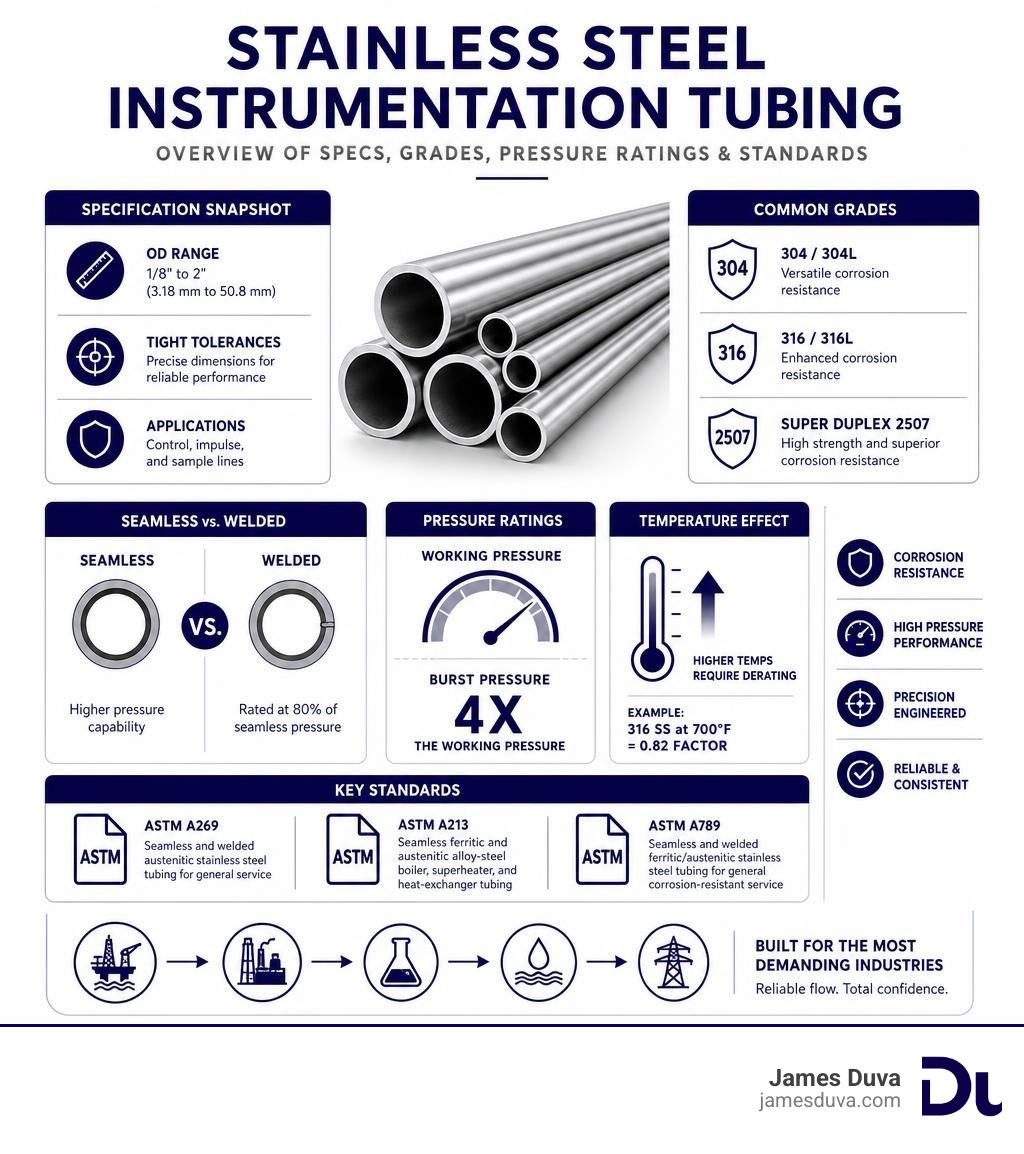
Here’s a quick overview of what you need to know:
| Topic | Key Facts |
|---|---|
| What it is | Small-diameter, tight-tolerance tubing used in control, impulse, and sample lines |
| Common grades | 304/304L, 316/316L, Super Duplex 2507 |
| Key standards | ASTM A269, ASTM A213, ASTM A789 |
| Typical OD range | 1/8″ to 2″ (3.18 mm to 50.8 mm) |
| Seamless vs. welded | Seamless = higher pressure; welded = 80% of seamless rating |
| Safety factor | Burst pressure is 4x the working pressure |
| Temperature effect | Higher temps require derating (e.g., 316 SS at 700°F = 0.82 factor) |
A single microscopic leak in a high-pressure instrumentation line can escalate quickly — causing costly downtime, environmental spills, or serious safety hazards. Getting the right tubing spec matters before installation, not after.
This guide walks you through everything: seamless vs. welded construction, pressure ratings, material grades, temperature derating, and proper installation practices. Whether you’re specifying tubing for a new system or troubleshooting an existing one, you’ll find the answers here.
I’m Billy Walker, Vice President of James Duva Inc., where I’ve spent years helping engineers and procurement specialists in the power, process, and water treatment industries source the right instrumentation tubing in stainless steel and high-nickel alloys for critical applications. In the sections that follow, I’ll share the practical knowledge our team applies every day to help clients avoid costly specification errors.
Instrumentation tubing stainless steel definitions:
Why Are Alloys So Valuable in Industry?
To understand why we rely so heavily on stainless steel and advanced nickel alloys for modern instrumentation, we must first look at the core science of metals. Pure metals, such as elemental iron, are rarely suitable for demanding industrial environments. In their unalloyed states, pure metals are often too soft, structurally weak, and highly prone to rust and chemical oxidation.
By strategically melting and combining pure iron with other elements like chromium, nickel, and molybdenum, metallurgists create alloys. These engineered materials offer vastly superior tensile strength, hardness, and corrosion resistance. For instance, adding at least 10.5% chromium to steel forms a microscopic, self-healing chromium oxide layer on the metal’s surface, which acts as a shield against rust and chemical degradation.
This balance of durability and chemical resistance makes alloys invaluable across a wide range of critical industries:
- Construction: Alloys provide the structural integrity required for heavy-duty beams, support structures, and industrial piping networks.
- Oil & Gas: High-strength alloy fittings, flanges, and valves withstand aggressive chemical exposure, high pressures, and sour gas environments.
- Automotive & Aerospace: Advanced alloys are essential for fabricating lightweight, high-strength structural frames, jet engine turbine blades, and exhaust systems.
- Medical & Consumer Goods: Bio-compatible alloys are used for surgical implants and medical instruments, while durable stainless alloys form the basis of commercial kitchenware and food processing equipment.
For a deeper look into the metallurgy behind these materials, consult our In-Depth Guide to Stainless Steel Alloy Properties and explore how these metals are utilized globally in Stainless Steel Applications for Every Industry.
What is Instrumentation Tubing Stainless Steel?
Instrumentation tubing stainless steel refers to a class of thin-walled, high-precision tubing designed specifically for fluid distribution, process control, and measurement systems. Unlike standard structural pipe, which is sized by nominal pipe size (NPS) and schedule, instrumentation tubing is specified by its exact outside diameter (OD) and wall thickness. This precision is critical because the tubing must interface seamlessly with specialized compression fittings to form gas-tight, metal-to-metal seals.
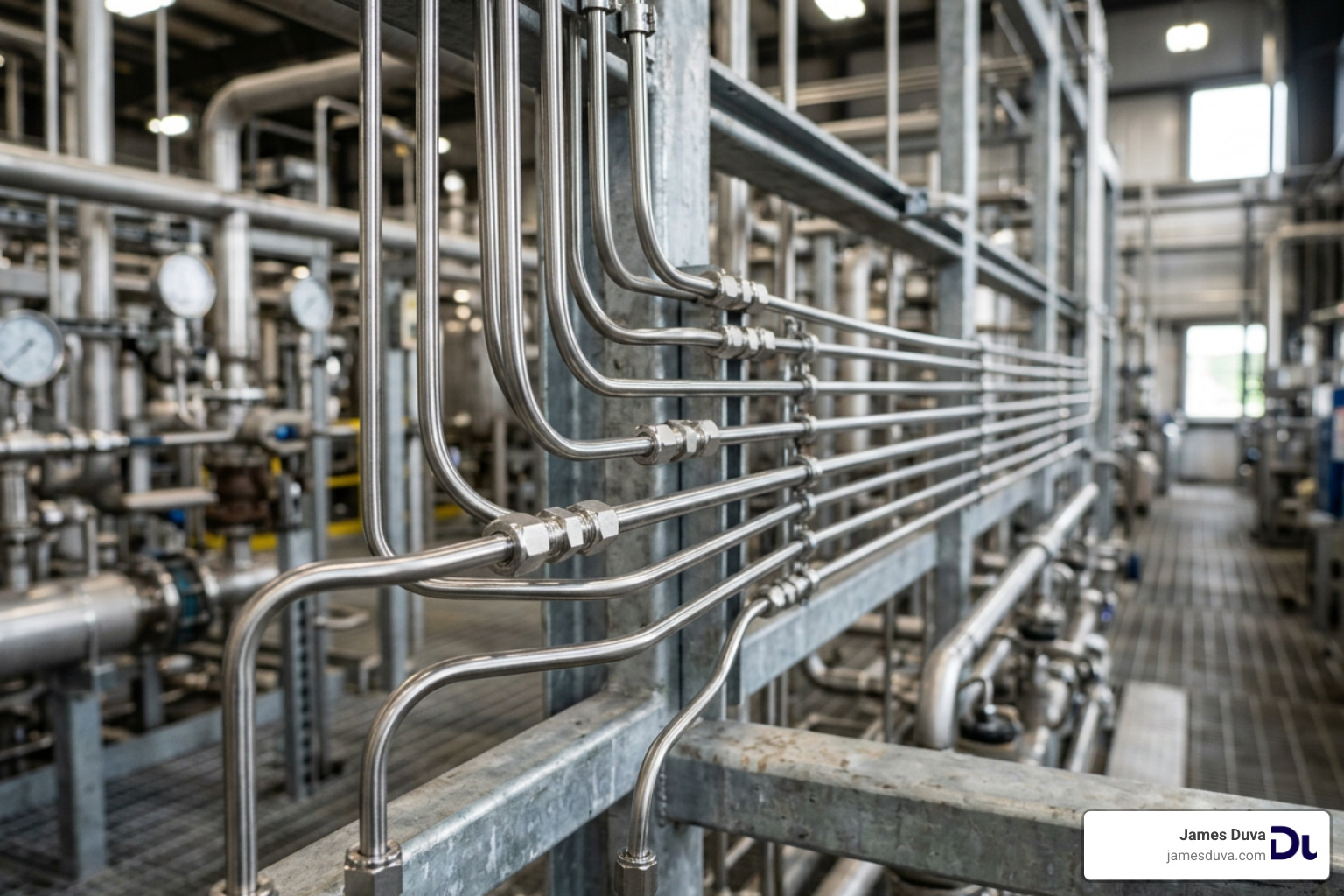
We primarily deploy instrumentation tubing in three core areas of a fluid system:
- Control Lines: Transmitting pneumatic or hydraulic signals to operate valves, actuators, and safety systems.
- Impulse Lines: Connecting process piping to pressure transmitters, flow meters, and analytical instruments.
- Sample Lines: Sourcing small, representative process streams for analyzer systems to monitor chemical composition.
In industrial fluid systems, choosing high-quality instrumentation tubing over traditional piping offers several distinct advantages. Tubing is highly bendable, allowing technicians to route lines around obstacles with a hand or benchtop tube bender. This flexibility significantly reduces the number of elbows, joints, and fittings required, which in turn minimizes potential leak paths and reduces system pressure drops.
Furthermore, tubing systems are lighter, less bulky, and far easier to assemble and disassemble using simple wrench operations. This eliminates the need for highly skilled, certified welders or complex pipe-threading machinery on-site, drastically lowering overall installation and labor costs. To learn more about selecting the right tubing geometry and style for your project, read A Practical Guide to Stainless Steel Tubing.
Seamless vs. Welded Instrumentation Tubing
When specifying instrumentation tubing stainless steel, one of the most fundamental decisions you will make is whether to use seamless or welded tubing. The difference lies entirely in the manufacturing process, which ultimately dictates the physical characteristics, pressure capabilities, and cost of the finished product.
Seamless tubing is manufactured from a solid billet of steel that is heated, pierced, and then cold-drawn over a mandrel. This cold-drawing process refines the grain structure, ensures tight dimensional tolerances, and results in a smooth, continuous tube wall with no weld bead or seam.
In contrast, welded tubing is produced by taking a flat-rolled strip of stainless steel, continuously forming it into a tubular shape, and welding the longitudinal seam. After welding, high-quality instrumentation tubing undergoes bead-reduction and cold-drawing to minimize the internal and external weld profile, followed by annealing to restore ductility.
To help you compare these two manufacturing methods, we have outlined their key differences below:
| Feature | Seamless Tubing | Welded Tubing |
|---|---|---|
| Manufacturing Process | Extruded and cold-drawn from solid billet | Rolled from flat strip and longitudinally welded |
| Weld Seam / Bead | Completely absent | Present (though minimized by bead-reduction) |
| Pressure Rating | 100% of calculated allowable working pressure | 80% of seamless rating (due to weld joint factor) |
| Dimensional Uniformity | Slight wall thickness variations possible | Highly uniform wall thickness across strip width |
| Continuous Lengths | Typically limited to straight 20-foot (6-meter) lengths | Available in long continuous coils (up to 200+ feet) |
| Relative Cost | Premium pricing | Cost-effective for mild-to-moderate pressures |
For an in-depth exploration of these manufacturing techniques, see our guide on Industrial Tubing: A Down-to-Earth Guide to Seamless and Welded Tubing Solutions and review the structural differences in Seamless Pipe and Welded Pipe: What’s the Difference?.
Performance Differences in Seamless Instrumentation Tubing Stainless Steel
Seamless instrumentation tubing is the gold standard for high-pressure, critical-safety, and high-vibration applications. Because a seamless tube has no weld bead, its wall thickness is structurally homogeneous. This eliminates any risk of a localized weld defect, weld decay, or stress concentration along a seam.
The absence of a weld seam provides several practical performance advantages:
- Unrestricted Internal Flow: The smooth-bore interior minimizes turbulence and prevents particulate entrapment, which is crucial in analytical sampling and ultra-high-purity gas distribution.
- Superior Pressure Containment: Seamless tubes can handle extreme pressures—up to 15,000 psi or more for heavy-wall configurations—without risking split seams.
- Exceptional Fatigue Resistance: In systems subject to severe pressure pulsations or mechanical vibrations (such as hydraulic control lines on offshore rigs), seamless tubing resists fatigue cracking far better than welded alternatives.
For a comprehensive breakdown of why seamless construction excels in demanding environments, read about Seamless Pipe Advantages, Manufacturing and Applications.
Cost and Efficiency of Welded Instrumentation Tubing Stainless Steel
Welded instrumentation tubing is a highly practical, cost-effective solution for low-to-medium pressure applications. Because flat-rolled steel strip can be manufactured with extremely precise thickness tolerances, welded tubing often exhibits exceptional concentricity and wall-thickness uniformity.
However, the presence of the longitudinal weld seam requires a design penalty. Under standard piping codes like ASME B31.3, welded tubing must be de-rated using a weld joint quality factor. For standard welded instrumentation tubing, the maximum allowable working pressure is calculated at 80% (a 0.80 factor) of the equivalent seamless tubing rating. For example, if a 5/8″ OD x 0.049″ wall seamless tube is rated for 4,000 psig at ambient temperature, the welded version of the exact same size is rated for 3,200 psig (4,000 psig x 0.80).
Despite the lower pressure rating, welded tubing offers a major efficiency advantage: it can be manufactured and shipped in long, continuous coiled runs (often up to 200 feet or more via LTL freight). These long coils are ideal for remote chemical injection lines or trace heating bundles, as they allow technicians to run tubing over long distances without intermediate fittings, drastically reducing installation labor and eliminating intermediate leak points. For more advice on choosing between these two options, check out Navigating the Maze of Industrial Tubing: From Welded Pipe to Seamless Wonders.
Pressure Ratings and Temperature Derating Factors
Determining the safe operating limits of instrumentation tubing stainless steel requires a clear understanding of working pressure, burst pressure, and the environmental factors that affect material strength.
Working pressure is the maximum safe pressure a tube can experience during normal system operation. It is calculated using Barlow’s Formula, which relates the tube’s outer diameter, wall thickness, and the allowable stress value of the material:
Where:
P= Allowable working pressure (psi)S= Allowable stress value of the material (psi) per design codes (e.g., ASME B31.3)t= Nominal wall thickness (inches)D= Outside diameter of the tubing (inches)
For standard ASTM A269 tubing, the allowable stress value at ambient temperature (-20°F to 100°F) is established at 20,000 psi per the ASME B31.3 Code. This incorporates a robust safety factor of 3.75 to 1 based on the material’s ultimate tensile strength of 75,000 psi. To simplify design work, manufacturers publish maximum working pressure charts for seamless tubing. If you are using welded tubing, you must multiply these standard chart values by the weld joint de-rating factor of 0.80.
Burst pressure is the theoretical pressure at which the tube wall will physically rupture. For high-quality stainless steel instrumentation tubing, the burst pressure is typically rated at 4 times the maximum allowable working pressure limit (a 4:1 safety factor).
The Impact of Temperature on Pressure Ratings
As operating temperatures rise, stainless steel alloys naturally lose tensile and yield strength. Therefore, when designing systems that operate at elevated temperatures, you must apply a temperature derating factor to the ambient working pressure.
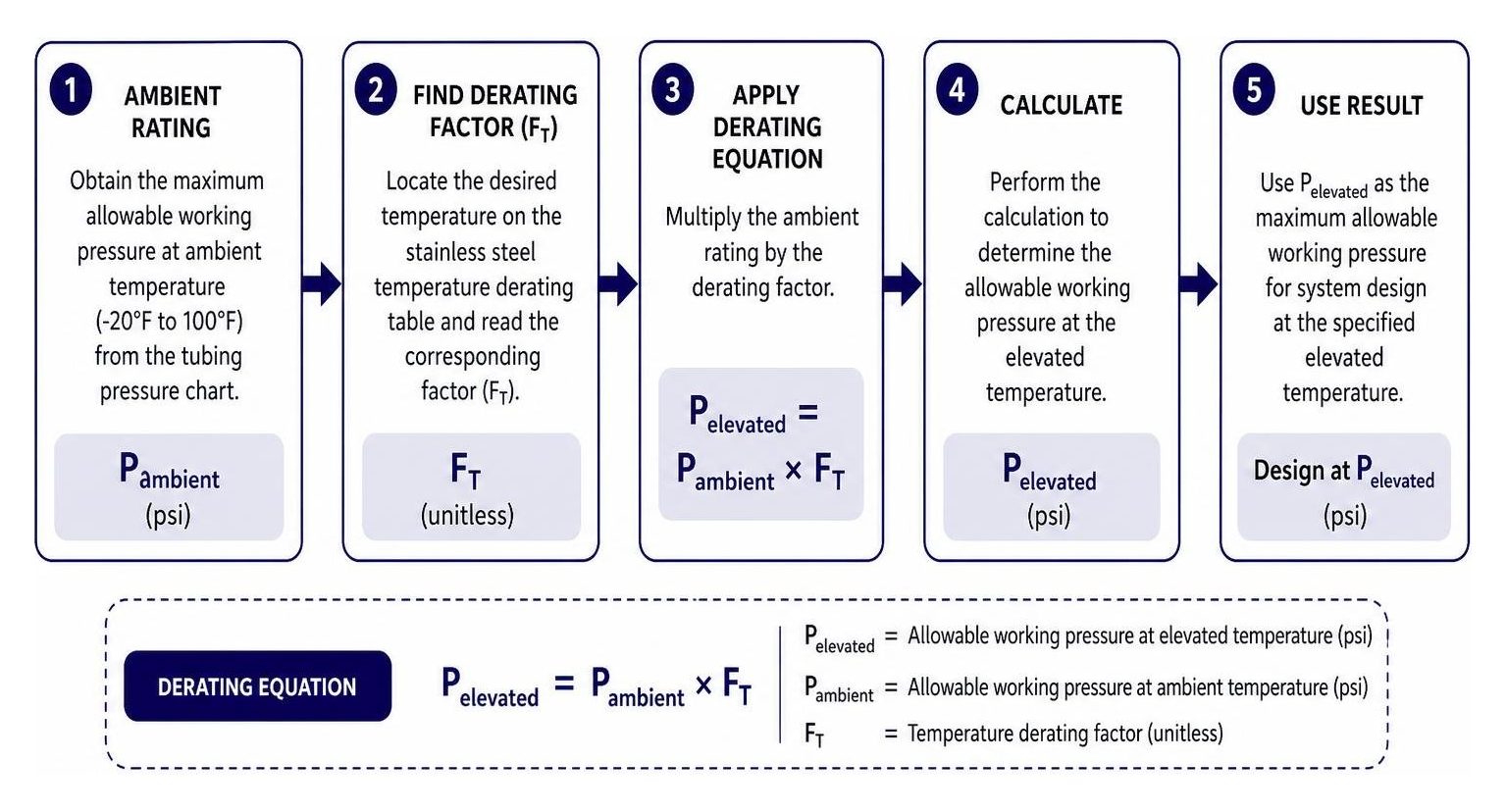
To calculate the allowable working pressure at an elevated temperature, use this simple formula:
Where:
P_elevated= Working pressure at operating temperatureP_ambient= Maximum working pressure at ambient temperature (-20°F to 100°F)FT= Temperature derating factor
Below is a reference table of temperature derating factors (FT) for the most common instrumentation alloys:
| Temperature (°F) | Temperature (°C) | 304 Stainless Steel | 316 Stainless Steel |
|---|---|---|---|
| 100 | 38 | 1.00 | 1.00 |
| 200 | 93 | 1.00 | 1.00 |
| 400 | 204 | 0.93 | 0.96 |
| 600 | 315 | 0.82 | 0.85 |
| 700 | 371 | 0.80 | 0.82 |
| 800 | 426 | 0.76 | 0.80 |
| 1000 | 537 | 0.69 | 0.76 |
Let’s look at a real-world example: A 1/2″ OD x 0.065″ wall seamless SS316 tube has an ambient working pressure rating of 4,700 psig. If this tube is installed in a system operating at 700°F, we must apply the 316 SS derating factor of 0.82:
At 700°F, the safe maximum working pressure of the tubing is reduced to 3,854 psig. Failing to apply this derating factor can lead to catastrophic tube deformation or failure. For more fundamental engineering principles regarding pressure boundaries, consult our guide on Industrial Tubing Core Principles
Material Grades, Sizes, and Industry Standards
To ensure safety and compatibility, instrumentation tubing stainless steel must be sourced in the correct alloy grade and manufactured to strict international standards.
Common Material Grades
- 304/304L: The most widely used general-purpose stainless steel. Grade 304 offers excellent corrosion resistance in mild environments and good formability. The low-carbon variant, 304L (maximum 0.03% carbon), minimizes carbide precipitation during welding, preserving corrosion resistance near weld joints.
- 316/316L: The industry standard for process instrumentation. Grade 316 contains 2% to 3% molybdenum, which significantly improves resistance to chloride pitting and crevice corrosion compared to 304. Like 304L, 316L features a low carbon content (0.03% max) for superior weldability.
- Super Duplex 2507 (UNS S32750): A mixed microstructure of austenite and ferrite. Super Duplex 2507 contains 25% chromium, 4% molybdenum, and 7% nickel, offering exceptional yield strength (550–750 MPa) and tensile strength (800–950 MPa). It is highly resistant to chloride stress corrosion cracking, making it the premier choice for offshore oil platforms and desalination plants.
Key Industry Specifications
- ASTM A269: The standard specification for seamless and welded austenitic stainless steel tubing for general service. This is the most common specification for standard instrumentation tubing, governing dimensional tolerances, chemical composition, and mechanical properties.
- ASTM A213: Covers seamless ferritic and austenitic alloy steel boiler, superheater, and heat-exchanger tubes. Tubing certified to ASTM A213 undergoes rigorous testing for high-temperature service.
- ASTM A789: Governs seamless and welded ferritic/austenitic (duplex) stainless steel tubing for general service, typically applied when sourcing Super Duplex 2507.
Sizing and Wall Thicknesses
Instrumentation tubing is available in a wide array of sizes to suit different flow rates and pressure requirements:
- Outside Diameter (OD): Standard fractional sizes range from 1/8″ to 2″ (with 1/4″, 3/8″, and 1/2″ being the most common for process transmitters). Metric sizes typically range from 3 mm to 50 mm.
- Wall Thickness: Ranges from thin-wall 0.028″ (0.7 mm) for low-pressure gas lines to heavy-wall 0.188″ (4.8 mm) for high-pressure hydraulic systems. Common intermediate wall thicknesses include 0.035″, 0.049″, 0.065″, 0.083″, and 0.095″.
To dive deeper into standard grades, explore The Definitive Guide to 304 Stainless Tubing and our comprehensive resource on 316 Stainless Steel Corrosion Resistance: In-Depth Guide to Performance.
Best Practices for Handling, Bending, and Installation
Even the highest-grade instrumentation tubing stainless steel will leak or fail if it is handled, cut, or installed incorrectly. Achieving a reliable, leak-free metal-to-metal seal with compression fittings requires strict adherence to physical and mechanical best practices.
1. Handling and Storage
- Keep Ends Capped: Always leave the plastic shipping caps on the tube ends during transport and storage. This prevents dirt, moisture, and airborne particles from contaminating the clean interior bore.
- Avoid Physical Damage: Never drag tubing across rough surfaces like concrete floors, gravel, or metal storage racks. Scratches, gouges, or deep surface defects on the tube’s outer diameter can create leak paths that compression fittings cannot seal.
2. Cutting and Deburring
- Use a Sharp Cutter: Cut the tubing using a high-quality, sharp tube cutter designed specifically for stainless steel. Avoid cutting too deeply with each turn of the tool, as this can squeeze the tube end out of round. If using a hacksaw, use a blade with at least 32 teeth per inch to ensure a clean cut.
- Deburr Thoroughly: Cutting always leaves a small metal burr on the inside and outside edges of the tube. You must thoroughly remove these burrs using a specialized deburring tool. External burrs prevent the tube from bottoming out fully inside the fitting, while internal burrs can break loose and damage sensitive downstream instrumentation or block Ball Valves.
3. Precise Tube Bending
- Use the Right Tool: Always use a dedicated mechanical tube bender. Never attempt to bend tubing by hand or over a pipe, as this will crimp, flatten, or thin the tube wall, severely reducing its pressure rating.
- Maintain Straight Lengths: When planning a bend near a fitting connection, ensure there is a sufficient straight length of tubing before the bend begins. This straight section is critical because it allows the tube to align perfectly and bottom out completely inside the fitting body before the ferrules are swaged.
4. Hardness and Material Compatibility
To achieve a reliable seal, the tubing material must be softer than the fitting material. For standard stainless steel compression fittings, we recommend using fully annealed tubing with a maximum hardness of 80 HRB (Rockwell B) or less. This hardness differential is essential because the fitting’s ferrules must be able to deform, cut into, and grip the outer surface of the tubing during the swaging process. If the tubing is too hard, the ferrules will simply slide along the surface, resulting in a loose connection and a high risk of pressure blowout.

Furthermore, always match the tubing material to the fitting material (e.g., stainless steel tubing with stainless steel fittings). Mixing materials can lead to galvanic corrosion and different thermal expansion rates, both of which can compromise the seal over time.
For detailed instructions on selecting and assembling compression fittings, refer to Understanding Tube Fittings: Types, Applications, and Benefits for Industrial Systems and our expert resource, A Comprehensive Guide to Choosing Tube Fittings.
Frequently Asked Questions about Instrumentation Tubing
What is the difference between working pressure and burst pressure?
Working pressure is the maximum safe pressure that the tubing system can experience under normal operating conditions, incorporating a robust safety factor (typically 3.75:1 or 4:1) in compliance with industrial design codes. Burst pressure is the theoretical pressure at which the tube wall will physically rupture under extreme stress. In high-quality instrumentation systems, the burst pressure is rated at 4 times the allowable working pressure limit.
Why must instrumentation tubing be softer than the fitting material?
The tubing must be fully annealed and softer than the fitting (ideally 80 HRB or less) so that the fitting’s hard metallic ferrules can deform and grip the tube surface during installation. This deformation creates a secure, gas-tight, metal-to-metal seal. If the tubing is harder than the fitting, the ferrules cannot bite into the tube wall, leading to connection failures under pressure.
How does welded tubing pressure rating compare to seamless?
Welded tubing is rated at 80% (a 0.80 weld joint factor) of the allowable working pressure of an equivalent seamless tube of the same material, outer diameter, and wall thickness. This reduction accounts for potential variations in the weld seam and is mandated by industrial piping codes like ASME B31.3.
Conclusion
Sourcing and installing the correct instrumentation tubing stainless steel is a critical decision that directly impacts the safety, efficiency, and reliability of your fluid systems. By understanding the performance differences between seamless and welded tubing, calculating precise pressure ratings with temperature derating, and adhering to strict handling and installation practices, you can ensure a long-lasting, leak-free system.
At James Duva Inc., we have been helping industrial clients navigate complex piping and tubing specifications since 1978. Operating out of our premier facility in Branchburg, New Jersey, we serve as a trusted, one-stop shop for high-grade stainless steel and nickel alloy products. Whether your project requires high-pressure seamless tubing, long-run welded coils, or specialized duplex alloys, our team has the deep technical expertise to deliver the exact solutions you need.
Ready to secure the highest-quality materials for your next project? Discover the quality and reliability of our inventory by visiting our guide on Expert Stainless Tubing Suppliers: Discover the Quality of James Duva, or explore our complete catalog of High-Quality Tubing Solutions and Ball Valves today.
About James Duva Inc.
Since 1978, James Duva Inc. has been your trusted source for stainless steel and high-nickel alloy industrial products. Whether you’re in the water treatment, process or power industry, we pride ourselves on always having what you need. Say goodbye to your sourcing problems with just one call to James Duva.