
A Deep Dive into Duplex 2205 Pipe Specifications

Jul 29, 2026
What Is Duplex 2205 Pipe — And Why Does It Matter?
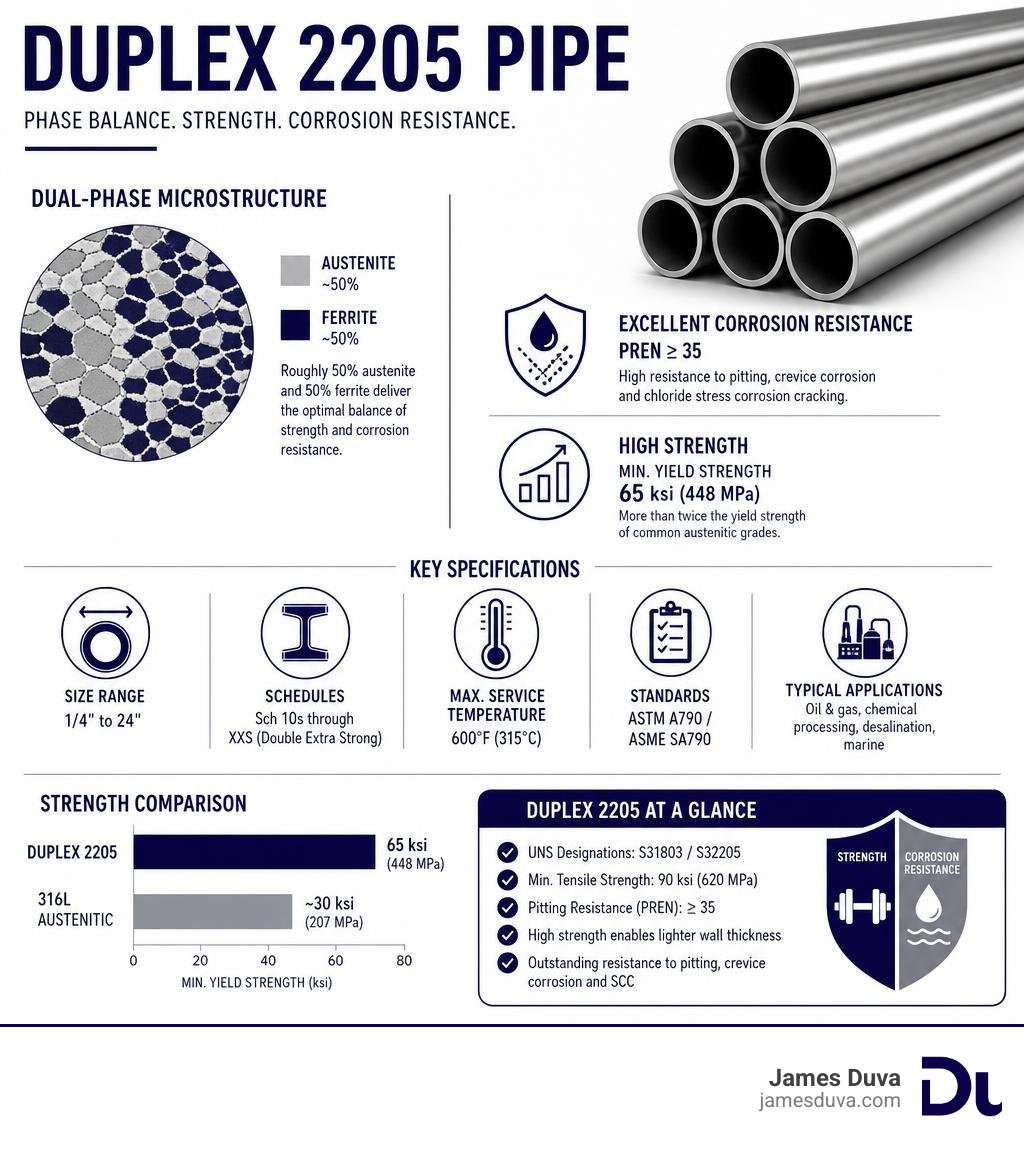
Duplex 2205 pipe is a high-strength, corrosion-resistant stainless steel pipe built on a unique dual-phase microstructure — roughly 50% austenite and 50% ferrite — that gives it properties neither phase could deliver alone.
Here’s a quick overview of what you need to know:
| Property | Duplex 2205 |
|---|---|
| UNS Designations | S31803 / S32205 |
| Min. Yield Strength | 65 ksi (448 MPa) |
| Min. Tensile Strength | 90 ksi (620 MPa) |
| Pitting Resistance (PREN) | ≥ 35 |
| Max. Service Temperature | 600°F (315°C) |
| Available Sizes | 1/4″ to 24″ |
| Schedules | Sch 10s through XXS (Double Extra Strong) |
| Key Standards | ASTM A790 / ASME SA790 |
| Typical Applications | Oil & gas, chemical processing, desalination, marine |
That yield strength figure is worth pausing on. Duplex 2205 delivers more than twice the yield strength of conventional austenitic grades like 316L — which often means engineers can specify a lighter wall thickness and still meet pressure requirements.
Its corrosion performance is equally impressive. The dual-phase microstructure, combined with high chromium, molybdenum, and nitrogen content, gives it outstanding resistance to chloride stress corrosion cracking (SCC), pitting, and crevice corrosion — the failure modes that make standard 304 and 316 stainless steels a liability in aggressive environments.
It is widely considered the workhorse grade of the duplex stainless steel family, and for good reason: it covers a broad range of demanding industrial applications at a cost that typically undercuts super duplex alternatives.
I’m Billy Walker, Vice President of James Duva Inc., and I’ve spent years helping engineers and procurement professionals source specialty piping materials — including duplex 2205 pipe — for the power, process, and water treatment industries. In this guide, I’ll walk you through everything from the metallurgy to the practical sizing and fabrication details you need to spec this material with confidence.
Duplex 2205 pipe glossary:
Why Are Alloys So Valuable in Industry?
To appreciate why duplex 2205 pipe is such a massive leap forward for industrial piping systems, it helps to take a step back and look at why we use alloys in the first place.
In their pure chemical states, elemental metals are rarely suited for heavy-duty industrial applications. Pure iron, for instance, is relatively soft, highly malleable, and incredibly prone to rust when exposed to oxygen and moisture. To solve these inherent limitations, metallurgists mix pure metals with other elements to create alloys. By carefully balancing the addition of carbon, chromium, nickel, molybdenum, and nitrogen, we can engineer alloys that offer vastly superior strength, durability, and corrosion resistance compared to pure metals.
Alloys are the literal backbone of modern infrastructure, with critical applications spanning virtually every major sector:
- Construction: Large-scale infrastructure projects rely heavily on alloy steel for structural beams, high-pressure utility piping, and concrete reinforcement. The added strength allows for taller, safer, and more structurally efficient designs.
- Oil & Gas: Upstream drilling and downstream refining operations subject materials to extreme pressures, corrosive gases, and harsh environments. This demands specialized alloy fittings, flanges, and piping systems that can withstand sour gas (H2S) and high-chloride conditions without cracking.
- Automotive & Aerospace: High-strength, lightweight alloys are essential for constructing aircraft frames, high-performance jet engines, and vehicle safety cages, where reducing weight directly translates to fuel efficiency without sacrificing structural integrity.
- Medical & Consumer Goods: Biocompatible alloys are used to manufacture surgical implants and joint replacements, while durable, corrosion-resistant alloys find their way into high-end commercial kitchenware and food processing machinery.
In fluid handling and control systems, we also see the critical role of alloys in components like industrial Ball Valves, which must maintain a bubble-tight seal under corrosive and abrasive conditions. Selecting the right alloy ensures these valves and piping systems do not fail prematurely. To explore how these materials are deployed across different sectors, you can read our guide on Stainless Steel Applications for Every Industry.
Technical Specifications and Standards for Duplex 2205 Pipe
When sourcing duplex 2205 pipe for critical applications, relying on precise engineering specifications is vital. The unique performance of this alloy depends entirely on maintaining a precise chemical balance and meeting strict manufacturing standards.
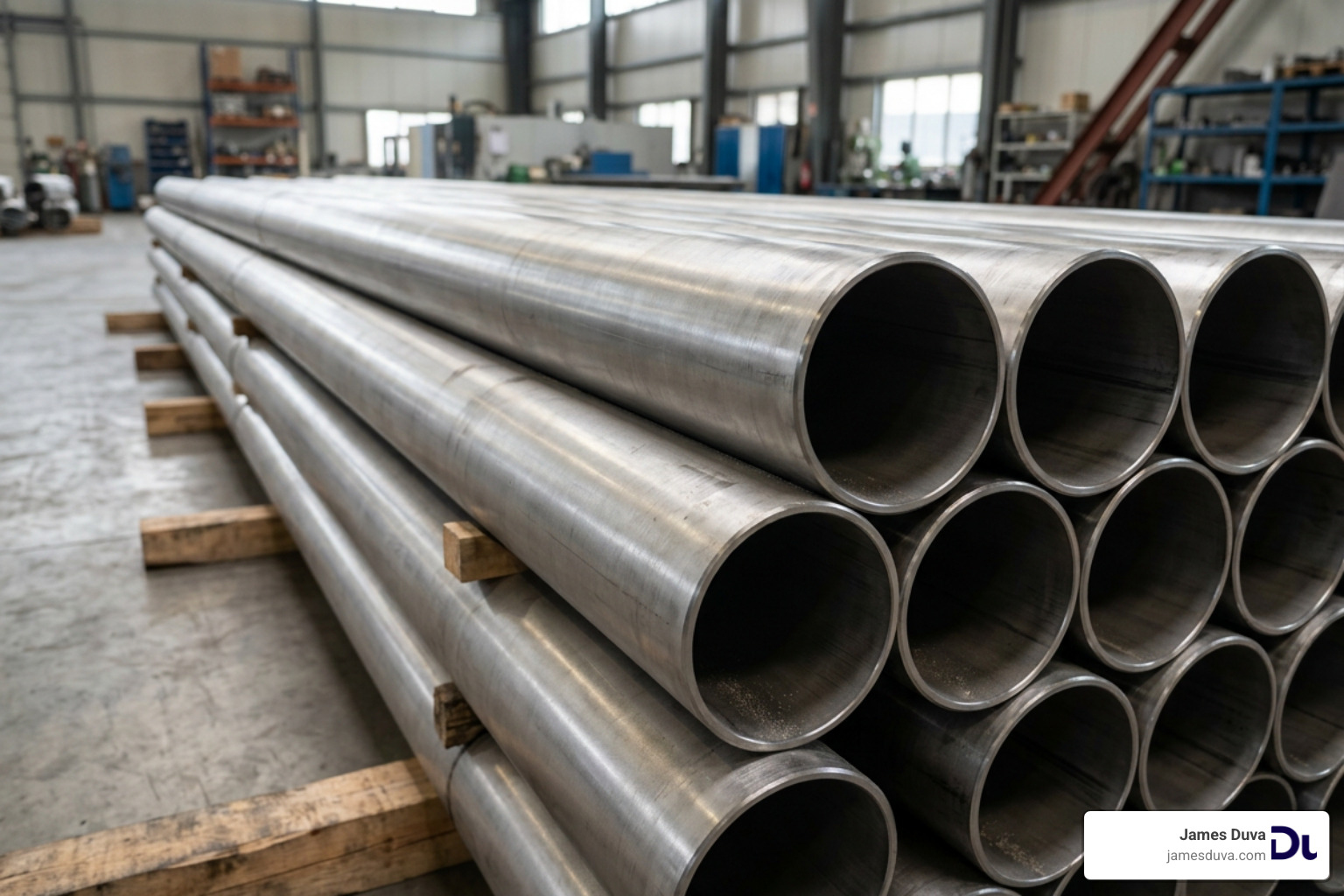
To understand the core mechanical, physical, and chemical thresholds of this material, you can consult our detailed breakdown, A Comprehensive Guide to Duplex 2205 Properties.
Microstructure and Chemical Composition (UNS S31803 vs. S32205)
The outstanding properties of duplex 2205 stem from its balanced, dual-phase microstructure. In the annealed condition, it consists of approximately 40% to 50% ferrite, with the remainder being austenite. This specific phase balance is what makes duplex steel the ultimate hybrid, combining the high yield strength and stress corrosion cracking resistance of ferritic steels with the superior ductility and localized corrosion resistance of austenitic steels. For a deeper look at this metallurgical blend, see our article, Why Duplex Stainless Steel is the Ultimate Hybrid.
Over the years, the chemical specification for duplex 2205 has evolved. Originally designated under the Unified Numbering System (UNS) as S31803, the chemistry was later optimized to create S32205. The newer S32205 specification restricts the chemistry to the upper end of the S31803 range, specifically requiring higher minimum levels of chromium, molybdenum, and nitrogen. This nitrogen enhancement is particularly critical because it significantly improves localized corrosion resistance and ensures the alloy retains its properties in the heat-affected zone (HAZ) after welding.
The table below outlines the chemical composition requirements for both designations:
| Element | UNS S31803 (%) | UNS S32205 (%) |
|---|---|---|
| Chromium (Cr) | 21.0 – 23.0 | 22.0 – 23.0 |
| Nickel (Ni) | 4.50 – 6.50 | 4.50 – 6.50 |
| Molybdenum (Mo) | 2.50 – 3.50 | 3.00 – 3.50 |
| Nitrogen (N) | 0.08 – 0.20 | 0.14 – 0.20 |
| Carbon (C) | 0.030 max | 0.030 max |
| Manganese (Mn) | 2.00 max | 2.00 max |
| Silicon (Si) | 1.00 max | 1.00 max |
| Phosphorus (P) | 0.030 max | 0.030 max |
| Sulfur (S) | 0.020 max | 0.020 max |
| Iron (Fe) | Balance | Balance |
Because UNS S32205 offers superior pitting and crevice corrosion resistance, most modern manufacturers produce duplex 2205 to meet both S31803 and S32205 specifications simultaneously (often referred to as dual-certified).
Sizing, Schedules, and Forms of Duplex 2205 Pipe
Duplex 2205 piping is manufactured in both seamless and welded configurations, each serving distinct roles in industrial plants.
- Seamless Pipe: Typically available in sizes ranging from 1/2″ to 12″ nominal pipe size (NPS). Because seamless pipe has no welded seam, it is highly favored for high-pressure applications where maximum structural integrity is required.
- Welded Pipe: Generally available in larger sizes, typically from 4″ to 24″ NPS and higher. Welded pipes are fabricated from rolled plate and welded along a longitudinal seam.
For a detailed comparison of these two manufacturing styles, refer to our guide, Seamless Pipe and Welded Pipe Whats the Difference.
In terms of wall thickness, duplex 2205 pipe is available in a wide variety of schedules conforming to ASME B36.19. These range from light-wall Schedule 10s (often used in low-pressure process piping to save weight) up to heavy-duty Schedule 80s, Schedule 160, and Double Extra Strong (XXS) for high-pressure systems.
To ensure consistent quality, all duplex 2205 pipes must be manufactured to rigorous industry standards:
- ASTM A790 / ASME SA790: The standard specification for seamless and welded ferritic/austenitic stainless steel pipe.
- ASME B36.19: The standard governing the dimensions and weights of stainless steel pipe.
Industrial Applications and Performance Limitations
The combination of high mechanical strength and exceptional corrosion resistance makes duplex 2205 pipe a highly versatile material. However, like any alloy, it has specific physical and thermal limitations that must be respected during design and fabrication.
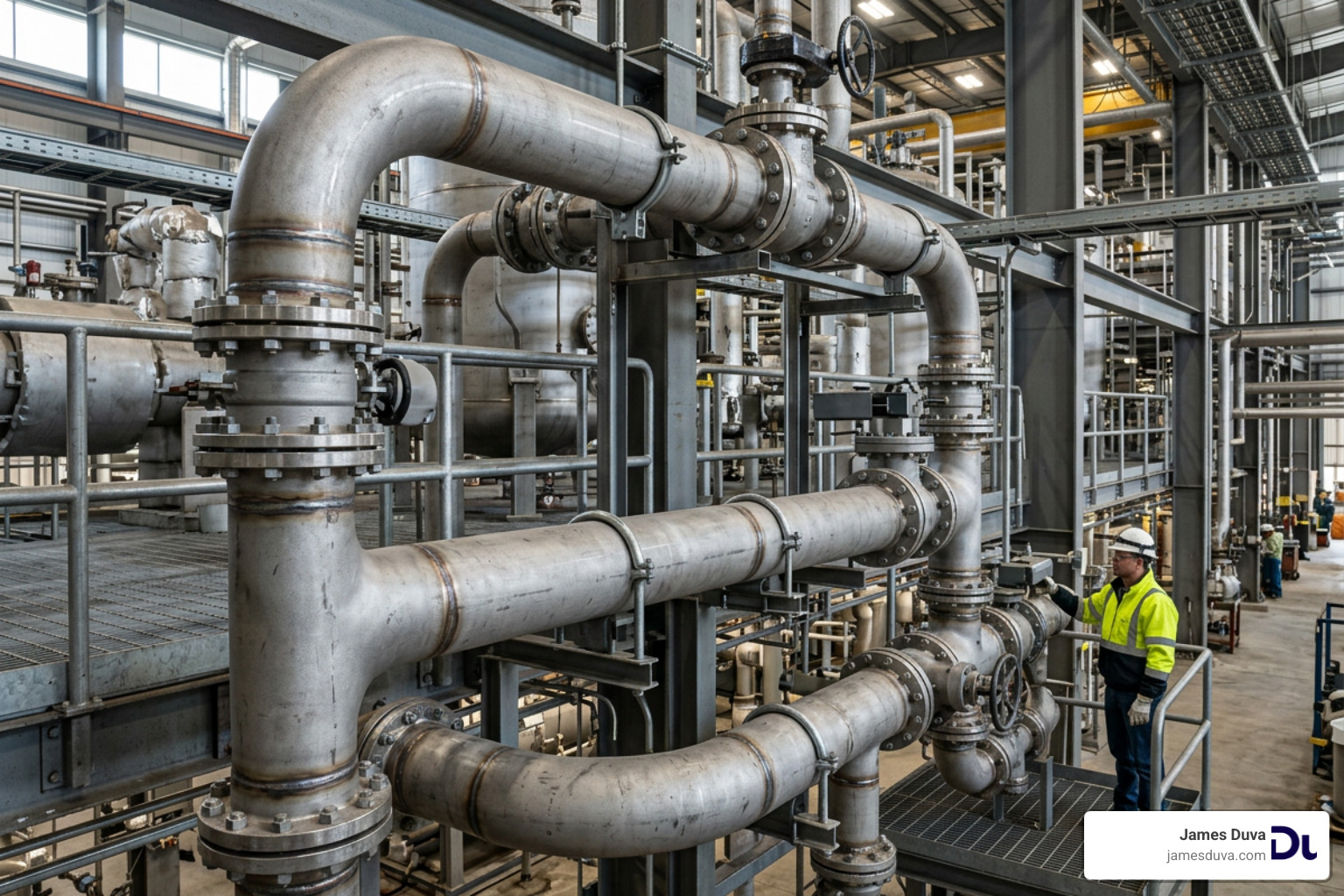
To explore the broad range of products made from this grade, you can read our article on Exploring the Versatility of Duplex 2205 Stainless Steel and Industrial Products.
Corrosion Resistance Advantages of Duplex 2205 Pipe
Standard austenitic stainless steels, such as 316L, are highly susceptible to chloride-induced stress corrosion cracking (SCC) when exposed to temperatures above 140°F (60°C) in the presence of chlorides. Under these conditions, standard pipes can crack and fail catastrophically with little to no warning.
Duplex 2205 is virtually immune to this failure mode. The ferritic phase within its dual-phase microstructure provides excellent resistance to SCC, making it highly reliable for hot, chloride-rich process environments.
Additionally, duplex 2205 offers superior localized corrosion resistance. This performance is quantified by the Pitting Resistance Equivalent Number (PREN), calculated using the following formula:
PREN = %Cr + 3.3(%Mo) + 16(%N)
With a minimum PREN of 35 (and often higher in dual-certified S32205), duplex 2205 provides far greater resistance to pitting and crevice corrosion than 316L (which typically has a PREN of 24). This superior chemistry also yields a much higher Critical Pitting Temperature (CPT), meaning duplex 2205 can handle higher concentrations of aggressive sodium chloride before pitting begins. For a detailed breakdown of how this alloy compares to standard options, see Double the Strength Why Duplex Beats Standard Austenitic Steel.
Temperature Limits and Fabrication Considerations
Despite its impressive strength and corrosion resistance, duplex 2205 has strict temperature limits that cannot be ignored:
- Elevated Temperature Limit: The ASME Boiler and Pressure Vessel Code limits the maximum service temperature of duplex 2205 to 600°F (315°C). Prolonged exposure to temperatures above this threshold leads to a phenomenon known as “885°F (475°C) embrittlement,” where brittle micro-components precipitate within the ferrite phase, severely reducing the material’s impact toughness.
- Low Temperature Limit: At the lower end of the spectrum, duplex 2205 undergoes a ductile-to-brittle transition when temperatures fall below -50°F (-46°C). Consequently, it is not suitable for extreme cryogenic applications.
When it comes to fabrication and welding, duplex 2205 requires precise procedures to maintain its 50/50 phase balance. Welding without filler metal (autogenous welding) is highly discouraged because the weld pool will cool too quickly, resulting in an excessively ferritic structure that lacks toughness and corrosion resistance.
Instead, we recommend using matching filler metals, such as AWS E2209 or ER2209. These filler metals are enriched with additional nickel (typically 8% to 9%) to promote the formation of austenite during cooling, ensuring a balanced, corrosion-resistant weld joint.
Furthermore, fabricators must carefully control the heat input (recommended at 0.5 to 2.5 kJ/mm) and maintain an interpass temperature below 300°F (150°C). For more practical advice on selecting materials for challenging process environments, read our guide on Alloy Adventures Choosing the Right Welded Pipe for Extreme Conditions.

Frequently Asked Questions about Duplex 2205
To help you make the best decision for your piping systems, we have compiled answers to some of the most common questions we receive about specifying and working with duplex 2205.
How does Duplex 2205 compare to 316L and 317L stainless steel?
Duplex 2205 represents a major upgrade over standard 316L and 317L austenitic stainless steels in both strength and corrosion resistance. In the annealed condition, duplex 2205 has more than double the yield strength of 316L. This high design strength allows engineers to specify significantly thinner pipe walls, reducing the overall structural weight of the piping system by up to 30% while maintaining the same pressure ratings.
While the raw material cost per pound of duplex 2205 may be higher than 316L, the ability to use thinner walls, combined with its longer service life and reduced maintenance downtime, makes it highly cost-efficient over the life cycle of a project. To see a detailed, head-to-head comparison of these materials, you can read our analysis, Duplex 2205 vs Other Stainless Steels a Comparative Analysis.
What are the primary industry standards for Duplex 2205 piping?
The primary manufacturing standards for duplex 2205 piping are ASTM A790 and ASME SA790, which govern the production, chemical composition, and testing of seamless and welded duplex pipes. For projects in the oil and gas sector where sour gas (H2S) is present, the piping must also comply with NACE MR0175 / ISO 15156 to ensure resistance to sulfide stress cracking. For a broader look at how these specifications fit into the larger landscape of industrial piping, see A Simplified Guide to Duplex and Super Duplex Piping.
Can Duplex 2205 be welded without filler metal?
No, welding duplex 2205 without filler metal (autogenous welding) is generally not recommended. Doing so alters the critical 50/50 phase balance in the weld zone, leading to an excessive concentration of ferrite. This unbalanced microstructure significantly reduces both the impact toughness and the corrosion resistance of the weld joint. Using an over-alloyed filler metal like ER2209 is essential to ensure the weld pool solidifies with the proper balance of austenite and ferrite.
Conclusion
Sourcing the right materials for demanding industrial applications requires more than just looking at a spec sheet. It requires partnering with a supplier that understands the metallurgy, the manufacturing standards, and the practical challenges of fabrication.
At James Duva Inc., based in Branchburg, NJ, we have been providing high-grade stainless steel and nickel alloy industrial products since 1978. Whether you are designing a high-pressure chemical pipeline, an offshore oil flowline, or a municipal water treatment system, our team has the technical expertise and inventory to help you select the exact piping, fittings, and flanges your project demands.
To learn more about how this high-strength alloy can improve the reliability and efficiency of your operations, read our comprehensive overview, Understanding Duplex 2205 Properties Advantages and Applications, or reach out to our team in New Jersey today to discuss your project specifications.
About James Duva Inc.
Since 1978, James Duva Inc. has been your trusted source for stainless steel and high-nickel alloy industrial products. Whether you’re in the water treatment, process or power industry, we pride ourselves on always having what you need. Say goodbye to your sourcing problems with just one call to James Duva.