
Industrial Flange Dimensions: Charts, Sizes, and Everything in Between
Mar 15, 2026
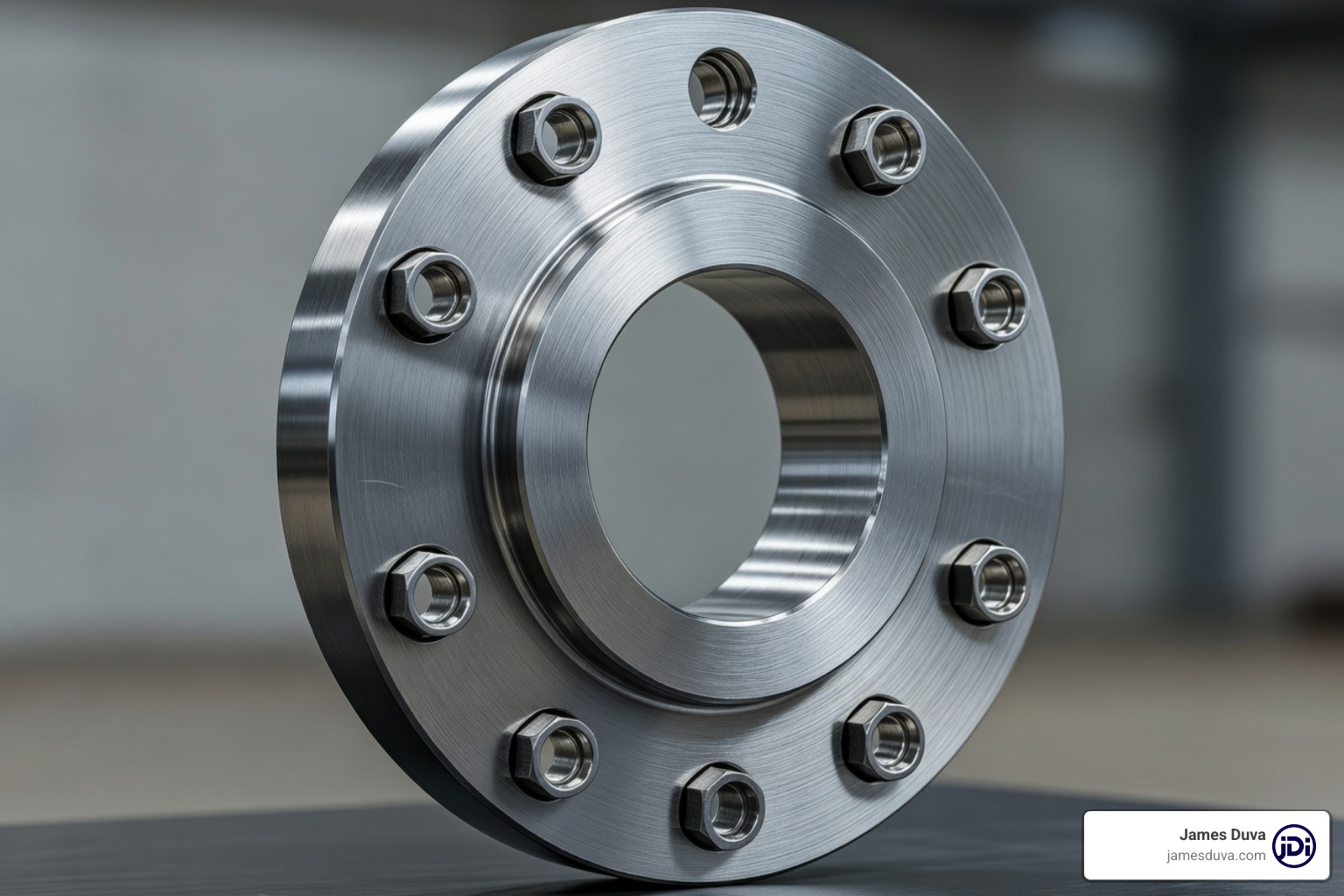
Industrial flange dimensions are the precise measurements that define how flanges connect pipes, valves, and equipment in piping systems. These standardized specifications—including outside diameter, thickness, bolt circle diameter, and bolt hole size—ensure proper fit, leak-tight sealing, and safe operation across different manufacturers and applications.
Quick Reference: Key Industrial Flange Dimensions
- Outside Diameter (OD) – The total width of the flange face
- Flange Thickness – Height of the flange body, increases with pressure class
- Bolt Circle Diameter (BCD) – Diameter of the circle through bolt hole centers
- Number of Bolt Holes – Typically in multiples of four, increases with pipe size
- Bolt Hole Diameter – Usually 1/8 inch larger than bolt diameter
- Raised Face Height – Typically 1/16 inch or 1/4 inch depending on pressure class
Every day, industrial facilities rely on flanged connections to transport chemicals, petroleum products, steam, water, and other critical fluids under high pressure and extreme temperatures. When flange dimensions do not match or fall outside acceptable tolerances, the consequences range from minor leaks to catastrophic system failures. That is why standardization through organizations like ASME (American Society of Mechanical Engineers) and ANSI (American National Standards Institute) is essential.
The primary standards governing industrial flange dimensions are ASME B16.5 (covering sizes NPS 1/2 through NPS 24 in pressure classes 150 to 2500) and ASME B16.47 (covering large diameter flanges NPS 26 through NPS 60). These standards specify exact dimensions, tolerances, materials, and pressure-temperature ratings to ensure interchangeability and safety across the industry. You can see how these standards apply to real products on our flanges page.
Understanding these dimensions is not just about reading charts—it is about selecting the right flange type (Weld Neck, Slip-On, Blind, Threaded, Socket Weld, or Lap Joint), matching the correct pressure class to your application, and ensuring compatibility with mating components. The wrong choice can lead to joint failure, downtime, and safety hazards.
This guide breaks down everything you need to know about industrial flange dimensions: from basic anatomy and flange types to detailed dimension charts, material selection, and pressure-temperature ratings. Whether you are specifying flanges for a chemical processing plant, sizing connections for an oil and gas pipeline, or simply trying to match existing equipment, you will find the reference information you need.
I am Billy Walker, Vice President of James Duva Inc., and I have spent decades helping engineers and contractors source specialty piping components including domestic stainless steel flanges that meet rigorous ASME standards. Working with industrial flange dimensions daily has taught me that accuracy in specification and sourcing is the foundation of system integrity. For additional context on how flanges integrate with fittings and pipe, review our overview of flange standards and applications.
Understanding Flange Types and Their Core Dimensions
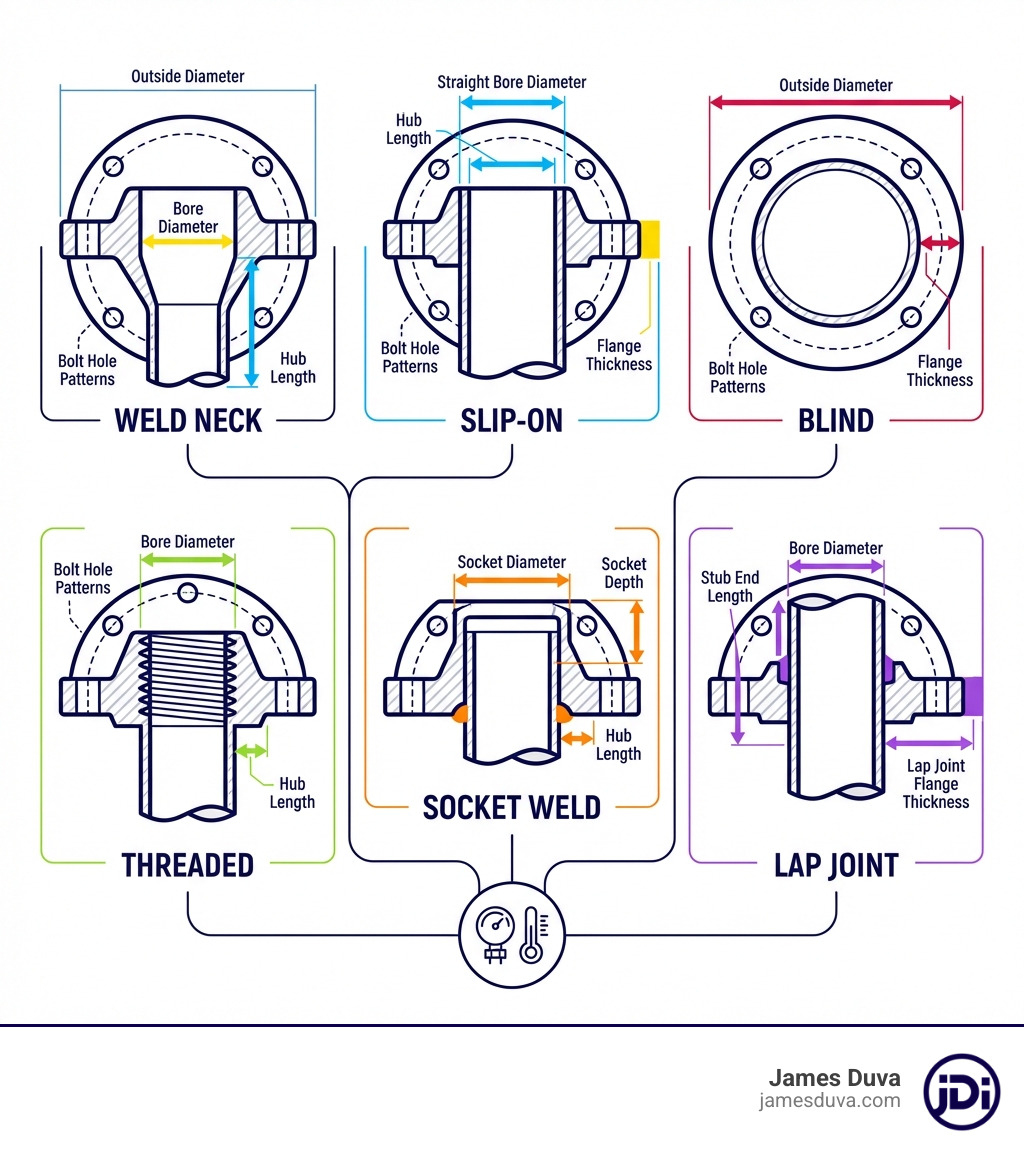
Before diving into the intricate charts, it is helpful to understand the basic anatomy of a flange and the different types available. While they all serve the purpose of connecting pipes, their design dictates their primary application and, consequently, their industrial flange dimensions.
A typical flange consists of several key parts: the hub (the tapered section that connects to the pipe), the bore (the internal diameter matching the pipe’s ID), the face (the sealing surface), and the bolt holes (where bolts pass through to connect two flanges). Each of these elements has precise dimensions that vary based on the flange type, size, and pressure rating. For a deeper dive into industrial flanges and how they relate to other piping components James Duva supplies, explore our guide on Understanding Industrial Flanges: Types, Applications, and Benefits.
Weld Neck (WN) Flanges
Weld Neck (WN) flanges are easily recognizable by their long, tapered hub that gradually transitions to the pipe wall thickness. This design provides a smooth, strong connection to the pipe via a butt weld, distributing stress effectively across the flange-pipe joint. This makes them ideal for demanding applications involving high pressure, high temperatures, and extreme stress. Our experience in industries like chemical processing and oil and gas often sees Weld Neck flanges as the go-to choice for critical lines due to their structural integrity and ability to minimize turbulence and erosion. For more on butt weld connections and how they complement weld neck flange dimensions, see our article on Butt Weld Fittings: Types, Applications, and Benefits.
Slip-On (SO) & Lap Joint Flanges
Slip-On (SO) flanges are designed to slide over the end of the pipe, where they are then secured with two fillet welds—one inside and one outside the flange. This design offers a simpler, less expensive installation compared to Weld Necks, but it typically has a lower pressure rating and can be more susceptible to stress fatigue.
Lap Joint flanges are similar to Slip-On flanges but are used with stub ends. A stub end is a short piece of pipe with a flared end, which the Lap Joint flange then slides over. The flange itself is not welded to the pipe; instead, it is free to rotate around the stub end. This rotational capability is incredibly useful for aligning bolt holes during assembly, especially in large diameter or complex piping systems. They are often used in applications requiring frequent dismantling and reassembly, or where the pipe material is expensive, as only the stub end needs to be made from the costly alloy. For general weld fitting dimensions that must align with slip-on or lap joint flange bores, check out our Standard Weld Fitting Dimensions: Quick Guide for Engineers and Technicians.
Blind Flanges
Blind flanges are solid discs used to close off the end of a piping system or a valve opening. They have no bore and are often used for testing pressure of a pipeline or for providing access to the pipeline. Because they completely block the flow, they must be robust enough to withstand the full system pressure. Their industrial flange dimensions focus on the overall thickness and bolting pattern to ensure a secure, leak-tight seal. We often use them in conjunction with other flange types to create temporary or permanent closures.
Threaded & Socket Weld Flanges
Threaded flanges (also known as screwed flanges) have internal threads that match the external threads on a pipe. This allows for assembly without welding, making them suitable for low-pressure, non-critical applications where welding is impractical or hazardous. However, the threaded connection can be prone to leakage, especially under vibration or thermal cycling.
Socket Weld flanges are designed with a shoulder inside the bore, allowing the pipe to be inserted until it hits this shoulder. A single fillet weld is then applied around the outside of the flange. They are commonly used for smaller pipe sizes in high-pressure systems where a smooth internal bore is not crucial. They offer good flow characteristics and are more robust than threaded flanges, but less so than Weld Neck flanges. For related welding information and how these joints work alongside standard flange dimensions, you might find our guide on What are Butt Weld Fittings? Benefits, Types, Industrial Applications useful. You can also see compatible flange products on our Flanges product category page.
The Cornerstone of Standardization: ASME B16.5 Dimensions
When we talk about industrial flange dimensions, the ASME B16.5 standard is often the first thing that comes to mind. It is the most widely recognized and used standard for pipe flanges and flanged fittings in North America and globally.
ASME B16.5 covers steel pipe flanges and flanged fittings from NPS 1/2 through NPS 24, across pressure classes ranging from 150 to 2500. This standard carefully details pressure-temperature ratings, materials, dimensions, tolerances, marking, testing, and methods for designating openings. The goal is simple: ensure interchangeability, safety, and reliability across diverse industrial applications. Whether we are supplying flanges for a complex chemical plant or a simple water system, adherence to ASME B16.5 is paramount. You can find more comprehensive information about flanges on our Flanges Tag Page and see real-world product options on our Flanges category.
Key Industrial Flange Dimensions Under B16.5
The ASME B16.5 standard specifies numerous critical dimensions for every flange type and size. These include:
- Outside Diameter (OD): The total diameter of the flange itself.
- Flange Thickness: The thickness of the flange ring, which increases with higher pressure classes.
- Bolt Circle Diameter (BCD): The diameter of the imaginary circle passing through the center of all bolt holes.
- Number of Bolt Holes: The count of holes for bolting, typically in multiples of four.
- Bolt Hole Diameter: The diameter of each bolt hole, usually 1/8 inch larger than the bolt diameter to allow for easier assembly.
- Raised Face (RF) Height: Many flanges feature a raised face, which is a small raised section on the sealing surface. For Class 150 and 300 flanges, this is typically 1/16 inch, while for higher classes (400, 600, 900, 1500, and 2500), it is 1/4 inch. This raised face concentrates the bolting force on a smaller gasket area, improving the seal.
These precise measurements are crucial for ensuring that components from different manufacturers can fit together correctly, creating a secure, leak-free connection.
Pressure Classes and Their Impact on Dimensions
The “Class” designation (for example, Class 150 or Class 300) is a critical part of industrial flange dimensions, indicating the maximum allowable working pressure (MAWP) a flange can withstand at a given temperature. As the pressure class increases, so do the dimensions of the flange, particularly its thickness and the number and size of bolts.
- Class 150: These are widely used for general industrial service, including HVAC and water systems. They are standard for steel pipe in lower-pressure applications.
- Class 300: Suitable for higher-pressure applications compared to Class 150, often seen in process industries.
- Class 400, 600, 900, 1500, 2500: As we move up these classes, the flanges become progressively thicker, heavier, and use more and/or larger bolts. For instance, a Class 600 flange is designed for high-pressure service, demanding more robust dimensions to contain the system pressure safely. A Class 2500 flange, typically available in sizes up to NPS 12, represents the highest pressure rating under ASME B16.5, requiring significantly stronger construction.
Our team at James Duva Inc. understands that selecting the correct pressure class is non-negotiable for system integrity.
Dimensional Tolerances and Markings
Accuracy is important, and ASME B16.5 specifies strict dimensional tolerances for all flanges. These tolerances, often measured in millimeters and inches, ensure that flanges produced by different manufacturers will fit together and provide a reliable seal. For example, tolerances for center-to-contact surfaces are typically tight, ranging from plus or minus 1.0 mm for smaller sizes to plus or minus 3.0 mm for larger ones. These tight tolerances are essential for proper fit-up and sealing, especially in high-pressure or high-temperature environments where even minor misalignments can lead to leaks.
Equally important are the markings on each flange. ASME B16.5 mandates specific information to be stamped or cast onto the flange, including:
- Manufacturer’s Name or Trademark: Identifies the origin.
- Material Identification: Such as ASTM A105 for forged carbon steel or ASTM A182 for stainless steel.
- Pressure Rating Designation: Clearly stating the Class (for example, 150 or 300).
- Size (NPS): The nominal pipe size.
- Standard Number: Typically “B16” or “B16.5” to confirm conformance.
- For ring joint flanges, an “R” and the ring groove number are also included.
These markings provide crucial information for installation, maintenance, and traceability, ensuring that the correct component is used for the intended application.
Sizing Up: Large Diameter Flanges (ASME B16.47)
While ASME B16.5 covers flanges up to NPS 24, larger piping systems require a different standard: ASME B16.47. This standard specifically addresses industrial flange dimensions for large diameter steel flanges, ranging from NPS 26 through NPS 60.
These larger flanges are typically found in industries with massive fluid transfer requirements, such as petrochemical plants, power generation facilities, and waterworks applications. Just like B16.5, ASME B16.47 specifies pressure-temperature ratings, materials, dimensions, tolerances, marking, and testing to ensure the integrity of these large connections. Our flange selection resources show how these standards translate into practical product choices for large-diameter systems.
Series A vs. Series B Flanges
ASME B16.47 defines two distinct series of large diameter flanges, which are generally not interchangeable:
- Series A (MSS SP-44): These flanges are generally thicker, heavier, and have larger outside diameters and bolt circles. They are often referred to as “general use” flanges and tend to have higher pressure capacities for a given NPS.
- Series B: These are designed to be more compact and economical. They typically have smaller outside diameters, thinner flanges, and a smaller bolt circle diameter with more, but smaller, bolts.
The choice between Series A and Series B depends on factors like available space, weight considerations, and specific pressure requirements. Our team has extensive experience navigating these choices for our clients’ projects across chemical processing, power, and water service.
Critical Dimensions for Large Diameter Flanges
The critical dimensions for ASME B16.47 flanges follow similar principles to B16.5, but on a larger scale. You will still find specifications for outside diameter, flange thickness, bolt circle diameter, and bolt hole count. However, due to the size and pressures involved, these flanges feature:
- Increased Number of Bolts: To distribute the forces required to seal large diameters.
- Thicker Profiles: To withstand high pressures and minimize deflection.
- Heavier Construction: Reflecting the substantial material required for structural integrity.
Ensuring these large components are manufactured to precise industrial flange dimensions and installed correctly is crucial for the safety and efficiency of industrial operations. When you are working with these flange sizes, pairing them with the right high-alloy materials from our stainless steel and nickel alloy product range further improves reliability.
Materials, Ratings, and Selecting the Right Flange
Beyond just dimensions, the material composition and pressure-temperature ratings are important when selecting an industrial flange. These factors dictate the flange’s ability to perform reliably under specific operating conditions. As experts in high-grade stainless steel and nickel alloy industrial products, we know that material selection is critical to performance. For insights into making the right choices for your components, our guide on The Art of Selecting Butt Weld Fittings: Your Blueprint for Success offers valuable perspectives that also apply when you specify flanges.
Common Flange Materials and Performance
The choice of material directly impacts a flange’s corrosion resistance, temperature strength, and overall durability.
- Carbon Steel (for example, ASTM A105): A common and economical choice for general-purpose applications where corrosion is not a major concern. It offers good strength and weldability.
- Stainless Steel (for example, ASTM A182 grades F304, F316): Essential for applications requiring superior corrosion resistance, especially in chemical processing, food, and pharmaceutical industries. Stainless steel flanges maintain their integrity in corrosive environments and at higher temperatures.
- Nickel Alloys (for example, Hastelloy, Inconel): For the most demanding applications involving highly corrosive media, extreme temperatures, or a combination of both, nickel alloy flanges are used. These high-performance materials offer resistance to pitting, crevice corrosion, and stress corrosion cracking.
At James Duva Inc., based in Branchburg, NJ, we specialize in supplying these high-grade stainless steel and nickel alloy flanges, understanding that their precise industrial flange dimensions combined with suitable material properties are essential for the critical systems our clients operate. Explore the advantages of these premium materials in our article on Flanges, Fittings, and Pipes and browse specific options on our Flanges product page.
The Importance of Pressure-Temperature Ratings
Pressure-temperature (P-T) ratings are charts within the ASME standards that specify the maximum allowable working pressure for a flange at various temperatures. This is an important factor because a flange’s pressure capacity decreases as the operating temperature increases.
For example, a Class 300 flange might safely handle a certain pressure at ambient temperature, but its MAWP will be lower at 500°F (260°C). This derating is due to the material’s reduced strength at liftd temperatures. The standards provide tables for different material groups (for example, carbon steel, stainless steel, alloy steel) across various pressure classes and temperature ranges. It is also important to note that, as per ASME B16.5, at temperatures above 200°C (400°F) for Class 150 and above 400°C (750°F) for other class designations, flanged joints may experience leakage issues if exposed to severe external loads or thermal gradients.
Understanding and following these P-T ratings is important for preventing failures in industrial piping systems. When you combine correct ratings with the right alloys from James Duva, you create a flange assembly that is dimensionally sound and suitable for your service.
A Practical Guide to Selecting Industrial Flange Dimensions
Selecting the correct flange involves more than just picking a size; it is a systematic process that considers all aspects of the application. Here is our practical guide:
- Determine Nominal Pipe Size (NPS): This is the starting point, matching the flange to the pipe’s nominal diameter.
- Identify Service Conditions (Pressure and Temperature): Determine the maximum operating pressure and temperature. This guides your choice of pressure class and material.
- Select Material: Based on the fluid being transported (corrosivity), operating temperature, and any specific industry requirements (for example, food grade or cryogenic service).
- Choose Flange Type: Consider the connection method (welded or threaded), ease of installation, frequency of dismantling, and stress requirements (for example, Weld Neck for high stress, Slip-On for ease of assembly).
- Refer to Correct Standard (B16.5 or B16.47): Ensure you are using the appropriate standard based on the NPS. For NPS 1/2 to NPS 24, it is ASME B16.5; for NPS 26 to NPS 60, it is ASME B16.47.
- Verify Mating Components: Confirm that the chosen flange dimensions are compatible with any mating flanges, valves, or equipment to ensure proper fit and sealing.
By following these steps, you can select the right industrial flange dimensions for your specific application, supporting performance and safety. For a wider range of selection resources and to see which flange materials and classes we keep in stock, visit our Flanges page.
Frequently Asked Questions about Industrial Flange Dimensions
We often encounter common questions about industrial flange dimensions from engineers and procurement specialists. Here are some of the most frequent ones:
What is the difference between ANSI and ASME flanges?
This is a common question. Historically, many industry standards were developed by organizations like ASME and then accredited by ANSI. The B16.5 standard, for example, was once commonly referred to as ANSI B16.5. Today, the standard is formally recognized as ASME B16.5. So, while the terms are often used interchangeably in the industry, “ASME B16.5” is the current and technically correct designation. Essentially, ASME develops and maintains the standards, and ANSI provides accreditation. To learn more about various flange standards and how they impact product selection, see our resources on flange standards.
What do “NPS” and “Class” mean for flanges?
- NPS (Nominal Pipe Size): This is a North American standard for designating pipe size. It is a dimensionless number that roughly corresponds to the pipe’s internal diameter, but it is primarily used for referencing standard pipe dimensions. For example, an NPS 6 pipe flange will have specific dimensions regardless of whether it is Schedule 40 or Schedule 80, though the bore might vary to match the pipe’s actual internal diameter.
- Class: This term, followed by a number (for example, Class 150, Class 300, Class 600), is the pressure rating designation for the flange. It indicates the maximum pressure the flange can be used for at increasing temperatures. A higher class number signifies a higher pressure rating, which also means the flange will have larger industrial flange dimensions, particularly in thickness and bolting.
If you are matching NPS and Class to specific James Duva products is a helpful starting point.
How do I read a flange dimension chart?
Reading a flange dimension chart is straightforward once you know your key parameters. First, you need to identify your Nominal Pipe Size (NPS) and the required Pressure Class. Once you have located the row corresponding to your NPS and the column for your Class, you will find various dimensions listed.
Key columns to look for include:
- Outside Diameter (OD): The overall width of the flange.
- Flange Thickness: How thick the flange body is.
- Bolt Circle Diameter (BCD): The diameter of the imaginary circle on which the bolt holes are centered.
- Number of Bolt Holes: How many bolts are required.
- Bolt Hole Diameter: The size of the holes for the bolts.
Always cross-reference these dimensions with your mating components to help ensure compatibility. For practical examples and detailed tables custom to the products we supply, check out our flange dimension charts and browse our flanges product category page.
Conclusion
Understanding industrial flange dimensions is more than just a technical exercise; it is a fundamental requirement for supporting the safety, efficiency, and longevity of industrial piping systems. The standardization provided by ASME B16.5 and ASME B16.47 helps ensure that components are interchangeable and reliable, regardless of their manufacturer.
We have explored the different types of flanges, from the Weld Neck to the Lap Joint, each with unique industrial flange dimensions suited for specific applications. We have also highlighted the role of pressure classes and material selection, emphasizing how factors like corrosion resistance and temperature strength relate to a flange’s performance and longevity.
Selecting the correct flange dimensions, appropriate material, and suitable pressure class is important for maintaining system integrity and avoiding downtime or failures. For high-grade stainless steel and nickel alloy flanges that meet ASME standards, it is useful to work with an experienced supplier. James Duva Inc., with expertise since 1978 and based in Branchburg, NJ, has provided industrial products and guidance to industries like chemical processing and oil and gas.
About James Duva Inc.
Since 1978, James Duva Inc. has been your trusted source for stainless steel and high-nickel alloy industrial products. Whether you’re in the water treatment, process or power industry, we pride ourselves on always having what you need. Say goodbye to your sourcing problems with just one call to James Duva.