
310 Stainless Steel: The Alloy That Handles the Heat Without Breaking a Sweat

May 18, 2026
When the Heat Is On, 310 Stainless Steel Delivers
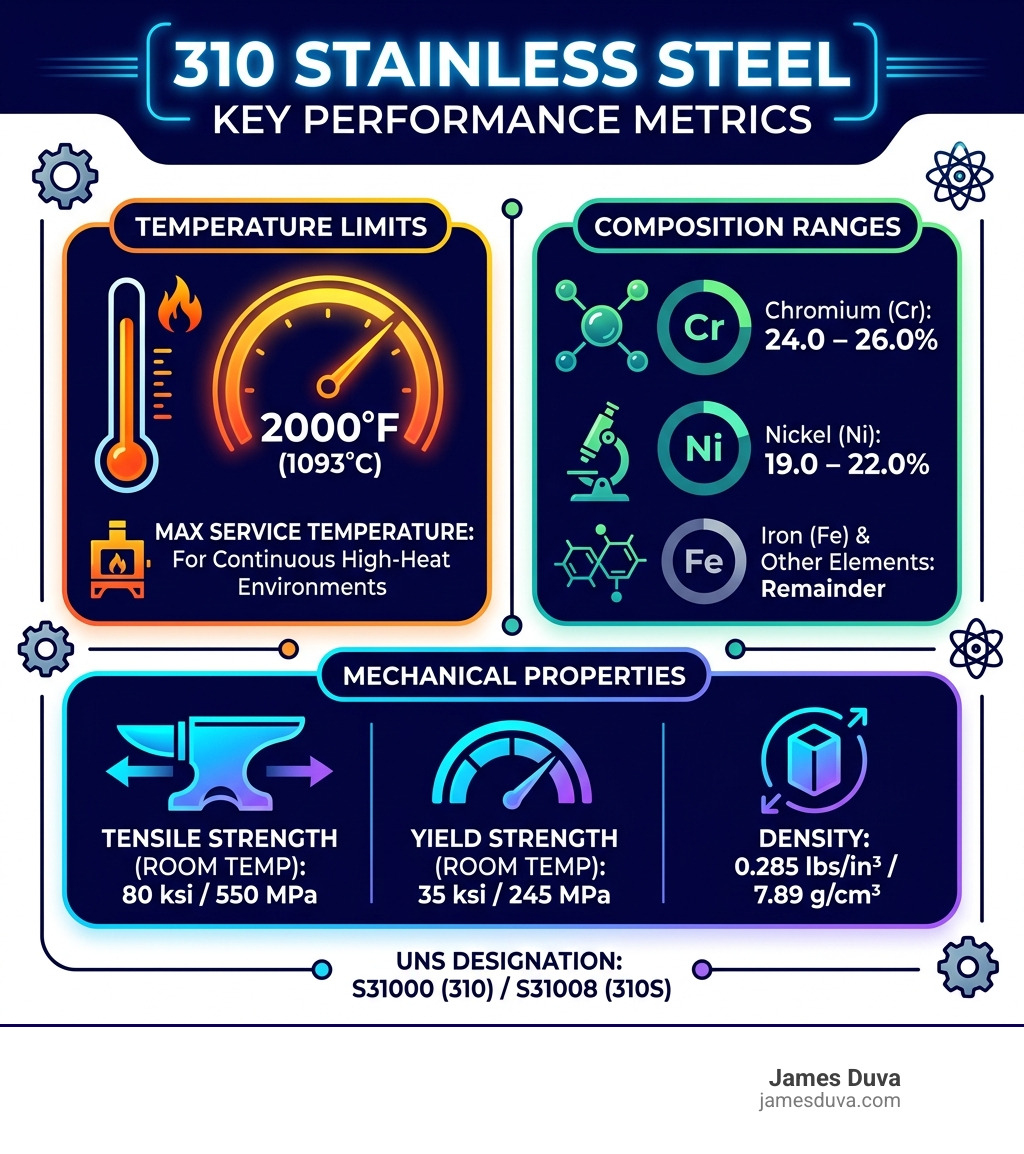
310 stainless steel is a high-alloy austenitic stainless steel engineered specifically for extreme heat — rated for continuous service up to 2000°F (1093°C). Here’s what you need to know at a glance:
| Property | Value |
|---|---|
| Max service temperature | 2000°F / 1093°C |
| Chromium content | 24.0–26.0% |
| Nickel content | 19.0–22.0% |
| Tensile strength (room temp) | 80 ksi / 550 MPa |
| Yield strength (room temp) | 35 ksi / 245 MPa |
| Density | 0.285 lbs/in³ / 7.89 g/cm³ |
| UNS designation | S31000 (310) / S31008 (310S) |
It’s the go-to alloy for furnaces, kilns, petroleum refining, and any application where standard grades like 304 or 316 simply can’t take the heat.
As in-service temperatures across industrial operations have climbed over the decades, 310 has become increasingly critical — not just useful, but essential — for engineers who can’t afford material failure at high temperatures.
I’m Billy Walker, Vice President of James Duva Inc., where I’ve spent years helping chemical processing, oil and gas, and power generation professionals source specialty stainless steel and high-nickel alloys — including 310 stainless steel — from trusted domestic manufacturers. In this guide, I’ll walk you through everything you need to know to select, specify, and work with this remarkable alloy.
Quick 310 stainless steel terms:
What is 310 Stainless Steel and Why is it Unique?
At its core, 310 stainless steel is a highly alloyed austenitic material designed for high-temperature service. What makes it a “superstar” in metals is its ability to maintain its structural integrity and resist oxidation at temperatures that would cause other steels to scale and flake away.
The “secret sauce” lies in its high chromium (24–26%) and nickel (19–22%) content. This combination creates a protective, adherent oxide layer on the surface of the metal. In our In-Depth Guide to Stainless Steel Alloy Properties, we discuss how these elements work together to provide superior performance. When you look at What is Stainless Steel Made Of, you’ll see that while all stainless steels contain chromium, the generous amounts found in 310 push its capabilities far beyond standard 300-series grades.
The Difference Between 310 and 310S Stainless Steel
You will often see two designations: 310 and 310S. The primary difference is the carbon content. Standard 310 allows for a maximum carbon content of 0.25%, whereas SAE 310S stainless steel is the low-carbon version, capped at 0.08%.
Why does this matter? In high-temperature environments, carbon can react with chromium to form chromium carbides at the grain boundaries—a process known as sensitization. This can make the steel brittle and susceptible to corrosion, especially when the equipment is shut down and moisture (condensate) forms. By using 310S, we minimize this risk, making it the preferred choice for applications where the metal might face corrosive gases or liquids during cooling periods. Interestingly, in April 2026, most “dual-certified” 310 material on the market naturally meets the 310S requirements because modern refining processes are excellent at keeping carbon low.
| Element | 310 (UNS S31000) | 310S (UNS S31008) |
|---|---|---|
| Carbon (C) | 0.25% max | 0.08% max |
| Chromium (Cr) | 24.0 – 26.0% | 24.0 – 26.0% |
| Nickel (Ni) | 19.0 – 22.0% | 19.0 – 22.0% |
| Manganese (Mn) | 2.0% max | 2.0% max |
| Silicon (Si) | 1.5% max | 1.5% max |
Chemical Composition and Standards
Understanding What is Stainless Steel Composition is vital for ensuring you have the right material for the job. Beyond chromium and nickel, 310 stainless steel contains manganese and silicon, which help with deoxidation and fluidity during the melting process.
In the United States, these materials are governed by strict standards to ensure consistency. The Unified Numbering System (UNS) identifies standard 310 as S31000 and the low-carbon 310S as S31008. You will typically find these specified under ASTM A240 (for plate, sheet, and strip) or ASTM A167. Adhering to these standards ensures that the pipe or fitting we provide you will perform exactly as the engineering data suggests.
Why Are Alloys So Valuable in Industry?
To understand why we use 310 stainless steel, we first have to look at why we use alloys at all. Pure metals, like iron, are rarely used in heavy industry because they have significant drawbacks. Pure iron is relatively soft and, as we all know, is incredibly prone to rust when exposed to oxygen and moisture.
By creating alloys—mixing iron with other elements like chromium, nickel, and molybdenum—we “upgrade” the metal. This process is detailed in our guide on How Different Alloys Change Steel’s Properties. Alloys offer superior strength, durability, and resistance to environmental factors. For more foundational knowledge, you can check out A Comprehensive Introduction to Stainless Steel Facts and Industry Insights.
Key Applications Across Sectors
Because of these enhanced properties, stainless steel alloys are the backbone of modern infrastructure. You can find Stainless Steel Applications for Every Industry, but here are some of the heavy hitters:
- Construction: Used in massive beams and structural piping for its strength and aesthetic longevity.
- Oil & Gas: Crucial for fittings, flanges, and high-pressure Ball Valves that must withstand harsh chemicals and high heat.
- Automotive & Aerospace: Used in frames and jet engines where weight-to-strength ratios and heat resistance are life-and-death factors.
- Medical & Consumer Goods: Found in everything from surgical implants to the high-end kitchenware in your home.
Mechanical and Physical Properties at Extreme Temperatures
When we talk about 310 stainless steel, we are talking about a material that scoffs at temperatures that would melt lead or soften other steels. Its room-temperature mechanical properties are impressive, with an ultimate tensile strength of 80 ksi (550 MPa) and a yield strength of 35 ksi (245 MPa).
However, its real value shows at the finish line. As noted in technical data from 310 Stainless – Rolled Alloys, this grade maintains a higher percentage of its strength at elevated temperatures compared to 304 or 316. This is why it has such a storied place in Power and Stainless Steel: A History.
Creep and Rupture Strength of 310 Stainless Steel
In high-temperature engineering, “creep” is the enemy. Creep is the tendency of a solid material to move slowly or deform permanently under the influence of persistent mechanical stresses. 310 stainless steel is prized for its creep-rupture strength.
At 1400°F, for example, 310 remains remarkably stable. While some alloys might stretch or “creep” significantly over time, 310 is designed for long-term endurance. It boasts a 100,000-hour rupture strength that makes it reliable for decades of service in a furnace environment. Furthermore, its ductility remains high, with an elongation of at least 45% at room temperature, allowing it to be formed into complex shapes without cracking. This versatility is what separates it from many Different Types of Stainless Steel.
Physical Constants and Thermal Conductivity
Beyond strength, the physical “constants” of 310 are important for design.
- Density: 0.285 lbs/in³ (7.89 g/cm³), which is standard for austenitic steels.
- Melting Range: A high 2470–2555°F (1354–1402°C).
- Magnetic Permeability: Like most austenitic steels, 310 is non-magnetic in the annealed condition.
One of the 6 Little-Known Facts About Stainless Steel is that its thermal expansion is higher than that of ferritic steels. This means when designing furnace parts, engineers must account for the metal “growing” as it heats up to 2000°F.
Fabrication, Welding, and Industrial Applications
Working with 310 stainless steel requires a bit of expertise. Because it is an austenitic grade, it work-hardens quickly. This means if you are machining it, you need sharp tools, heavy feeds, and plenty of lubricant to prevent the surface from becoming too hard to cut. It has a machinability rating of about 42% compared to AISI B1112 steel.
When it comes to welding, 310 is generally considered to have good weldability. We recommend using matching filler metals like AWS E310-15 electrodes or ER310 bare wire. Because of the high thermal expansion, it is important to manage heat input to prevent warping or cracking. If the material has undergone severe cold forming, we often suggest annealing it to restore its full corrosion resistance and ductility. This is a common practice across many Types of Stainless Steel.
Common Industrial Uses for 310 Stainless Steel
You’ll find 310 stainless steel in the “hot zones” of almost every major industry. Its resistance to sulfidation and hot corrosion makes it ideal for:
- Furnace Components: Conveyor belts, rollers, burner parts, and refractory supports.
- Petroleum Refining: Tube hangers and flare tips.
- Power Generation: Fluidized bed coal combustors and radiant tubes.
- Cryogenics: Interestingly, 310 also performs exceptionally well at the other end of the thermometer, maintaining toughness down to -450°F.
- Food Processing: Used in high-heat drying and baking equipment.
If you are looking for a specific component, you can always request an Alloy 310 Quote from us to see how we can fit your project’s needs.
Frequently Asked Questions about 310 Stainless Steel
What is the maximum service temperature for 310 stainless steel?
In oxidizing conditions, 310 stainless steel can be used in continuous service up to 2000°F (1093°C). If the service is intermittent (heating and cooling cycles), it is generally rated to about 1900°F. It is important to note that if sulfur is present in the atmosphere (more than 2 g/m³), the maximum temperature should be lowered to avoid accelerated corrosion.
Is 310 stainless steel magnetic?
No, 310 is an austenitic alloy, which means it is non-magnetic in the annealed condition. It has very low magnetic permeability, which it retains even at cryogenic temperatures. However, like many 300-series steels, it can become slightly magnetic if it is heavily cold-worked.
How does 310 compare to 304 and 316 grades?
The biggest difference is heat resistance. While 304 and 316 are excellent for general corrosion resistance at lower temperatures, they start to scale and lose significant strength once they pass 1500°F–1600°F. 310 stainless steel has significantly more chromium and nickel, allowing it to thrive at 2000°F. When asking How Many Types of Stainless Steel Are There, think of 310 as the “high-temperature specialist” of the family.
Conclusion
At James Duva Inc., we understand that when your operations involve extreme temperatures, there is no room for compromise. Since 1978, we have been a trusted one-stop shop for high-grade stainless steel and nickel alloys. Based in Branchburg, NJ, we pride ourselves on our deep technical expertise and our ability to supply the exact materials required for the most demanding jobs in chemical processing, oil and gas, and beyond.
Whether you need a single 310 stainless steel fitting or a full suite of high-temperature piping, we are here to help. Explore our full Category Stainless Steel offerings or contact us today to discuss your next project. We don’t just sell metal; we provide the peace of mind that comes with knowing your equipment is built to last—no matter how hot things get.
About James Duva Inc.
Since 1978, James Duva Inc. has been your trusted source for stainless steel and high-nickel alloy industrial products. Whether you’re in the water treatment, process or power industry, we pride ourselves on always having what you need. Say goodbye to your sourcing problems with just one call to James Duva.