
Nickel 200 Pipe: Purity, Performance, and Piping Hot Benefits
Jul 15, 2026
What Is Nickel 200 Pipe and Why Does It Matter?
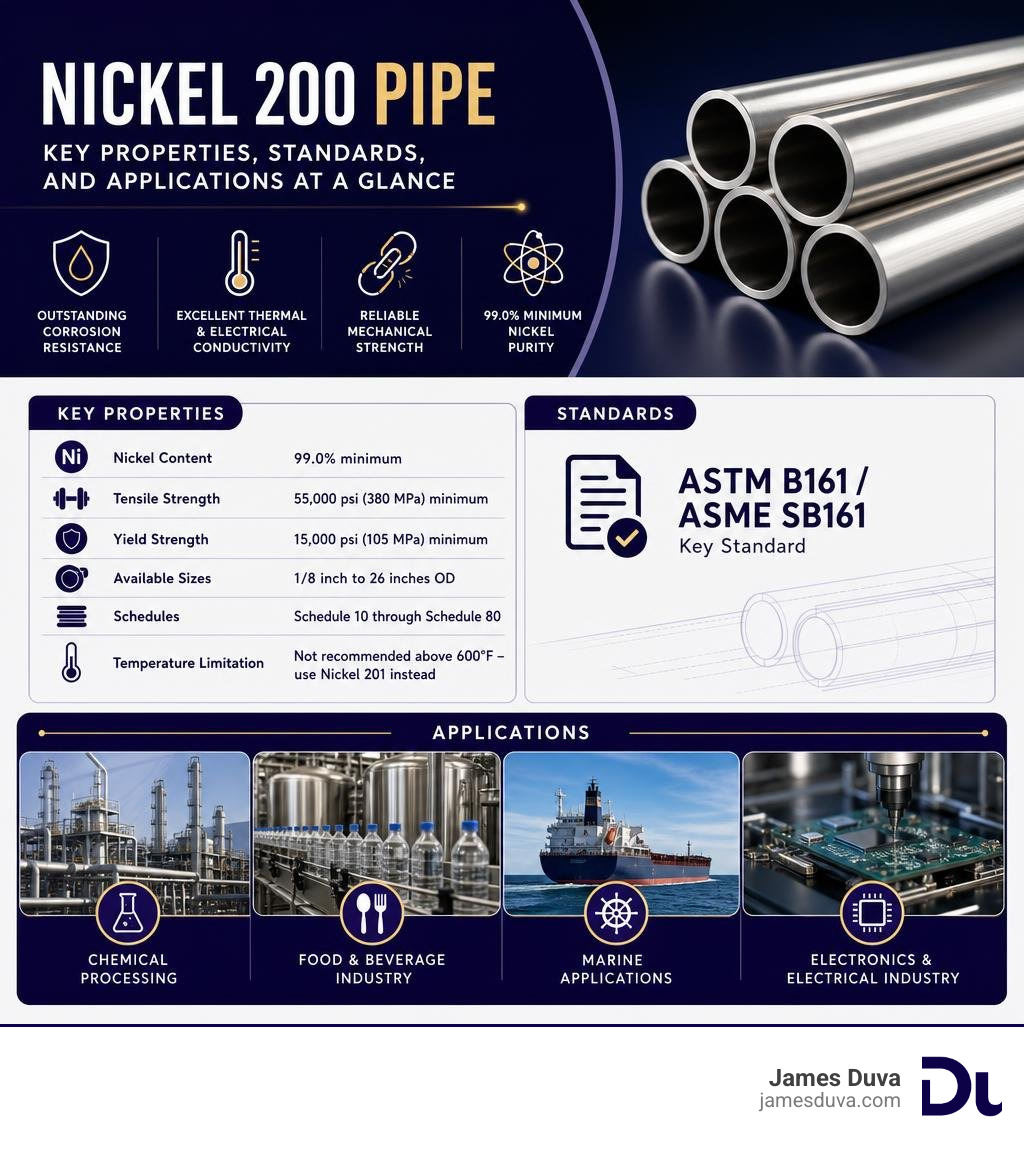
Nickel 200 pipe is a commercially pure wrought nickel piping product — containing at least 99.0% nickel — prized for its outstanding corrosion resistance, excellent thermal and electrical conductivity, and reliable mechanical strength across a wide range of industrial environments.
If you need a quick answer, here’s what you should know:
| Property | Detail |
|---|---|
| Nickel content | 99.0% minimum |
| Key standard | ASTM B161 / ASME SB161 |
| Tensile strength | 55,000 psi (380 MPa) minimum |
| Yield strength | 15,000 psi (105 MPa) minimum |
| Available sizes | 1/8 inch to 26 inches OD |
| Schedules | Schedule 10 through Schedule 80 |
| Best used for | Caustic alkalis, reducing media, food and chemical processing |
| Main limitation | Not recommended above 600°F — use Nickel 201 instead |
Because of its near-pure nickel content, Nickel 200 pipe behaves differently from stainless steel or lower-nickel alloys. It forms a protective oxide film in many corrosive environments, resists stress corrosion cracking, and holds up exceptionally well against caustic soda, sodium hydroxide, and other aggressive media that would quickly degrade standard piping materials.
That combination of purity and performance makes it a go-to choice for engineers in chemical processing, food production, marine systems, and electronics — anywhere product contamination or aggressive chemistry is a real concern.
I’m Billy Walker, Vice President of James Duva Inc., where I’ve spent years helping engineers and procurement professionals source specialty nickel 200 pipe and other high-nickel alloy piping components for demanding process and power generation applications. In this guide, I’ll walk you through everything you need to know to select, specify, and source Nickel 200 pipe with confidence.
Why Are Alloys So Valuable in Industry?
To truly appreciate the value of a highly specialized material like nickel 200 pipe, it helps to understand why we use alloys in industrial settings in the first place.
In their absolute pure states, many elementary metals are not well-suited for heavy-duty industrial work. For example, pure iron is relatively soft and highly susceptible to rust when exposed to oxygen and moisture. By mixing iron with carbon and other elements, we create steel—an alloy that offers far superior strength, durability, and wear resistance.
Alloys are the backbone of modern infrastructure because they allow us to fine-tune physical and chemical properties to survive environments that would quickly destroy pure base metals. We rely heavily on these engineered materials across every major sector:
- Construction: Heavy structural beams and specialized piping systems rely on high-strength alloys to support massive physical loads and resist atmospheric degradation.
- Oil & Gas: High-pressure environments demand specialized fittings, flanges, and robust Ball Valves that can withstand both extreme mechanical stress and sour, corrosive process fluids.
- Automotive & Aerospace: High-integrity structural frames and high-temperature jet engines require advanced alloys that maintain their strength under intense thermal and mechanical fatigue.
- Medical & Consumer Goods: From biocompatible medical implants to corrosion-resistant kitchenware, alloys ensure safety, longevity, and hygiene.
While standard stainless steels are excellent for general use, highly aggressive chemical environments often demand an upgrade. Understanding When to Choose Nickel Alloys Over Stainless Steel in Industrial Applications is critical for preventing catastrophic piping failures and minimizing costly plant downtime. When standard steels fall short, commercially pure nickel alloys step in to deliver the reliable performance modern industries require.
Understanding the Properties and Specifications of Nickel 200 Pipe
Nickel 200 pipe is designated under the Unified Numbering System as UNS N02200 and is frequently referenced in European standards as Werkstoff Nr. 2.4060 or 2.4066. It is a solid-solution strengthened, commercially pure wrought alloy that balances exceptional chemical purity with robust physical properties.
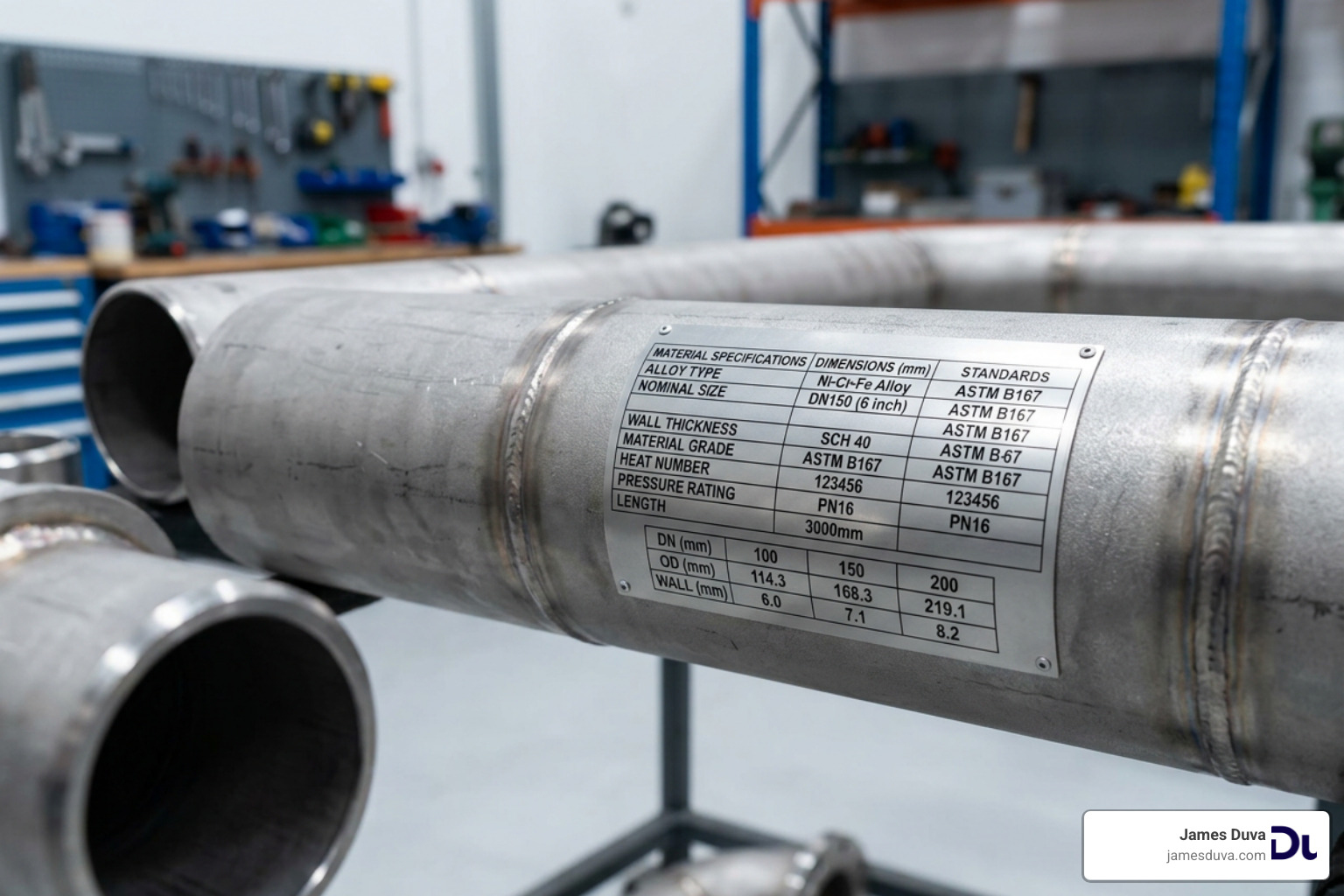
To get a complete picture of how this material behaves under stress and exposure, we must look closely at its chemical makeup and mechanical limits. For a deeper dive into these technical concepts, you can also explore our Nickel 200 Properties: Step-by-Step Guide to Terms Demystified.
Chemical Composition and Mechanical Properties of a Nickel 200 Pipe
The outstanding corrosion resistance of nickel 200 pipe is direct evidence of its high elemental purity. It contains a minimum of 99.0% nickel (often combined with cobalt). The remaining fraction is carefully controlled to limit impurities that could compromise its workability or corrosion resistance.
The table below outlines the standard chemical composition limits and the primary mechanical and physical properties of Nickel 200:
| Chemical Element | Composition Limit (Max % unless noted) |
|---|---|
| Nickel (Ni) + Cobalt (Co) | 99.0% Minimum |
| Iron (Fe) | 0.40% |
| Carbon (C) | 0.15% |
| Manganese (Mn) | 0.35% |
| Silicon (Si) | 0.35% |
| Copper (Cu) | 0.25% |
| Sulfur (S) | 0.01% |
| Mechanical & Physical Property | Standard Value |
|---|---|
| Tensile Strength (Minimum) | 55,000 psi (380 MPa) |
| Yield Strength (0.2% Offset, Minimum) | 15,000 psi (105 MPa) |
| Elongation (in 2 inches, Minimum) | 35% |
| Density | 8.89 g/cm³ (0.321 lb/in³) |
| Melting Range | 1435-1446°C (2615-2635°F) |
While its yield strength is relatively modest in the fully annealed state, Nickel 200 possesses excellent ductility (35% minimum elongation), allowing it to be easily formed into complex piping configurations. It also exhibits magnetic and magnetostrictive properties, alongside thermal and electrical conductivities that are significantly higher than those of stainless steels or more complex nickel-chromium alloys.
Key Standards and Manufacturing Specifications
To ensure safety and consistency in high-pressure and highly corrosive industrial systems, nickel 200 pipe must be manufactured in strict accordance with recognized international standards. Organizations such as ASTM International publish many of the material specifications engineers use to define chemistry, dimensional tolerances, testing, and acceptance requirements. The most common specifications we work with include:
- ASTM B161 / ASME SB161: The standard specification for nickel seamless pipe and tube. If you are sourcing high-integrity systems, you will often reference these specifications to verify wall thickness and diameter tolerances.
- ASTM B725 / ASME SB725: This covers welded copper-nickel and nickel alloy pipe, which is an economical choice for larger diameter lines operating under moderate pressures.
- ASTM B163 / ASME SB163: The standard specification for seamless nickel and nickel alloy condenser and heat exchanger tubes.
- ASME SB829: General requirements for nickel and nickel alloy seamless pipe and tube.
- International Standards: European and British projects frequently specify Werkstoff Nr. 2.4060/2.4066, DIN 17740, or BS 3072-3076 to certify material chemistry and mechanical properties.
For detailed procurement specifications and testing requirements, engineering teams often consult standard ASTM B161 data sheets to ensure compliance with local and international pressure piping codes.
Corrosion Resistance, Fabrication, and Comparing Nickel 200 vs. 201
Understanding how nickel 200 pipe behaves during fabrication and how it holds up in aggressive chemical environments is essential for successful system design.
Unlike more complex alloys that rely on high chromium content to resist oxidizing acids, Nickel 200 relies on its natural nobility and its ability to form a highly stable, passive oxide film when exposed to corrosive media. It performs exceptionally well in reducing environments, neutral salt solutions, and non-oxidizing halides. It also offers superb resistance to chloride stress corrosion cracking, a common failure mode for standard stainless steels.
When it comes to fabrication, Nickel 200 is highly versatile. It can be hot worked within a temperature range of 1200°F to 2250°F (with heavy forming best performed above 1600°F). It is also highly amenable to cold forming. When cold working increases the hardness of the material, it can be fully annealed within a temperature range of 1300°F to 1600°F to restore its ductility.
If your process involves extreme thermal cycling or temperatures far exceeding the limits of pure nickel, you might need to look at alternative alloys. In those cases, reviewing materials like Nickel Alloy 800H Properties, Applications and Benefits in High Temperature Environments can help you make the right choice.
Performance in Caustic Alkalis and Reducing Media
The absolute standout feature of nickel 200 pipe is its virtually unparalleled resistance to caustic alkalis, particularly caustic soda (sodium hydroxide) and potassium hydroxide.
Even in highly concentrated, boiling caustic solutions, the corrosion rate of Nickel 200 remains incredibly low. It is also highly resistant to dry fluorine, anhydrous ammonia, and non-oxidizing organic acids.
Because of this superior chemical resistance, engineers rely heavily on seamless nickel pipe manufactured to ASTM B161 and ASME SB161 piping specifications for the construction of caustic evaporators, chemical storage tanks, and alkaline distribution lines.
Common Industries Utilizing Nickel 200 Pipe
Due to its high purity and reliable performance, nickel 200 pipe is a staple in several critical industries:
- Chemical Processing: Used extensively in the production of caustic soda, chlorine, and synthetic fibers (such as viscose rayon) where maintaining product purity is critical.
- Food Processing: Pure nickel prevents metal contamination, making it ideal for handling natural oils, fatty acids, and juices.
- Marine Engineering: Excellent resistance to brackish water and natural seawater makes it valuable for specialized marine piping systems.
- Aerospace & Electronics: Highly valued for its electrical conductivity and thermal transfer properties. To learn more about how nickel-based materials support high-performance flight systems, read about Nickel-Based Alloys in the Aerospace Industry.
To complete these piping systems, designers pair these pipes with specialized components sourced through a trusted specialty piping manufacturer to ensure consistent corrosion resistance across all elbows, tees, and reducers.
Welding and Heat Treatment Guidelines
Welding nickel 200 pipe requires careful attention to cleanliness and technique. Because nickel alloys do not flow as easily as carbon or stainless steels, proper joint preparation is essential.
- Welding Processes: Gas Tungsten Arc Welding (GTAW/TIG) is the preferred method for thin-walled pipe, while Gas Metal Arc Welding (GMAW/MIG) is frequently used for heavier schedules.
- Shielding Gas: High-purity argon or argon-helium mixtures must be used to protect the weld pool from atmospheric contamination.
- Cleanliness: The weld joint and surrounding area must be completely free of oil, paint, grease, and sulfur compounds. Any trace contamination can cause severe hot cracking or embrittlement.
- Post-Weld Heat Treatment (PWHT): In most standard applications, PWHT is not required. However, stress-relief annealing may be performed to minimize residual stresses in highly critical process lines.
Nickel 200 vs. Nickel 201: Temperature and Carbon Limits
While Nickel 200 and Nickel 201 are very similar, they have one critical difference: their carbon content.
- Nickel 200: Contains a maximum carbon content of 0.15%.
- Nickel 201: Features a strictly controlled maximum carbon content of 0.02%.
This minor chemical variation has massive consequences at elevated temperatures. When Nickel 200 is exposed to temperatures above 600°F (315°C) for extended periods, the excess carbon precipitates out of the solid solution as graphite along the grain boundaries. This process, known as graphitization, leads to severe intergranular embrittlement and a catastrophic loss of ductility.
Therefore, for any pressure vessel or piping application operating above 600°F, the ASME Boiler and Pressure Vessel Code mandates the use of Nickel 201, which is code-approved for temperatures up to 1250°F. Many modern suppliers stock dual-certified Nickel 200/201 material, which carefully balances the chemistry of both grades to simplify inventory and procurement.
To see how these pure nickels compare to more complex, chromium-bearing superalloys, you can read our guide on Nickel Alloy Round Rod and Bar: Inconel, Hastelloy and Beyond.
Frequently Asked Questions About Nickel 200 Piping
Navigating the technical and commercial aspects of sourcing specialty piping can be challenging. Working with experienced professionals is always the best way to avoid costly mistakes. For general sourcing tips, check out our guide on 5 Ways to Find Nickel Alloy Suppliers Like a Pro.
Below, we answer some of the most common questions we receive regarding nickel 200 pipe systems.
What is the difference between seamless and welded Nickel 200 pipe?
The primary difference lies in how they are manufactured, which directly impacts their pressure ratings, cost, and availability:
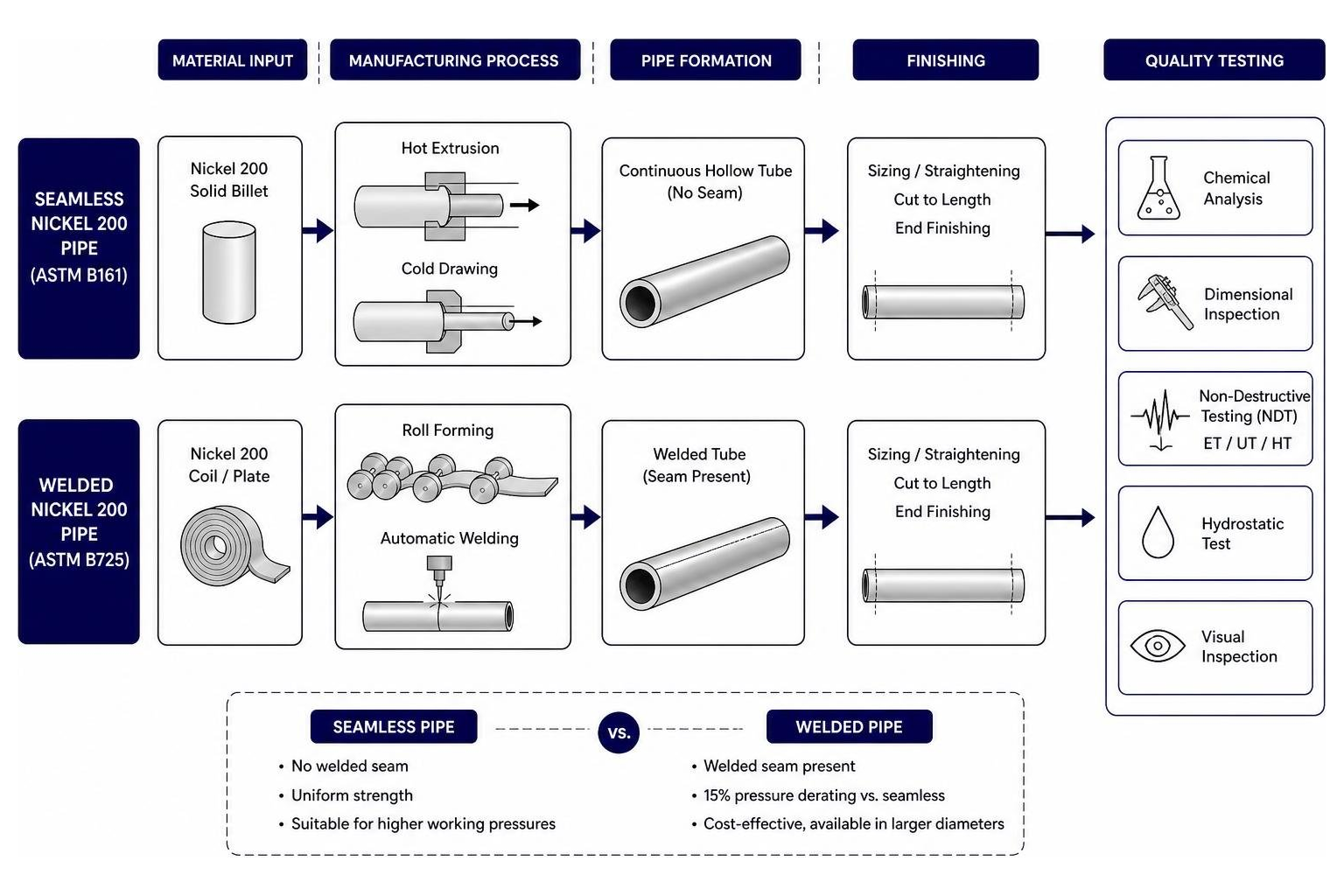
- Seamless Pipe (ASTM B161): Produced by hot extruding and cold drawing a solid metal billet into a continuous hollow shell. Because there is no welded seam, seamless pipe offers uniform strength throughout its circumference and is rated for higher working pressures. It is the preferred choice for critical high-pressure chemical reactors.
- Welded Pipe (ASTM B725): Manufactured by roll-forming flat-rolled sheet or plate and joining the seam with an automatic welding process. While modern welding techniques produce highly reliable joints, welded pipe typically carries a 15% pressure derating factor compared to seamless pipe, though it is often more cost-effective and readily available in larger diameters.
Why is Nickel 201 preferred over Nickel 200 at high temperatures?
As noted during our comparison, the 600°F (315°C) threshold is the critical dividing line. Above this temperature, the 0.15% maximum carbon in Nickel 200 begins to form graphite along the grain boundaries. This intergranular carbon precipitation destroys the structural integrity of the pipe, making it brittle and prone to sudden cracking under stress.
By keeping the carbon limit below 0.02%, Nickel 201 completely avoids graphitization, allowing it to maintain its ductility and strength in high-temperature service up to 1250°F under ASME Section VIII Division 1 guidelines.
What are the typical pricing and size ranges for Nickel 200 piping?
Nickel 200 piping is available in a broad range of dimensions to suit various industrial layouts:
- Size Range: Commonly stocked from 1/8 inch nominal pipe size (NPS) up to 26 inches outside diameter (OD).
- Schedules: Wall thicknesses range from light-wall Schedule 10 up to heavy-wall Schedule 80 and extra-heavy (XXH) profiles.
- Pricing Factors: Because pure nickel is a traded commodity, market pricing fluctuates based on global supply and demand. Sourcing from established distributors who maintain strong mill relationships is the best way to secure competitive pricing and reliable lead times.
When designing complex systems, engineers often coordinate with major regional distributors to verify local stock availability and coordinate rapid delivery to jobsites along the East Coast.
Conclusion
Selecting the right piping material is one of the most critical decisions you will make for the safety, efficiency, and longevity of your industrial process. When your operations involve highly concentrated caustic alkalis, reducing acids, or strict product purity standards, nickel 200 pipe delivers the uncompromising performance you need.
At James Duva Inc., based in Branchburg, NJ, we have spent nearly five decades building our reputation as a trusted, one-stop shop for high-grade stainless steel and specialty nickel alloys. Since 1978, we have combined deep technical expertise with a robust inventory to support critical projects in chemical processing, power generation, oil and gas, and beyond.
Whether you need seamless or welded Nickel 200 pipe, matching fittings, or specialized valves, our team is here to help you navigate your specifications and secure the high-quality materials your project demands.

Ready to source high-performance piping for your next project? Explore James Duva’s Premium Nickel Alloys today, or reach out to our Branchburg, New Jersey team for technical guidance and a fast, competitive quote.
About James Duva Inc.
Since 1978, James Duva Inc. has been your trusted source for stainless steel and high-nickel alloy industrial products. Whether you’re in the water treatment, process or power industry, we pride ourselves on always having what you need. Say goodbye to your sourcing problems with just one call to James Duva.