
A Practical Guide to Stainless Steel Tubing
Jul 13, 2026
What You Need to Know About Stainless Steel Tubing
Stainless steel tubing is a hollow, cylindrical product made from corrosion-resistant steel alloys used across industries like oil and gas, chemical processing, aerospace, food processing, and marine applications.
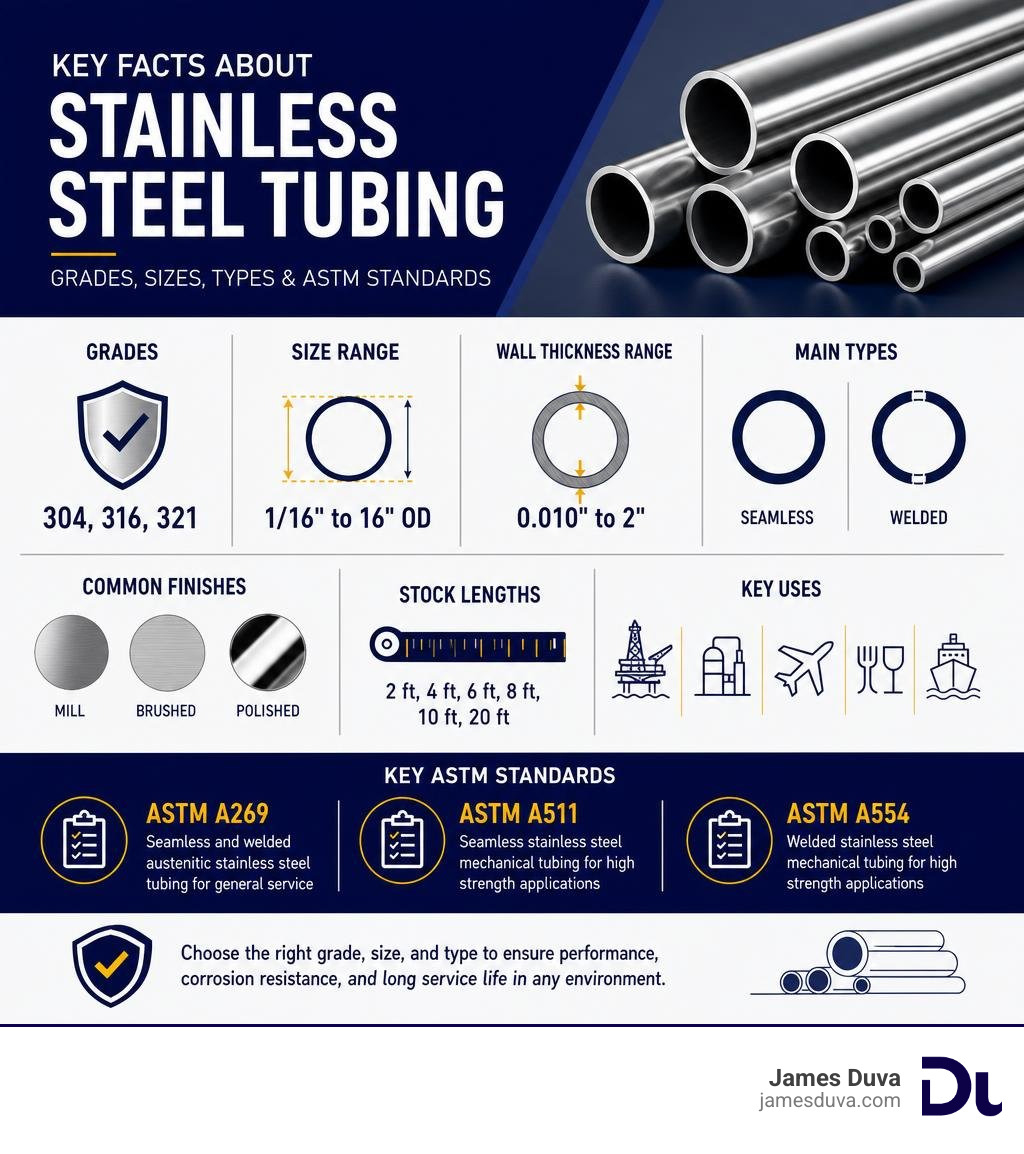
Quick answers to what most buyers need to know:
| Question | Quick Answer |
|---|---|
| Most common grades | 304, 316, 321 |
| Size range | 1/16″ to 16″ OD |
| Wall thickness range | 0.010″ to 2″ |
| Main types | Welded and seamless |
| Key standards | ASTM A269, A511, A554 |
| Common finishes | Mill, brushed, polished |
| Stock lengths | 2 ft, 4 ft, 6 ft, 8 ft, 10 ft, 20 ft |
Choosing the wrong grade, wall thickness, or manufacturing method can lead to premature failure, costly downtime, or rejected product — especially in high-pressure or chemically aggressive environments. This guide cuts through the complexity so you can source and specify stainless steel tubing with confidence.
I’m Billy Walker, Vice President of James Duva Inc., a specialty supplier of stainless steel tubing and high-nickel alloy products serving the power, process, and water treatment industries since 1978. In that time, I’ve worked alongside engineers and procurement teams to source the right tubing from trusted domestic manufacturers — and I’ll share what actually matters when making these decisions.
Why Are Alloys So Valuable in Industry?
To understand why we rely so heavily on stainless steel tubing, we have to look at metallurgy. Pure metals are rarely up to the task of modern industrial workloads. Take pure iron, for example: on its own, it is relatively soft, structurally weak, and highly prone to rust when exposed to oxygen and moisture.
By introducing other elements, we create alloys. Alloys are engineered materials that combine two or more elements to achieve superior mechanical properties and chemical resistance. Steel itself is an alloy of iron and carbon, but stainless steel goes a step further by adding chromium (at least 10.5%), nickel, molybdenum, titanium, and other elements. This cocktail of elements changes the molecular structure, creating a self-healing chromium oxide surface layer that prevents rust and withstands high temperatures and pressures.

For a deeper dive into how these alloys are produced and specified, you can read our guide on Behind the Bar: A Guide to Sourcing Stainless Steel.
Applications in Construction and Oil & Gas
In structural construction, alloys provide the high tensile strength required for load-bearing beams, support frameworks, and architectural design elements. In the oil and gas sector, the demands are even more extreme. Heavy-duty piping systems, fittings, and flanges must handle highly corrosive sour gas, saltwater, and immense pressures.
To control the flow within these punishing environments, specialized components like high-quality Ball Valves are integrated directly into the alloy piping networks, ensuring leak-free performance and reliable isolation under pressure.
Applications in Automotive, Aerospace, and Medical Fields
Beyond heavy infrastructure, alloys play a vital role in high-precision and safety-critical industries:
- Automotive: Stainless alloys are used in vehicle frames, structural braces, and high-temperature exhaust systems where resistance to road salt and heat cycles is essential.
- Aerospace: Jet engines, airframes, wing mounts, and fuel lines rely on advanced alloys (like titanium-stabilized grades) to survive extreme thermal shock and high mechanical stress.
- Medical & Consumer Goods: Biocompatible stainless alloys are critical for medical implants, surgical instruments, and pharmaceutical processing. In our everyday lives, these same sanitary, easy-to-clean alloys form the backbone of durable kitchenware and food processing equipment.
Key Grades of Stainless Steel Tubing
Austenitic stainless steels are the most popular family of alloys used for industrial tubing. They are non-magnetic, highly formable, and offer exceptional corrosion resistance across a broad temperature range.
When choosing stainless steel tubing, selecting the correct chemistry is half the battle. Below is a comparison of the three most common grades we supply:
| Property / Feature | 304 Stainless Steel | 316/316L Stainless Steel | 321 Stainless Steel |
|---|---|---|---|
| Primary Alloys | 18% Chromium, 8% Nickel | 16% Chromium, 10% Nickel, 2% Molybdenum | 18% Chromium, 9% Nickel, Titanium-stabilized |
| Corrosion Resistance | Excellent (general environments) | Superior (chlorides, acids, marine) | Excellent (high-temperature oxidation) |
| Max Service Temp | ~800°F (425°C) | ~850°F (454°C) | ~1500°F (815°C) |
| Intergranular Corrosion | Vulnerable after welding | Low risk (especially 316L) | Immune (stabilized by titanium) |
| Common Uses | Food processing, structural, general piping | Chemical processing, marine, pharmaceuticals | Aircraft exhausts, heat exchangers, manifolds |
Comparing 304 and 321 Stainless Steel Tubing
While 304 is the absolute workhorse of the industry, it has a vulnerability: carbide precipitation. When 304 is heated to temperatures between 800°F and 1500°F (such as during welding or in high-heat industrial processes), carbon combines with chromium at the grain boundaries. This depletes the chromium content, leaving the steel vulnerable to intergranular corrosion.
This is where 321 stainless steel shines. Grade 321 is stabilized by adding titanium, which has a much stronger affinity for carbon than chromium does. The carbon bonds with the titanium instead, leaving the chromium distributed evenly throughout the alloy to maintain its corrosion-resistant properties. Consequently, 321 is the premier choice for extreme high-temperature environments, aircraft exhaust systems, and heavy welding projects.
Learn more about the basics in The Definitive Guide to 304 Stainless Tubing.
The Role of 316 and 316L in Corrosive Environments
For environments rich in chlorides—such as marine coastlines, chemical processing plants, or pharmaceutical lines—grade 316 is the industry standard. The addition of 2% to 3% molybdenum dramatically increases its resistance to pitting and crevice corrosion.
When welding is required, we often recommend 316L. The “L” stands for low carbon (maximum 0.03% carbon compared to 0.08% in standard 316). Minimizing the carbon content virtually eliminates harmful carbide precipitation during welding, ensuring the joint remains as corrosion-resistant as the rest of the tube.
For a detailed breakdown of these differences, check out our Detailed Guide to 316L vs 316 Stainless Steel.
Welded vs. Seamless Tubing Solutions
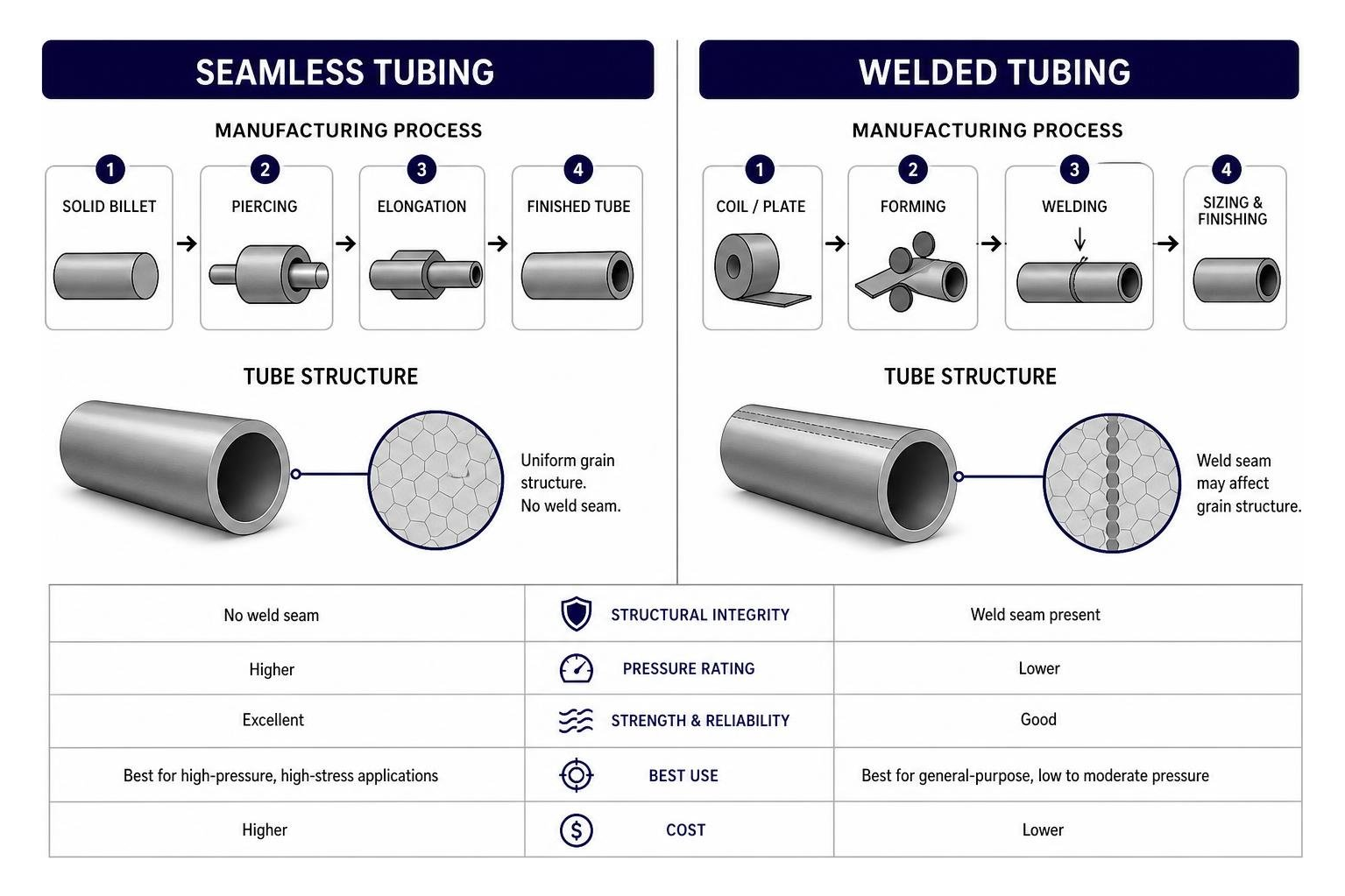
How a tube is made has a massive impact on its pressure rating, structural integrity, and cost. Understanding these manufacturing methods is key to choosing the right product for your application.
You can explore a comprehensive overview of this topic in Industrial Tubing: A Down-to-Earth Guide to Seamless and Welded Tubing Solutions.
Seamless Tubing Strength and High-Pressure Performance
Seamless tubing is manufactured without a welded seam. It is typically produced through an extrusion process, where a solid steel billet is heated, pierced, and drawn over a mandrel to form a hollow tube. Because there is no weld joint, seamless tubing offers a completely homogeneous grain structure.
This lack of a seam yields several advantages:
- Higher Pressure Ratings: Without a weld line (which is historically a potential point of weakness), seamless tubing can handle significantly higher operating pressures.
- Uniformity: It performs predictably under extreme heat, mechanical stress, and harsh chemical environments.
- Machining: It is ideal for critical mechanical components, nozzles, and high-pressure fluid lines.
To learn more about how seamless tubes are manufactured and where they are best deployed, see Seamless Pipe Advantages: Manufacturing and Applications.
Welded Tubing Cost and Structural Applications
Welded tubing is produced by taking a flat strip of stainless steel (coiled plate), roll-forming it into a cylindrical shape, and welding the longitudinal seam. Modern welding techniques—such as Tungsten Inert Gas (TIG) or laser welding—produce clean, high-strength joints that are often tested to ensure they match the strength of the parent metal.
- Cost-Efficiency: Welded tubing is generally much less expensive to manufacture than seamless tubing.
- Tolerances: It offers highly consistent wall thickness and excellent concentricity because it is formed from precision-rolled flat strip.
- Applications: It is widely used for structural frameworks, handrails, exhaust systems, and ornamental applications where high internal pressure is not a primary concern.
For a direct head-to-head comparison, read Seamless Pipe and Welded Pipe: What’s the Difference?.
Understanding ASTM Specifications and Dimensions
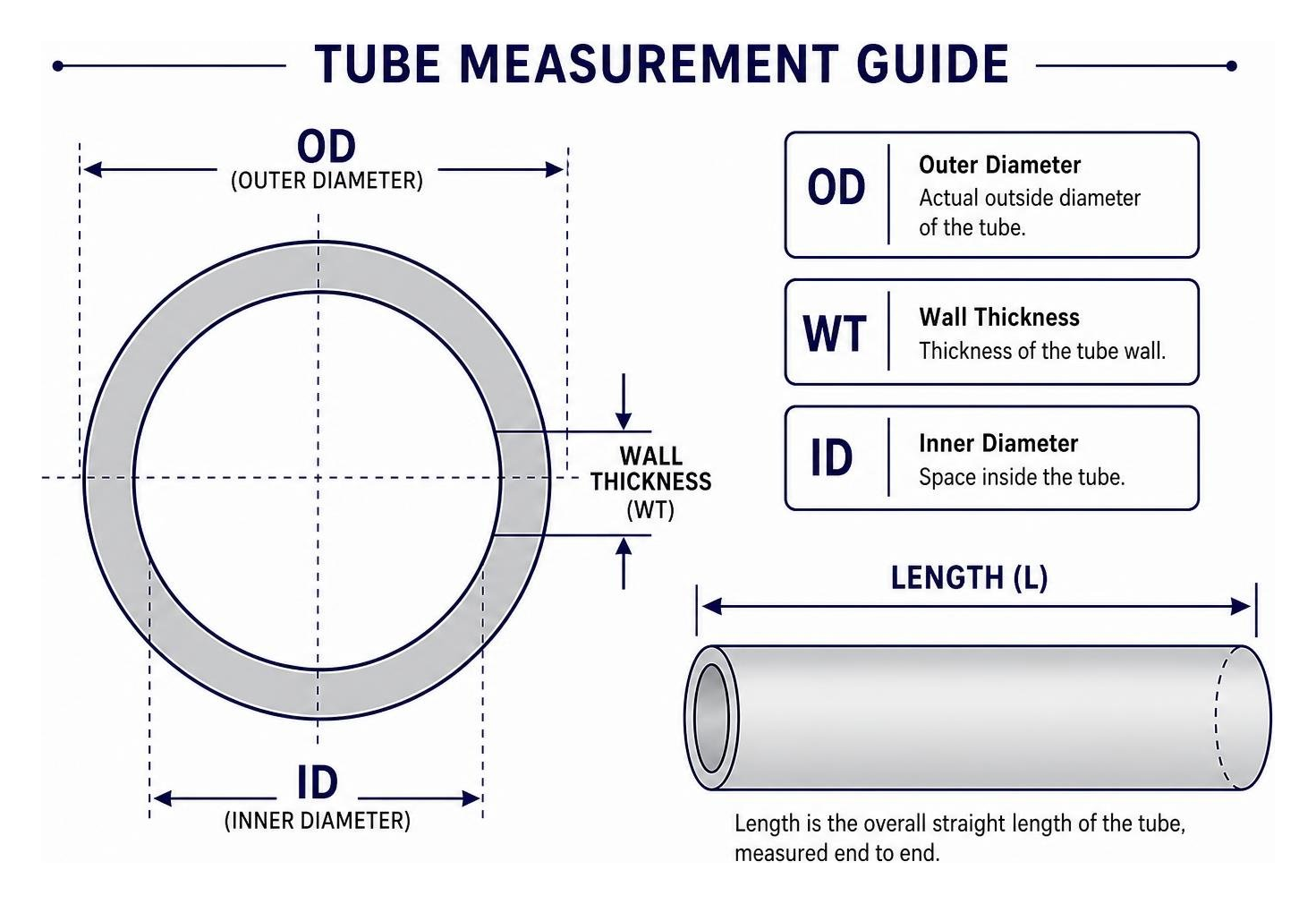
Unlike pipe, which is measured by Nominal Pipe Size (NPS) and schedule, tubing is measured by its actual Outer Diameter (OD) and Wall Thickness. For example, a 1-inch tube has an actual outer diameter of exactly 1.000 inch.
To navigate the complex world of industrial sizing, refer to our guide on Navigating the Maze of Industrial Tubing from Welded Pipe to Seamless Wonders.
Critical ASTM Standards for Stainless Steel Tubing
When purchasing stainless steel tubing, compliance with American Society for Testing and Materials (ASTM) standards is crucial for quality control, safety, and traceability. The most important standards to look for include:
- A269/A269M Standard Specification for Seamless and Welded Austenitic Stainless Steel Tubing for General Service : This covers nominal-wall-thickness tubing intended for general corrosion-resisting and low- or high-temperature service. It requires rigorous non-destructive electric or hydrostatic testing on every single tube.
- A511/A511M Standard Specification for Seamless Stainless Steel Mechanical Tubing and Hollow Bar : This specification applies to seamless tubing used in mechanical applications where corrosion resistance or high-temperature strength is required, particularly where parts will be machined.
- ASTM A632-01 – ASTM A632-01 : This covers small-diameter, thin-wall austenitic stainless steel tubing (sizes under 1/2-inch down to 0.050-inch OD) for general service. It details strict dimensional tolerances and heat-treatment requirements (minimum 1800°F followed by rapid quenching).
Sizing, Wall Thicknesses, and Lengths
Stainless steel round tube is incredibly versatile. It is stocked in over 1,354 different product configurations and is available in fractional sizes ranging from tiny 1/16-inch capillary lines up to large-diameter 16-inch industrial lines.
Wall thicknesses are often specified using the Birmingham Wire Gauge (BWG) system or direct decimal inches, ranging from ultra-thin 0.010-inch walls up to heavy 2-inch structural walls. Standard stock lengths typically include 2-foot, 4-foot, 6-foot, 8-foot, 10-foot, and 20-foot sections, though custom lengths can be cut to meet specific project demands.
Surface Finishes and Fabrication Services
The surface finish of stainless steel tubing does more than just determine how it looks; it plays a critical role in its corrosion resistance, cleanability, and mechanical performance.

How Finishes Affect Performance and Appearance
Different applications require different surface profiles:
- Mill Finish: This is the standard, unpolished finish as it comes from the manufacturing mill. It is dull, slightly rough, and may have a light scale. It is perfect for structural or industrial applications where appearance and extreme sanitary conditions are not critical.
- Brushed Finish (e.g., 180 Grit): Achieved by mechanically polishing the tube with abrasive belts, this finish has a directional, satin look. It is highly popular for architectural elements, handrails, and consumer goods because it hides fingerprints and scratches.
- Polished Finish (e.g., Mirror Finish): This ultra-smooth finish has a very low Roughness Average (Ra). It is vital for the food, beverage, and pharmaceutical industries because a smooth surface prevents bacteria, organic matter, and contaminants from clinging to the interior or exterior of the tubing.
Value-Added Supplier Services
As a comprehensive industrial supplier, we don’t just ship raw stock. We understand that projects move faster when materials arrive ready for installation. Typical value-added services we provide include:
- Precision Cutting: Band saw or cold saw cutting to exact tolerances to eliminate field-cutting labor.
- Deburring: Removing sharp edges and metal burrs from cut ends to ensure safe handling and clean weld prep.
- Custom Polishing: Adjusting the interior or exterior surface finish to match your specific sanitation or aesthetic requirements.
To understand what to look for in a processing partner, read The Complete Guide to Stainless Steel Suppliers.
Frequently Asked Questions about Industrial Tubing
What are the benefits of using stainless steel tubing over aluminum or carbon steel?
While carbon steel is inexpensive, it requires painting, galvanizing, or constant maintenance to prevent rust. Aluminum is lightweight but lacks the high tensile strength, extreme temperature limits, and chemical resistance of stainless steel. Stainless steel tubing offers the best overall lifecycle value because it does not degrade in harsh environments, reducing replacement and maintenance costs over decades of service.
How do you select the right wall thickness for high-pressure environments?
Selecting wall thickness requires calculating the internal design pressure using Barlow’s Formula:
$$P = frac{2 cdot S cdot t}{D}$$
Where:
- P = Internal pressure
- S = Allowable stress of the material (dependent on grade and temperature)
- t = Wall thickness
- D = Outside diameter
Engineers must also factor in safety margins, operating temperature derating, and a corrosion allowance to ensure the tubing operates safely throughout its service life.
What industries rely most heavily on stainless steel tubing?
Because of its versatility, stainless tubing is utilized across more than 15 major industries. The heaviest users include chemical processing plants, oil and gas refineries, aerospace manufacturers (for hydraulic and fuel lines), food and beverage processors (for sanitary lines), and the marine industry (for components exposed to saltwater).
Conclusion
Sourcing the right stainless steel tubing doesn’t have to be a guessing game. By understanding your environmental conditions, pressure requirements, and fabrication needs, you can select the perfect combination of grade, size, and finish.
At James Duva Inc., based in Branchburg, New Jersey, we have been helping businesses navigate these choices since 1978. Whether you need a standard stock length of 304 welded tube or a highly specialized seamless nickel alloy line, our team has the technical expertise to deliver exactly what your project requires.
Ready to get started?
- Expert Stainless Tubing Suppliers: Discover the Quality of James Duva
- Explore our full range of stainless steel tubing products or contact our sales office in Branchburg, NJ today to request a quote.
About James Duva Inc.
Since 1978, James Duva Inc. has been your trusted source for stainless steel and high-nickel alloy industrial products. Whether you’re in the water treatment, process or power industry, we pride ourselves on always having what you need. Say goodbye to your sourcing problems with just one call to James Duva.