
Nickel Alloy Round Rod and Bar: Inconel, Hastelloy, and Beyond

Jun 26, 2026
Why Nickel Alloy Bars Are Essential in Demanding Industrial Environments
A nickel alloy bar is a solid metal product made by combining nickel with one or more elements — such as chromium, molybdenum, copper, or iron — to produce a material engineered for extreme heat, corrosion, and mechanical stress.
Quick answer: What are the main types of nickel alloy bars?
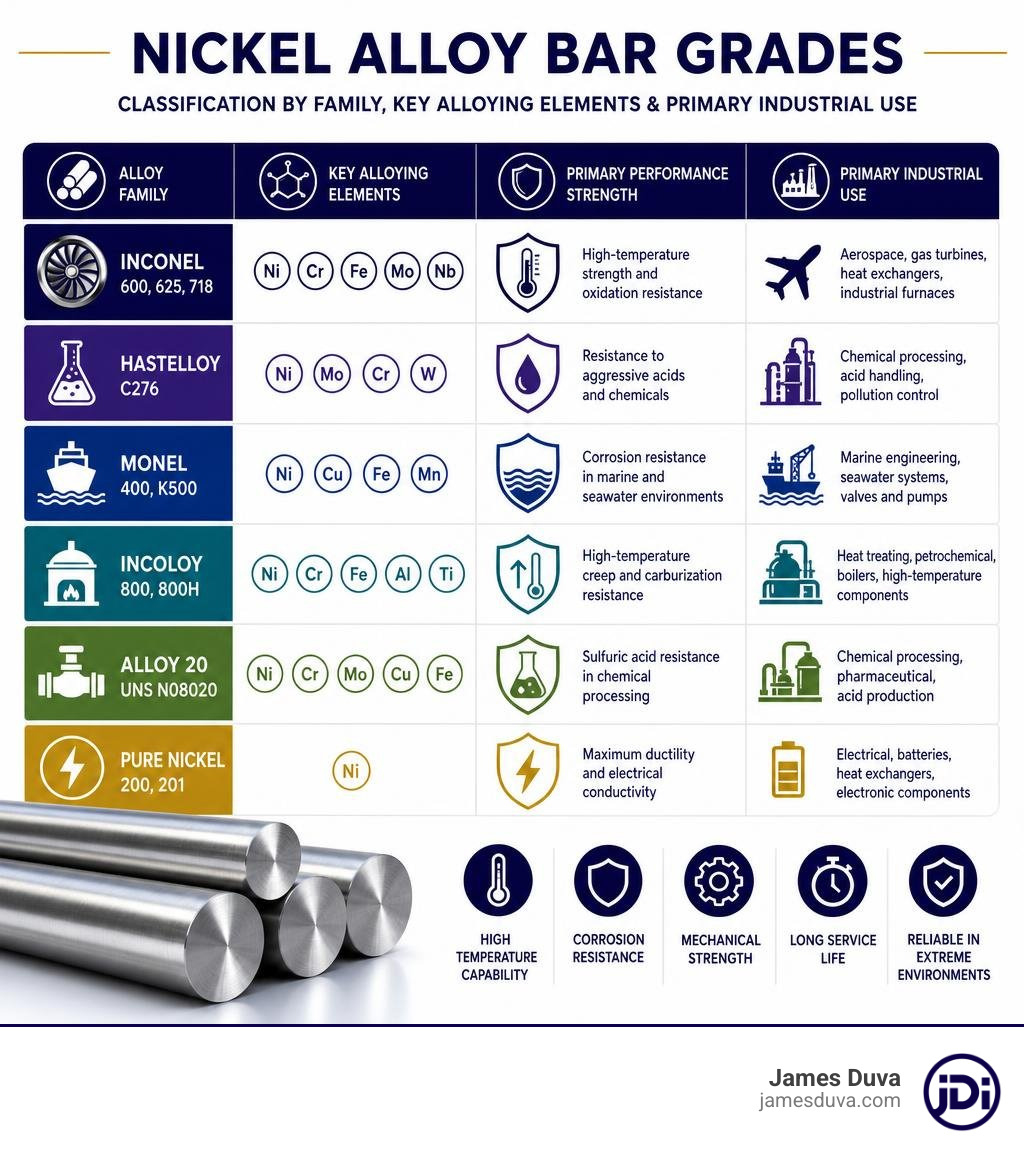
| Alloy Family | Common Grades | Best Known For |
|---|---|---|
| Inconel | 600, 625, 718 | High-temperature strength and oxidation resistance |
| Hastelloy | C276 | Resistance to aggressive acids and chemicals |
| Monel | 400, K500 | Corrosion resistance in marine and seawater environments |
| Incoloy | 800, 800H | High-temperature creep and carburization resistance |
| Alloy 20 | UNS N08020 | Sulfuric acid resistance in chemical processing |
| Pure Nickel | 200, 201 | Maximum ductility and electrical conductivity |
These bar grades serve industries like oil and gas, chemical processing, aerospace, marine engineering, and power generation — anywhere standard stainless steel simply isn’t enough.
Engineers and procurement specialists often face the same challenge: a process environment that runs too hot, too corrosive, or too mechanically demanding for common materials. Nickel alloys were developed specifically to close that gap. With tensile strengths ranging from roughly 450 MPa to over 1,000 MPa and service temperatures that can exceed 1,000°C, they cover a wide spectrum of the most punishing industrial conditions.
I’m Billy Walker, Vice President of James Duva Inc., where I’ve spent years helping process, power, and water treatment professionals source the right nickel alloy bar products — from Inconel and Hastelloy to Monel and beyond. In the guide below, I’ll walk you through every major alloy family, how they’re made, and how to choose the right one for your application.
Why Are Alloys So Valuable in Industry?

To understand why a nickel alloy bar is so highly valued, we must first look at the basic science of metallurgy. In many demanding applications, pure metals fall short. They simply do not possess the diverse combination of physical and chemical traits required to survive modern industrial processes.
By strategically blending different elements, metallurgists create engineered materials that outperform their individual components. This is why we rely so heavily on advanced alloys to keep critical systems running safely and efficiently. For a broader look at this topic, you can read about What Is Alloy Metal and Its Many Uses? to see how these combinations shape modern manufacturing.
Pure Metals vs. Engineered Alloys
Pure metals, such as pure iron or pure nickel, have highly regular atomic structures. While this regularity makes them ductile and excellent conductors, it also makes them relatively soft. In pure iron, for example, the layers of atoms slide past one another with ease under mechanical stress, resulting in low yield strength. Furthermore, pure iron is highly vulnerable to rust and oxidation when exposed to moisture and oxygen.
To overcome these limitations, we turn to engineered alloys. By introducing different-sized atoms (like carbon, chromium, nickel, or molybdenum) into the host metal’s crystal lattice, we disrupt its structural regularity. This internal disruption makes it much harder for the atomic layers to slip past one another, dramatically increasing the material’s overall strength and hardness.
Additionally, alloying elements like chromium react with environmental oxygen to form a microscopic, self-healing passive oxide layer on the metal’s surface, shielding the underlying material from rust and chemical attack. For a deeper breakdown of these differences, check out our guide on Metal Alloys: Properties, Types, and Uses as well as our article on What’s a Metal Alloy? A Deeper Look into the Building Blocks of Modern Industry.
When standard options like stainless steel reach their limits under extreme conditions, nickel-based alloys become the clear choice. We discuss this transition in detail in our article on When to Choose Nickel Alloys Over Stainless Steel in Industrial Applications.
Key Industrial Applications of Alloys
Engineered alloys are the unsung heroes of modern infrastructure, transport, and manufacturing. Different alloy groups are tailored to specific sectors based on their unique performance profiles:
- Construction: High-strength structural steel alloys form the beams, columns, and concrete reinforcing bars that support high-rise buildings and bridges. Corrosion-resistant alloy piping networks ensure safe water distribution and sewage management.
- Oil & Gas: This sector operates under incredible pressures and corrosive conditions. High-performance alloys are used to manufacture heavy-duty fittings, flanges, and high-pressure Ball Valves that prevent leaks and withstand sour gas environments.
- Automotive & Aerospace: The automotive industry relies on advanced high-strength steels and aluminum alloys to build lightweight, crash-resistant vehicle frames. Meanwhile, the aerospace industry uses specialized nickel and cobalt superalloys to construct jet engines, turbine blades, and exhaust nozzles that operate at near-melting temperatures.
- Medical & Consumer Goods: In the medical field, biocompatible alloys like Cobalt Chrome Molybdenum (such as ASTM F1537) are essential for orthopedic implants and joint replacements. In our homes, consumer goods like kitchenware and appliances rely on durable, hygienic stainless steels to resist staining and wear.
Understanding these material differences is key to successful engineering. You can explore these relationships further in our comparison guide, Deciphering the Power of Alloy Materials: Stainless Steel, Inconel, and Monel.
What is a Nickel Alloy Bar and How is it Manufactured?

A nickel alloy bar is a solid, straight metal product available in various cross-sections, including round, square, hexagonal, and flat. These bars are highly valued for their balanced mechanical properties, structural integrity, and exceptional resistance to both heat and aggressive chemicals.
To ensure these bars perform reliably in the field, they are manufactured to strict industry standards. For instance, the ASTM B160-24 – Nickel Rod and Bar Specification establishes clear requirements for chemical composition, mechanical properties, and dimensional tolerances. You can also learn more about our foundational work with these high-performance materials in Unraveling the World of Alloy Metals: A Deep Dive into James Duva’s Expertise.
Pure Nickel Bars vs. Nickel Alloy Bars
Understanding the difference between commercially pure nickel and nickel alloys is crucial when sourcing materials for a project:
- Pure Nickel Bars (e.g., UNS N02200 / Nickel 200): Commercially pure nickel (typically 99.6% pure) is a ferromagnetic metal known for its excellent electrical and thermal conductivity, high ductility, and outstanding resistance to caustic alkalis (such as sodium hydroxide). It maintains its mechanical properties across a wide temperature range but lacks the high-temperature tensile strength of engineered alloys.
- Nickel Alloy Bars: These are created by melting pure nickel and mixing it with substantial amounts of other elements like chromium, molybdenum, iron, copper, cobalt, or tungsten. This process creates a material with a lower melting point than pure nickel, which makes it highly suitable for casting and forging. Adding these elements yields superior high-temperature strength, excellent creep resistance, and targeted protection against specific corrosive agents like sulfuric, hydrochloric, or phosphoric acids.
The Manufacturing Process of a Nickel Alloy Bar
Producing a high-quality nickel alloy bar requires precise control over thermal and mechanical processes. The journey from raw ore to finished bar involves several critical steps:
- Melting and Alloying: Raw nickel is melted alongside precise ratios of alloying elements in an Electric Arc Furnace (EAF) or Vacuum Induction Melting (VIM) furnace to prevent contamination.
- Forming (Hot Rolling or Extrusion): The cast ingot is heated to high temperatures (often exceeding 1,100°C) and passed through heavy rollers to shape it into a rough round, square, or hex profile. Hot rolling refines the metal’s grain structure and improves its density (which sits around 8.89 g/cm³ for many nickel grades).
- Cold Drawing: For applications requiring precise dimensional tolerances and a polished surface finish, the hot-rolled bar is pulled through a die at room temperature. Cold drawing increases the bar’s yield and tensile strength while offering excellent dimensional accuracy.
- Heat Treatment (Solution Annealing): To relieve internal stresses and optimize corrosion resistance, the bars undergo heat treatment. For example, specifications like AMS5754L: Nickel Alloy, Corrosion and Heat-Resistant, Bars, Forgings, and Rings 47.5Ni – 22Cr – 1.5Co – 9.0Mo – 0.60W – 18.5Fe Solution Heat Treated – Material Specification mandate precise solution heat treatment parameters to ensure the alloy elements remain evenly distributed within the metal matrix.
- Testing and Quality Assurance: Before packaging, reputable manufacturers perform rigorous testing. This includes chemical analysis, tensile testing, hardness testing, and non-destructive ultrasonic testing to detect any internal voids or defects.
Comparing Key Nickel Alloy Grades and Their Properties
Selecting the right grade of nickel alloy bar requires comparing their chemical compositions and mechanical limits. The table below outlines the core properties of the most common families:
| Alloy Grade | Key Elements | Tensile Strength (Min) | Yield Strength (Min) | Max Service Temp | Primary Benefit |
|---|---|---|---|---|---|
| Inconel 600 | 72% Ni, 15% Cr, 8% Fe | 550 MPa (80 ksi) | 240 MPa (35 ksi) | 1,093°C (2,000°F) | Oxidation & carburization resistance |
| Inconel 625 | 61% Ni, 22% Cr, 9% Mo, 3.6% Nb | 827 MPa (120 ksi) | 414 MPa (60 ksi) | 982°C (1,800°F) | High fatigue strength & pitting resistance |
| Inconel 718 | 52% Ni, 19% Cr, 3% Mo, 5.1% Nb/Ta | 1,240 MPa (180 ksi) | 1,034 MPa (150 ksi) | 704°C (1,300°F) | High strength via precipitation hardening |
| Hastelloy C276 | 57% Ni, 16% Cr, 16% Mo, 4% W | 690 MPa (100 ksi) | 283 MPa (41 ksi) | 1,038°C (1,900°F) | Wet chlorine & strong acid resistance |
| Monel 400 | 63% Ni, 31% Cu, 2% Fe | 480 MPa (70 ksi) | 195 MPa (28 ksi) | 538°C (1,000°F) | Rapidly flowing seawater resistance |
| Alloy 20 | 35% Ni, 20% Cr, 35% Fe, 2.5% Mo, 3.5% Cu | 550 MPa (80 ksi) | 240 MPa (35 ksi) | 538°C (1,000°F) | Exceptional sulfuric acid resistance |
Inconel Alloys (600, 625, 718)
Inconel alloys are nickel-chromium-based materials designed to maintain their structural integrity in high-temperature environments where steel and aluminum would succumb to thermal creep or oxidation:
- Inconel 600 (UNS N06600): This grade offers excellent resistance to high-temperature dry chlorine, oxidation, and stress-corrosion cracking. For a closer look at this versatile material, see our articles Inconel 600 UNS N06600: Unveiling Its Industrial Prowess, Inconel 600 UNS N06600: Strength, Durability, and Versatility, and A Comprehensive Guide to Inconel 600.
- Inconel 625 (UNS N06625): Solid-solution strengthened by molybdenum and niobium, Alloy 625 delivers high strength and outstanding resistance to pitting and crevice corrosion in marine and chemical processing environments. Learn more in Exploring Alloy 625 UNS N06625: Strength and Corrosion Resistance Unveiled and Inconel 625 UNS N06625: Properties, Applications, and Future Innovations.
- Inconel 718 (UNS N07718): This precipitation-hardening alloy contains niobium, iron, and molybdenum. It offers exceptionally high yield and tensile strength alongside good weldability, making it a staple in aerospace and defense.
Hastelloy Alloys (C276)
Hastelloy alloys are the premier choice for highly corrosive chemical environments:
- Hastelloy C276 (UNS N10276): With high concentrations of molybdenum, chromium, and tungsten, C276 provides outstanding resistance to pitting, crevice corrosion, and strong reducing agents. It is one of the few materials capable of resisting wet chlorine gas, hypochlorite, and chlorine dioxide. You can review its properties and maintenance guidelines in our articles: Hastelloy Material: Properties, Applications, and Benefits, Hastelloy C276 UNS N10276: Your Guide to Superior Alloy Solutions, Exploring the Applications of Hastelloy C-276: Versatility in Industrial Solutions, and Maintenance Tips for Hastelloy C-276: Ensuring Longevity and Performance.
Monel Alloys (400, K500)
Monel alloys are nickel-copper-based materials known for their durability in marine and chemical environments:
- Monel 400 (UNS N04400): This alloy offers high strength and excellent corrosion resistance in rapidly flowing seawater, hydrofluoric acid, sulfuric acid, and alkalis. It is widely used in marine engineering and chemical processing. You can read more about its diverse options in Dive Deep into Monel 400: Everything You Need to Know About Its Many Forms.
- Monel K500 (UNS N05500): By adding aluminum and titanium to the nickel-copper base, Monel K500 undergoes precipitation hardening. This gives it the same excellent corrosion resistance as Monel 400, but with three times the yield strength and double the tensile strength.
Other Notable Grades (Alloy 20, Alloy 800)
Several other specialized grades play vital roles in process industries:
- Alloy 20 (UNS N08020): Often referred to as “sulfuric acid proof,” this nickel-iron-chromium alloy contains niobium, copper, and molybdenum. It was specifically developed to resist hot sulfuric acid in chemical mixing and processing. Learn more in The Ultimate Guide to Alloy 20 Bars: Properties, Uses, and More.
- Alloy 800 / 800H (UNS N08800 / N08810): These nickel-iron-chromium alloys offer high tensile strength and excellent resistance to oxidation, carburization, and sulfidation at temperatures up to 815°C. For deeper insights, read Nickel Alloy 800H: Properties, Applications, and Benefits in High Temperature Environments and How Incoloy 825 Composition Improves Performance in Oil & Gas and Chemical Processing.
- Cobalt Alloys: Though not nickel-based, cobalt-chromium-tungsten alloys like Haynes 25 provide exceptional high-temperature strength and wear resistance. Discover more in Unlocking the High Temperature Power of Haynes Alloy 25.
Industrial Applications of Nickel Alloy Bars
Because of their unique properties, nickel alloy bars are used across a wide variety of demanding fields:
- Aerospace Propulsion: Jet engine components, compressor blades, and exhaust nozzles rely on Inconel 718 and Inconel 625 bars to withstand high centrifugal forces and extreme heat. You can explore this in Nickel-Based Alloys in the Aerospace Industry.
- Chemical Processing: Reactors, heat exchangers, agitators, and mixing vessels utilize Hastelloy C276 and Alloy 20 bars to handle highly corrosive acids, salts, and organic compounds.
- Marine Engineering: Propeller shafts, rudder shafts, pump shafts, and marine fasteners rely on Monel 400 and Monel K500 bars to prevent corrosion in fast-moving seawater and marine atmospheres.
- Oil & Gas Extraction: Subsea valve stems, downhole drill collars, and offshore piping systems use high-strength nickel alloy bars to resist sour gas (H2S), high pressures, and corrosive chlorides.
- Power Generation: Nuclear reactor core components, steam generator tubing, and coal-fired boiler supports use Inconel 600 and Alloy 800H to ensure long-term stability under high heat and radiation.
To understand why these alloys are so critical to piping and connection systems, read Why Nickel Alloy Fittings Are Essential for Demanding Environments.
How to Select the Right Nickel Alloy Bar for Your Project
Choosing the right nickel alloy bar requires balancing several key project factors:
- Operating Temperature: Determine the continuous and peak temperatures your system will experience. If temperatures exceed 540°C (1,000°F), Inconel or Incoloy grades are usually required.
- Corrosive Media: Identify all chemicals, acids, gases, and salts in your process. For reducing acids like hydrochloric or sulfuric, Hastelloy C276 or Alloy 20 are ideal. For marine environments, Monel is often the most cost-effective choice.
- Mechanical Stress: Evaluate the load-bearing requirements. If high tensile and fatigue strength are paramount, look to precipitation-hardened grades like Inconel 718 or Monel K500.
- Dimensional Tolerances: Decide whether your application requires the tight tolerances and polished finish of cold-drawn bars, or if hot-rolled bars are sufficient.
- Cost Efficiency: While nickel alloys have a higher upfront cost than stainless steel, their long service life, reduced maintenance needs, and prevention of catastrophic failures make them highly cost-effective over their lifecycle.
Frequently Asked Questions
What is the difference between hot-rolled and cold-drawn nickel bars?
Hot-rolled nickel bars are shaped at high temperatures, resulting in a rough, dark oxide finish and slightly larger dimensional tolerances. They are ideal for applications where the bar will be forged or heavily machined. Cold-drawn bars are pulled through a die at room temperature, which gives them a smooth, bright finish, precise dimensional tolerances, and higher yield and tensile strength due to work hardening.
Can nickel alloy bars be recycled?
Yes, nickel is highly recyclable. Recycled nickel alloys maintain 100% of their chemical and mechanical properties. Using scrap metal in the production of new nickel alloys significantly reduces energy consumption and carbon emissions, supporting sustainability and a circular economy.
What standards govern the production of nickel bars?
The primary standards governing nickel alloy bars include ASTM B160 (for nickel rods and bars), ASTM B166 (for Inconel 600, 601, and 690), ASTM B637 (for precipitation-hardened alloys like Inconel 718), and ASME SB-160. These standards define the required chemical composition, mechanical properties, and testing protocols to ensure consistent quality.
Conclusion
Sourcing the right nickel alloy bar is essential for ensuring the safety, efficiency, and longevity of your high-stress industrial systems. Whether you are dealing with the corrosive depths of marine engineering, the high pressures of oil and gas, or the extreme temperatures of chemical processing, selecting the proper grade makes all the difference.
At James Duva Inc., we have been helping companies find the perfect materials for their most challenging projects since 1978. Based in Branchburg, NJ, we stock a comprehensive inventory of high-grade stainless steel and nickel alloy products. If you need assistance choosing the right alloy, verifying compliance standards, or securing high-quality materials, our experienced team is here to help.
Explore our full inventory of high-performance bars and plates by visiting the James Duva Bar and Plate Products catalog, or reach out to us today to request a quote for your next project.
About James Duva Inc.
Since 1978, James Duva Inc. has been your trusted source for stainless steel and high-nickel alloy industrial products. Whether you’re in the water treatment, process or power industry, we pride ourselves on always having what you need. Say goodbye to your sourcing problems with just one call to James Duva.