
Choose the Right Pharmaceutical Stainless Fittings for Sterile Systems
Nov 4, 2026
How to Choose Pharmaceutical Stainless Fittings
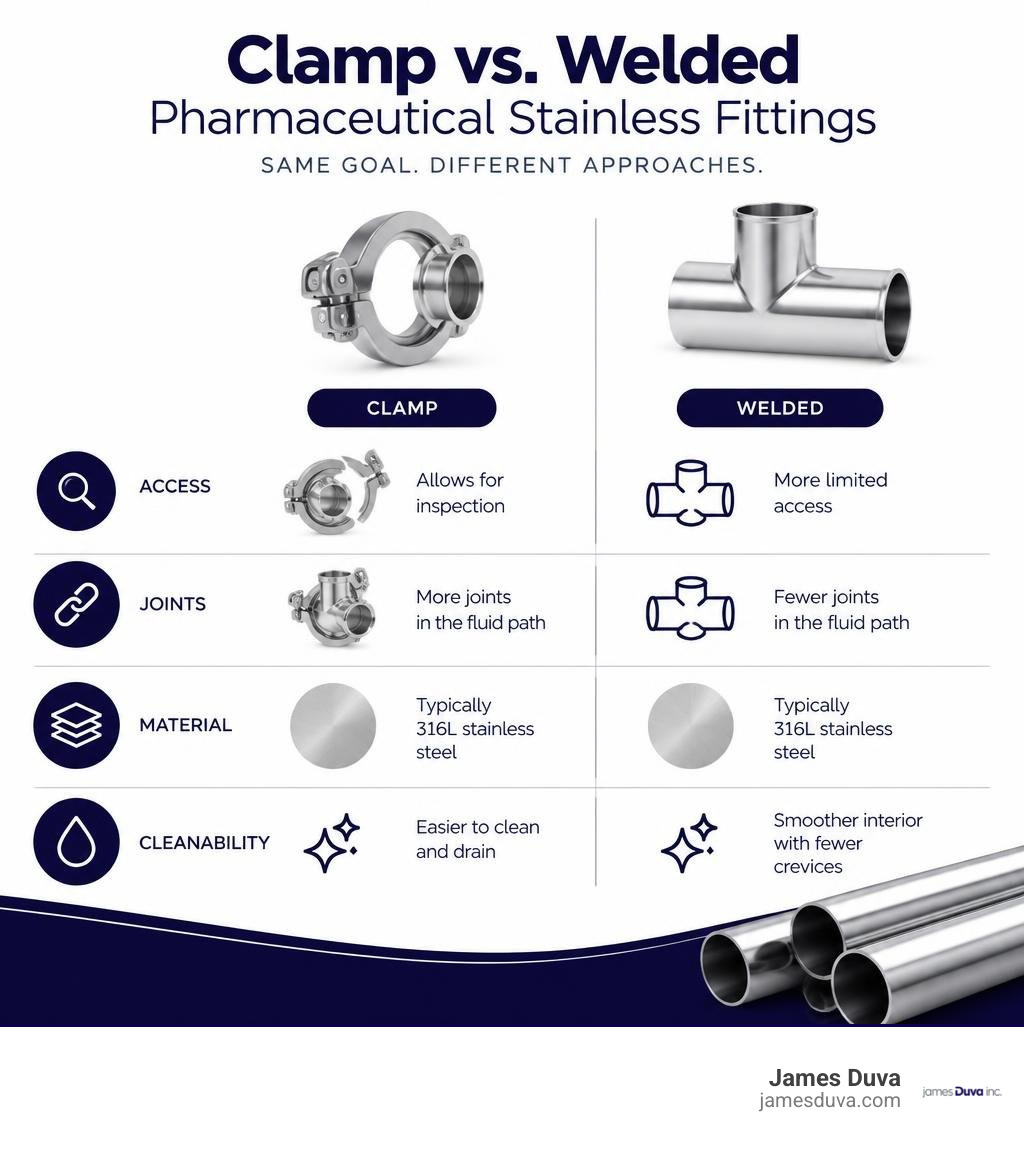
Compare pharmaceutical stainless fittings by connection style, material, and cleanability. Clamp fittings allow access for inspection, while welded fittings reduce the number of joints in the fluid path. For either type, check the stainless grade, internal finish, gasket fit, and whether the assembled line can be cleaned and drained as required. 316L stainless steel is often chosen where strong corrosion resistance is needed.
The right choice helps keep product residue from collecting in hard-to-clean spaces. It also makes it easier to meet a process’s cleaning and documentation needs.
I’m Billy Walker, Vice President of James Duva Inc. My experience sourcing stainless steel piping components helps me explain what to check when selecting pharmaceutical stainless fittings.
Why Are Alloys So Valuable in Industry?
Pure metals like elemental iron are often too soft for structural demands and remain vulnerable to rapid oxidation and rust when exposed to moisture and air. In contrast, engineered alloys combine base metals with elements such as chromium, nickel, and molybdenum to deliver superior mechanical strength, corrosion resistance, and thermal endurance.
In stainless alloys, adding at least 10.5% chromium forms an invisible, self-healing passive chromium oxide film across the surface. This layer prevents environmental oxygen and process chemicals from attacking the underlying metal. Depending on the specific formulation, manufacturers can review detailed stainless steel types to find alloys customized for specific mechanical and thermal stresses across diverse sectors:
- Construction: Heavy-duty structural beams, architectural cladding, and industrial piping rely on high-yield steel alloys for structural integrity and environmental resistance.
- Oil & Gas: Severe-service piping systems depend on high-pressure Ball Valves, robust fittings, and specialized flanges engineered from nickel and duplex alloys to handle sour gas and corrosive hydrocarbons.
- Automotive & Aerospace: High-strength alloy frameworks, jet turbine components, and high-performance engine parts require materials that resist extreme mechanical fatigue and high temperatures.
- Medical & Consumer Goods: Surgical tools, orthopedic implants, and commercial kitchenware demand dense, non-porous alloys that endure frequent sterilization cycles without leaching harmful elements.
Sanitary vs. Non-Sanitary Fittings: Design and Contamination Control
In biopharmaceutical manufacturing, the difference between sanitary and standard industrial pipe fittings is critical for safety and compliance. Standard utility fittings often feature coarse threaded joints, sharp internal corners, or irregular weld seams. In a pharmaceutical fluid pathway, these irregularities create micro-pockets and entrapment zones where organic matter lodges, encouraging bacterial colonization and biofilm growth.
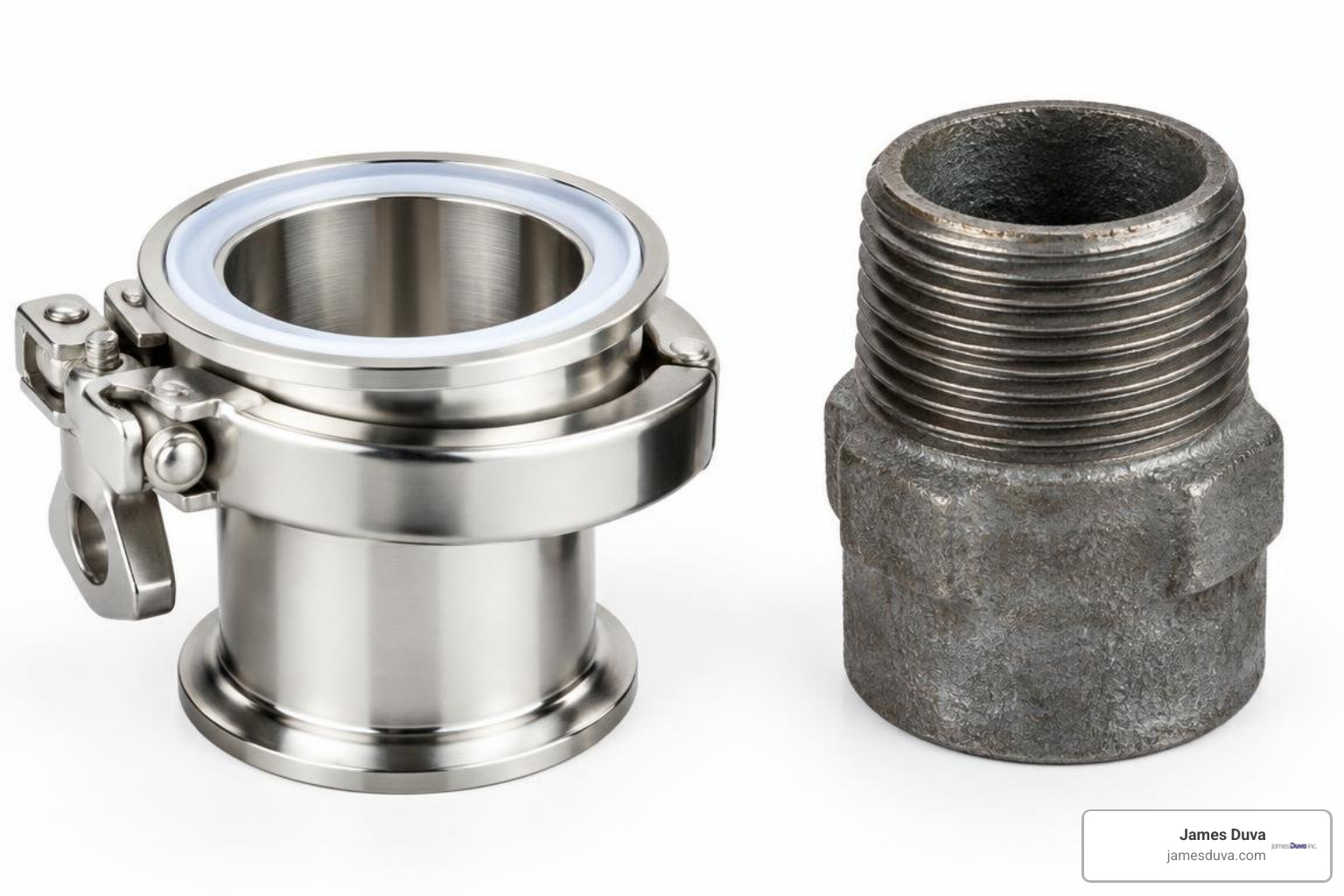
Sanitary fittings eliminate these harborage points through crevice-free internal geometries, flush-fitting elastomer seals, and polished contact surfaces. Regulatory agencies like the FDA enforce rigorous standards for sterile processing equipment. Using non-sanitary hardware in drug product pathways risks severe regulatory penalties, including FDA warning letters, mandatory production shutdowns, and costly product recalls. A single contaminated batch can cause millions of dollars in lost product and compromise patient safety. To understand these criteria across high-purity sectors, engineers often evaluate sanitary standards for food and pharma when designing sanitary fluid paths.
Preventing Biofilm and Contamination in Sterile Fluid Paths
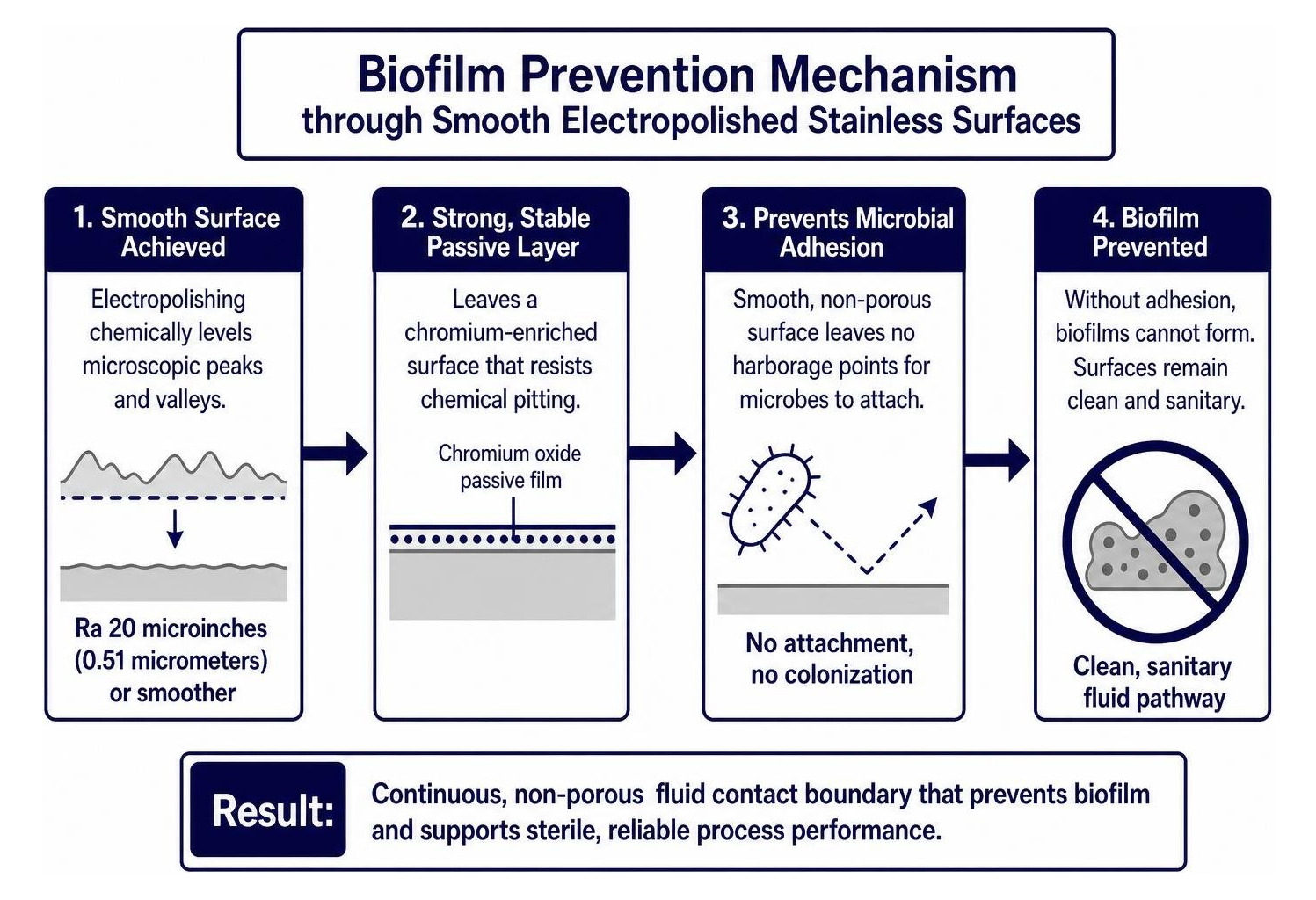
Preventing microbial biofilms requires maintaining a continuous, non-porous fluid contact boundary. Biofilms form when free-floating microbes adhere to microscopic surface imperfections, secreting an extracellular matrix that shields them against chemical sanitizers.
To prevent adherence, sanitary fittings undergo mechanical polishing and electropolishing to achieve low surface roughness values, typically specified as an Ra (Roughness Average) of 20 microinches (0.51 micrometers) or smoother. Electropolishing chemically levels microscopic peaks and valleys, leaving a chromium-enriched surface that resists chemical pitting.
System design must also maintain self-draining slopes, typically a minimum pitch of 1/8 to 1/4 inch per foot, to ensure gravity drains all fluid without pooling. Proper alignment and compression at connection points are equally important, as detailed in our guide on gasket surface finish requirements. Gaskets that intrude into the fluid path create turbulence and entrapment points, while over-compressed or recessed gaskets leave exposed gaps where bacteria can grow.
Key Types and Designs of Pharmaceutical Stainless Fittings
Hygienic piping systems use specific connection designs to balance structural integrity with routine maintenance access. Selecting the right joint style depends on whether the line requires regular disassembly for inspection or forms a permanent, leak-free continuous loop. Engineers navigating these layouts can consult our guide to choosing tube fittings for high-purity fluid transfer.
| Connection Type | Primary Pharmaceutical Use | Clean-In-Place (CIP) Rating | Pressure Capability | Maintenance & Disassembly Needs |
|---|---|---|---|---|
| Tri-Clamp (Hygienic Clamp) | Modular process lines, pump headers, and sampling ports | Excellent; requires verified gasket alignment | Moderate (up to 150–250 psi depending on clamp/size) | Quick, tool-free access; regular elastomer inspection and replacement |
| Orbital Butt-Weld | Permanent fluid pathways, bioprocess loops, and pure steam lines | Superior; seamless fluid transition with zero dead-legs | High (matches underlying tube rating) | Permanent joint; inspected via borescope during qualification |
| Aseptic Flange / Hygienic Union | High-pressure sterile transfers and heavy valve-body connections | Excellent; controlled gasket compression limits extrusion | High to Very High (rated for high-pressure cycles) | Bolted mechanical joint; requires torque verification during service |
Comparing Pharmaceutical Stainless Fittings by Connection Style
- Tri-Clamp Fittings: Comprising two precision-machined ferrules, a cross-sectional elastomer gasket, and an external clamp, these fittings create a reliable seal. Their main advantage is speed and convenience, allowing operators to disconnect lines for inspection without tools. Consistent performance requires proper alignment to prevent the gasket from pinching into the fluid bore.
- Orbital Butt-Weld Fittings: Butt-weld fittings are permanently joined using automated orbital welding systems. This method creates a continuous, crevice-free joint with zero dead-legs. Butt welds eliminate mechanical seals and potential leak paths, making them the standard choice for permanent bioprocess distribution loops, clean steam lines, and Water for Injection (WFI) networks.
- Aseptic Flange Assemblies: Aseptic flanges provide the mechanical rigidity needed for high-pressure or heavy-load installations where standard clamps might distort. They feature integrated mechanical stops that ensure consistent gasket compression without over-squeezing the elastomer into the stream. Reviewing sanitary fittings terms helps ensure correct specification of these components across engineering teams.
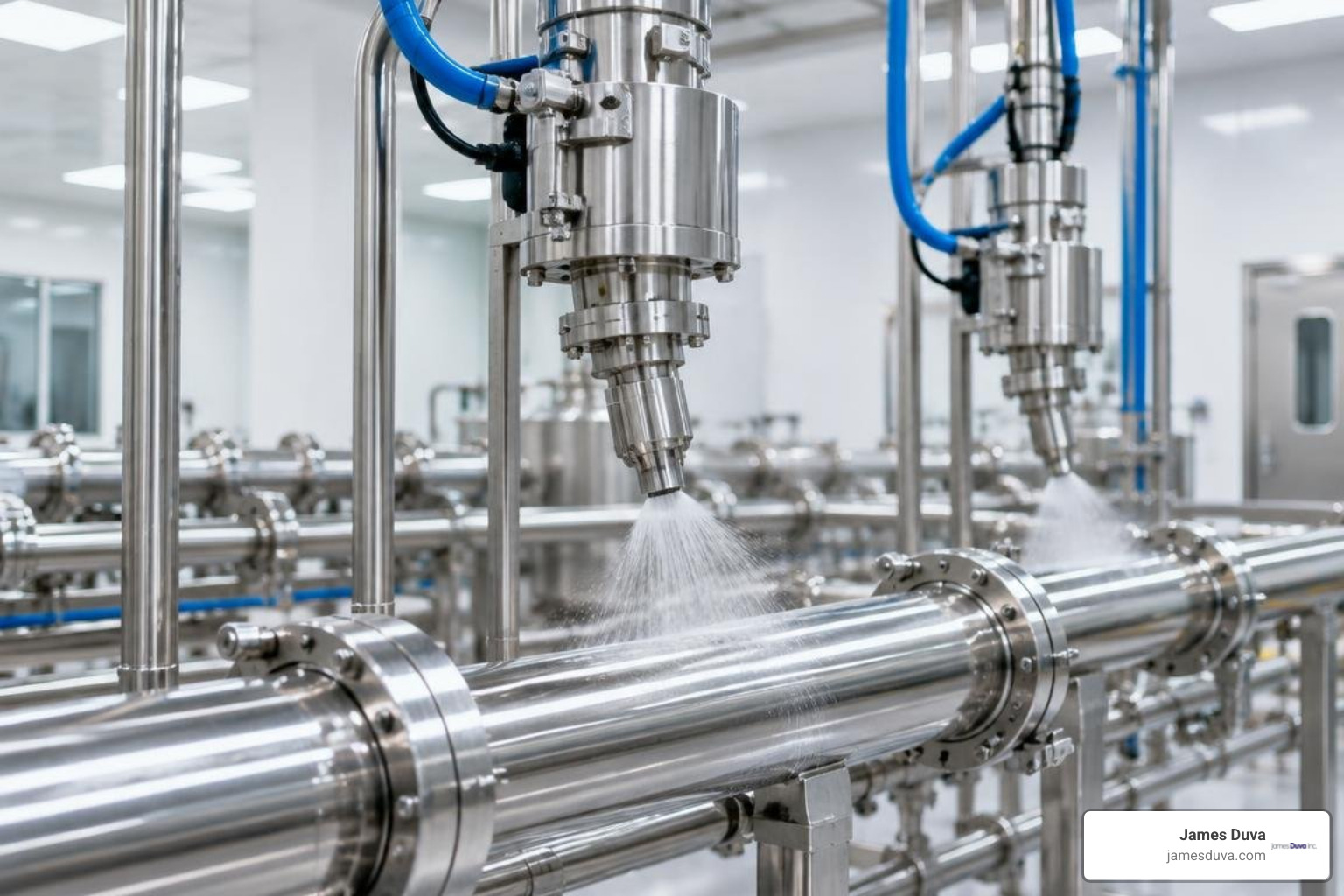
How to Maintain Pharmaceutical Stainless Fittings for CIP Cycles
Clean-In-Place (CIP) systems clean process pipe interiors automatically without dismantling the piping network. Validating a CIP protocol requires proving 100% removal of active drug residues and cleaning agents.
Hygienic fittings must withstand aggressive cleaning cycles, including:
- Turbulent Flow Velocities: Fluid velocities between 2.0 to 3.0 meters per second (approx. 6.5 to 10 feet per second) generate the mechanical shear stress needed to clear line residue.
- High-Temperature Sanitization: Flushing lines with water at 95°C (203°F) or clean steam at 121°C for at least one hour without structural distortion or seal degradation.
- Chemical Resistance: Enduring alternating washes of hot caustic solutions (such as 1–2% sodium hydroxide) and acidic rinses (such as nitric or phosphoric acid) without surface pitting.
Material Selection and Regulatory Standards
Selecting the proper alloy and sealing materials is essential for meeting compliance standards and ensuring long operational life in biopharmaceutical systems. Grade 316L stainless steel serves as the industry standard due to its specific chemical composition:
- Low Carbon Content (0.03% max): The “L” in 316L denotes low carbon, which prevents carbide precipitation at grain boundaries during welding. This preserves corrosion resistance along heat-affected zones.
- Molybdenum Content (2.0–3.0%): Molybdenum protects against localized pitting and crevice corrosion caused by chloride-bearing buffers and sanitizing agents.
- Comparison to 304 Grade: While standard 304 stainless steel is common in food and beverage processing, it lacks molybdenum and contains higher carbon levels, making it susceptible to pitting in harsh pharmaceutical chemical environments.
For transfer lines, using verified hygienic fluid transfer tubing ensures consistent wall thicknesses and weld compatibility. Elastomeric seals must also be matched to operating conditions; common options include USP Class VI-compliant PTFE, EPDM, FKM, and silicone.
Regulatory compliance is governed by strict industry standards:
- ASME BPE (Bioprocessing Equipment): Sets detailed requirements for dimensional tolerances, surface finishes, weld quality, and materials for biopharmaceutical systems.
- 3-A Sanitary Standards: Verifies cleanability and hygienic design for food, dairy, and beverage fluid equipment.
- FDA 21 CFR Part 211: Mandates that equipment surfaces must not react with, add to, or absorb drug products.
Sourcing from verified regional suppliers such as New Jersey Stainless Steel Pipe Fitting Suppliers helps ensure components carry complete material traceability, including Material Test Reports (MTRs) and surface polish certifications.
Frequently Asked Questions About Sanitary Fittings
Why are threaded fittings prohibited in sterile pharmaceutical processes?
Standard National Pipe Thread (NPT) and British Standard Pipe (BSP) connections rely on interlocking helical threads sealed with tape or paste. These threads create deep, inaccessible micro-crevices that trap product residues and moisture. Cleaning fluids cannot reach these zones with sufficient velocity during CIP cycles, turning them into points for bacterial colonization and biofilm growth. Threaded connections also risk galling, which can shed metallic particulate directly into the process fluid.
How does 316L stainless steel support sanitary lines?
Grade 316L stainless steel combines mechanical strength, corrosion resistance, and thermal stability. Its low carbon content prevents intergranular corrosion during orbital welding, while its molybdenum content resists pitting from chloride sanitizers and clean steam. The alloy also retains its dimensional tolerances across repeated thermal cycles, from ambient process temperatures up to 121°C clean steam sterilization.
What standards govern pharmaceutical-grade sanitary fittings?
The ASME BPE (Bioprocessing Equipment) standard is the primary standard governing high-purity fittings. It details precise specifications for metallurgy, dimensional tolerances, weld geometry, and surface finishes (from SF1 through SF6). In addition, elastomeric gaskets must meet USP Class VI and FDA 21 CFR 177 standards for low extractables, while manufacturing operations must follow Current Good Manufacturing Practice (cGMP) regulations.
Conclusion
Choosing the right pharmaceutical stainless fittings requires matching connection types, alloy grades, surface finishes, and gasket materials to your specific cleanability and operating requirements. Using properly specified components prevents contamination risks, ensures dependable Clean-In-Place validation, and maintains compliance with current regulatory standards.
Since 1978, James Duva Inc., based in Branchburg, NJ, has supplied high-grade stainless steel and nickel alloy industrial products to biopharmaceutical, chemical, and industrial processors. To explore fully certified tubing, valves, and high-purity sanitary components supported by complete material traceability, contact our technical team at James Duva, Inc. – Wholesale Pipe, Valves & Fittings.
About James Duva Inc.
Since 1978, James Duva Inc. has been your trusted source for stainless steel and high-nickel alloy industrial products. Whether you’re in the water treatment, process or power industry, we pride ourselves on always having what you need. Say goodbye to your sourcing problems with just one call to James Duva.