
Why Sanitary Tubing is Essential for Hygienic Fluid Transfer

Aug 17, 2026
Why Sanitary Stainless Tubing is Essential for Hygienic Fluid Transfer
Sanitary stainless tubing is a specialized type of stainless steel tube engineered to meet strict hygiene standards for fluid transfer in industries where contamination is simply not an option. Here’s a quick breakdown of what it is and why it matters:
- What it is: Smooth-bore stainless steel tubing manufactured to tight surface finish tolerances, designed to prevent bacterial growth and withstand repeated sterilization
- Who uses it: Food and beverage producers, pharmaceutical manufacturers, biotechnology firms, and dairy processors
- Key standards: ASTM A270, 3-A Sanitary Standards, and ASME BPE
- Common grades: 304 and 316L stainless steel
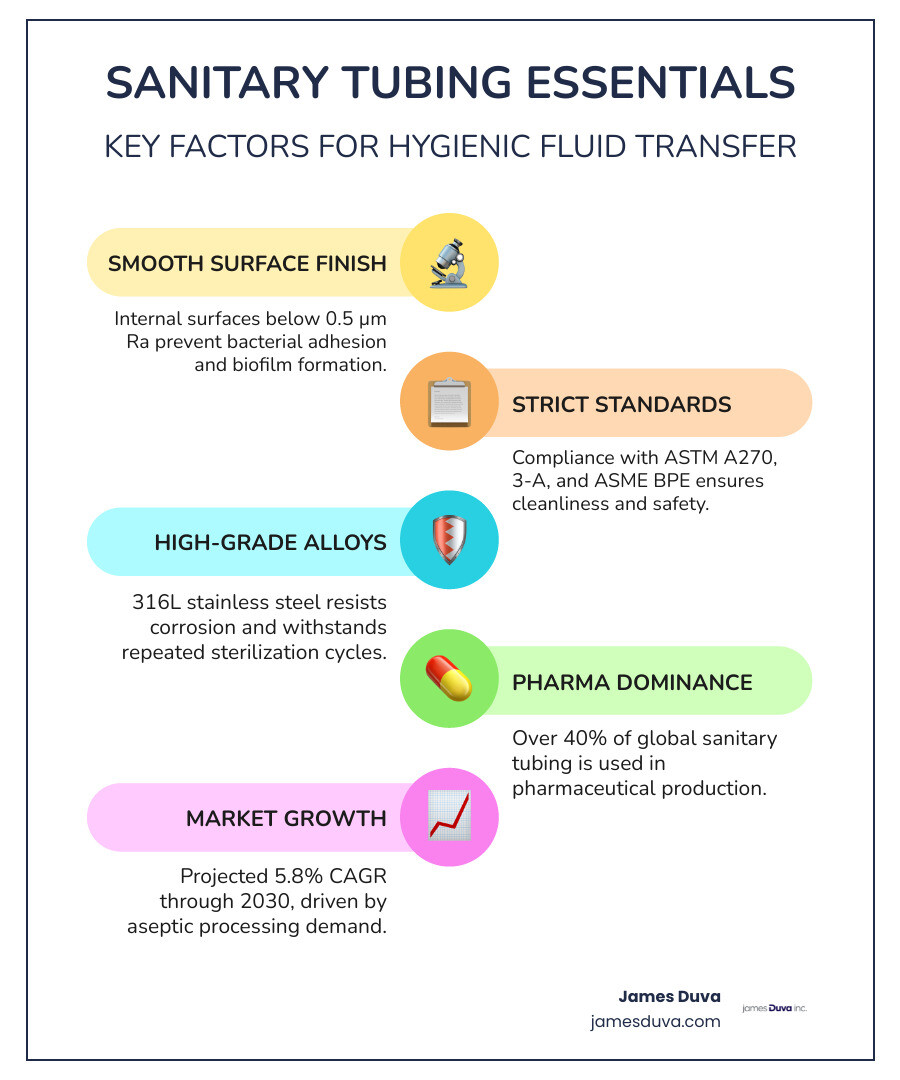
- Why it’s different from standard tubing: Tighter dimensional tolerances, smoother internal surfaces (often below 0.5 µm Ra), and stricter cleanliness requirements throughout manufacturing
In industries like pharmaceuticals — which account for over 40% of all sanitary stainless steel tubing used globally — a contaminated fluid line isn’t just a quality problem. It’s a safety crisis. The same applies to dairy, beverage, and biotech processing, where even microscopic surface imperfections can harbor biofilm and bacteria.
The global market for this material is growing fast, projected at a 5.8% CAGR through 2030, driven by tightening regulatory requirements and rising demand for aseptic processing worldwide.
I’m Billy Walker, Vice President of James Duva Inc., where I’ve spent years helping engineers and industrial professionals source high-quality specialty tubing — including sanitary stainless tubing — from trusted domestic manufacturers. In the sections below, I’ll walk you through everything you need to know to select, specify, and maintain the right sanitary tubing system for your application.
Related content about sanitary stainless tubing:
What is Sanitary Stainless Tubing and Where is it Used?
At its core, sanitary stainless tubing is designed for hygienic processing. Unlike standard structural or commercial piping, sanitary tubing is manufactured with an incredibly smooth internal diameter (ID) and external diameter (OD). This ultra-smooth profile ensures that product does not get trapped in microscopic crevices, which would otherwise become breeding grounds for bacteria, mold, and biofilms.
In clean-critical environments, stainless steel accounts for approximately 70% of all materials used in sanitary tubing applications. Its dominance is no accident; the material offers an unmatched combination of corrosion resistance, structural strength, and cleanability.
Whether you are routing pasteurized milk, processing active pharmaceutical ingredients (APIs), or transferring delicate vaccine components, you need a system that can be thoroughly cleaned and sterilized without degrading. This is where specialized Product Categories Sanitary Tubing solutions come into play, providing the structural backbone for safe, contamination-free operations.
Key Applications of Sanitary Stainless Tubing in Food and Beverage
In the food and beverage sector, hygiene is directly tied to consumer safety and product shelf life. From dairy processing plants handling raw milk to breweries transferring craft beer, sanitary systems must prevent any microbial buildup.
Dairy processing is particularly demanding. Milk contains fats, proteins, and sugars that easily stick to rough metal surfaces, forming organic soils that are difficult to wash away. To maintain sanitary conditions, facilities rely heavily on Sanitary Tri-Clamp Fittings in Food Beverage Industry Use Cases to create leak-proof, easy-to-disassemble connections that can be cleaned daily.
In beverage production, maintaining flavor integrity is just as critical as preventing bacteria. Wine, juices, and soft drinks are often highly acidic, which can cause inferior metals to leach metallic tastes into the product. High-quality sanitary tubing prevents this chemical interaction. For an in-depth look at how these systems are designed, you can read Pouring Perfection A Deep Dive into Beverage Sanitary Fittings. Additionally, aseptic packaging lines use sanitary tubing to transport sterilized food products into sterile containers, ensuring they remain shelf-stable without preservatives.
High-Purity Requirements for Pharmaceutical and Biotech Systems
While the food and beverage industry requires exceptionally clean systems, the pharmaceutical and biotechnology sectors operate on an entirely different level of purity. Here, the presence of even a single foreign microbe or pyrogen can ruin a multi-million-dollar batch of medicine or, worse, harm a patient.
Vaccine production, gene therapies, and the manufacturing of intravenous drugs require ultra-pure water (UPW) systems and highly controlled fluid pathways. In these environments, biofilm prevention is the primary challenge. Biofilms are colonies of microorganisms that adhere to surfaces and secrete a protective slime layer, making them incredibly resistant to standard sanitizers.
To combat this, the pharmaceutical industry relies on electropolished sanitary tubing. This tubing is designed to withstand continuous Clean-in-Place (CIP) and Steam-in-Place (SIP) cycles. In fact, high-grade sanitary stainless steel tubing can withstand sterilization temperatures up to 150°C (302°F) without structural or chemical degradation, making it ideal for continuous aseptic processing. To learn more about how clean-tech fluid systems are evolving to meet these extreme requirements, explore Why Sanitary Fittings Are the Unsung Heroes of Clean Tech in 2025.
Why Are Alloys So Valuable in Industry?
To understand why sanitary tubing performs so exceptionally well, it is helpful to look at the metallurgy behind it. In industrial applications, pure metals are rarely used in their raw states. For instance, pure iron is relatively soft, highly malleable, and incredibly susceptible to rust when exposed to oxygen and moisture.
By mixing pure iron with other elements, we create alloys. Alloys are materials engineered to combine the best properties of multiple elements, resulting in superior strength, durability, and corrosion resistance. Steel itself is an alloy of iron and carbon, but when we introduce elements like chromium, nickel, and molybdenum, we create stainless steel — a material capable of resisting harsh chemicals, high pressures, and extreme temperatures.
Selecting the right alloy is critical for ensuring the longevity of your fluid systems. For a comprehensive overview of how different manufacturing methods affect performance, you can read our guide on Industrial Tubing A Down to Earth Guide to Seamless and Welded Tubing Solutions.
Key Applications of Alloys Across Sectors
Alloys are the unsung heroes of modern infrastructure, with distinct formulations tailored to the unique demands of various industries:
- Construction: Heavy structural beams, high-strength concrete reinforcing bars, and architectural piping rely on carbon and low-alloy steels to bear massive loads and resist environmental wear.
- Oil & Gas: High-pressure environments, corrosive sour gas, and subsea operations require specialized alloy fittings, flanges, and heavy-walled piping to prevent catastrophic leaks.
- Automotive & Aerospace: Engine blocks, exhaust systems, and structural frames utilize advanced aluminum, titanium, and nickel alloys to maximize strength while minimizing weight.
- Medical & Consumer Goods: From surgical implants and orthopedic screws to everyday kitchenware and food processing equipment, biocompatible alloys ensure safety, cleanliness, and long-term durability.
Sanitary vs. Standard Stainless Steel Tubing
It is a common misconception that all stainless steel tubes are created equal. In reality, standard industrial tubing and sanitary tubing are designed for completely different environments.
The primary differentiator is surface roughness, typically measured in Ra (Roughness Average). Standard industrial tubing often has a visible grain and microscopic pits where bacteria can easily hide and multiply. Sanitary tubing, however, undergoes intensive polishing and treatment to achieve an ultra-smooth finish.
Research shows that sanitary tubing with an internal surface roughness of less than 0.5 micrometers (Ra) reduces bacterial adhesion by up to 90% compared to standard stainless steel tubing. This smooth profile makes it incredibly easy for cleaning solutions to sweep away organic residues during CIP cycles.
| Feature | Standard Industrial Tubing | Sanitary Stainless Tubing |
|---|---|---|
| Primary Standard | ASTM A312 / A269 | ASTM A270 / ASME BPE |
| Internal Surface Finish | Unpolished, mill finish (Rough) | Polished (Mechanical or Electropolished, < 0.5 µm Ra) |
| Bacterial Resistance | Low (Microscopic crevices harbor biofilm) | High (90% reduction in bacterial adhesion) |
| Joining Method | Threaded, compression, or standard weld | Orbital welding or hygienic Tri-Clamp connections |
| Main Applications | Structural, chemical lines, hydraulics | Food, beverage, pharma, biotech |
For a deeper dive into the mechanical differences and pressure ratings of various tube types, check out A Practical Guide to Stainless Steel Tubing.
Manufacturing Standards and Cleanliness Requirements
Because sanitary systems carry products destined for human consumption or medical use, their production is governed by strict regulatory bodies. Standard industrial tubes are manufactured to ensure structural integrity and pressure resistance, but they do not undergo the specialized cleaning, capping, and packaging steps that sanitary tubes do.
Sanitary tubing must comply with rigorous guidelines to ensure it is free from manufacturing oils, metal shavings, and chemical residues. To understand what makes a component truly safe for food contact, you can consult What Makes a Fitting Food Grade Your Guide to Sanitary Standards.
Material Grades and Specifications for Hygienic Systems
The performance of a sanitary system depends heavily on the specific grade of stainless steel selected. The two most common grades used in hygienic applications are 304 and 316L stainless steel.
- 304 Stainless Steel: This is the standard “18/8” stainless steel, containing approximately 18% chromium and 8% nickel. It offers excellent corrosion resistance, formability, and weldability at a cost-effective price point. It is widely used in dairy processing, brewery piping, and general food processing where corrosive exposure is moderate. For a detailed breakdown of this material, read The Definitive Guide to 304 Stainless Tubing.
- 316L Stainless Steel: This grade contains chromium and nickel, but adds 2% to 3% molybdenum to its composition. The addition of molybdenum significantly increases resistance to chlorides (such as salt) and acidic environments. The “L” stands for low carbon (less than 0.03%), which minimizes carbide precipitation during welding, preserving the alloy’s corrosion resistance near welded joints. This makes 316L the gold standard for pharmaceutical, biotech, and highly acidic food processing applications.
Key Standards: ASTM A270, 3-A, and ASME BPE
To ensure consistency and safety across industries, several key standards govern the design and production of sanitary tubing:
- ASTM A270: This is the standard specification for seamless and welded austenitic and ferritic/austenitic stainless steel sanitary tubing. It defines the dimensional tolerances, mechanical properties, and surface finish requirements for the tubing.
- 3-A Sanitary Standards: Formulated by the dairy and food industry, these standards focus on the cleanability of processing equipment. They ensure that all product-contact surfaces can be mechanically cleaned or easily dismantled for manual cleaning.
- ASME BPE (Bioprocess Equipment): This is the leading standard for the design of equipment used in the biopharmaceutical and personal care industries. It mandates strict rules for surface finishes (such as electropolishing), material joining, and weld inspection to guarantee the highest level of purity.
Best Practices for Installation, Welding, and Maintenance
Installing and maintaining a sanitary system requires specialized techniques to preserve the hygienic properties of the tubing. Standard manual welding can introduce rough weld beads and oxidation, which destroy the smooth surface profile required for clean operations.
To prevent this, orbital welding is the industry standard for joining sanitary tubing. Orbital welding is an automated process where the welding arc rotates 360 degrees around a static joint. This produces highly consistent, smooth, and full-penetration welds that do not impede fluid flow or trap bacteria.
After welding, the system must undergo passivation. Passivation is a chemical treatment (typically using nitric or citric acid) that removes free iron from the surface of the stainless steel. This process restores and enhances the protective chromium oxide layer, which prevents future rust and corrosion.
For a complete overview of how to connect and secure these systems using hygienic components, refer to The Ultimate Guide to Sanitary Tube Fittings Types Applications and Benefits. To explore the flow control devices designed to pair with these lines, browse our Product Categories Sanitary Valves.
Manufacturing and Surface Finishing of Sanitary Stainless Tubing
The journey from raw metal to a high-purity sanitary tube involves several highly controlled manufacturing steps:
- Cold Drawing: The tube is pulled through a die to achieve precise wall thickness and outer diameter tolerances.
- Annealing: Heat treatment relieves internal stresses in the metal, restoring its ductility and preparing it for polishing.
- Pickling: An acid wash removes high-temperature scale and oxidation left over from the annealing process.
- Mechanical Polishing: Abrasive wheels or belts are used to physically smooth the inner and outer surfaces to a specified Ra value.
- Electropolishing: An electrochemical process that removes microscopic high points from the metal surface. This creates a mirror-like finish that drastically reduces the surface area available for bacterial adhesion.
For an explanation of why seamless manufacturing methods are preferred for especially harsh environments, read Smooth Operator Why Seamless Stainless Tubing Rules Harsh Environments.
Preventing Common Failure Modes in Sanitary Systems
Even the highest-quality sanitary systems can fail if they are not monitored and maintained correctly. Some of the most common failure modes include:
- Pitting Corrosion: Small, localized holes that form when protective oxide layers are compromised, often due to high chloride concentrations.
- Crevice Corrosion: Corrosion occurring in shielded areas, such as under gaskets or unaligned joints, where stagnant fluid is trapped.
- Rouge Formation: A reddish-brown iron oxide discoloration that can form in high-purity water and steam systems. It must be chemically removed to prevent product contamination.
By adhering to the 3-A Sanitary Standards Guidelines, facilities can implement proactive cleaning and inspection schedules to mitigate these risks before they impact production.
Frequently Asked Questions about Sanitary Tubing
What is the difference between sanitary tubing and schedule pipe?
The main difference lies in how they are measured and their surface finishes. Sanitary tubing is sized by its outer diameter (OD) and wall thickness, ensuring precise alignment with sanitary fittings. Schedule pipe is sized by nominal pipe size (NPS) and schedule wall thickness, which are approximate dimensions. Additionally, sanitary tubing features highly polished internal surfaces, whereas standard schedule pipe has a rougher mill finish that is unsuitable for hygienic processing.
Why is 316L preferred over 304 in pharmaceutical applications?
316L stainless steel contains molybdenum, which provides significantly higher resistance to chlorides, acids, and pitting corrosion compared to 304. Because pharmaceutical systems undergo aggressive chemical cleaning and high-temperature steam sterilization, the enhanced durability of 316L is required to prevent material degradation and contamination.
How often should sanitary tubing systems be passivated?
The frequency of passivation depends on the operating conditions of the system. New systems must always be passivated after installation and welding. For existing systems, passivation is typically performed annually, or whenever the line is modified, repaired, or shows early signs of rouge or surface discoloration.
Conclusion
Selecting the right sanitary stainless tubing is essential for maintaining the safety, purity, and efficiency of your hygienic fluid transfer systems. From food and beverage packaging to high-purity pharmaceutical manufacturing, using the correct material grades and standards is the only way to guarantee a contamination-free process.
At James Duva Inc., based in Branchburg, NJ, we have been providing high-grade industrial supply expertise since 1978. We understand the strict requirements of clean-critical industries and stock a comprehensive inventory of Product Categories Sanitary components.
Whether you need high-purity https://jamesduva.com/product-categories/tubing/, sanitary fittings, or reliable Ball Valves for your next project, our team is here to help you find the perfect solution. Contact us today to discuss your system requirements.
About James Duva Inc.
Since 1978, James Duva Inc. has been your trusted source for stainless steel and high-nickel alloy industrial products. Whether you’re in the water treatment, process or power industry, we pride ourselves on always having what you need. Say goodbye to your sourcing problems with just one call to James Duva.