
Sizing Stainless Pipes Correctly Under Modern ASME Standards

Nov 2, 2026
How ASME Stainless Pipe Standards Guide Sizing
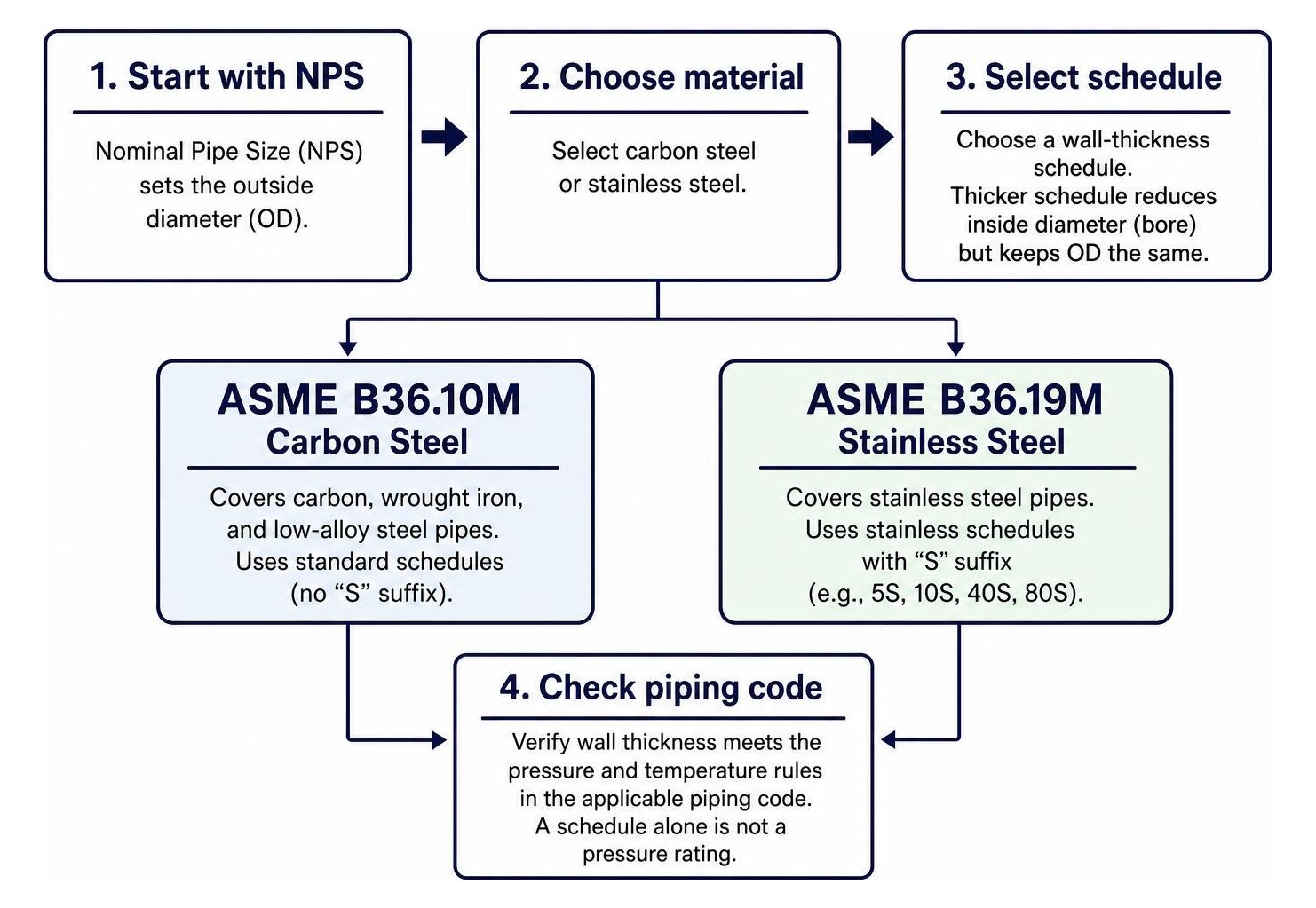
ASME B36.19M gives the standard outside diameters and wall thicknesses for welded and seamless stainless steel pipe. To size a pipe, start with its nominal pipe size (NPS), then choose a wall-thickness schedule such as 10S or 40S. A thicker schedule reduces the inside diameter but keeps the outside diameter the same. Before specifying pipe, check that its wall thickness meets the pressure and temperature rules in the applicable piping code; a schedule alone is not a pressure rating.
I’m Billy Walker, vice president of James Duva Inc., where I help customers source stainless steel and nickel alloy piping products. My experience with ASME stainless pipe standards comes from helping customers match pipe sizes and schedules to industrial project needs.
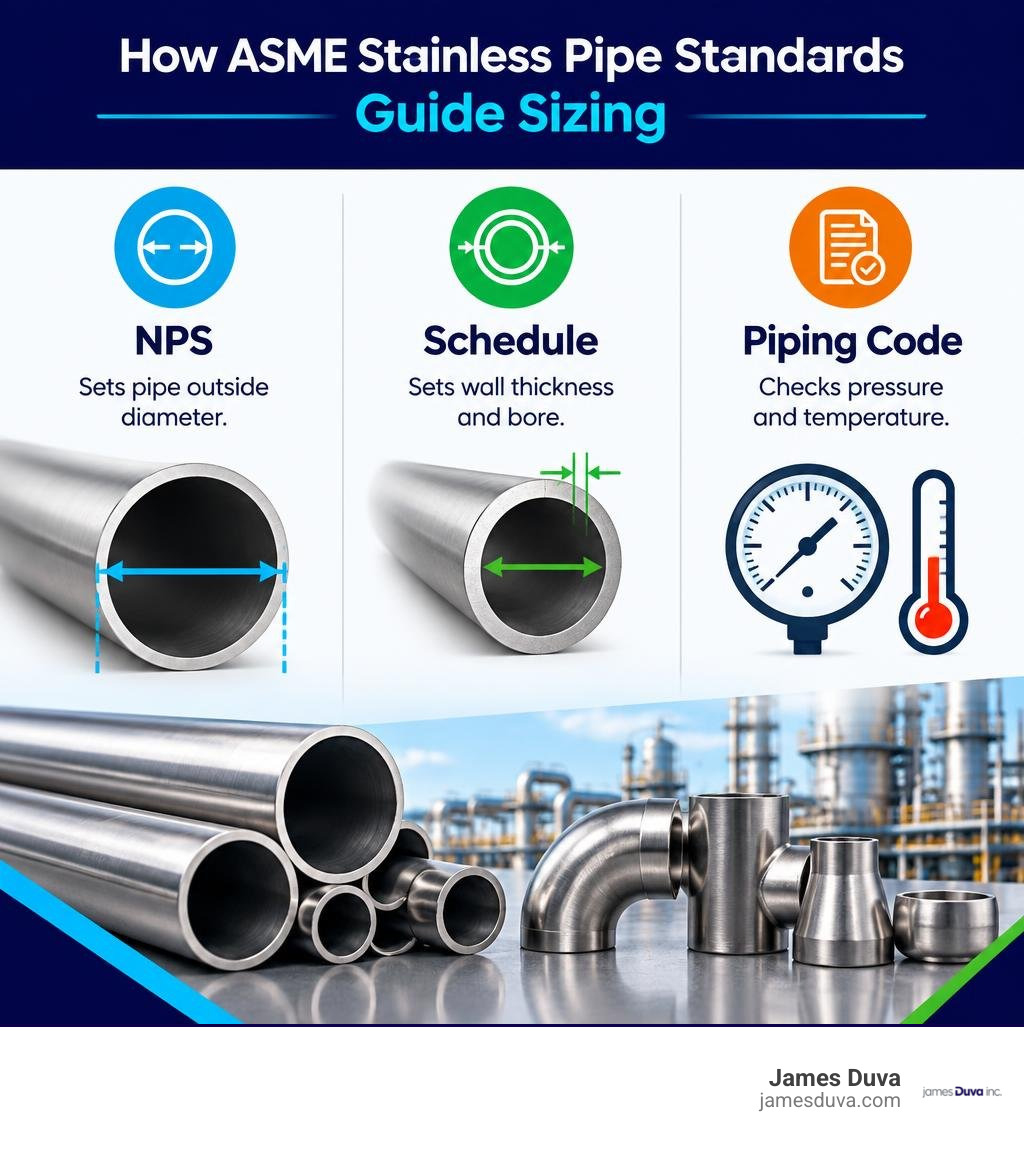
To design and build reliable piping systems under modern ASME stainless pipe standards, engineers must evaluate stainless steel corrosion resistance, understand the distinct types of stainless steel, and determine how to choose stainless steel grade options for specific process environments.
Why Are Alloys So Valuable in Industry?
In industrial piping and manufacturing, pure metals like elemental iron are often too soft or prone to rust when exposed to moisture and oxygen, whereas alloys like steel offer superior strength, durability, and corrosion resistance. To overcome these inherent weaknesses, metallurgists combine base elements with carbon, chromium, nickel, molybdenum, and other elements to form advanced alloys.
Understanding the differences when comparing stainless steel or carbon steel performance helps clarify why specific alloys are chosen across demanding environments:
- Construction: Heavy structural beams, columns, and industrial piping rely on high-strength alloys to withstand immense mechanical loads and environmental exposure without premature failure.
- Oil & Gas: Severe downhole and subsea environments require high-alloy flanges, heavy fittings, and specialized ball valves that endure hydrogen sulfide, volatile hydrocarbons, and high operating pressures.
- Automotive & Aerospace: High-temperature exhaust systems, structural frames, and engine components require alloys that maintain mechanical integrity and creep resistance under thermal extremes.
- Medical & Consumer Goods: From surgical implants and diagnostic tools to commercial kitchenware and food processing lines, non-reactive stainless alloys provide hygienic, non-leaching, and easily sanitized surfaces.
The defining advantage of stainless steel alloys lies in their chromium content (typically at least 10.5%). This chromium reacts naturally with oxygen to create an ultra-thin, self-healing chromium oxide passive layer. This invisible shield stops corrosive media from attacking the underlying metal, delivering remarkable resistance to pitting, crevice corrosion, and oxidation across extreme temperature ranges.
Navigating ASME Stainless Pipe Standards: B36.19M vs. B36.10M
When procuring and engineering piping systems, navigating the exact dimensional codes established by the American Society of Mechanical Engineers (ASME) ensures safety and interchangeability. The primary standard governing stainless steel piping dimensions is ASME B36.19M. In contrast, ASME B36.10M covers carbon, wrought iron, and low-alloy steel pipes.
While both standards share identical outside diameters for nominal sizes, their wall thicknesses and schedule classifications differ significantly. Reviewing the official ASME B36.19M stainless specifications reveals that stainless schedules are explicitly identified by an “S” suffix (e.g., 5S, 10S, 40S, 80S). This designation warns designers that these wall thicknesses follow stainless design criteria rather than standard carbon steel tables.
A common point of confusion occurs with larger pipe sizes. While Schedule 40S and Schedule 40 share identical wall thicknesses across most small-to-medium diameters, specific sizes diverge:
- Schedule 10S: Wall thicknesses for NPS 14 through NPS 22 (DN 350 to DN 550) in ASME B36.19M are not identical to Schedule 10 values in ASME B36.10M.
- Schedule 40S: The wall thickness for NPS 12 (DN 300) in ASME B36.19M is 0.375 inches (9.52 mm), whereas ASME B36.10M Schedule 40 lists 0.406 inches (10.31 mm).
- Schedule 80S: The wall thicknesses for NPS 10 (DN 250) and NPS 12 (DN 300) differ between the two standards, with B36.19M specifying 0.500 inches (12.70 mm) for both sizes.
| Nominal Pipe Size (NPS) | Outside Diameter (Inches / mm) | ASME B36.19M Schedule | B36.19M Wall Thickness (Inches / mm) | ASME B36.10M Schedule | B36.10M Wall Thickness (Inches / mm) | Identical Dimensions? |
|---|---|---|---|---|---|---|
| NPS 2 (DN 50) | 2.375 / 60.3 | 40S | 0.154 / 3.91 | 40 | 0.154 / 3.91 | Yes |
| NPS 4 (DN 100) | 4.500 / 114.3 | 40S | 0.237 / 6.02 | 40 | 0.237 / 6.02 | Yes |
| NPS 10 (DN 250) | 10.750 / 273.0 | 80S | 0.500 / 12.70 | 80 | 0.593 / 15.06 | No |
| NPS 12 (DN 300) | 12.750 / 323.9 | 40S | 0.375 / 9.52 | 40 | 0.406 / 10.31 | No |
| NPS 12 (DN 300) | 12.750 / 323.9 | 80S | 0.500 / 12.70 | 80 | 0.687 / 17.48 | No |
| NPS 16 (DN 400) | 16.000 / 406.4 | 10S | 0.165 / 4.19 | 10 | 0.250 / 6.35 | No |
Historical Evolution of ASME Stainless Pipe Schedules
The development of ASME B36.19M stems directly from economic and metallurgical considerations. In early industrial piping, carbon steel was the primary material. Because carbon steel corrodes over time, standard pipe schedules (like Schedule 40 and 80) were engineered with generous wall thicknesses to accommodate corrosion allowances.
When industrial plants began adopting corrosion-resistant stainless alloys in the mid-20th century, engineers recognized that stainless steel did not require heavy sacrificial wall allowances. Because stainless retains its structural integrity without progressive wall loss in compatible chemical services, specifying heavy Schedule 40 or 80 carbon steel profiles wasted expensive raw material.
To capitalize on this efficiency, ASME introduced thin-wall schedules—namely Schedule 5S and Schedule 10S—documented in published standards such as the technical dimensions from ASME B36.19-2022. These lighter schedules lowered total project tonnage, reduced structural dead load on pipe racks, cut material shipping costs, and simplified high-volume chemical and processing plant installations.
Dimensional Rules: NPS, Outside Diameter, and Pipe vs. Tubing
A fundamental rule of pipe design is that the Nominal Pipe Size designation does not equal the physical outside diameter for smaller sizes. For all pipes measuring NPS 12 (DN 300) and smaller, the outside diameter is numerically larger than the nominal size number:
- An NPS 1/2 pipe has an outside diameter of 0.840 inches (21.3 mm).
- An NPS 2 pipe has an outside diameter of 2.375 inches (60.3 mm).
- An NPS 4 pipe has an outside diameter of 4.500 inches (114.3 mm).
Only at NPS 14 (DN 350) and above does the nominal size match the outside diameter directly (e.g., an NPS 14 pipe has an outside diameter of exactly 14.000 inches, and NPS 24 is 24.000 inches).
It is equally vital to avoid confusing pipe with tubing. When differentiating pipe from precision stainless steel tubing, tubing is measured by its exact outside diameter and precise wall thickness across all sizes. A 1-inch stainless tube measures exactly 1.000 inches on the outside, whereas a 1-inch nominal stainless pipe measures 1.315 inches outside diameter.
Understanding Stainless Schedules: 5S, 10S, 40S, and 80S Dimensions
Selecting the right schedule involves balancing internal pressure retention against flow efficiency and weight. Because the outside diameter remains constant for any given NPS, changing schedules directly alters the inside diameter (bore).
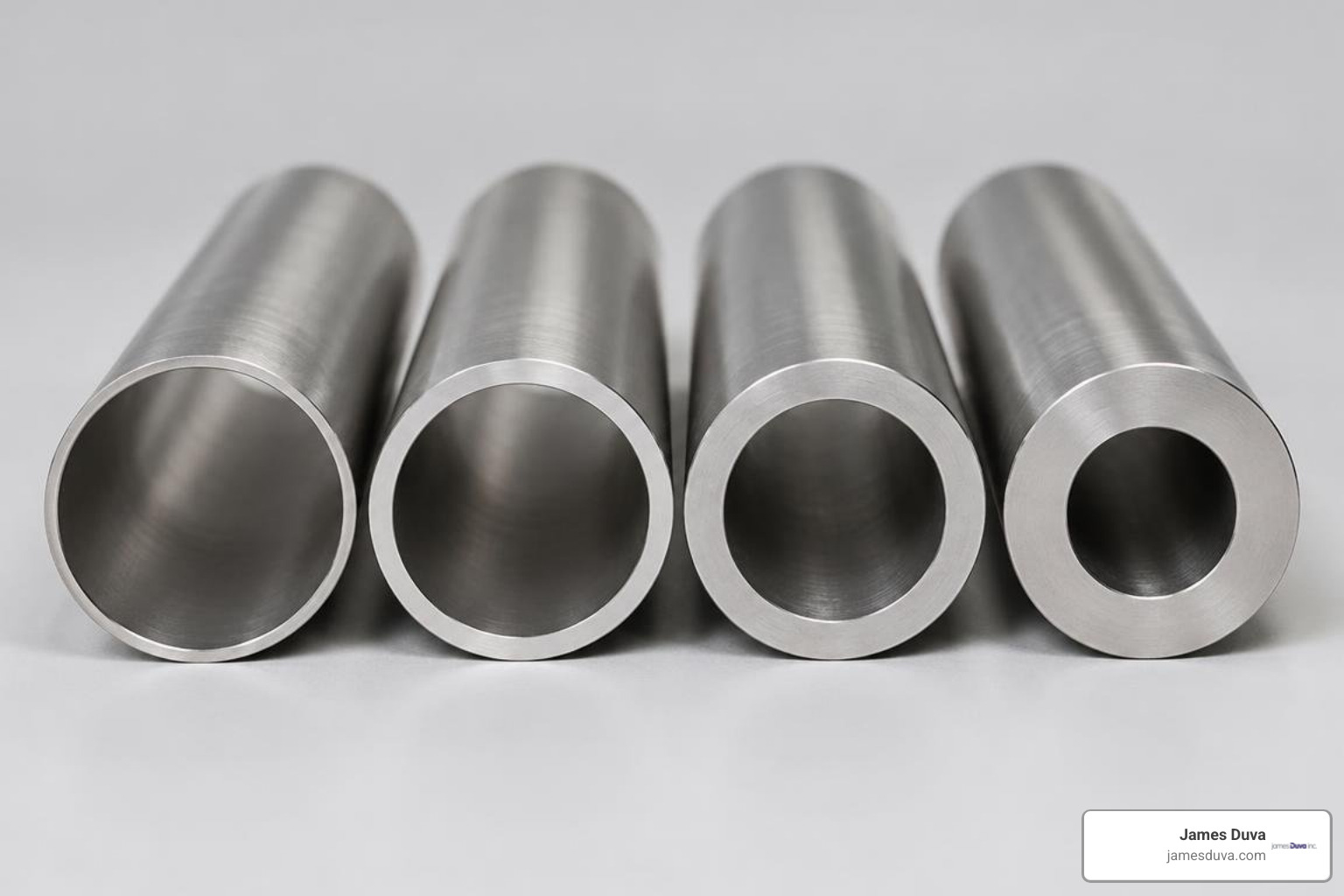
As wall thickness increases from Schedule 5S up to Schedule 80S, the pipe’s internal bore contracts, reducing its cross-sectional flow area:
- A 4-inch (100 mm) Schedule 5S pipe has an outside diameter of 4.500 inches, a wall thickness of 0.083 inches (2.11 mm), and a nominal bore of 4.334 inches (110.08 mm).
- A 4-inch Schedule 40S pipe keeps the 4.500-inch outside diameter, increases wall thickness to 0.237 inches (6.02 mm), and reduces the bore to 4.026 inches (102.26 mm).
- A 4-inch Schedule 80S pipe maintains the 4.500-inch outside diameter, features a 0.337-inch (8.56 mm) wall, and reduces the internal bore down to 3.826 inches (97.18 mm).
Engineers referencing standard dimensions for steel and stainless pipes use these physical values to calculate flow velocity, head loss, and total line weight:
| Nominal Pipe Size (NPS) | Metric Designation (DN) | Outside Diameter (Inches / mm) | Schedule Designation | Nominal Wall Thickness (Inches / mm) | Inside Diameter / Bore (Inches / mm) | Plain End Weight (lb/ft / kg/m) |
|---|---|---|---|---|---|---|
| NPS 1/2 | DN 15 | 0.840 / 21.3 | Sch 5S | 0.065 / 1.65 | 0.710 / 18.03 | 0.54 / 0.80 |
| NPS 1/2 | DN 15 | 0.840 / 21.3 | Sch 10S | 0.083 / 2.11 | 0.674 / 17.12 | 0.67 / 1.00 |
| NPS 1/2 | DN 15 | 0.840 / 21.3 | Sch 40S | 0.109 / 2.77 | 0.622 / 15.80 | 0.85 / 1.27 |
| NPS 1/2 | DN 15 | 0.840 / 21.3 | Sch 80S | 0.147 / 3.73 | 0.546 / 13.87 | 1.09 / 1.62 |
| NPS 2 | DN 50 | 2.375 / 60.3 | Sch 5S | 0.065 / 1.65 | 2.245 / 57.02 | 1.61 / 2.39 |
| NPS 2 | DN 50 | 2.375 / 60.3 | Sch 10S | 0.109 / 2.77 | 2.157 / 54.79 | 2.64 / 3.93 |
| NPS 2 | DN 50 | 2.375 / 60.3 | Sch 40S | 0.154 / 3.91 | 2.067 / 52.50 | 3.65 / 5.44 |
| NPS 2 | DN 50 | 2.375 / 60.3 | Sch 80S | 0.218 / 5.54 | 1.939 / 49.25 | 5.02 / 7.48 |
| NPS 4 | DN 100 | 4.500 / 114.3 | Sch 5S | 0.083 / 2.11 | 4.334 / 110.08 | 3.92 / 5.84 |
| NPS 4 | DN 100 | 4.500 / 114.3 | Sch 10S | 0.120 / 3.05 | 4.260 / 108.20 | 5.61 / 8.36 |
| NPS 4 | DN 100 | 4.500 / 114.3 | Sch 40S | 0.237 / 6.02 | 4.026 / 102.26 | 10.79 / 16.07 |
| NPS 4 | DN 100 | 4.500 / 114.3 | Sch 80S | 0.337 / 8.56 | 3.826 / 97.18 | 14.98 / 22.32 |
| NPS 12 | DN 300 | 12.750 / 323.9 | Sch 10S | 0.180 / 4.57 | 12.390 / 314.71 | 24.19 / 35.99 |
| NPS 12 | DN 300 | 12.750 / 323.9 | Sch 40S | 0.375 / 9.52 | 12.000 / 304.80 | 49.56 / 73.82 |
| NPS 12 | DN 300 | 12.750 / 323.9 | Sch 80S | 0.500 / 12.70 | 11.750 / 298.45 | 65.42 / 97.46 |
Weight Calculation Differences for Ferritic and Austenitic Grades
The standard weight tables published in ASME B36.19M and ASME B36.10M are calculated using the nominal density of carbon steel (approximately 0.2833 lb/in³ or 7.84 g/cm³). However, different stainless steel alloy families have distinct chemical compositions that alter their actual mass:
- Austenitic Stainless Steels (e.g., 304, 304L, 316, 316L): Due to their high nickel (and often molybdenum) content, austenitic alloys possess a slightly higher density (approx. 0.290 lb/in³ or 8.00 g/cm³). Their actual weight is approximately 2% greater than the standard published carbon steel values.
- Ferritic and Martensitic Stainless Steels (e.g., 405, 410, 430): Lacking substantial nickel additions, straight chromium ferritic grades are slightly less dense (approx. 0.278 lb/in³ or 7.70 g/cm³). Consequently, their actual weight is approximately 5% less than the published standard values.
When evaluating project material requirements and deciding which stainless steel grade is best for your project, engineering teams must factor these variances into structural load models, dynamic hanger spacing calculations, and overall freight calculations.
Joining Thin-Wall Pipes Under ASME Stainless Pipe Standards
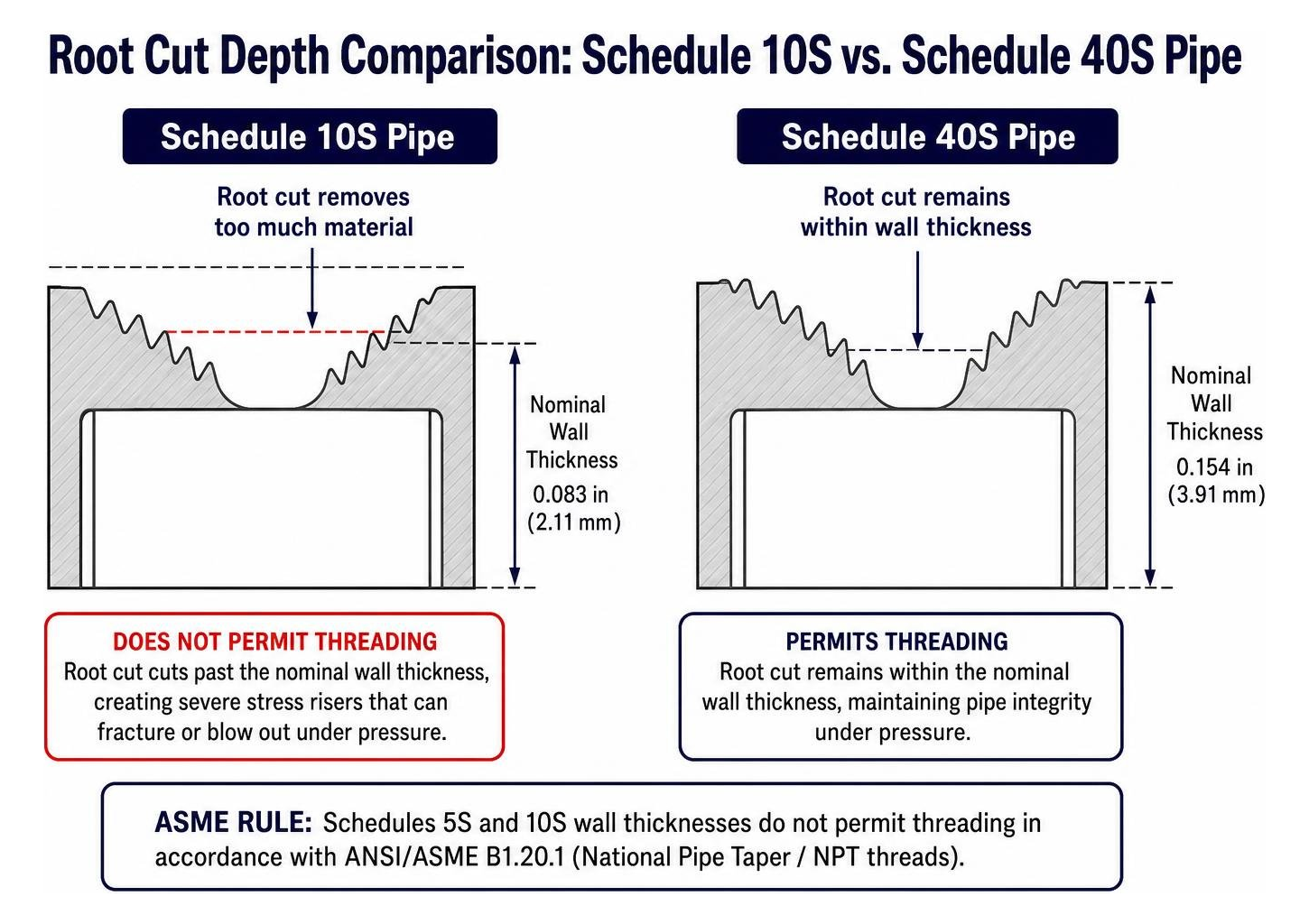
A critical safety rule governed by ASME standard notes involves joining methods. Schedules 5S and 10S wall thicknesses do not permit threading in accordance with ANSI/ASME B1.20.1 (National Pipe Taper / NPT threads).
Cutting standard NPT tapered threads into a Schedule 5S or 10S pipe removes too much material at the thread root. The root cut cuts past the nominal wall thickness, creating severe mechanical stress risers that fracture or blow out under moderate pressure.
Instead of threaded connections, thin-wall stainless pipe relies on:
- Butt-Welding: Following established welded pipeline fabrication guidelines to achieve full-penetration circumferential joint strength without compromising base metal thickness.
- Flanged Connections: Utilizing lap-joint stub ends with slip-on backing flanges or welding neck flanges, as detailed in our guide on flange types and sealing.
- Mechanical Roll Grooving: Displacing the metal radially using cold forming rather than cutting away metal wall thickness.
For threaded or socket-weld systems requiring field assembly, designers must specify heavier schedules—typically Schedule 40S or Schedule 80S—to ensure sufficient remaining wall thickness beneath the thread root.
Engineering Selection Guide: Pressure Ratings, Temperature, and Sizing
A pipe schedule designation is purely a dimensional categorization, not an intrinsic pressure rating. Sizing a stainless pipe requires verifying that the selected schedule satisfies the design conditions under governing construction codes, most commonly ASME B31.3 (Process Piping) or ASME Section VIII (Boiler and Pressure Vessel Code).
To calculate the minimum required wall thickness for an internal design pressure, engineers employ Barlow’s formula modified for piping codes:
minimum wall thickness = (design pressure × outside diameter) / (2 × (allowable stress × joint quality factor + design pressure × temperature coefficient)) + corrosion allowance + thread depth
When working through this calculation:
- Allowable Stress Values: The maximum allowable stress is temperature-dependent. As operating temperatures rise, stainless steel experiences lower yield and tensile strength, requiring thermal derating.
- Weld Joint Quality Factor: Seamless pipe carries a joint factor of 1.0, whereas longitudinally welded pipe may carry lower quality factors (such as 0.85) unless subjected to non-destructive examination (NDE) like full radiography.
- Corrosion / Erosion Allowance: Even with stainless alloys, fluid velocity, particulate entrainment, and chemical impurities may dictate adding an extra mechanical cushion to the theoretical minimum thickness.
Frequently Asked Questions About ASME Stainless Pipe Standards
What is the primary difference between ASME B36.19M and ASME B36.10M?
ASME B36.19M specifically standardizes dimensions, wall thicknesses, and schedule designations (marked with an “S” suffix) for welded and seamless stainless steel pipe. ASME B36.10M covers carbon, alloy, and wrought iron steel pipes. Additionally, ASME B36.19M includes lightweight schedules (5S and 10S) and features different wall thicknesses for specific large-diameter sizes (like NPS 10 through NPS 22).
Why do pipes NPS 12 and smaller have outer diameters larger than their nominal size?
This sizing convention dates back to early Iron Pipe Size (IPS) standards in the 19th century. Originally, the nominal size designated the approximate inside diameter of a standard pipe. To keep outside diameters constant when heavier wall schedules were introduced (ensuring compatibility with standard dies and fittings), manufacturers thickened the wall toward the inside, reducing the bore while preserving the established outside diameter.
Can Schedule 10S stainless pipe be threaded?
No. Under ANSI/ASME B1.20.1 standards, Schedule 10S and Schedule 5S wall thicknesses are too thin to accommodate pipe threads safely. Threading cuts away metal at the root, compromising structural integrity. Schedule 10S piping must be joined using butt-welding, socket-welding with appropriate fittings, lap-joint stub ends, or mechanical roll-grooved couplings.
Conclusion
Correctly sizing and specifying stainless steel pipe requires a clear understanding of ASME B36.19M dimensional boundaries, schedule designations, and joining constraints. Choosing the right schedule ensures structural reliability, optimizes fluid dynamics, and avoids unnecessary material expenses.
At James Duva Inc., our team in Branchburg, NJ has supplied high-grade stainless steel and nickel alloy pipe, fittings, valves, and flanges since 1978. When planning your next piping layout or verifying code compliance, explore our industrial stainless steel solutions to ensure your systems are built with proven materials.
About James Duva Inc.
Since 1978, James Duva Inc. has been your trusted source for stainless steel and high-nickel alloy industrial products. Whether you’re in the water treatment, process or power industry, we pride ourselves on always having what you need. Say goodbye to your sourcing problems with just one call to James Duva.