
Hastelloy Alloy C-276 vs. Inconel Alloy 625: A Comprehensive Comparison
Aug 25, 2026
Hastelloy C-276 vs. Inconel 625: Which High-Performance Alloy Is Right for Your Application?
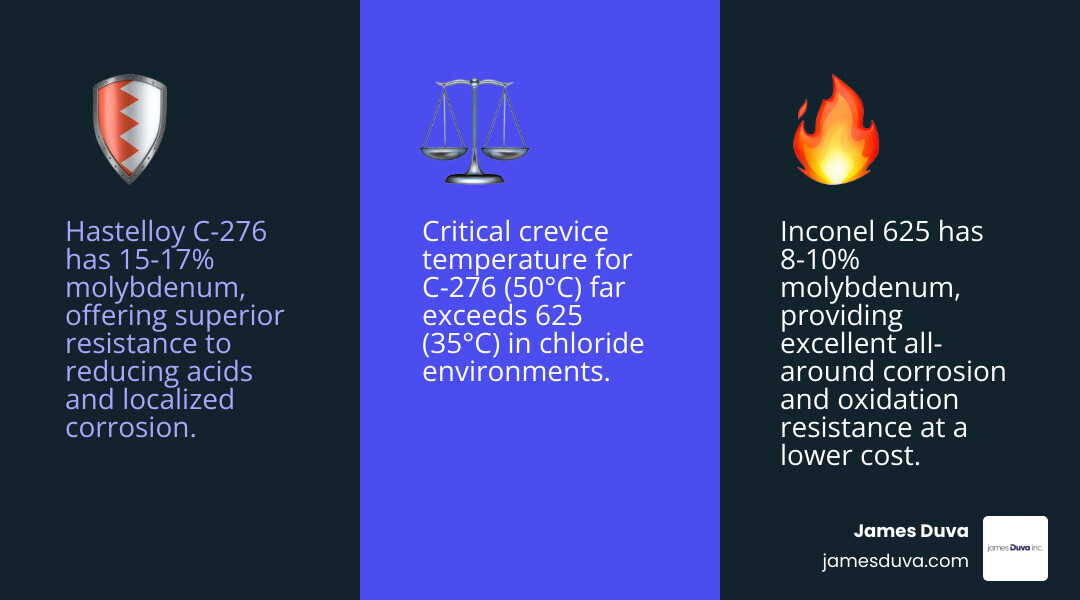
When comparing hastelloy c-276 vs inconel 625, the short answer is this: C-276 wins in the most aggressive acid environments, while 625 offers broader versatility and is generally easier to source at a lower cost.
| Property | Hastelloy C-276 | Inconel 625 |
|---|---|---|
| Primary Strength | Superior resistance to reducing acids and localized corrosion | Excellent all-around corrosion and oxidation resistance |
| Molybdenum Content | 15–17% | 8–10% |
| Critical Crevice Temp (ASTM G48) | 50°C (122°F) | 35°C (95°F) |
| Boiling 85% Phosphoric Acid | 10 mpy (0.25 mm/a) | >180 mpy (>4.57 mm/a) |
| Density | 8.89 g/cm³ | 8.44 g/cm³ |
| Best For | FGD systems, sour gas, aggressive acids | Aerospace, seawater, moderate acid service |
| Relative Cost | Higher | Lower |
Both are premium nickel alloys built for environments where standard stainless steel simply fails. But they are not interchangeable — picking the wrong one can mean premature failure, costly downtime, and serious safety risk.
This guide breaks down the key differences in composition, corrosion resistance, mechanical properties, weldability, and cost — so you can make a confident, data-backed material selection decision.
I’m Billy Walker, Vice President of James Duva Inc., where we’ve been supplying stainless steel and high-nickel alloy products — including both Hastelloy C-276 and Inconel 625 — to the power, process, and water treatment industries since 1978. Sourcing the right alloy for aggressive service environments is something I deal with every day, and I’ll walk you through exactly what the data says about hastelloy c-276 vs inconel 625.
Why Are Alloys So Valuable in Industry?
To understand why high-performance nickel-based alloys are so critical, we have to look at the limitations of pure metals. In their elemental forms, pure metals like iron are often too soft, chemically unstable, or highly prone to rust and degradation when exposed to oxygen and moisture.
By combining different metallic elements, we create alloys that dramatically outclass their parent metals. For instance, adding carbon and chromium to iron produces steel and stainless steel, which offer vastly superior strength and durability. In the most demanding industrial fields, standard steels still fall short. This is where advanced nickel-chromium-molybdenum alloys step in to provide the ultimate defense against mechanical stress and chemical attack.
Across global industries, high-performance alloys are indispensable:
- Construction: Heavy-duty structural beams, high-strength fasteners, and architectural piping rely on alloys to support immense loads and withstand weathering.
- Oil & Gas: Downhole fittings, flanges, and piping systems must endure high pressures, sour gas (containing hydrogen sulfide), and corrosive ocean water.
- Automotive & Aerospace: High-strength frames, exhaust systems, jet engine components, and turbine blades depend on alloys that keep their mechanical integrity at blistering temperatures.
- Medical & Consumer Goods: Biocompatible implants, surgical tools, high-end kitchenware, and food processing machinery utilize specialized alloys to ensure sanitation, durability, and resistance to cleaning chemicals.
Chemical Composition and Physical Properties of Hastelloy C-276 vs Inconel 625
When we evaluate high-performance alloys, we always start with the chemical composition. The specific ratios of nickel, chromium, molybdenum, and other elements dictate how the metal behaves under thermal, physical, and chemical stress.
To explore the foundational distinctions between these families, you can read our detailed guide on Inconel vs Hastelloy: Key Differences, Applications, and Benefits.
Chemical Makeup and the Role of Alloying Elements
The primary difference between hastelloy c-276 vs inconel 625 lies in their balancing of chromium and molybdenum.
- Nickel (Ni): Both alloys utilize a nickel base (roughly 57% minimum for C-276 and 58% minimum for 625) which provides exceptional resistance to chloride-induced stress corrosion cracking and maintains ductility from cryogenic temperatures up to red-hot environments.
- Molybdenum (Mo): Hastelloy C-276 contains 15.0% to 17.0% molybdenum, which is significantly higher than Inconel 625’s 8.0% to 10.0%. Molybdenum is the key element that defends against localized attacks like pitting and crevice corrosion in reducing (oxygen-depleted) acid environments.
- Chromium (Cr): Inconel 625 carries a higher chromium content (20.0% to 23.0%) compared to Hastelloy C-276 (14.5% to 16.5%). Chromium is vital for resisting oxidizing media, such as nitric acid, and preventing high-temperature oxidation.
- Tungsten (W): Hastelloy C-276 includes 3.0% to 4.5% tungsten, which works synergistically with molybdenum to further bolster corrosion resistance in highly severe reducing environments.
- Niobium (Nb): Inconel 625 contains 3.15% to 4.15% niobium. Niobium works alongside molybdenum to stiffen the alloy’s matrix, providing high strength without requiring heat treatment.
For a deeper look into the chemistry of C-276, see our guide on Hastelloy C-276 101: Key Alloy Properties Compared.
Physical Properties Comparison
While their chemistry differs, their physical properties show how closely matched they are in weight and thermal behavior:
- Density: Hastelloy C-276 has a density of 0.321 lb/in³ (8.89 g/cm³), making it slightly heavier than Inconel 625, which has a density of 0.305 lb/in³ (8.44 g/cm³).
- Melting Range: Hastelloy C-276 melts between 2415°F and 2500°F (1325°C to 1370°C). Inconel 625 has a slightly lower melting range of 2350°F to 2460°F (1290°C to 1350°C).
- Thermal Conductivity: At a room temperature of 77°F (25°C), both alloys exhibit virtually identical thermal conductivity. Hastelloy C-276 measures 67.9 Btu·in/ft²·h·°F (9.8 W/m·°C), while Inconel 625 sits at 68.0 Btu·in/ft²·h·°F (9.8 W/m·°C).
- Young’s Modulus: At room temperature, Hastelloy C-276 has a Young’s Modulus of 29.8 x 10³ ksi (205 GPa), compared to Inconel 625’s 30.1 x 10³ ksi (207 GPa), reflecting a very similar level of stiffness.
To learn more about the physical and mechanical properties of Inconel 625, check out The Ultimate Guide to Inconel 625 Properties.
Corrosion Resistance in Aggressive Environments
Choosing between these two materials usually comes down to the specific corrosive chemicals they will encounter. For a high-level overview of this selection process, you can read Inconel vs Hastelloy: Which is Better for Corrosive Environments?.
Performance of Hastelloy C-276 vs Inconel 625 in Acidic Media
The chemical differences translate directly to empirical corrosion rates in aggressive acids. To help you decide which is better for your specific acid environment, we have put together a guide: Is Hastelloy Better Than Inconel for Acid Environments?.
- Sulfuric Acid ($H2SO4$): In mild, boiling 10% sulfuric acid, Inconel 625 performs slightly better with a corrosion rate of 17 mpy (0.43 mm/a) compared to C-276’s 20 mpy (0.51 mm/a). In highly concentrated, aggressive sulfuric acid environments, C-276 is the superior choice. For example, in 95% concentrated sulfuric acid at 122°F (50°C), Hastelloy C-276 is exceptionally resistant with a corrosion rate of just 0.1 mpy (0.0025 mm/a), whereas Inconel 625 corrodes rapidly at 48 mpy (1.22 mm/a).
- Hydrochloric Acid (HCl): Hydrochloric acid is highly reducing and notoriously aggressive. In boiling 2% HCl, Hastelloy C-276 shows a corrosion rate of 43 mpy (1.09 mm/a), outperforming Inconel 625, which corrodes at 52 mpy (1.32 mm/a).
- Phosphoric Acid ($H3PO4$): In boiling 85% phosphoric acid, Inconel 625 is heavily attacked, exceeding a corrosion rate of 180 mpy (>4.57 mm/a). Hastelloy C-276 handles this environment with ease, maintaining a low corrosion rate of only 10 mpy (0.25 mm/a).
- Mixed-Gas Condensates: In simulated flue gas desulfurization (FGD) mixed-gas condensate solutions (consisting of 60% $H2SO4$ + 0.5% HCl + 0.1% HF + 0.1% $HNO_3$ at 185°F/85°C), Hastelloy C-276 exhibits a corrosion rate of 14 mpy (0.36 mm/a), whereas Inconel 625 degrades at a much faster rate of 82 mpy (2.08 mm/a).
Pitting, Crevice Corrosion, and Chloride Resistance
Chloride-rich environments, such as marine applications and chemical waste streams, cause localized corrosion attacks like pitting corrosion and crevice corrosion.
Under the standardized ASTM G48 testing protocol (which utilizes an acidified 6% ferric chloride solution to simulate extreme localized corrosion conditions), both alloys showcase outstanding resistance to pitting, with critical pitting temperatures exceeding 185°F (>85°C).
When it comes to crevice corrosion, the higher molybdenum and tungsten content in Hastelloy C-276 provides a distinct advantage:
- Hastelloy C-276 has a critical crevice temperature of 122°F (50°C).
- Inconel 625 has a critical crevice temperature of 95°F (35°C).
This makes Hastelloy C-276 much more reliable in tight joints, flange faces, and under-gasket areas exposed to hot, high-chloride environments.
Mechanical Properties and High-Temperature Performance
While corrosion resistance is often the primary driver for selection, these alloys must also bear structural loads and survive high temperatures without softening or scaling. For a detailed breakdown of 625’s mechanical capabilities, see Inconel 625 UNS N06625: Properties, Applications, and Future Innovations.
Tensile Strength, Yield Strength, and Elongation
In their annealed states, both alloys display high strength and exceptional ductility. Inconel 625 generally exhibits slightly higher yield and tensile strength than Hastelloy C-276. This is due to the solid-solution strengthening effect of niobium and molybdenum within its nickel-chromium matrix.
- Inconel 625 (Annealed Grade 1): Typically features a minimum yield strength of 60 ksi (414 MPa), a minimum tensile strength of 120 ksi (827 MPa), and an elongation of about 30% to 50%.
- Hastelloy C-276 (Annealed): Typically features a minimum yield strength of 45 ksi (310 MPa), a minimum tensile strength of 100 ksi (690 MPa), and an elongation of 40% to 60%.
Both alloys retain excellent toughness at cryogenic temperatures and do not suffer from the low-temperature brittleness common to standard carbon steels.
Oxidation Resistance and Thermal Stability
At elevated temperatures, both alloys form protective oxide scales that prevent deep metal degradation:
- Inconel 625 is highly favored for high-temperature structural components (up to 1800°F / 980°C) because its high chromium content forms a highly stable, protective chromium-oxide scale. It maintains excellent creep-rupture strength over long-term thermal exposure.
- Hastelloy C-276 also offers excellent oxidation resistance and thermal stability. It is approved under the ASME Boiler and Pressure Vessel Code Section VIII for allowable design stresses up to 1250°F (677°C). Beyond this temperature, long-term exposure can lead to the precipitation of brittle intermetallic phases (such as mu phase), which can reduce its ductility and corrosion resistance.
Industrial Applications and Material Selection
Choosing between hastelloy c-276 vs inconel 625 requires a careful look at the chemical makeup, temperature, physical stress, and budget of your specific project.
Key Applications for Hastelloy C-276 vs Inconel 625
Due to its unmatched resistance to localized attack and reducing acids, Hastelloy C-276 is the premier choice for:
- Flue Gas Desulfurization (FGD): Scrubbers, ducting, dampers, and stack liners in coal-fired power plants, where they must survive highly acidic, high-chloride condensates.
- Chemical Processing: Reaction vessels, heat exchangers, evaporators, and transfer piping handling highly concentrated sulfuric, hydrochloric, and phosphoric acids.
- Sour Gas Recovery: Downhole tubing, casing, and surface valves in deep wells containing high concentrations of hydrogen sulfide ($H_2S$), carbon dioxide, and chlorides, where standard steels would fail due to sulfide stress cracking.
Inconel 625 is highly versatile and is the preferred choice for:
- Marine Engineering: Propeller blades, submarine quick-disconnect fittings, exhaust ducts, and utility piping, where it resists biofouling and seawater corrosion.
- Aerospace: Jet engine exhaust systems, fuel lines, thrust reverser systems, and bellows.
- Valves and Piping: High-pressure flow control systems, including specialty Ball Valves, operating in offshore oil platforms and moderate chemical environments.
Cost, Availability, and Fabrication Considerations
Because Hastelloy C-276 contains much higher levels of molybdenum and tungsten, it carries a higher raw material cost and is more sensitive to global metal market fluctuations. Inconel 625 is generally more widely available in a broader range of off-the-shelf product forms, making it easier to source quickly for fast-track projects.
When it comes to fabrication:
- Hot Forming: For Hastelloy C-276, heavy hot forming should be performed above 2000°F (1090°C), with general hot forming carried out between 1600°F and 2250°F (870°C to 1230°C).
- Work Hardening: Both alloys work-harden rapidly during machining. Heavy-duty machine tools, sharp carbide tooling, slow speeds, and continuous, positive feeds are required to prevent glazing and tool wear.
Welding and Joining Guidelines
Welding high-performance nickel alloys requires strict adherence to clean procedures to maintain structural integrity and corrosion resistance in the weld zone. To keep your system running smoothly after fabrication, review our Maintenance Tips for Hastelloy C-276: Ensuring Longevity and Performance.
Dissimilar Metal Welding and Filler Metals
In many industrial plants, you may need to weld a Hastelloy C-276 component directly to an Inconel 625 component — such as joining a thick C-276 slip-on flange to an Inconel 625 vessel body. Fortunately, these alloys have excellent weld compatibility.
When performing dissimilar metal welds, selecting the correct filler metal is critical:
- Alloy 625 Filler (ERNiCrMo-3 / ENiCrMo-3): This is highly acceptable and widely used for general joints where the weld zone won’t face the absolute highest acid concentrations.
- Alloy C-276 Filler (ERNiCrMo-4 / ENiCrMo-4): This is preferred if the weld zone requires the superior reducing-acid resistance of C-276.
- Alloy C-22 Filler (ERNiCrMo-10 / ENiCrMo-10): This is a highly versatile option that provides excellent corrosion resistance across both oxidizing and reducing media.
- Overmatching Filler Metals: For the most severe service environments, overmatching welding products like INCO-WELD filler metal 686CPT are highly recommended. These filler metals help offset elemental segregation (alloy depletion) that can occur in the weld pool during solidification.
Post-Weld Corrosion Resistance and Heat Treatment
During welding, standard high-carbon alloys are susceptible to carbide precipitation in the heat-affected zone (HAZ), which can lead to intergranular attack.
To prevent this, Hastelloy C-276 is manufactured with an ultra-low carbon content (0.01% maximum). This low carbon level minimizes the precipitation of grain-boundary carbides during the welding process, allowing the alloy to be used in the as-welded condition in most chemical processing applications.
If maximum corrosion resistance must be restored after heavy hot forming or welding of very thick sections, a full solution anneal is recommended:
- Heat the material to 2100°F to 2150°F (1150°C to 1175°C).
- Follow this immediately with a rapid water quench to prevent any harmful phases from precipitating during cooling.
Frequently Asked Questions
Which alloy is better for sulfuric acid applications?
For mild, dilute, or boiling sulfuric acid solutions up to about 10% concentration, Inconel 625 performs exceptionally well and is often selected for its lower cost. For highly concentrated sulfuric acid (especially up to 95% concentration at moderate temperatures) or in mixed-acid systems containing chlorides and fluorides, Hastelloy C-276 is the far superior choice due to its higher molybdenum content.
Can you weld Hastelloy C-276 directly to Inconel 625?
Yes, they can be welded directly to one another using standard processes like Gas Tungsten Arc Welding (GTAW/TIG) or Gas Metal Arc Welding (GMAW/MIG). The recommended filler metals are Alloy 625 (ERNiCrMo-3), Alloy C-276 (ERNiCrMo-4), or Alloy C-22 (ERNiCrMo-10), depending on which side of the joint faces the most aggressive corrosive media.
Why is Hastelloy C-276 more expensive than Inconel 625?
Hastelloy C-276 contains significantly higher amounts of molybdenum (15–17% vs. 8–10% in 625) and includes tungsten (3–4.5%), both of which are expensive, heavy refractory metals. The manufacturing and refining processes required to keep carbon levels below 0.01% in C-276 also add to its overall production cost.
Conclusion
Both Hastelloy C-276 and Inconel 625 are top-tier engineering materials, but selecting the right one depends on your specific process environment. If your system handles highly concentrated reducing acids, high-temperature chlorides, or wet flue gases, Hastelloy C-276 is the industry standard. If you need a high-strength, versatile alloy for marine environments, aerospace components, or moderate chemical service, Inconel 625 delivers outstanding performance.
Making the right choice prevents premature failures, saves on maintenance costs, and keeps your operations running safely. For more technical details on C-276, you can read our comprehensive Hastelloy C-276 UNS N10276 Guide.
At James Duva Inc., based in Branchburg, NJ, we have been helping companies select and source the perfect high-grade stainless steel and nickel alloy products since 1978. Whether you need pipes, fittings, flanges, or specialty valves, our experienced team is here to help. Reach out to us today to discuss your project requirements and let us assist you in finding the right alloy solution.
About James Duva Inc.
Since 1978, James Duva Inc. has been your trusted source for stainless steel and high-nickel alloy industrial products. Whether you’re in the water treatment, process or power industry, we pride ourselves on always having what you need. Say goodbye to your sourcing problems with just one call to James Duva.