
Hot Stuff: Why High Temperature Nickel Alloys Don’t Melt Under Pressure
Aug 27, 2026
When Standard Metals Fail: Understanding Nickel Alloy Properties
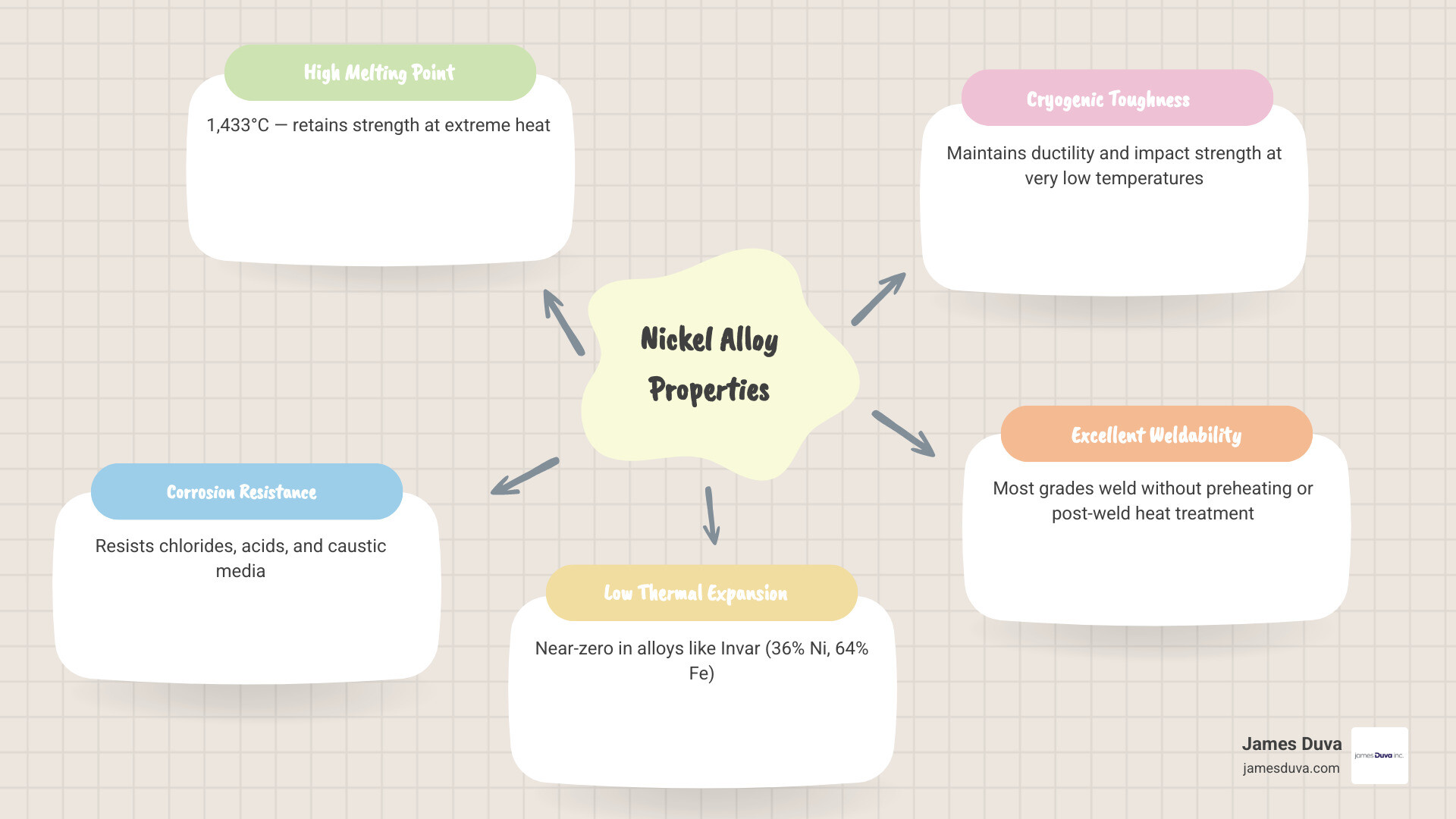
Nickel alloy properties make these materials one of the most important choices in industrial engineering. Here’s a quick summary of what sets them apart:
| Property | Performance |
|---|---|
| Melting point | 1,433°C — retains strength at extreme heat |
| Tensile strength | Up to 136,000 psi (940 MPa) in annealed condition |
| Corrosion resistance | Resists chlorides, acids, and caustic media |
| Thermal expansion | Near-zero in alloys like Invar (36% Ni, 64% Fe) |
| Cryogenic toughness | Maintains ductility and impact strength at very low temperatures |
| Weldability | Most grades weld without preheating or post-weld heat treatment |
Nickel alloys are used across aerospace, chemical processing, oil and gas, medical, and electronics industries — anywhere that heat, pressure, or corrosion would destroy a standard metal.
They’re not all the same, though. The right alloy depends on your exact environment, temperature range, and fabrication method. This guide breaks all of that down clearly.
I’m Billy Walker, Vice President of James Duva Inc., where I’ve spent years helping engineers and procurement professionals in the power, process, and water treatment industries source the right high-nickel alloy materials — and understanding nickel alloy properties is the foundation of every good material decision. If you’re specifying components for a demanding environment, the sections below will give you the technical grounding you need.
Why Are Alloys So Valuable in Industry?
To understand why nickel alloys are so vital, it helps to look at why we use alloys in the first place. In their pure, elemental states, many metals simply aren’t cut out for heavy-duty industrial work. Pure iron, for example, is relatively soft and highly susceptible to rust when exposed to oxygen and moisture. By melting iron and combining it with carbon and other elements, we create steel—a material with vastly superior strength, durability, and wear resistance.
Alloys allow us to engineer specific physical and mechanical characteristics that pure elements cannot provide. This versatility is why alloys are the backbone of modern infrastructure and technology:
- Construction: Heavy-duty structural beams and high-strength piping rely on alloys to support massive physical loads and withstand environmental exposure over decades.
- Oil & Gas: Severe downhole environments and offshore platforms require rugged fittings, flanges, and valves that can handle high pressures and corrosive fluids without failing. For highly demanding setups, choosing the correct material is critical, which is Why Nickel Alloy Fittings Are Essential for Demanding Environments.
- Automotive & Aerospace: Structural frames must be lightweight yet incredibly strong, while high-performance engines require materials that will not deform or degrade under intense heat.
- Medical & Consumer Goods: From biocompatible joint implants that survive inside the human body to durable kitchenware and appliances that resist daily wear and tear, alloys touch almost every part of our lives.
By carefully tuning the recipe of elements, metallurgists can create alloys tailored to survive the most punishing conditions imaginable. When standard steel or stainless steel reaches its operational limits, nickel-based alloys step in to fill the gap.
Core Nickel Alloy Properties and Metallurgical Characteristics
At the heart of nickel alloy properties is the unique nature of nickel itself. With an atomic structure that easily hosts a wide range of alloying elements, nickel serves as an exceptionally stable matrix. This stability allows the metal to maintain its mechanical integrity across an astonishing temperature range.
To see how nickel alloys compare to standard stainless steel, consider the following baseline comparison:
| Feature | Austenitic Stainless Steel (e.g., 316) | High-Performance Nickel Alloy (e.g., Alloy 625) |
|---|---|---|
| Melting Point | ~1,375°C to 1,400°C | ~1,290°C to 1,350°C (retains higher mechanical strength near melting point) |
| Chloride Corrosion | Prone to pitting, crevice corrosion, and stress cracking | Highly resistant; virtually immune to chloride stress cracking |
| High-Temperature Strength | Drops rapidly above 540°C (1,000°F) | Maintained up to 1,093°C (2,000°F) |
| Cryogenic Ductility | Good, but can experience reduced toughness | Exceptional; maintains high impact strength |
Nickel has a melting point of 1,433°C in its pure form, which provides a robust thermal foundation. When alloyed, these materials exhibit high strength, outstanding corrosion resistance, excellent heat resistance, and remarkable ductility. This means they can be deformed without fracturing, making them highly workable despite their toughness. To understand the terminology used when evaluating these metals, you can read our Nickel 200 Properties: Step-by-Step Guide to Terms Demystified.
How Heat Treatment Modifies Nickel Alloy Properties
The mechanical properties of nickel alloys are not static; they can be profoundly altered through precise heat treatment processes. Depending on the chemical composition of the alloy, different thermal cycles are used to optimize the grain structure for specific applications:
- Solution Annealing: This process involves heating the alloy to a high temperature (often between 1,900°F and 2,150°F, depending on the grade) to dissolve any secondary phases into the solid-solution matrix. It is typically followed by rapid cooling or quenching. Solution annealing refines the grain structure, relieves internal stresses, and maximizes corrosion resistance and ductility.
- Precipitation Hardening (Age Hardening): Some nickel alloys contain elements like titanium, aluminum, or columbium (niobium). When subjected to a secondary heat treatment at intermediate temperatures, these elements form microscopic precipitates throughout the metal matrix. These precipitates block slip planes, dramatically increasing the alloy’s yield and tensile strength.
- Stabilization Anneal: Often performed on alloys designed for high-temperature service, a stabilization anneal precipates carbon as stable carbides. This prevents sensitization—the depletion of chromium at grain boundaries—which could otherwise make the material vulnerable to intergranular corrosion.
For a deeper look at how these thermal treatments optimize performance in extreme heat, explore the Nickel Alloy 800H Properties, Applications, and Benefits in High-Temperature Environments.
Magnetic and Thermal Expansion Nickel Alloy Properties
Beyond mechanical strength and corrosion resistance, nickel alloys exhibit fascinating physical properties that make them indispensable for specialized high-tech applications.
One of the most notable of these is controlled thermal expansion. While most metals expand significantly when heated, certain nickel-iron alloys maintain incredibly stable dimensions. Known as low-expansion alloys, these materials are critical for precision instruments, scientific equipment, and glass-to-metal or ceramic-to-metal sealing where mismatched expansion rates would cause seals to shatter.
Additionally, nickel alloys can be engineered for specific magnetic properties. Some alloys exhibit high magnetic permeability, making them perfect for electromagnetic shielding in sensitive electronics, while others remain completely non-magnetic even at cryogenic temperatures. To see how pure nickel forms serve as the foundation for these specialized piping systems, read about the Nickel 200 Pipe: Purity, Performance, and Piping Hot Benefits.
Notable Nickel Alloys and Their Chemical Compositions

By adjusting the chemical composition, metallurgists have created family groups of nickel alloys, each tailored to specific operational demands. Let’s look at some of the most notable alloys used in modern industry:
Invar (Alloy 36)
Invar is an iron-nickel alloy famous for its uniquely low coefficient of thermal expansion.
- Composition: 36% Nickel, 64% Iron.
- Key Property: It exhibits almost zero thermal expansion at room temperature, making it the premier choice for precision scales, laser systems, and aerospace carbon-fiber molds.
Kovar
Kovar is designed specifically to match the thermal expansion characteristics of borosilicate glass.
- Composition: 29% Nickel, 17% Cobalt, 54% Iron.
- Key Property: It allows for reliable, airtight glass-to-metal seals in electronic tubes, hermetic packages, and scientific sensors, ensuring the seal does not crack during heating and cooling cycles.
ATI 625™ (UNS N06625)
This is a premier nickel-chromium-molybdenum superalloy renowned for its high strength and superb resistance to severe aqueous corrosion and high-temperature oxidation.
- Composition: Typical chemistry includes 22.0% Chromium, 9.0% Molybdenum, 3.5% Columbium (Niobium) plus Tantalum, 4.0% Iron, with Nickel as the balance.
- Key Property: Unlike many other high-strength alloys, ATI 625™ does not rely on precipitation hardening. Instead, it derives its exceptional strength from the solid-solution strengthening effects of molybdenum and columbium within its nickel-chromium matrix.
According to the official ATI 625™ technical data sheet, when annealed at 1,920°F (1,065°C), this alloy exhibits a typical room temperature tensile strength of 136,000 psi (940 MPa), a yield strength of 63,000 psi (430 MPa), and an elastic modulus of 29.8 × 10^6 psi (205 GPa) at 70°F (21°C).
For a comprehensive comparison of how these materials stack up against other heavyweights, see our guide on Deciphering the Power of Alloy Materials: Stainless Steel, Inconel, and Monel.
Performance in Extreme Environments and Industry Specifications
When operating in extreme environments, standard materials fail rapidly. High-performance nickel alloys are specifically engineered to withstand these punishing conditions, which include:
- Extreme High Temperatures: In environments up to 2,000°F (1,093°C), such as gas turbines and waste-heat recuperators, nickel alloys resist oxidation, scaling, and creep deformation.
- Severe Chemical Corrosion: Nickel alloys withstand highly reducing and oxidizing acids. In chloride-rich environments, they are virtually immune to chloride-ion stress corrosion cracking (SCC). In a standard 42% Magnesium Chloride stress corrosion test, ATI 625™ showed no cracks after 1,000 hours of continuous exposure, whereas standard Type 316 stainless steel cracked in less than 24 hours.
- Cryogenic Conditions: Many structural metals become brittle and shatter at sub-zero temperatures. Nickel alloys maintain their ductility and remarkable toughness down to cryogenic ranges. For example, ATI 625™ exhibits a Charpy impact energy of 49 ft-lbs (66 Joules) at 85°F (30°C) in both longitudinal and transverse orientations, maintaining high impact resistance even as temperatures plunge.
To ensure consistency and safety in these high-stakes applications, aerospace and industrial engineering bodies maintain strict material specifications.
Key Aerospace Material Specifications (AMS)
- AMS5869A: NICKEL ALLOY, CORROSION AND HEAT RESISTANT, SHEET, STRIP, AND PLATE 62Ni – 21.5Cr – 9.0Mo – 3.7Cb Solution Heat Treated – Material Specification : This specification covers high-grade nickel alloy sheets, strips, and plates designed for maximum corrosion and heat resistance.
- AMS5872D: Nickel Alloy, Corrosion and Heat Resistant, Sheet, Strip, and Plate 48Ni – 20Cr – 20Co – 5.9Mo – 2.2Ti – 0.45Al Consumable Electrode or Vacuum Induction Melted Solution Heat Treated – Material Specification : This standard (along with AMS5872) outlines requirements for a specialized nickel-base alloy containing cobalt and titanium, melted via consumable electrode or vacuum induction melting to ensure extreme purity.
- AMS5754L: Nickel Alloy, Corrosion and Heat-Resistant, Bars, Forgings, and Rings 47.5Ni – 22Cr – 1.5Co – 9.0Mo – 0.60W – 18.5Fe Solution Heat Treated – Material Specification : This specification governs solution heat-treated nickel alloy bars, forgings, and flash-welded rings utilized in highly stressed structural components.
- AMS5878E: Nickel Alloy, Corrosion and Heat-Resistant, Sheet, Strip, and Plate 59Ni – 22Cr – 2Mo – 14W – 0.35Al – 0.03La Solution Heat Treated – Material Specification : This standard specifies a unique nickel-chromium-tungsten alloy containing trace amounts of lanthanum (0.03%) to dramatically improve high-temperature oxidation resistance.
Understanding these rigorous standards is essential when deciding When to Choose Nickel Alloys Over Stainless Steel in Industrial Applications.
Fabrication, Machining, and Welding Best Practices
Because of their incredible strength and rapid work-hardening rates, fabricating nickel alloys presents unique challenges. However, following industry-standard best practices ensures successful manufacturing outcomes:
- Machining and Tooling: Nickel alloys work-harden rapidly, meaning they become harder and tougher as they are deformed by cutting tools. To overcome this, machinists must use heavy-duty, highly rigid setups, sharp carbide tooling, and positive rake angles. It is critical to maintain a constant feed rate; allowing a tool to dwell or rub against the metal will cause immediate work hardening, destroying the cutting edge.
- Weld Preparation and Descaling: Before initiating any welding processes, the alloy surfaces must be thoroughly cleaned and descaled. Any oil, grease, paint, or scale left on the metal can introduce impurities, leading to weld defects or cracking.
- Preheating and Post-Weld Heat Treatment (PWHT): One of the greatest advantages of solid-solution strengthened alloys like Alloy 625 is their ease of welding. Unlike many high-strength steels, they do not require preheating. Furthermore, post-weld heat treatment is generally not needed to restore or maintain the alloy’s superb corrosion resistance.
To source the correct raw materials for your fabrication projects, check out our guide on Nickel Alloy Round Rod and Bar: Inconel, Hastelloy, and Beyond.
Frequently Asked Questions About Nickel Alloys
Why are nickel alloys preferred over stainless steel in highly corrosive environments?
While stainless steel is excellent for general corrosion resistance, it is highly vulnerable to localized attacks in halide-rich environments. Chloride ions can easily penetrate the passive chromium-oxide layer of stainless steel, causing rapid pitting, crevice corrosion, and catastrophic stress corrosion cracking. Nickel alloys feature a robust nickel-chromium-molybdenum matrix that resists these localized attack mechanisms, making them virtually immune to chloride-induced failure.
What is the difference between Invar and Kovar?
The primary difference lies in their chemical compositions and their intended thermal expansion behaviors. Invar (36% Nickel, 64% Iron) is designed to exhibit nearly zero thermal expansion at room temperature, making it ideal for dimensionally stable precision instruments. Kovar (29% Nickel, 17% Cobalt, 54% Iron) is engineered to expand and contract at the exact same rate as borosilicate glass, making it the premier choice for creating hermetic glass-to-metal seals in electronics.
How does molybdenum improve nickel alloy performance?
Molybdenum acts as a powerful solid-solution strengthening element within the nickel matrix, significantly increasing the alloy’s mechanical strength without the need for complex heat treatments. Chemically, molybdenum drastically improves the material’s resistance to localized pitting and crevice corrosion, particularly in aggressive acidic and chloride-rich environments.
Conclusion
Sourcing materials that can withstand extreme heat, high pressures, and highly corrosive chemicals requires deep expertise and reliable supply chains. At James Duva Inc., based in Branchburg, NJ, we have served as a trusted, one-stop shop for high-grade stainless steel and nickel alloy products since 1978.
Whether your project requires specialized piping, custom fittings, or high-performance Ball Valves, our experienced team is here to help you select the ideal material with the exact nickel alloy properties your application demands.
Explore our extensive inventory of high-performance materials in our Nickel Alloys Category or contact us today to discuss your project requirements!
About James Duva Inc.
Since 1978, James Duva Inc. has been your trusted source for stainless steel and high-nickel alloy industrial products. Whether you’re in the water treatment, process or power industry, we pride ourselves on always having what you need. Say goodbye to your sourcing problems with just one call to James Duva.