
The Ultimate Guide to Inconel 625 Properties

Jul 3, 2026
What Is Inconel 625 and Why Does It Matter for Extreme Service Environments?
Inconel 625 is a nickel-chromium-molybdenum superalloy (UNS N06625) engineered for extreme heat, pressure, and corrosion environments that would destroy most other metals.
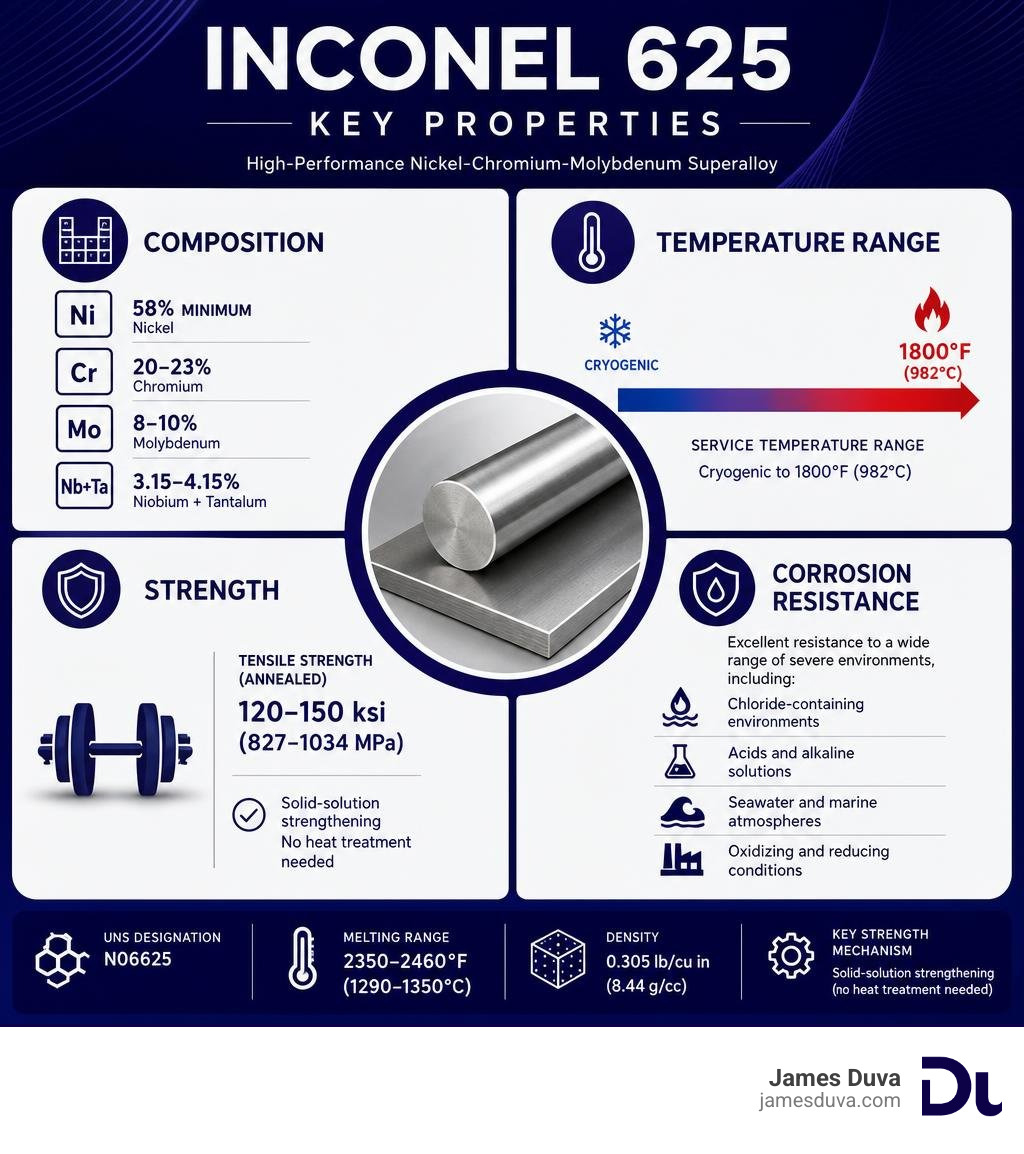
Quick-reference key facts:
| Property | Value |
|---|---|
| UNS Designation | N06625 |
| Nickel Content | 58% minimum |
| Chromium | 20-23% |
| Molybdenum | 8-10% |
| Niobium + Tantalum | 3.15-4.15% |
| Service Temperature Range | Cryogenic to 1800°F (982°C) |
| Tensile Strength (annealed) | 120-150 ksi (827-1034 MPa) |
| Density | 0.305 lb/cu in (8.44 g/cc) |
| Melting Range | 2350-2460°F (1290-1350°C) |
| Key Strength Mechanism | Solid-solution strengthening (no heat treatment needed) |
What makes Inconel 625 unusual is how it achieves its strength. Most high-strength alloys need a precipitation hardening heat treatment. Inconel 625 gets its strength simply from molybdenum and niobium stiffening the nickel-chromium matrix — no special aging treatment required.
That combination of properties — high strength, immunity to chloride-ion stress corrosion cracking, and a service window stretching from cryogenic temperatures all the way to 1800°F — makes it one of the most versatile alloys in industrial use today.
It was first patented on December 8, 1964, originally developed for steam-line piping. Today it appears in aerospace, chemical processing, marine, nuclear, and oil and gas applications worldwide.
I’m Billy Walker, Vice President of James Duva Inc., where since 1978 we’ve supplied high-grade stainless steel and nickel alloys — including Inconel 625 products — to engineers and contractors in the power, process, and water treatment industries. In the sections below, I’ll walk you through everything you need to know to evaluate, specify, and work with this alloy confidently.
Inconel 625 terms simplified:
Why Are Alloys So Valuable in Industry?

To appreciate the brilliance of Inconel 625, we first have to understand why we turn to alloys in the first place. Pure metals, while chemically simple, rarely have the mechanical stamina required for demanding industrial work.
Take pure iron, for example. In its unalloyed state, iron is relatively soft, structurally weak, and highly prone to rust when exposed to oxygen and moisture. To solve these limitations, metallurgists mix elements together to form alloys. By combining iron with carbon, we get steel, which offers dramatically superior strength and durability. When we add chromium to steel, we get stainless steel, which builds a thin, protective oxide layer to fight off rust.
Superalloys take this concept to the absolute limit. Instead of using iron as the base, superalloys like Inconel 625 use nickel. By adding heavy-hitting elements like chromium, molybdenum, and niobium, we create a material that doesn’t just survive extreme environments — it thrives in them.
Knowing When to Choose Nickel Alloys Over Stainless Steel in Industrial Applications is crucial. While stainless steel is fantastic for everyday commercial use, nickel alloys are the undisputed champions when temperatures climb past 1000°F or when the chemical environment becomes highly acidic.
Applications of Industrial Alloys
Because industrial alloys can be tailored for specific mechanical and chemical properties, they are the backbone of modern infrastructure. We see them deployed across four primary sectors:
- Construction: Heavy-duty structural beams, high-strength reinforcement bars, and specialized architectural piping rely on alloys to carry massive physical loads and resist weathering over decades of service.
- Oil & Gas: Deep-sea drilling and extraction place immense pressure on equipment. High-performance alloy fittings, connectors, and flanges are essential for preventing catastrophic failures in sour-gas wells and high-pressure subsea pipelines. This is exactly Why Nickel Alloy Fittings Are Essential for Demanding Environments where corrosion and pressure strike simultaneously.
- Automotive & Aerospace: High-stress structural frames, landing gear, jet engine turbines, and exhaust manifolds require materials that maintain their shape and strength under rapid thermal cycling and extreme vibration.
- Medical & Consumer Goods: Biocompatible titanium and cobalt-chrome alloys are used for orthopedic implants and pacemakers, while highly durable stainless steels and nickel alloys form the heat-resistant components of commercial kitchenware and food processing lines.
What is Inconel 625? Chemical Composition and Specifications
Inconel 625 (officially designated as UNS N06625, Werkstoff Number 2.4856, and ISO NW6625) is an austenitic, nickel-based superalloy. Its internal structure is a solid-solution matrix with a face-centered-cubic (FCC) crystal lattice.
Unlike precipitation-hardening alloys that rely on heat-treating to grow microscopic strengthening particles, Inconel 625 derives its high strength from the physical “stiffening” effect that molybdenum and niobium exert on the nickel-chromium matrix. These larger atoms crowd the crystal structure, blocking the movement of atomic planes and naturally hardening the metal.
For a deep dive into how this unique structural design translates to real-world performance, you can read our comprehensive analysis: Alloy 625 UNS N06625 Strength and Corrosion Resistance Unveiled.
Chemical Composition Limits of Inconel 625
The precise balancing of elements is what gives Inconel 625 its legendary performance. According to standard specifications, the limiting chemical composition of the alloy is defined by the following weight percentages:
- Nickel (Ni): 58.0% minimum (provides the stable FCC matrix and exceptional resistance to chloride-ion stress corrosion cracking)
- Chromium (Cr): 20.0% to 23.0% (delivers high-temperature oxidation resistance and protection against oxidizing chemicals)
- Molybdenum (Mo): 8.0% to 10.0% (stiffens the matrix and provides remarkable resistance to localized pitting and crevice corrosion)
- Niobium + Tantalum (Nb + Ta): 3.15% to 4.15% (stabilizes the alloy against sensitization during welding and contributes to solid-solution strengthening)
- Iron (Fe): 5.0% maximum (controlled to maintain high-temperature stability)
- Manganese (Mn): 0.50% maximum
- Silicon (Si): 0.50% maximum
- Carbon (C): 0.10% maximum
- Phosphorus (P): 0.015% maximum
- Sulfur (S): 0.015% maximum
- Cobalt (Co): 1.0% maximum (if joined with tantalum)
- Titanium (Ti): 0.40% maximum
- Aluminum (Al): 0.40% maximum
For more historical context and structural details, you can view the general overview of Inconel 625 on Wikipedia.
ASTM and ASME Specifications for Alloy 625
When specifying Inconel 625 for industrial projects, engineers rely on standardized ASTM and ASME specifications to ensure material consistency and safety. The most common specifications include:
- ASTM B443 / ASME SB443: Covers Inconel 625 plate, sheet, and strip.
- ASTM B444 / ASME SB444: Covers seamless pipe and tubing, typically specified in either Grade 1 (annealed) or Grade 2 (solution annealed) conditions.
- ASTM B446 / ASME SB446: Covers hot-worked and cold-worked rod and bar.
- ASTM B705 / ASME SB705: Covers welded pipe.
- ASTM B564 / ASME SB564: Covers nickel alloy forgings.
- ASTM B366 / ASME SB366: Covers factory-made wrought nickel alloy fittings.
Importantly, Inconel 625 is an approved material under the ASME Boiler and Pressure Vessel Code (BPVC), meaning its design stresses are certified for safe use in pressurized systems at temperatures up to 1600°F (and up to 1800°F for specific Grade 2 applications).
Mechanical, Physical, and Thermal Properties
Evaluating Inconel 625 for a project requires looking closely at its physical constants and mechanical performance across wide temperature spans. With a density of 0.305 lb/cu in (8.44 g/cc) and a melting range of 2350°F to 2460°F (1290°C to 1350°C), it is built to handle thermal environments that would melt or soften standard structural steels.
Mechanical Properties of Inconel 625 Across Heat Treatments
The mechanical properties of Inconel 625 vary depending on the product form and the heat treatment it receives. Below is a breakdown of typical properties for rod, bar, and plate in the as-rolled and annealed states:
- Tensile Strength: 120 to 160 ksi (827 to 1103 MPa) in the as-rolled and annealed conditions.
- Yield Strength (0.2% offset): 60 to 110 ksi (414 to 758 MPa).
- Elongation: 30% to 60%, showing that the alloy retains excellent ductility despite its high strength.
- Hardness: 175 to 240 Brinell (HB).
When cold-worked, the alloy work-hardens rapidly. For example, cold-drawn wire subjected to a 75% to 90% reduction can develop tensile strengths exceeding 300,000 psi (2068 MPa) while still maintaining sufficient ductility for spring applications.
Physical and Thermal Characteristics
The physical and thermal properties of Inconel 625 remain stable across an incredibly wide operating range:
- Modulus of Elasticity (Young’s Modulus): Ranges from 207.5 x 10^3 ksi (143 GPa) at 70°F down to 147.5 x 10^3 ksi (101.7 GPa) at 1600°F in the annealed condition.
- Impact Strength: It retains exceptional toughness at sub-zero temperatures. Charpy V-notch impact tests on hot-rolled, as-rolled plate show a strength of 35 to 35.5 ft-lb (47 to 48 J) even at cryogenic temperatures of -320°F (-196°C).
- Fatigue Strength: At room temperature, cold-rolled annealed sheet exhibits a smooth-bar endurance limit of 90,000 psi (620 MPa) at 10^8 cycles. Even with a sharp notch (Kt = 3.3), the endurance limit remains at a highly respectable 35,000 psi (241 MPa).
- Thermal Conductivity: Ranges from 9.8 W/m·K at room temperature up to roughly 22.8 W/m·K at 1800°F, allowing for predictable heat transfer in thermal barrier systems.
Inconel 625 vs. Inconel 718
While Inconel 625 and Inconel 718 are siblings in the same nickel-alloy family, they are optimized for different engineering problems.
| Feature | Inconel 625 | Inconel 718 |
|---|---|---|
| Strengthening Method | Solid-solution (Niobium + Molybdenum) | Precipitation hardening (Gamma Prime / Gamma Double Prime) |
| Primary Base Elements | Nickel-Chromium | Nickel-Cobalt-Iron |
| Typical Yield Strength | 60 – 95 ksi (Annealed) | 150 – 180 ksi (Aged) |
| Melting Range | 2350 – 2460°F (1290 – 1350°C) | 2410 – 2500°F (1321 – 1393°C) |
| Maximum Service Temp | Up to 1800°F (982°C) | Up to 1200°F (649°C) for structural strength |
| Weldability | Exceptional (highly resistant to cracking) | Good, but requires precise post-weld heat treatment |
| Best Used For | Severe aqueous corrosion, high-temp oxidation | High-strength structural parts, gas turbine discs |
The main trade-off comes down to strength versus corrosion resistance and weldability. Inconel 718 can achieve nearly double the yield strength of Inconel 625 through age-hardening, but it loses this strength advantage above 1200°F as the strengthening precipitates begin to dissolve. Furthermore, Inconel 625 features higher chromium and molybdenum levels, giving it superior resistance to chemical attack.
Corrosion Resistance and Fabrication Guidelines
Inconel 625 is perhaps best known for its ability to survive highly corrosive environments. It resists both oxidizing and reducing acids, neutral salts, and high-temperature gases. If you’re weighing your options between superalloys, our comparison guide on Inconel vs Hastelloy: Which is Better for Corrosive Environments provides excellent context on how these materials behave under chemical exposure.
Aqueous and Marine Corrosion Resistance

In marine environments, Inconel 625 is virtually unmatched. It is completely immune to chloride-ion stress corrosion cracking, which frequently causes standard stainless steels to fail.
Whether exposed to stagnant seawater under heavy marine fouling or subjected to high-velocity flowing water, the alloy resists pitting and crevice corrosion. Its high molybdenum content (9%) acts as a shield against localized attack, making it the premier choice for submarine propeller blades, mooring cables, and subsea transducers.
High-Temperature Oxidation and Scaling
At elevated temperatures, Inconel 625 forms a tightly adherent, protective oxide scale that resists cracking and spalling, even under rapid heating and cooling cycles. It resists oxidation and scaling at temperatures up to 2000°F (1093°C).
Importantly, because the alloy contains niobium, it is stabilized against sensitization during welding. This prevents chromium carbides from precipitating at the grain boundaries, ensuring that the heat-affected zone of welded parts remains fully resistant to intergranular corrosion.
Machining, Forming, and Welding Best Practices
Because Inconel 625 is designed to withstand extreme forces, fabricating it requires specialized techniques:
- Machining: The alloy work-hardens rapidly. To machine it successfully, we recommend using low cutting speeds, rigid tooling, heavy equipment, and positive feeds to ensure the tool cuts beneath the work-hardened surface layer. Ample sulfur-base chlorinated coolant must be used to dissipate heat.
- Hot Working: Hot forming should be performed between 1650°F and 2150°F. It is critical to maintain uniform reductions of 15% to 20% during final open-die forging to prevent the formation of a duplex grain structure.
- Welding: Inconel 625 has excellent weldability. It can be welded using conventional processes like GTAW (TIG) or GMAW (MIG) without requiring preheating or post-weld heat treatment. We recommend using INCONEL Filler Metal 625 or Electrode 112 to match the chemistry and corrosion resistance of the base metal.
- Heat Treatments:
- Soft Annealing (Grade 1): Performed at 1700°F to 1900°F (927°C to 1038°C). This is recommended for parts operating below 1200°F where maximum ductility and tensile strength are required.
- Solution Annealing (Grade 2): Performed at 2000°F to 2200°F (1093°C to 1204°C). This treatment dissolves grain-boundary precipitates and produces a coarser grain structure, providing optimum resistance to creep and rupture at service temperatures above 1100°F.
Key Applications Across Industries
The exceptional properties of Inconel 625 make it indispensable across a variety of demanding fields:
- Aerospace: Used in aircraft ducting systems, jet engine exhaust systems, engine thrust-reversers, and turbine shroud rings where high fatigue strength and heat resistance are required.
- Chemical Processing: Used for bubble caps, reaction vessels, distillation columns, and heat exchangers handling highly corrosive organic and mineral acids.
- Marine Engineering: Used for subsea piping, exhaust systems, and specialized marine valves.
- Nuclear: Used for reactor-core and control-rod components in nuclear water reactors.
- Flow Control: In high-pressure chemical and marine lines, we frequently supply Inconel 625 components for severe-service Ball Valves to prevent corrosion-related leakage.
Frequently Asked Questions
What gives Inconel 625 its high strength without precipitation hardening?
Its strength is derived entirely from solid-solution strengthening. The addition of molybdenum (8-10%) and niobium (3.15-4.15%) distorts the nickel-chromium matrix, creating internal lattice strains that block atomic slippage. This allows the alloy to maintain high strength and ductility from cryogenic temperatures up to 1800°F without requiring a specialized aging heat treatment.
Is Inconel 625 approved for pressure vessel construction?
Yes, Inconel 625 is approved under the ASME Boiler and Pressure Vessel Code (Section VIII). It is certified for use in pressure vessels, heat exchangers, and piping systems. Grade 2 (solution-annealed) material is specifically approved for high-temperature design stresses up to 1600°F.
What is the difference between Grade 1 and Grade 2 Inconel 625?
The difference lies in the annealing temperature and the resulting grain structure:
- Grade 1 (Annealed) is processed at 1700-1900°F. It produces a fine-grain structure optimized for high tensile strength, fatigue life, and resistance to wet (aqueous) corrosion at temperatures below 1200°F.
- Grade 2 (Solution Annealed) is processed at 2000-2200°F. This high-temperature treatment dissolves secondary phases and creates a coarse-grain structure, which provides maximum creep-rupture strength and resistance to deformation at service temperatures above 1100°F.
Conclusion
Since 1978, James Duva Inc. has been a trusted, one-stop shop for high-grade stainless steel and nickel alloy industrial products. Operating out of our state-of-the-art facility in Branchburg, New Jersey, we bring decades of hands-on expertise to every order, serving critical industries like chemical processing, power generation, and oil & gas.
Whether you need seamless pipe, plate, or custom-fabricated fittings, we have the stock and the technical know-how to deliver exactly what your project demands. If you are ready to source high-performance materials for your next project, explore our extensive selection of Inconel Alloys or reach out to our engineering team in Branchburg, NJ, for a custom quote today.
About James Duva Inc.
Since 1978, James Duva Inc. has been your trusted source for stainless steel and high-nickel alloy industrial products. Whether you’re in the water treatment, process or power industry, we pride ourselves on always having what you need. Say goodbye to your sourcing problems with just one call to James Duva.