
The Ultimate Guide to Corrosion Resistant Nickel Alloys

Aug 23, 2026
Why Corrosion Resistant Nickel Alloys Are Critical for Industrial Applications
Corrosion resistant nickel alloys are specialty metals engineered to withstand highly aggressive chemical environments where standard materials like carbon steel or stainless steel fail. Here is a quick overview of the most common types and what they are used for:
| Alloy Type | Key Elements | Best For |
|---|---|---|
| Pure Nickel (Nickel 200) | 99%+ Ni | Caustic solutions, food processing |
| Nickel-Copper (Alloy 400) | Ni + Cu | Seawater, hydrofluoric acid (liquid) |
| Nickel-Molybdenum (B-3) | Ni + Mo | Pure hydrochloric acid, strong reducing acids |
| Nickel-Chromium-Molybdenum (C-276, C-2000) | Ni + Cr + Mo | Mixed/oxidizing acids, chloride environments |
| Nickel-Iron-Chromium (Incoloy 825) | Ni + Fe + Cr | Sulfuric acid, phosphoric acid, oil & gas |
| Nickel Superalloys (Inconel 718) | Ni + Cr + Nb | Aerospace, extreme heat, cryogenic |
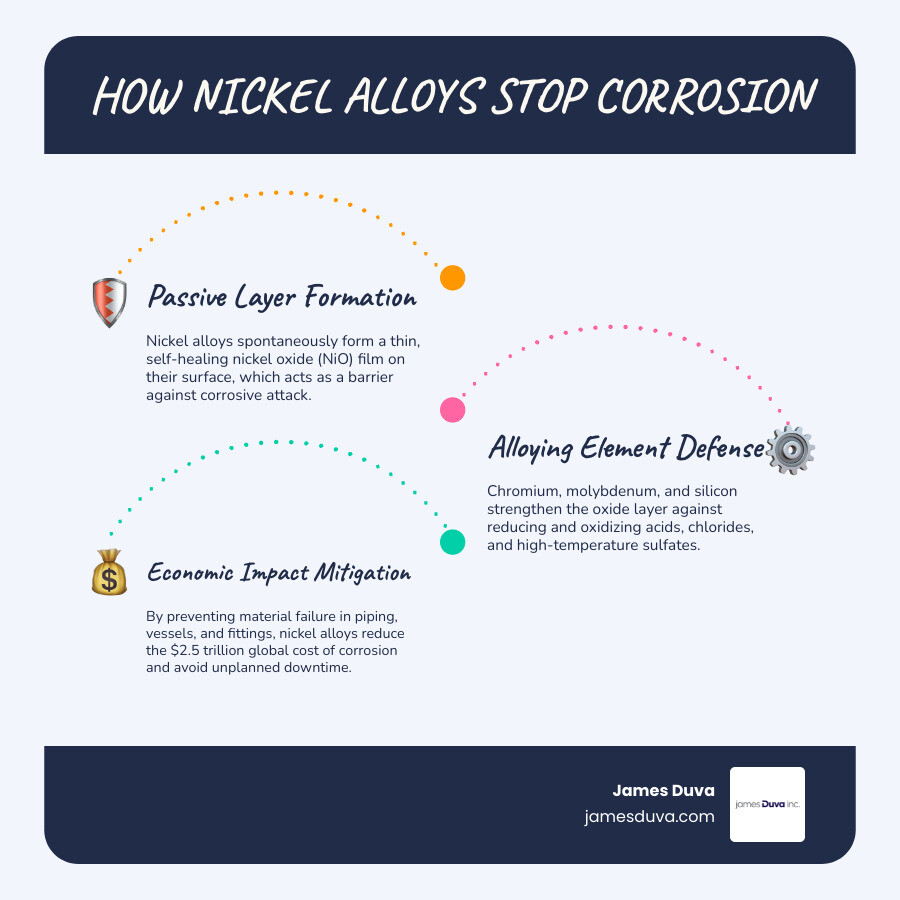
Corrosion is not just a materials problem — it is an enormous economic one. The global cost of corrosion recently exceeded $2.5 trillion USD, equivalent to roughly 3.4% of global GDP. For industrial operators in chemical processing, oil and gas, and power generation, material failures from corrosion translate directly into unplanned downtime, safety risks, and expensive repairs.
Nickel alloys exist precisely to solve this problem. Their unique chemistry gives them an ability to resist attack from the most aggressive acids, caustic solutions, and high-temperature environments on earth — environments where even high-grade stainless steel cannot keep up.
I’m Billy Walker, Vice President of James Duva Inc., where we have supplied corrosion resistant nickel alloys and specialty piping components to the process, power, and water treatment industries since 1978. My experience working with engineers and procurement teams across these sectors gives me a practical, ground-level understanding of how alloy selection directly impacts system reliability and total cost of ownership.
Why Are Alloys So Valuable in Industry?

In demanding industrial environments, pure metals are rarely up to the challenge. While pure iron is abundant, it is relatively soft and highly prone to oxidation, which quickly leads to rust. To overcome these natural limitations, metallurgists develop alloys. By combining a primary metal with precise quantities of other elements, we can create materials with vastly superior strength, durability, and resistance to environmental degradation.
For example, mixing iron with carbon and chromium yields stainless steel, which is far more resilient than basic iron. However, when temperatures soar or chemical attacks become extremely aggressive, even stainless steel reaches its limits. This is where high-performance nickel-based alloys become essential. They maintain their structural integrity and chemical stability under conditions that would rapidly destroy standard steels.
Because of this outstanding versatility, industrial alloys are utilized across a wide range of critical sectors:
- Construction: Heavy-duty structural beams and foundational piping systems rely on high-strength alloys to support massive loads and resist atmospheric weathering over decades of service.
- Oil & Gas: Deep-well drilling and offshore production systems subject equipment to extreme pressures and corrosive sour gases. High-performance alloy fittings, flanges, and piping are vital to preventing catastrophic leaks. For more details on this, you can read about why nickel alloy fittings are essential in these demanding setups.
- Automotive & Aerospace: Jet engines, exhaust systems, and high-speed airframes require materials that can withstand intense mechanical stress and high-temperature oxidation without losing their shape or strength.
- Medical & Consumer Goods: From biocompatible joint implants that must resist bodily fluids to high-end kitchenware exposed to acidic foods and heat, alloys provide the necessary safety and longevity.
Understanding the Metallurgy of Corrosion Resistant Nickel Alloys
The secret to the exceptional performance of corrosion resistant nickel alloys lies in their unique metallurgical structures. Nickel itself has a face-centered cubic (FCC) crystal structure, which is highly stable and allows the metal to host a large percentage of other beneficial alloying elements—such as chromium, molybdenum, and tungsten—without forming brittle phases.
When sourcing these materials, we must distinguish between wrought and cast alloys. Wrought alloys are mechanically worked into forms like plates, sheets, bars, and pipes. Because they undergo intensive rolling or forging, they generally exhibit highly refined grain structures. Cast alloys, on the other hand, are poured directly into molds. While casting allows for complex shapes, cast alloys often require the addition of silicon to improve fluid flow during the pour.
This silicon addition can complicate welding and fabrication. Silicon and carbon can promote the formation of undesirable second-phase precipitates along the grain boundaries during welding or high-temperature exposure. These second-phase formations deplete the surrounding metal of its protective elements, making the alloy susceptible to localized corrosion. To prevent this, wrought alloys are manufactured with carbon and silicon levels kept as low as possible. Additionally, heat treatments such as solution annealing followed by rapid water quenching are utilized to dissolve these secondary phases back into the solid matrix, restoring the material’s uniform corrosion resistance.
The Self-Healing Passive Layer of Corrosion Resistant Nickel Alloys
Like stainless steel, nickel’s primary line of defense against corrosion is its passive layer. When exposed to oxygen, nickel spontaneously reacts to form a thin, invisible, and highly adherent nickel oxide (NiO) film on its surface. This film acts as a physical barrier, blocking corrosive ions from reaching the underlying metal.
What makes this passive layer truly remarkable is its self-healing property. If the surface of the alloy is scratched, abraded, or mechanically damaged, the exposed metal immediately reacts with surrounding oxygen to reform the protective oxide film. This continuous passivation provides outstanding electrochemical stability, even in highly turbulent fluid systems. To see how these principles apply to specific industrial grades, you can read about how Inconel 600 provides strength and durability in highly demanding process environments.
Key Alloying Elements and Their Protective Roles
While pure nickel provides a solid foundation, its resistance is dramatically amplified by the addition of key alloying elements. Each element is selected to combat specific types of chemical attack:
- Chromium (Cr): This is the most critical element for resisting oxidizing environments, such as nitric acid or hot oxygen-rich gases. Chromium reacts to form a highly stable chromium-rich oxide layer that reinforces the primary passive film.
- Molybdenum (Mo): Molybdenum is highly effective at resisting reducing conditions, such as pure hydrochloric or hydrofluoric acids. It also plays a vital role in preventing localized attacks like pitting and crevice corrosion in chloride-rich environments.
- Silicon (Si): At exceptionally high corrosion potentials where standard chromium-rich passive films can break down, silicon forms protective, silicon-rich oxides that shield the alloy matrix from aggressive oxidizing acids.
- Aluminum (Al): Aluminum is primarily added to high-temperature alloys to promote the formation of a dense, protective alumina scale, which blocks the inward diffusion of oxygen and sulfur.
- Tungsten (W) & Cobalt (Co): These elements act as solid-solution strengtheners. Tungsten also works in tandem with molybdenum to enhance resistance to localized pitting in acidic chloride environments.
By carefully balancing these elements, metallurgists can tailor alloys to withstand high-temperature sulfate environments, severe dew point corrosion, or highly concentrated reducing acids. For instance, you can learn more about how Incoloy 825 composition improves performance in environments prone to sulfur and chloride attack.
Primary Categories of Nickel-Base Alloys and Industrial Applications
To help engineers select the right material, corrosion resistant nickel alloys are grouped into distinct families based on their chemical composition. Each family is optimized for specific chemical exposures and mechanical demands. If you are looking for specific material shapes, you can explore our nickel alloy round rod and bar options to find the right fit for your project.
Pure Nickel and Nickel-Copper Alloys
This category includes commercially pure nickel, such as Nickel 200, which contains 99% or more nickel. These materials offer outstanding resistance to highly concentrated caustic solutions (like sodium hydroxide) at boiling temperatures, making them a staple in chemical manufacturing where iron contamination must be completely avoided. To understand their specifications, you can read our guide on the purity and performance of Nickel 200 pipes.
When copper is added to nickel, we get the nickel-copper family, most notably represented by Alloy 400 (which contains roughly 67% nickel and 31.5% copper). This combination provides exceptional resistance to marine environments, rapidly flowing seawater, and high-temperature steam. For a comprehensive breakdown of this family, check out our deep dive into Monel 400 properties.
Selecting Corrosion Resistant Nickel Alloys for Acidic Environments
When processing systems involve highly aggressive mineral acids, we must turn to more complex alloys. The primary choices include:
- Inconel 625: A nickel-chromium-molybdenum alloy that offers high strength and excellent resistance to a broad range of corrosive environments, particularly in wet, chloride-rich settings.
- Hastelloy C-276: A versatile nickel-chromium-molybdenum-tungsten alloy known for its outstanding resistance to localized pitting, stress corrosion cracking, and both oxidizing and reducing media.
- Hastelloy C-2000: This alloy incorporates a deliberate copper addition, which provides exceptional resistance to sulfuric acid while maintaining the chromium and molybdenum levels needed to resist oxidizing impurities.
- Hastelloy B-3: A nickel-molybdenum alloy specifically engineered to handle highly concentrated, boiling hydrochloric acid in the complete absence of oxidizing species.
Choosing between these options requires analyzing your chemical stream’s specific balance of oxidizing and reducing components. To assist with this decision, you can read our comparison on Inconel vs Hastelloy for corrosive environments or view our detailed Hastelloy C-276 key properties compared reference.
Performance in Highly Aggressive Acidic Environments
Handling concentrated acids at elevated temperatures is one of the most difficult challenges in chemical processing. Below is a general performance comparison of key nickel alloys across the major industrial acids:
| Acid Type | Concentration Range | Temperature Range | Recommended Alloy | Performance Notes |
|---|---|---|---|---|
| Hydrochloric (HCl) | 0 – 37% | Ambient to Boiling | Hastelloy B-3 | Unmatched in pure reducing HCl; avoid if ferric ions are present. |
| Hydrochloric (HCl) | 0 – 10% | Ambient to Hot | Hastelloy C-2000 | Excellent if oxidizing impurities (like Fe3+) are present. |
| Sulfuric (H2SO4) | 0 – 98% | Ambient to Boiling | Hastelloy C-2000 / Incoloy 825 | C-2000 handles higher temperatures; Incoloy 825 is excellent for moderate concentrations. |
| Hydrofluoric (HF) | All Concentrations | Ambient to Hot | Alloy 400 (Monel) | Must restrict oxygen in the vapor phase to avoid intergranular attack. |
| Phosphoric (H3PO4) | Wet Process | Hot / Boiling | Hastelloy G-30 | Specifically formulated to resist phosphoric acid contaminated with fluorides and sulfates. |
| Nitric (HNO3) | Concentrated | Hot | Nickel-Chromium Alloys | High chromium content (at least 15%) is mandatory to maintain passivation. |
To help determine which material family is right for your acid processing setup, you can read our technical guide on is Hastelloy better than Inconel for acid environments?.
Hydrochloric Acid and the Impact of Oxidizing Impurities
Hydrochloric acid is a strong, highly reducing mineral acid. Reducing solutions generally induce hydrogen evolution at cathodic sites, which accelerates the uniform dissolution of standard metals. For pure hydrochloric acid across all concentrations and temperatures, the nickel-molybdenum group—such as B-3 alloy (containing roughly 68.5% nickel and 28.5% molybdenum)—is the industry standard. Molybdenum is the key element for resisting pure reducing acid attack.
However, the presence of even trace impurities can completely alter the corrosion chemistry. If the hydrochloric acid stream contains oxidizing impurities, such as ferric ions (Fe3+) or cupric ions (Cu2+), B-3 alloy can experience rapid, catastrophic corrosion.
Under these contaminated conditions, a nickel-chromium-molybdenum alloy like Hastelloy C-2000 is much more suitable. In a boiling 2.5% HCl solution, a content of only 3 ppm Fe3+ (ferric ions) produces a decline in the corrosion rate of C-2000 alloy by almost two orders of magnitude. The ferric ions act as oxidizers that promote the passivation of the chromium in the C-2000, allowing it to form a stable protective film that halts uniform dissolution.
Sulfuric, Hydrofluoric, and Phosphoric Acid Handling
Sulfuric acid is the most widely used acid in modern industry. Its corrosiveness varies wildly depending on its concentration and temperature, which also dictate its boiling point. For reference, the boiling point of 20% sulfuric acid is 104 °C (220 °F), 50% is 123 °C (253 °F), and 80% is 202 °C (395 °F). While materials like Incoloy 825 handle moderate temperatures and concentrations beautifully, highly concentrated, hot sulfuric acid requires the advanced protection of alloys like Hastelloy C-2000.
Hydrofluoric (HF) acid presents a unique challenge because it is incredibly aggressive and actively dissolves reactive metals like titanium, zirconium, niobium, and tantalum. It even eats through glass. Nickel alloys are among the very few materials capable of handling hot hydrofluoric acid. Alloy 400 (Monel) is widely used for HF service; however, operators must be extremely careful regarding oxygen ingress. In the presence of oxygen, Alloy 400 is subject to accelerated intergranular attack, particularly in the vapor phase where vapor condenses. If oxygen ingress cannot be strictly restricted, alternative alloy selections must be made.
For “wet process” phosphoric acid—which is commonly used in the agricultural chemical industry and is heavily contaminated with sulfuric acid, active silica, and highly corrosive halide ions—Hastelloy G-30 (containing 30% chromium and 44% nickel) is generally preferred. Its high chromium content provides superior resistance to this highly complex, abrasive, and acidic slurry.
Nickel Alloys vs. Alternative Materials
When designing a chemical processing system, engineers often compare nickel alloys against alternative materials such as stainless steel, titanium, and zirconium. While these materials have their place, nickel alloys offer distinct advantages in hot, highly aggressive environments:
- Stainless Steel (e.g., 316 SS): Stainless steel is highly cost-effective but has clear performance limits. At intermediate acid concentrations, the corrosion rate of 316 SS can be more than four orders of magnitude higher than the corrosion rate of zirconium or B-3 alloy in boiling hydrochloric acid. Additionally, stainless steels are highly susceptible to stress corrosion cracking (SCC), localized pitting, and crevice attack in hot, chloride-bearing solutions—phenomena that nickel alloys resist exceptionally well.
- Titanium: Titanium relies on a titanium dioxide passive film, which provides excellent resistance to oxidizing acids and seawater. However, titanium performs poorly in strong reducing acids (like hydrochloric or sulfuric acids) and is rapidly destroyed by hydrofluoric acid.
- Zirconium: Zirconium offers outstanding resistance to pure reducing acids but is expensive, highly specialized, and vulnerable to trace oxidizing impurities (like ferric ions) that actually help passivate certain nickel alloys.
For a detailed analysis of when to upgrade your system components, you can read our guide on when to choose nickel alloys over stainless steel. Selecting high-performance materials for critical flow control components, such as Ball Valves, ensures long-term operational safety and prevents localized crevice corrosion in stagnant zones.
Aerospace Specifications and High-Temperature Standards
Beyond wet chemical processing, nickel alloys are indispensable in the aerospace industry, where materials must withstand extreme mechanical stress and high-temperature oxidation. In these applications, nickel-based superalloys like Inconel 718 are prized for their ability to maintain high tensile strength, fatigue resistance, and structural stability across temperatures ranging from cryogenic limits up to 1300 °F. You can read more about these demanding environments in our overview of nickel-based alloys in the aerospace industry.
To guarantee consistency, safety, and performance in these critical applications, the aerospace and defense sectors rely on strict Aerospace Material Specifications (AMS) managed by SAE International:
- AMS5872D Material Specification: Covers a corrosion and heat-resistant nickel alloy in the form of sheet, strip, and plate. The chemistry is defined as 48Ni – 20Cr – 20Co – 5.9Mo – 2.2Ti – 0.45Al, produced via consumable electrode or vacuum induction melting (VIM) and solution heat treated.
- AMS5869A Material Specification: Defines the standards for a solution heat-treated nickel alloy sheet, strip, and plate with a composition of 62Ni – 21.5Cr – 9.0Mo – 3.7Cb.
- AMS5754L Material Specification: Governs solution heat-treated nickel alloy bars, forgings, and flash-welded rings with a chemistry of 47.5Ni – 22Cr – 1.5Co – 9.0Mo – 0.60W – 18.5Fe (characteristic of Hastelloy X).
- AMS5878E Material Specification: Specifies a solution heat-treated nickel-chromium-tungsten-molybdenum alloy sheet, strip, and plate with a composition of 59Ni – 22Cr – 2Mo – 14W – 0.35Al – 0.03La, designed for extreme high-temperature oxidation resistance.
- AMS5598A Material Specification: Covers a high-strength, corrosion and heat-resistant alloy sheet, strip, and plate (72Ni – 15.5Cr – 0.95(Cb + Ta) – 2.5Ti – 0.70Al – 7.0Fe) that is consumable electrode or vacuum induction melted and solution heat treated.
- AMS5872 Material Specification: Establishes the baseline standards for the 20Cr – 20Co – 5.9Mo – 2.2Ti – 0.45Al nickel-base alloy sheet, strip, and plate.
Frequently Asked Questions about Nickel Alloys
Does nickel rust like iron does?
No, nickel does not rust. Rust is a term reserved specifically for the iron oxides that form on iron and steel. Iron oxides are highly porous and flaky; they absorb moisture and easily flake off, continuously exposing fresh metal to further oxidation until the component fails completely.
In contrast, nickel undergoes passivation. When exposed to oxygen, it reacts to form a highly compact, adherent, and stable nickel oxide (NiO) film. This micro-thin layer seals the underlying metal, halting further oxidation and preventing the structural degradation associated with rust.
Why are nickel alloys less subject to cracking than stainless steels in hot chloride solutions?
Standard austenitic stainless steels (like 304 and 316) are highly vulnerable to chloride stress corrosion cracking (SCC) in hot, chloride-bearing solutions. This is a form of localized attack where a combination of tensile stress and chloride ions causes rapid, brittle cracking.
Nickel-base alloys are highly resistant to SCC, pitting, and crevice attack due to their high nickel content. A high nickel matrix dramatically increases the material’s resistance to crack propagation in hot chloride environments. When combined with molybdenum and chromium, these alloys maintain their protective passive films even under high mechanical stress and localized chemical attack.
How do oxidizing impurities like ferric ions affect nickel alloy performance?
The effect of oxidizing impurities depends entirely on the composition of the alloy:
- In Nickel-Molybdenum Alloys (like B-3): Oxidizing impurities like ferric (Fe3+) or cupric (Cu2+) ions are highly detrimental. Because B-3 alloy lacks chromium, it cannot passivate under oxidizing conditions, leading to rapid, uniform dissolution of the material.
- In Nickel-Chromium-Molybdenum Alloys (like C-2000): Oxidizing impurities can actually be beneficial in reducing acids. The presence of even trace amounts of ferric ions (such as 3 ppm Fe3+) acts as an oxidizing catalyst that promotes the rapid passivation of the chromium. This forms a highly stable protective oxide film, reducing the uniform dissolution rate in boiling hydrochloric acid by almost two orders of magnitude.
Conclusion
Selecting the right material for highly corrosive, high-pressure, or high-temperature environments is critical to ensuring safety, preventing unplanned downtime, and optimizing your total cost of ownership. While standard metals rapidly degrade under these harsh conditions, corrosion resistant nickel alloys provide the chemical stability and mechanical strength needed to keep your systems running smoothly.
At James Duva Inc., based in Branchburg, NJ, we have supplied high-grade stainless steel and nickel alloy industrial products to the chemical processing, oil and gas, and power generation industries since 1978. As a trusted, one-stop shop with decades of technical expertise, we are here to help you navigate material standards and select the perfect piping components, fittings, and valves for your specific application.
Ready to secure the longevity of your processing systems? Explore James Duva’s Nickel Alloys today, or contact our New Jersey team to request a quote.
About James Duva Inc.
Since 1978, James Duva Inc. has been your trusted source for stainless steel and high-nickel alloy industrial products. Whether you’re in the water treatment, process or power industry, we pride ourselves on always having what you need. Say goodbye to your sourcing problems with just one call to James Duva.