
The Definitive Guide to 304 Stainless Tubing

Jul 6, 2026
The Grade That Powers Industry: A Quick Answer on 304 Stainless Tubing
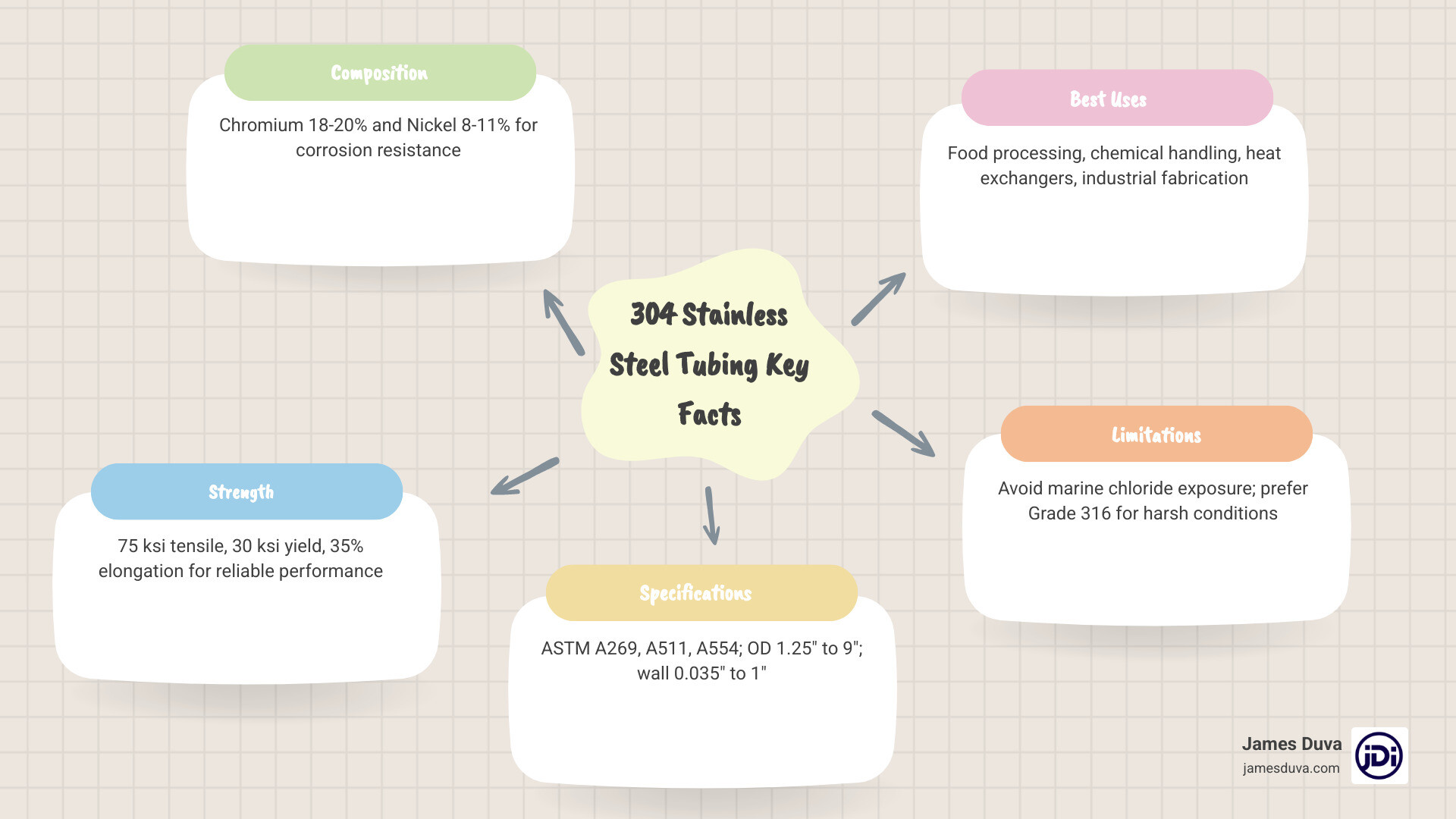
304 stainless tubing is the most widely used grade of stainless steel tube in industrial applications — and for good reason.
Here’s what you need to know at a glance:
| Property | Value |
|---|---|
| Chromium content | 18.0–20.0% |
| Nickel content | 8.0–11.0% |
| Min. tensile strength | 75 ksi |
| Min. yield strength | 30 ksi |
| Min. elongation | 35% |
| Common ASTM specs | A269, A511, A554 |
| Magnetic? | No (annealed condition) |
| Typical OD range | 1.250″ to 9.000″ |
| Wall thickness range | 0.035″ to 1.000″ |
| Available lengths | Up to 20 feet |
Best for: food processing, chemical handling, architectural fabrication, heat exchangers, and general industrial use.
Not ideal for: marine environments with direct chloride exposure or aggressive chemical processing — consider Grade 316 instead.
If you work in chemical processing, oil and gas, or industrial manufacturing, choosing the wrong tube material can mean costly failures, downtime, and compliance headaches. The good news: 304 stainless tubing hits a reliable sweet spot of corrosion resistance, mechanical strength, and weldability that covers the vast majority of industrial needs.
It’s an austenitic chromium-nickel alloy — commonly called 18/8 stainless — meaning roughly 18% chromium and 8% nickel. That combination creates a passive oxide layer on the surface that resists rust and many corrosive agents without any coating or treatment.
It’s available in seamless and welded forms, a wide range of diameters and wall thicknesses, and multiple surface finishes — giving engineers and fabricators serious flexibility.
I’m Billy Walker, Vice President of James Duva Inc., where I’ve spent years helping industrial professionals in power, process, and water treatment source the right 304 stainless tubing and specialty alloy products from leading domestic manufacturers. Let’s break down everything you need to know to select, specify, and purchase with confidence.
Why Are Alloys So Valuable in Industry?
In a perfect world, pure metals would do the trick. But in the real world of industrial manufacturing, pure metals like iron are often too soft for structural use and are notoriously prone to rust. When iron meets oxygen and moisture, it oxidizes—creating that familiar red flake that eventually eats through the material.
This is where alloys come in. By mixing iron with elements like chromium, nickel, and manganese, we create “super-materials” that maintain structural integrity under pressure and resist the elements. Alloys like 304 stainless tubing offer superior strength and durability compared to carbon steel, ensuring that your systems don’t just work today, but stay functional for decades.

Key Applications Across Sectors
The versatility of stainless alloys means they are everywhere. You’ll find them in:
- Construction: Used for structural beams and architectural accents where both strength and aesthetics matter.
- Oil & Gas: Critical for high-pressure fittings, flanges, and Ball Valves that must withstand harsh environments.
- Automotive & Aerospace: Providing the backbone for high-performance frames and heat-resistant engines.
- Medical & Consumer Goods: From surgical implants to the kitchenware in your home, stainless steel is the gold standard for hygiene.
To learn more about the basics of how these materials function, check out our guide on Industrial Tubing: Core Principles.
Technical Specifications and Properties of 304 stainless tubing
When we talk about 304 stainless tubing, we are referring to a material defined by strict international standards. Understanding these is the first step in ensuring your project meets safety and performance requirements. For a deeper dive into the metallurgy, see our In-Depth Guide to Stainless Steel Alloy Properties.
Most 304 stainless tubing is manufactured to specific ASTM standards:
- ASTM A269: Covers seamless and welded austenitic stainless steel tubing for general service.
- ASTM A511: Specifically for seamless stainless steel mechanical tubing, often used when machining is required.
- ASTM A554: The standard for ornamental tubing where aesthetics and weldability are prioritized.
One of the most notable characteristics of 304 stainless is that it is non-magnetic in the annealed condition. This makes it ideal for sensitive electronic applications or environments where magnetic interference must be avoided. If you are looking for local availability, you can find New York 304 Stainless Steel Tubing Suppliers – IQS Directory to see how the regional market stacks up.
Mechanical Performance of 304 stainless tubing
Mechanically, 304 stainless tubing is a workhorse. It offers a minimum tensile strength of 75 ksi and a yield strength of 30 ksi. With a Brinell hardness of approximately 160 to 170, it is tough enough for structural support but remains workable enough for fabrication.
We often get asked about the 304L variant. The “L” stands for low carbon. While standard 304 has a maximum carbon content of 0.08%, 304L is capped at 0.03%. This slight change is vital for welding; it prevents “carbon precipitation” in the heat-affected zone, which can lead to corrosion near the weld. If your project involves heavy welding without the possibility of post-weld annealing, 304L is usually the smarter choice. For more on these distinctions, read Navigating the Maze of Industrial Tubing: From Welded Pipe to Seamless Wonders.
Available Sizes and Finishes for 304 stainless tubing
At James Duva, we see a massive variety of size requirements. 304 stainless tubing is typically available in outside diameters (OD) ranging from 1.250″ to 9.000″, though smaller instrumentation sizes down to 1/8″ are also common.
Finishes are equally diverse:
- Polished OD/ID: Common in food and beverage or sanitary applications to prevent bacterial growth.
- Brushed Finish (Grit): Often 180 grit, used for architectural or ornamental purposes.
- Mill Finish: The standard unpolished look for industrial applications where aesthetics don’t matter.
| OD Size (Inches) | Wall Thickness (Inches) | Weight per Foot (lbs) |
|---|---|---|
| 1.500″ | 0.065″ (16ga) | 0.997 |
| 2.000″ | 0.065″ (16ga) | 1.344 |
| 2.500″ | 0.083″ (14ga) | 2.144 |
| 3.000″ | 0.120″ (11ga) | 3.691 |
| 4.000″ | 0.188″ | 7.653 |
Comparing 304 Stainless Tubing to Other Grades
While 304 is the most popular grade, it isn’t always the right one. Our A Comprehensive Introduction to Stainless Steel Facts and Industry Insights explains that the “300 series” of stainless steels includes several specialized alloys.
Grade 316 is the most common step up. It includes molybdenum, which provides significantly better resistance to chlorides (like salt water) and pitting. If you are building a seaside railing or a chemical line for bleach, 316 is the way to go.
Grade 321 is another alternative, often used in aerospace. It is stabilized with titanium, allowing it to perform in high-temperature service environments (800°F to 1500°F) where 304 might fail due to intergranular corrosion.
Choosing Between Welded and Seamless Construction
The “welded vs. seamless” debate is one we help customers navigate daily. You can find a detailed breakdown in our article Seamless Pipe and Welded Pipe: What’s the Difference?.
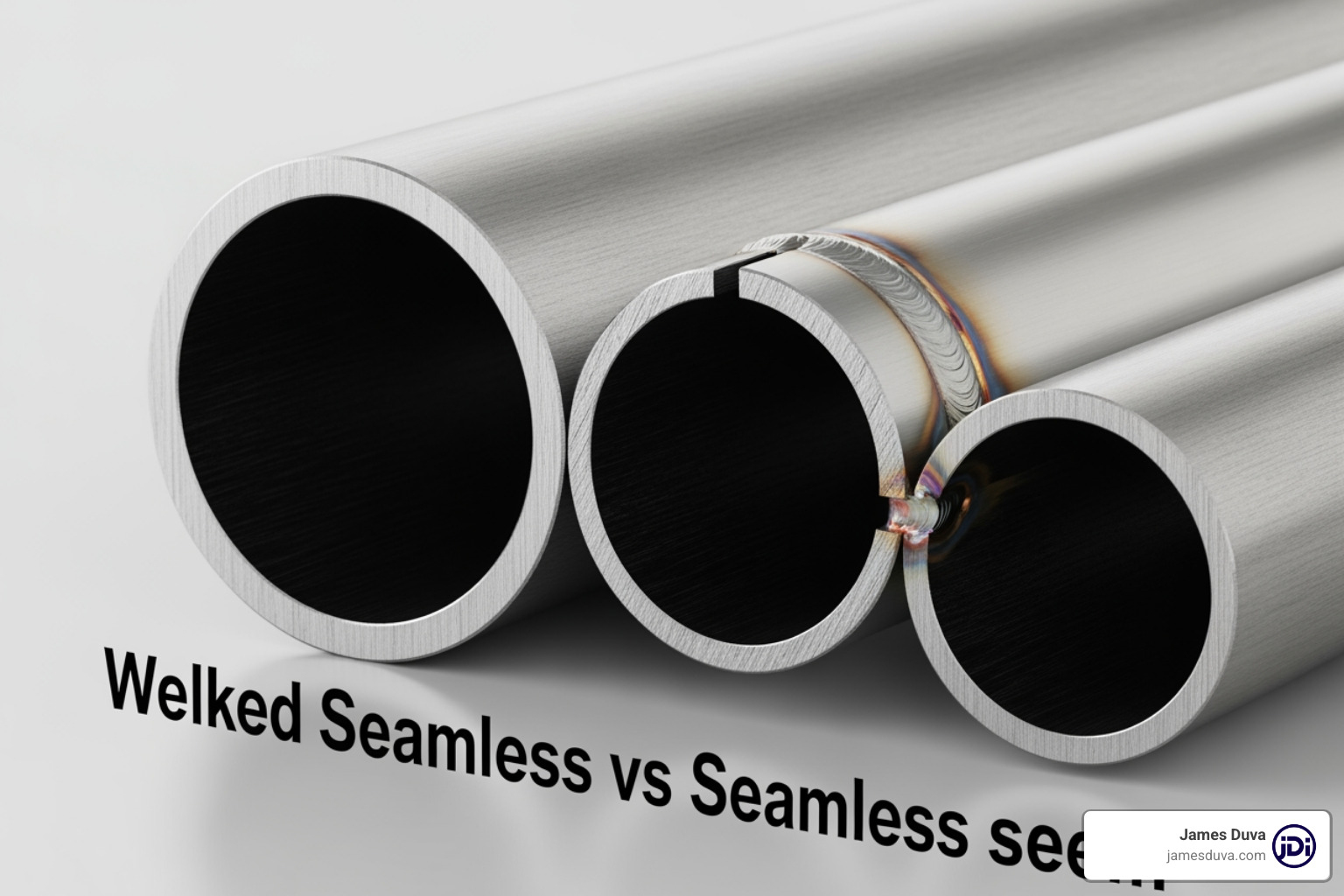
- Seamless Tubing: Created by piercing a solid billet of steel. It has no seam, making it the superior choice for high-pressure service and critical environments where failure is not an option. It is typically available in lengths up to 20 feet.
- Welded Tubing: Formed by rolling a strip of steel and welding the seam. It is generally more cost-effective and offers tighter dimensional tolerances for the wall thickness. It’s perfect for ornamental tubing, exhaust systems, and moderate-pressure industrial lines.
Industrial Applications and Selection Criteria
The applications for 304 stainless tubing are nearly endless. Because of its 18% chromium content, it excels in environments that would destroy carbon steel. For a broader look at how these are used, see Stainless Steel Applications for Every Industry.
In the Food and Beverage sector, 304 is used for beer brewing, milk processing, and winemaking equipment because it is easy to sanitize and doesn’t leach metallic flavors into the product. In Chemical Processing, it serves as the primary material for transport containers and heat exchangers. Even in Marine environments, while 316 is preferred for direct saltwater contact, 304 is often used for structural components that are shielded from direct spray.
Sanitary and Instrumentation Requirements
For industries like pharmaceuticals and biotechnology, the requirements go beyond just material grade. They require Sanitary Tubing. This tubing must meet high hygiene standards to minimize contamination risks. You can learn more about the components that join these systems in The Ultimate Guide to Sanitary Tube Fittings: Types, Applications and Benefits.
Precision is also key in instrumentation. 304 stainless tubing used for sensors and control lines must have incredibly tight tolerances. Choosing the right connectors is just as important as the tube itself, which is why we recommend reviewing A Comprehensive Guide to Choosing Tube Fittings and Understanding Tube Fittings: Types, Applications and Benefits for Industrial Systems.
Conclusion
At James Duva Inc., we’ve been helping our partners navigate the complexities of stainless steel since 1978. Based in Branchburg, NJ, we understand that selecting 304 stainless tubing isn’t just about picking a size off a shelf—it’s about ensuring the safety and longevity of your industrial systems. Whether you need seamless mechanical tubing for a machining project or polished ornamental tube for an architectural masterpiece, our expertise ensures you get exactly what you need.
To see why so many trust us as their primary partner, read more about how to Expert Stainless Tubing Suppliers Discover the Quality of James Duva.
Frequently Asked Questions about 304 Stainless Tubing
What is the difference between 304 and 304L tubing? 304L has a lower carbon content (0.03% max) compared to standard 304 (0.08% max). This makes 304L better for welding, as it prevents carbon precipitation that can lead to corrosion at the weld joints.
Is 304 stainless tubing suitable for marine environments? It depends on the exposure. 304 is great for freshwater and mild outdoor environments. However, for direct contact with saltwater or coastal air, Grade 316 is recommended because its molybdenum content resists chloride-induced pitting.
How does tubing differ from standard stainless pipe? Tubing is measured by its actual Outside Diameter (OD) and wall thickness, often with very tight tolerances for precision fit. Pipe is measured by “Nominal Pipe Size” (NPS), which is a more generalized naming convention used for fluid transport and structural applications.
Contact Our Specialists
Ready to start your next project? Our team in New Jersey is standing by to help you find the perfect fit for your application.
About James Duva Inc.
Since 1978, James Duva Inc. has been your trusted source for stainless steel and high-nickel alloy industrial products. Whether you’re in the water treatment, process or power industry, we pride ourselves on always having what you need. Say goodbye to your sourcing problems with just one call to James Duva.