
The Ultimate Guide to Hastelloy C-276 Applications
Aug 19, 2026
What Are the Most Important Hastelloy C-276 Applications?
Hastelloy C-276 applications span some of the harshest industrial environments on earth — from chemical reactors handling boiling hydrochloric acid to offshore platforms exposed to corrosive seawater.
Here is a quick overview of where this alloy is most commonly used:
| Industry | Typical C-276 Applications |
|---|---|
| Chemical Processing | Reactors, heat exchangers, columns, piping, valves |
| Oil & Gas | Sour gas equipment, pressure vessels, downhole components |
| Pollution Control | Flue gas desulfurization scrubbers, stack liners |
| Marine | Seawater cooling systems, pump housings, fasteners |
| Pharmaceutical | Process vessels, mixers, transfer piping |
| Pulp & Paper | Bleach plant equipment, digesters, piping |
| Power Generation | Waste incineration systems, heat recovery equipment |
What makes this alloy stand out is not just what it resists — it’s how consistently it resists it. Hastelloy C-276 has more than 50 years of proven performance across a vast range of corrosive chemicals as of July 2026. It was also the first wrought nickel-chromium-molybdenum alloy engineered with extremely low carbon and silicon content, which solved a long-standing industry problem: weld decay. That single innovation made it practical for fabricated equipment — not just solid components — to perform reliably in aggressive chemical service.
For engineers and procurement professionals sourcing materials for severe-service environments, understanding where and why C-276 excels can mean the difference between a 20-year asset and a costly premature failure.
I’m Billy Walker, Vice President of James Duva Inc., where I’ve spent years helping engineers in the power, process, and water treatment industries source specialty nickel alloys — including components built from C-276 — through our network of trusted domestic manufacturers. My work connecting clients with the right materials for demanding Hastelloy C-276 applications gives me a practical, real-world perspective on this alloy that goes beyond the datasheet. in the sections below, we’ll break down the chemistry, corrosion data, fabrication requirements, and specific use cases so you can make confident material decisions.
Why Are Alloys So Valuable in Industry?
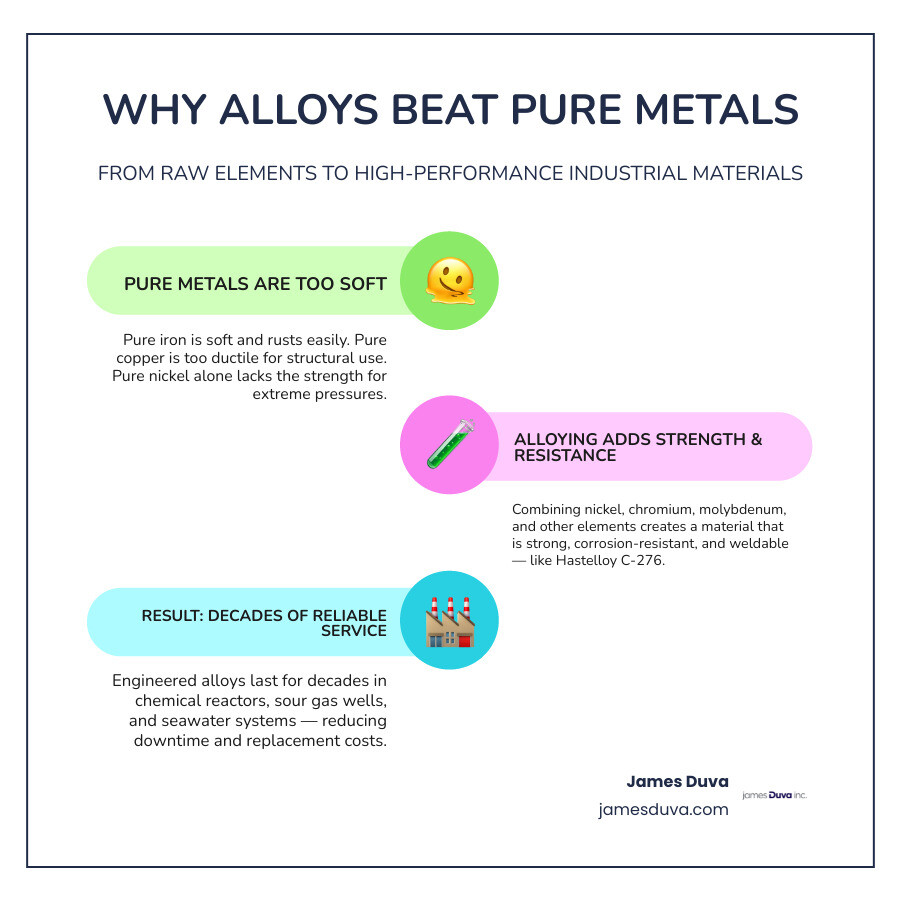
In heavy industry, pure metals are rarely up to the challenge of extreme service. While pure iron or nickel are fundamental building blocks, they possess inherent limitations. Pure iron, for instance, is relatively soft, mechanically weak, and highly susceptible to rust and rapid oxidation when exposed to moisture and oxygen.
To overcome these structural limitations, we turn to alloys. By precisely blending primary metals with other elements, metallurgists can dramatically alter their physical and chemical properties. This process creates materials with significantly higher load-bearing capacity, wear resistance, and long-term durability. For example, standard carbon steel adds carbon to iron to increase strength, but it still lacks the chemical stability required for corrosive service.
When standard steels fall short, specialty materials like stainless steel and nickel-based superalloys become essential. To understand when to step up from basic steels, you can read our guide on When to Choose Nickel Alloys Over Stainless Steel in Industrial Applications. For a broader look at available formats, explore our inventory of Nickel Alloy Round Rod and Bar Inconel Hastelloy and Beyond.
Construction and Infrastructure
Modern infrastructure relies heavily on the enhanced properties of alloys. Structural steel beams provide the high load-bearing capacity and structural durability required for skyscrapers, bridges, and industrial plants. In water distribution and waste management systems, alloy-based industrial piping prevents premature structural failure, ensuring that critical infrastructure remains safe and functional for decades without needing constant, disruptive repairs.
Oil & Gas Sector
The oil and gas sector operates in some of the most punishing environments on earth, where components face high-pressure environments and sour gas containing hydrogen sulfide ($H_2S$). Standard metals would fail almost immediately under these conditions due to sulfide stress cracking. High-performance alloy fittings, flanges, and valves provide the necessary mechanical strength and chemical inertness to withstand these severe depths and pressures safely.
Automotive and Aerospace
In the automotive and aerospace sectors, materials must perform flawlessly under intense mechanical stress and extreme thermal cycles. Aerospace engine components and structural frames require alloys that maintain their high-temperature strength and resist oxidation near jet exhausts. Similarly, automotive exhaust systems and turbocharger housings utilize advanced alloys to handle constant thermal expansion and contraction without cracking.
Medical and Consumer Goods
Alloys also touch our daily lives in deeply personal ways. In medicine, surgical implants require exceptional biocompatibility and corrosion resistance to prevent adverse reactions inside the human body. In consumer goods, high-grade alloys are used in kitchenware and food processing equipment to meet strict hygiene standards, ensuring surfaces are easy to sanitize and entirely resistant to food acids.
Chemical Composition and Key Properties of Hastelloy C-276
The secret behind the success of Hastelloy C-276 in severe chemical services lies in its unique, highly balanced chemical composition. It is categorized as a nickel-chromium-molybdenum wrought alloy, with each element playing a specific role in defending the metal against chemical attack.
- Nickel (approximately 57% balance): Provides a highly ductile matrix and exceptional resistance to stress corrosion cracking (SCC) in hot chloride environments.
- Molybdenum (15% to 17%): Confers outstanding resistance to reducing environments, such as hydrochloric and sulfuric acids, while also preventing localized pitting and crevice corrosion.
- Chromium (14.5% to 16.5%): Delivers essential resistance to oxidizing media, such as wet chlorine gas, nitric acid, and ferric salts.
- Iron (4% to 7%): Helps control material costs and improves workability without compromising the alloy’s core corrosion resistance.
- Tungsten (3% to 4.5%): Works in tandem with molybdenum to further suppress pitting and crevice corrosion in highly acidic chloride solutions.
- Carbon (0.01% max) & Silicon (0.08% max): Kept to absolute minimums to prevent grain-boundary precipitation during welding, preserving corrosion resistance in the heat-affected zone (HAZ).
To see how this unique chemistry stacks up against other high-performance materials in our inventory, you can read our comparison guide on Hastelloy C-276 101 Key Alloy Properties Compared.
Mechanical and Physical Characteristics Across Temperatures
Hastelloy C-276 is not just a corrosion-resistant material; it is also a highly capable structural alloy. It exhibits excellent tensile strength, yield strength, and elongation properties, maintaining its structural integrity from cryogenic temperatures up to elevated service temperatures.
At room temperature, typical mechanical properties for wrought C-276 include:
- Ultimate Tensile Strength (UTS): 100,000 psi (690 MPa)
- Yield Strength (0.2% Offset): 45,000 psi (310 MPa)
- Elongation in 2 inches: 60%
- Density: 0.321 lb/in³ ($8.89text{ g/cm}^3$)
As temperatures rise, the alloy retains its mechanical stability. Its low coefficient of thermal expansion reduces thermal fatigue risks in cyclic temperature applications, while its dynamic modulus of elasticity remains high, ensuring minimal deformation under load. For a deeper dive into these specifications, check out Hastelloy Material Properties Applications and Benefits.
Industry Standards and Compliance Codes
Because C-276 is so frequently used in high-pressure, hazardous chemical processes, it is governed by strict international standards. We supply C-276 products certified to major industry specifications, ensuring complete compliance with codes established by ASME, ASTM International, NACE, and TÜV.
Common material specifications include:
- ASTM B575 / ASME SB575: Sheet, plate, and strip
- ASTM B574 / ASME SB574: Rod and bar
- ASTM B619 & B622 / ASME SB619 & SB622: Welded and seamless pipe
- ASTM B366 / ASME SB366: Wrought fittings
- NACE MR0175 / ISO 15156: Standards governing materials for use in $H_2S$-containing environments in oil and gas production.
For a comprehensive look at sourcing these certified materials, refer to Hastelloy C276 UNS N10276 Your Guide to Superior Alloy Solutions.
Corrosion Resistance in Extreme Environments
To truly appreciate the performance of Hastelloy C-276, we must look at how it fares against standard stainless steel (316L) and super-austenitic stainless steel (254SMO) in aggressive testing media.
| Corrosion Parameter / Test Environment | 316L Stainless Steel | 254SMO Super-Austenitic | Hastelloy C-276 |
|---|---|---|---|
| Critical Pitting Temp (CPT) in Acidified 6% $FeCl_3$ | 59°F (15°C) | 140°F (60°C) | 302°F (150°C) |
| Critical Crevice Temp (CCT) in Acidified 6% $FeCl_3$ | 32°F (0°C) | 113°F (45°C) | 131°F (55°C) |
| Stress Corrosion Cracking (Boiling 45% $MgCl_2$) | Cracks in 2 Hours | Cracks in 24 Hours | No Cracking after 1,008 Hours |
| Corrosion Rate in Boiling 10% HCl | Rapid Failure | High Corrosion Rate | 288 mpy |
| Pitting in Green Death Solution (Boiling) | Severe Attack | Rapid Pitting | No Pitting below Boiling Point |
Performance in Mineral Acids and Corrosive Media
Hastelloy C-276 performs exceptionally well in both reducing and oxidizing acids. In hydrochloric acid (HCl), where many stainless steels fail rapidly due to active corrosion, C-276 demonstrates remarkable resistance. For example, in 20% hydrochloric acid at 100°F (38°C), C-276 exhibits a corrosion rate of only 0.14 mm/y (5.5 mpy) in wrought form. Even in boiling 10% HCl, C-276 maintains a manageable corrosion rate of 288 mpy, vastly outperforming C-22 alloy (400 mpy) and alloy 625 (642 mpy) under the same boiling conditions.
The alloy is also highly resistant to:
- Sulfuric Acid ($H2SO4$): Excellent resistance in concentrations up to 70% at boiling temperatures, and across the entire concentration range at moderate temperatures.
- Phosphoric Acid ($H3PO4$): Highly resistant to impure, wet-process phosphoric acid, which often contains aggressive fluoride and chloride impurities.
- Hydrobromic Acid (HBr): Superior resistance to wet bromine gas and hydrobromic acid solutions.
- Nitric Acid ($HNO_3$): While primarily an oxidizing acid, C-276’s chromium content provides good resistance, though it is not recommended for highly concentrated, hot nitric acid services where chromium-rich alloys like C-22 perform better.
For a detailed analysis of how Hastelloy handles these acidic environments compared to Inconel, you can read Is Hastelloy Better than Inconel for Acid Environments.
Pitting, Crevice Corrosion, and Stress Corrosion Cracking Resistance
In chloride-rich environments, localized corrosion (pitting and crevice corrosion) is the primary threat to equipment integrity. Hastelloy C-276’s high molybdenum and tungsten content prevents the localized breakdown of its protective passive oxide film.
In the standard “Green Death” solution (a highly aggressive mixture of 11.5% $H2SO4$, 1.2% HCl, 1% $FeCl3$, and 1% $CuCl2$), the lowest temperature at which pitting is observed in C-276 is its boiling point. In the “Yellow Death” solution (4% NaCl, 0.1% $Fe2(SO4)_3$, and 0.021M HCl), C-276 has not exhibited pitting even at the maximum test temperature of 150°C.
Furthermore, during boiling 45% magnesium chloride stress corrosion cracking tests (ASTM G36), C-276 showed zero cracking after 1,008 hours (six weeks) of continuous exposure. This makes it an incredibly reliable choice over standard stainless steels. For a wider comparison of these alloy families, read Inconel vs Hastelloy Which is Better for Corrosive Environments.
Primary Industrial Hastelloy C-276 Applications
The immense corrosion resistance of C-276 makes it an indispensable material across several heavy industries. Where process safety and equipment longevity are paramount, C-276 is the standard choice. To read more about how this alloy’s versatility translates to different industrial solutions, explore Exploring the Applications of Hastelloy C-276 Versatility in Industrial Solutions.
Key Hastelloy C-276 Applications in Chemical Processing
In the chemical process industry (CPI), reactors, heat exchangers, distillation columns, and piping systems are subjected to highly aggressive chemical mixtures. We supply C-276 materials for these critical components because they can handle rapid temperature changes and corrosive process chemistries simultaneously.
Specific components that benefit from C-276 include:
- Reactors and Vessel Liners: Handling organic chloride processes, pesticide production, and plastic monomer synthesis.
- Heat Exchangers: Coolers and reheaters utilizing brackish water or seawater on one side and aggressive process acids on the other.
- Valves and Piping: High-performance Ball Valves made of C-276 ensure absolute shutoff and prevent dangerous leaks in acid lines.
- Sour Gas Equipment: Downhole tubing, packers, and surface piping exposed to high-temperature sour gas.
To understand the key differences between Hastelloy and Inconel in these applications, you can read Inconel vs Hastelloy Key Differences Applications and Benefits.
Marine and Environmental Hastelloy C-276 Applications
Environmental regulations require power plants and waste incinerators to clean their exhaust gases. Flue gas desulfurization (FGD) scrubbers remove sulfur dioxide ($SO_2$) from exhaust streams, creating an incredibly hostile, warm acidic slurry containing high levels of chlorides. C-276 is widely used for scrubber liners, dampers, and stack reheaters in these systems because it resists the dew-point corrosion caused by condensing sulfuric acid.
In marine environments, C-276 is virtually immune to local corrosion. A U.S. Navy study conducted at LaQue Laboratories in Wrightsville Beach, NC, tested C-276 in flowing and quiescent seawater for 180 days. In flowing seawater crevice corrosion tests at 29°C, C-276 showed zero attacked sites and zero depth of attack, while standard 316L stainless steel suffered severe localized pitting up to 0.48 mm deep.
Welding and Fabrication Guidelines for Hastelloy C-276
While Hastelloy C-276 is highly corrosion-resistant, its performance in the field depends entirely on proper fabrication and welding techniques. Because nickel alloys behave differently than carbon steel or standard stainless steel, fabricators must adjust their procedures accordingly. For long-term maintenance advice, see our Maintenance Tips for Hastelloy C-276 Ensuring Longevity and Performance.
Recommended Welding Processes and Filler Metals
Hastelloy C-276 is readily weldable using standard industrial processes, including Gas Tungsten Arc Welding (GTAW/TIG), Gas Metal Arc Welding (GMAW/MIG), and Shielded Metal Arc Welding (SMAW/Stick).
Key welding considerations include:
- Filler Metals: We recommend matching filler metals, such as ERNiCrMo-4 solid wire or ENiCrMo-4 covered electrodes. For highly critical service, some engineers specify alloy C-22 filler metal (ERNiCrMo-10) to provide an extra margin of corrosion resistance in the weld metal.
- Weld Cleanliness: The joint area must be completely free of oil, grease, paint, or marking crayons before welding. Contaminants can introduce carbon or sulfur, leading to embrittlement and cracking.
- Interpass Temperature: Keep interpass temperatures low (below 200°F / 93°C) to minimize heat input and prevent hot cracking.
- Weld Metal Corrosion Rates: In 20% hydrochloric acid at 100°F (38°C), C-276 weld metal exhibits a corrosion rate of 0.16 mm/y (6.3 mpy), which is nearly identical to the 0.14 mm/y (5.5 mpy) rate of the wrought base metal, proving that welded joints retain excellent chemical resistance.
Hot and Cold Forming Heat Treatment Procedures
Hastelloy C-276 work hardens much more rapidly than standard austenitic stainless steels. Consequently, cold forming operations require high-capacity tooling and frequent intermediate annealing.
- Annealing Requirements: If cold forming results in an outer fiber elongation of 7% or more, we recommend a full solution anneal to restore optimum corrosion resistance and ductility.
- Annealing Parameters: Solution annealing should be performed at 1121°C (2050°F), followed by a rapid water quench. For thin-walled structures (less than 10 mm), rapid air cooling is acceptable.
- Hot Forging: For hot working, the alloy should be heated to a starting temperature of 1232°C (2250°F) and finished above 954°C (1750°F). Frequent reheating is recommended to maintain workability.
Frequently Asked Questions about Hastelloy C-276 Applications
Why does Hastelloy C-276 resist weld decay so effectively?
Historically, welding nickel-chromium-molybdenum alloys caused carbon and silicon to precipitate along the grain boundaries in the heat-affected zone (HAZ). This depleted the surrounding matrix of key corrosion-resistant elements, leading to rapid “weld decay” in acidic service. Hastelloy C-276 was the first wrought alloy to solve this by reducing carbon content to a maximum of 0.01% and silicon to 0.08%. This ultra-low carbon chemistry prevents carbide precipitation during welding, allowing the alloy to be used in the as-welded condition without requiring post-weld heat treatment.
How does Hastelloy C-276 compare to 316L stainless steel in chloride environments?
The difference is night and day. In boiling 45% magnesium chloride stress corrosion cracking tests, C-276 showed zero cracking after 1,008 hours, whereas 316L cracked in just 2 hours. Furthermore, in acidified 6% ferric chloride tests, C-276 has a Critical Pitting Temperature of 302°F (150°C), while 316L has a Critical Pitting Temperature of only 59°F (15°C). This makes C-276 the clear choice for high-chloride, warm-temperature applications.
What is the recommended annealing temperature for Hastelloy C-276?
To restore maximum corrosion resistance and relieve stresses after heavy cold working or hot forging, C-276 should be solution annealed at 1121°C (2050°F). This must be followed immediately by a rapid water quench (or rapid air cooling for parts thinner than 10 mm) to prevent the formation of detrimental secondary phases.
Conclusion
When industrial processes demand absolute reliability in the face of aggressive acids, high temperatures, and severe mechanical stress, Hastelloy C-276 applications deliver proven performance. From chemical reactors and heat exchangers to seawater piping and pollution control scrubbers, this alloy’s balanced nickel-chromium-molybdenum chemistry provides a robust defense against pitting, crevice corrosion, and stress corrosion cracking.
At James Duva Inc., we have been supplying high-grade stainless steel and nickel alloy industrial products from our base in Branchburg, NJ, since 1978. Over nearly five decades, we have established ourselves as a trusted, one-stop shop with deep expertise in sourcing and delivering the exact materials required for complex industrial projects. Whether you need seamless pipe, plate, fittings, or specialty valves, our team has the technical knowledge and inventory to keep your operations running safely and efficiently.
To discuss your project specifications or to source high-performance C-276 components, explore our comprehensive guide on Hastelloy C276 UNS N10276 Your Guide to Superior Alloy Solutions or contact us directly today.
About James Duva Inc.
Since 1978, James Duva Inc. has been your trusted source for stainless steel and high-nickel alloy industrial products. Whether you’re in the water treatment, process or power industry, we pride ourselves on always having what you need. Say goodbye to your sourcing problems with just one call to James Duva.