
Behind the Bar: A Guide to Sourcing Stainless Steel

Jul 1, 2026
What to Look for in a Stainless Steel Bar Supplier
Finding the right stainless steel bar supplier can make or break your project timeline — especially in demanding industries like chemical processing, oil & gas, and power generation.
Here’s what to look for at a glance:
| Factor | What to Check |
|---|---|
| Grade availability | 304/304L, 316/316L, 303, 17-4PH, and specialty alloys |
| Bar shapes | Round, flat, hex, and square |
| Size range | From under 1/4″ diameter up to 26″ for large-diameter bars |
| Specifications | ASTM A276, A479, A484, A582 |
| Value-added services | Cutting, polishing, heat treating, ultrasonic testing |
| Certifications | ISO 9001, Mill Test Certificates, ASTM A388 testing |
| Order flexibility | Small and large order handling, lead time transparency |
Stainless steel bar is one of the most widely used industrial materials on the market. It shows up in everything from food processing equipment and marine hardware to aerospace components and power plant heat exchangers. But not all bar stock — or bar suppliers — are created equal.
The grade you choose, the finish you specify, and the supplier you trust all have a direct impact on performance, cost, and lead time.
This guide walks you through everything you need to know to source stainless steel bar with confidence — from understanding grades and shapes to evaluating suppliers and placing smart orders.
I’m Billy Walker, Vice President of James Duva Inc., where I’ve spent years helping engineers and procurement professionals in the power, process, and water treatment industries find the right stainless steel bar supplier for their most demanding applications. Read on for a practical, no-fluff breakdown of everything that matters when sourcing bar stock.
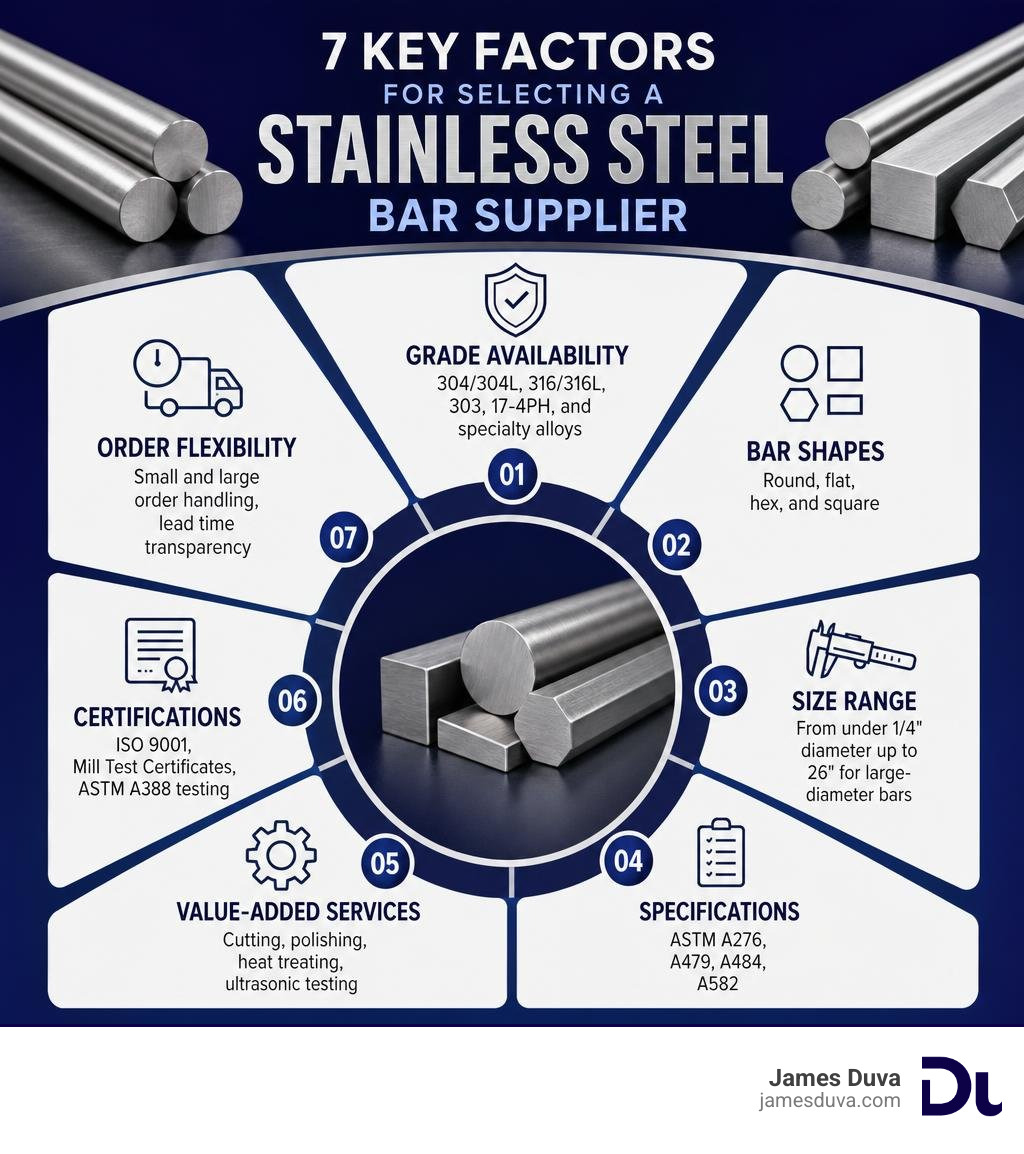
Simple guide to stainless steel bar supplier:
Why Are Alloys So Valuable in Industry?
To understand why a dependable stainless steel bar supplier is so critical, we have to look at the fundamental science of metals. Pure metals, like pure iron, are rarely used in heavy industrial applications. In their unalloyed states, pure metals are often too soft, structurally weak, or highly susceptible to environmental degradation. Iron, for instance, reacts eagerly with oxygen and moisture to form iron oxide—better known as rust—which flakes away and rapidly destroys the structural integrity of the material.
Alloying is the process of melting two or more chemical elements together to create a new material with enhanced properties. By adding elements like chromium, nickel, and molybdenum to iron, metallurgists create stainless steel, an alloy engineered for superior strength, hardness, and corrosion resistance.
In industrial settings, these alloys are invaluable. They keep critical systems running safely and efficiently across several major sectors:
- Construction: Heavy-duty structural beams, supports, and specialized concrete reinforcing bars rely on alloys to withstand massive loads while resisting atmospheric corrosion in humid or coastal areas.
- Oil & Gas: High-pressure pipelines, valves, fittings, and flanges must survive sour gas, brine, and highly corrosive hydrocarbon streams. Alloys ensure these components do not fail catastrophically under extreme stress.
- Automotive & Aerospace: High-strength frames, engine blocks, landing gear, and exhaust components require alloys that retain their physical properties at extremely high temperatures.
- Medical & Consumer Goods: Surgical implants, dental tools, and high-end kitchenware require materials that are non-reactive, easy to sterilize, and visually appealing over decades of use.
For a deeper dive into how different alloys are categorized and structured, you can read our Detailed Guide to Stainless Steel Types.
Understanding Stainless Steel Bar Grades and Properties
When you contact a stainless steel bar supplier, the first question you will face is: What grade do you need? Choosing the correct grade requires a balance between mechanical properties, corrosion resistance, and budget.
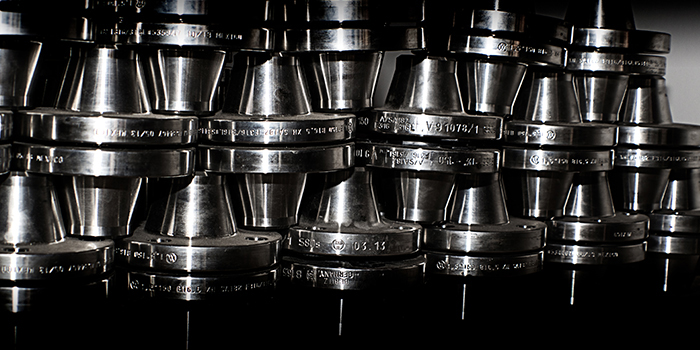
The secret behind stainless steel’s performance lies in its chemical composition. The most critical element is chromium. By law, stainless steel must contain at least 10.5% chromium. When exposed to oxygen, chromium forms an invisible, self-healing passive layer of chromium oxide on the surface of the metal, which blocks further oxygen from reaching the underlying iron.
Other alloying elements are added to fine-tune the material:
- Nickel improves ductility, toughness, and high-temperature stability.
- Molybdenum dramatically enhances resistance to localized pitting and crevice corrosion, particularly in chloride-rich environments like seawater or chemical processing units.
- Sulfur or Selenium is added to make the steel easier to cut and machine, though this slightly reduces corrosion resistance.
Let’s look at the most common grades you will find in a supplier’s inventory:
304/304L Stainless Steel
Often referred to as 18-8 (due to its composition of roughly 18% chromium and 8% nickel), 304 is the workhorse of the stainless steel world. It is highly versatile, easy to weld, and offers excellent corrosion resistance in mild environments. The “L” designation stands for low carbon (maximum 0.03%), which helps prevent carbide precipitation during welding, maintaining the material’s corrosion resistance near welded joints. For more details, see The Definitive Guide to 304 Stainless Steel Bar.
316/316L Stainless Steel
For harsher environments, 316 is the industry standard. It contains 2% to 3% molybdenum, which provides superior resistance to chlorides and industrial solvents. It is widely used in marine hardware, chemical processing plants, and pharmaceutical environments where aggressive cleaning agents are used.
303 Stainless Steel
If your project involves high-volume machining on automatic screw machines or CNC lathes, 303 is often the best choice. It is a “free-machining” grade, meaning it contains added sulfur to break up chips easily and reduce tool wear. However, the added sulfur makes it difficult to weld and slightly reduces its overall corrosion resistance.
17-4PH Stainless Steel
This is a precipitation-hardening martensitic stainless steel that offers an exceptional combination of high strength, hardness, and moderate corrosion resistance. By heat-treating 17-4PH, fabricators can achieve tensile strengths exceeding 150,000 psi. It is widely used for shafts, gears, and structural aerospace parts.
To understand how these elements alter the physical capabilities of each metal, take a look at our In-Depth Guide to Stainless Steel Alloy Properties.
Selecting Grades for Corrosion Resistance and Machinability
Choosing the right grade is always a series of trade-offs. For example, if you prioritize high machinability for complex, high-tolerance parts, you might lean toward 303 or 416. However, if those parts are going to sit on an offshore oil rig, those free-machining grades will rust quickly. In that case, you would need to step up to 316L or a duplex alloy like 2205, which require slower machining speeds and more robust tooling but will survive the salty air.
Magnetic properties also play a role. Austenitic grades (like 304 and 316) are generally non-magnetic in their annealed state, making them ideal for sensitive electronics, medical imaging rooms (like MRI suites), and aerospace instruments. Martensitic and ferritic grades (like 410, 440C, or 17-4PH) are magnetic.
Understanding these mechanical differences—such as tensile strength, yield strength, and elongation—is essential to prevent premature failure. For a comprehensive breakdown of how these alloys hold up against aggressive chemicals and environments, check out our Ultimate Guide: Stainless Steel Corrosion Resistance.
Common Shapes, Sizes, and Specifications of Bar Stock
A fully stocked stainless steel bar supplier will offer material in several primary shapes, each suited to specific manufacturing processes:
- Round Bar (or Rod): The most common shape, used extensively for machining shafts, fasteners, valves, and pins.
- Flat Bar: Rectangular in cross-section, ideal for structural supports, brackets, braces, and trim work.
- Hexagonal (Hex) Bar: Six-sided bars commonly used to manufacture nuts, bolts, and fittings because the flat sides are perfect for wrenches to grip.
- Square Bar: Four equal sides, frequently used for framework, machinery keys, and structural components.
When sourcing these products, you must specify the manufacturing standards they must meet. The most common industry specifications include:
- ASTM A276: The standard specification for stainless steel bars and shapes, covering hot-finished or cold-finished bars (excluding free-machining grades).
- ASTM A479: Covers stainless steel bars and shapes specifically for use in boilers and other pressure vessels.
- ASTM A484: Establishes the general requirements and dimensional tolerances for stainless steel bars, billets, and forgings.
- ASTM A582: The standard specification for free-machining stainless steel bars.
- ASTM B473: Covers nickel alloy bar stock for specialized high-corrosion applications.
Most suppliers stock bar products in 12-foot random lengths, though some specialized products may come in longer lengths or be custom-cut to meet specific job requirements. If you are working on a project that requires smaller, high-precision diameters, you might find our resource, The Skinny on 1/4 Inch Stainless Steel Round Bar, highly useful.
Sourcing Custom Sizes from a Stainless Steel Bar Supplier
Standard off-the-shelf sizes work for many projects, but complex industrial designs often require custom dimensions. Sourcing custom sizes can minimize material waste and eliminate the need for expensive secondary machining in your own shop.
When talking to your supplier, consider the delivery condition of the metal:
- Cold-Finished Bars: These are processed at room temperature, resulting in tight dimensional tolerances, a smooth, bright finish, and increased mechanical strength.
- Hot-Finished Bars: Rolled at high temperatures, these bars are more economical but have a rougher, scaled surface and wider dimensional tolerances. They are ideal for parts that will undergo heavy machining anyway.
- Centerless Ground / Turned & Polished: For high-speed Swiss machining, you may require centerless ground bars (such as specialty precision ground products) that offer extremely tight diameter tolerances (sometimes down to ±0.0005 inches) and a mirror-like finish.
To see what types of high-grade raw materials are available for your next production run, explore our catalog of Sourcing High-Grade Bar and Plate Products.
Choosing the Right Stainless Steel Bar Supplier
Sourcing metal is about more than just finding the lowest price per pound. A poor-quality supplier can cost you thousands of dollars in ruined tooling, delayed shipments, or—worst of all—material failures in the field.
When evaluating a stainless steel bar supplier in New Jersey or the wider Mid-Atlantic region, look for these indicators of quality:
- Quality Certifications: Ensure the supplier is certified to international quality standards, such as ISO 9001. If you are sourcing for medical applications, look for suppliers with ISO 13485 compliance.
- Traceability and Mill Test Certificates (MTCs): A reputable supplier should always be able to provide an MTC (often compliant with EN 10204 3.1) for every batch of steel they deliver. This document tracks the exact chemical composition and mechanical properties back to the original steel mill.
- Non-Destructive Testing (NDT): For critical applications, such as high-pressure gas lines or aerospace parts, bars should undergo ultrasonic testing per ASTM A388 to ensure there are no internal voids, cracks, or impurities.
For a broader look at what makes a metal distributor dependable, read The Complete Guide to Stainless Steel Suppliers. If you are sourcing locally in the Northeast, you can check regional directories like Stainless Steel in or near Northern New Jersey (NJ) on Thomasnet to find verified distributors that meet your specific requirements.
How a Stainless Steel Bar Supplier Manages Order Volumes
Every business has different procurement needs. A large manufacturing plant might need 10 tons of 316L round bar delivered every month, while a local machine shop might only need three 12-foot lengths of 17-4PH for a quick repair job.
Ask potential suppliers how they handle different order volumes:
- Minimum Order Quantities (MOQs): Some large industrial distributors have strict MOQs (sometimes as high as 3 tons per size), while others cater to smaller shops by offering no-minimum orders or flat-rate processing fees for small orders.
- Lead Times: Ask about their current inventory levels. A supplier with a deep local inventory can often offer next-day delivery or same-day will-call pickup, whereas a supplier relying on overseas mills might quote lead times of several weeks or months.
- Logistics: Do they operate their own fleet of delivery trucks, or do they rely on third-party LTL (less-than-truckload) carriers? Having a dedicated local delivery truck ensures your material arrives on time and undamaged.
You can learn more about how we streamline this supply chain for our customers by reading our guide: One-Stop Solution: Sourcing Stainless Steel and Nickel Alloy Products Made Easy.
Value-Added Services and Industrial Applications
Many modern metal service centers offer more than just raw material storage. By choosing a stainless steel bar supplier that provides value-added processing, you can receive material that is ready to go straight onto your production line.
| Value-Added Service | What It Involves | Typical Benefit |
|---|---|---|
| Production Cutting | Band sawing, abrasive cutting, or laser cutting to exact lengths | Eliminates in-house cutting, reduces scrap, and lowers shipping costs. |
| Polishing | Mechanical polishing to specific grit finishes (e.g., #4 or #8 mirror finish) | Saves time on cosmetic, architectural, or food-grade applications. |
| Heat Treating | Annealing, quenching, tempering, or age-hardening (for PH grades) | Adjusts the hardness and strength of the metal before machining. |
| Shearing & Edging | Processing flat rolled sheets into custom-width flat bars with finished edges | Provides custom-sized flat bars quickly when standard sizes aren’t in stock. |
| Ultrasonic Testing | High-frequency sound wave inspection per ASTM A388 | Guarantees the absence of internal cracks or voids in critical shafting. |
To see how these services and materials are utilized across different sectors, check out Stainless Steel Applications for Every Industry.
Critical Industries Relying on Bar Products
Stainless steel bar stock is the backbone of several major industrial sectors:
- Chemical Processing: Used to manufacture pump shafts, valve stems, and mixing paddles that must withstand constant exposure to acids, bases, and high temperatures.
- Marine Environments: Boat propeller shafts, rudder posts, and deck hardware rely on marine-grade 316L or duplex stainless steels to prevent salt-spray corrosion.
- Food & Beverage: Mixing tanks, conveyor shafts, and food processing machinery use polished 304 and 316 bars to meet strict sanitary standards and resist aggressive washdown chemicals.
- Energy & Power Generation: Heat exchangers, steam turbines, and nuclear reactor components require specialized high-strength, heat-resistant alloy bars to operate safely under immense pressure.
Frequently Asked Questions about Stainless Steel Bars
What is the difference between hot-rolled and cold-drawn stainless steel bars?
Hot-rolled bars are produced by rolling the steel at temperatures above its recrystallization point (usually over 1,700°F). This makes the steel easy to shape but leaves a dark, rough oxide scale on the surface and results in wider dimensional tolerances.
Cold-drawn bars are made by taking hot-rolled bars, cleaning them, and pulling them through a die at room temperature. This cold-working process improves the dimensional tolerances, creates a smooth, bright surface finish, and increases both the yield and tensile strength of the metal. Cold-drawn bars are preferred for high-precision machining, while hot-rolled bars are more economical for structural applications.
Is stainless steel bar stock completely rust-proof?
No metal is entirely rust-proof. While stainless steel is highly resistant to corrosion thanks to its passive chromium oxide layer, it can still rust under certain conditions.
If the passive layer is damaged by mechanical scratching, chemical attack (such as exposure to concentrated hydrochloric or sulfuric acid), or prolonged exposure to stagnant saltwater, the iron underneath will begin to oxidize. This often manifests as localized “pitting” or “crevice corrosion.” Regular cleaning, choosing the correct grade (like 316L or Duplex instead of 304 for marine environments), and proper passivation treatments can prevent this. For more interesting tidbits on this material, read our 6 Little-Known Facts About Stainless Steel.
How do I request a quote or check inventory for specific bar grades?
To get an accurate quote quickly, you should provide your supplier with:
- The exact grade (e.g., 316L, 17-4PH).
- The shape and dimensions (e.g., 2-inch diameter round bar, or 1/4″ x 2″ flat bar).
- The quantity needed (either in total feet, number of pieces, or total weight).
- The required specification (e.g., ASTM A276).
- Any value-added services needed (e.g., cut to 3-foot lengths, ultrasonic testing).
Once you submit this information through an RFQ (Request for Quote) process, your supplier will verify their current inventory and provide pricing, delivery options, and estimated lead times.
Conclusion
Sourcing the right stainless steel bar stock doesn’t have to be a headache. By understanding the differences between grades like 304, 316, and 17-4PH, and knowing what specifications your project requires, you can make smart procurement decisions that keep your operations running smoothly.
At James Duva Inc., we’ve been helping businesses navigate the complexities of specialty metals since 1978. From our headquarters in Branchburg, NJ, we stock a comprehensive inventory of high-grade stainless steel and nickel alloy products. Whether you need heavy-duty bar stock, specialized piping, or high-performance Ball Valves, we are here to serve as your reliable, long-term supply partner.
Ready to simplify your metal sourcing? Explore our One-Stop Solution: Sourcing Stainless Steel and Nickel Alloy Products Made Easy or check out our full range of Sourcing High-Grade Bar and Plate Products to find exactly what you need for your next project.
About James Duva Inc.
Since 1978, James Duva Inc. has been your trusted source for stainless steel and high-nickel alloy industrial products. Whether you’re in the water treatment, process or power industry, we pride ourselves on always having what you need. Say goodbye to your sourcing problems with just one call to James Duva.