
Unlocking the Power of 254SMO Alloy in Extreme Environments
Jul 31, 2026
What Is 254SMO Alloy and Why Does It Matter in Extreme Environments?
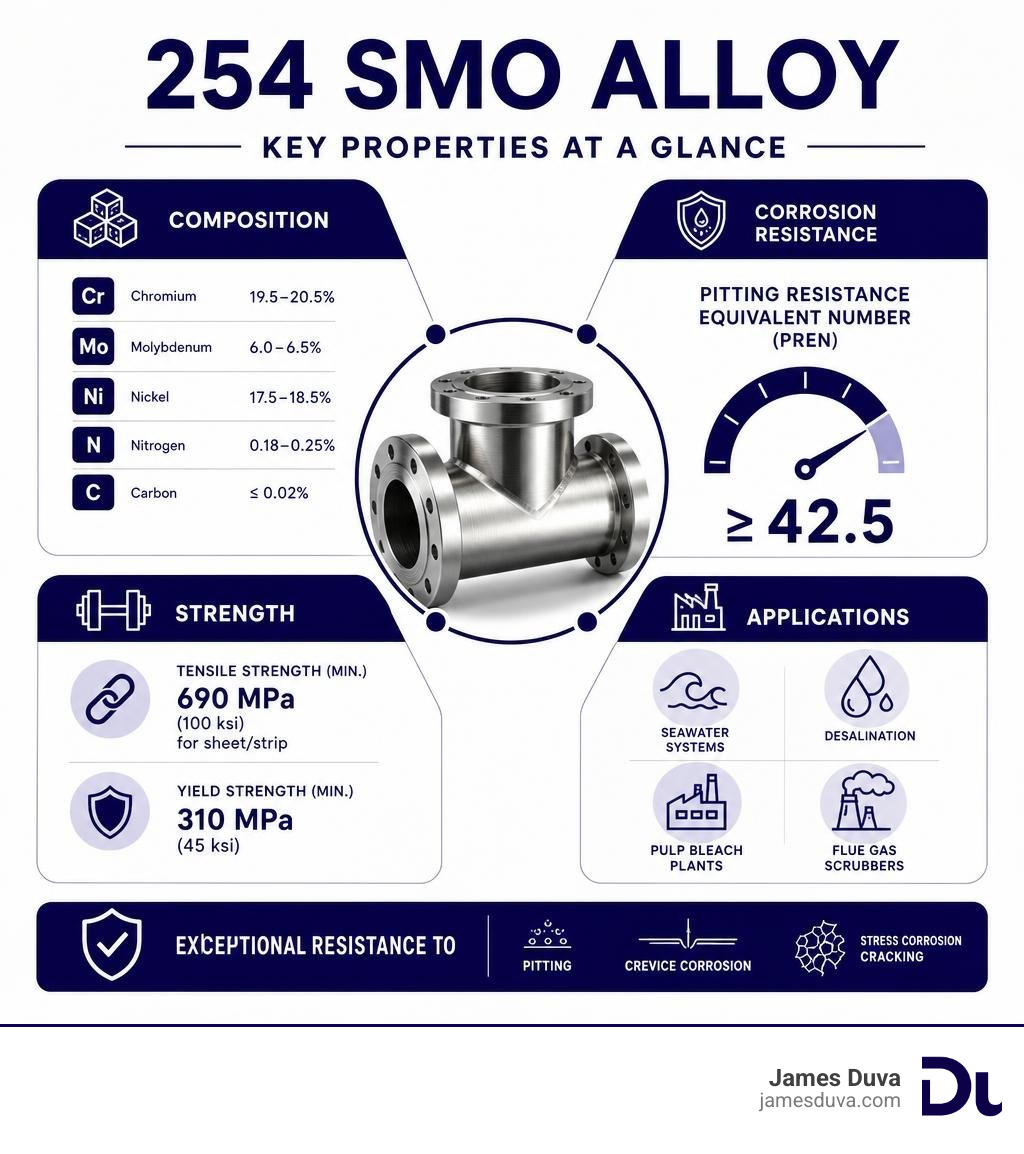
The 254SMO alloy (UNS S31254) is a super austenitic stainless steel engineered specifically for aggressive, high-chloride environments where standard grades like 316L simply fail. Here is a quick summary of what makes it stand out:
| Property | 254 SMO Value |
|---|---|
| Classification | Super austenitic stainless steel (6% Moly) |
| Chromium content | 19.5–20.5% |
| Molybdenum content | 6.0–6.5% |
| Pitting Resistance Equivalent (PREN) | ≥ 42.5 |
| Tensile strength (min.) | 690 MPa (100 ksi) for sheet/strip |
| Yield strength (min.) | 310 MPa (45 ksi) |
| Key advantage | Exceptional resistance to pitting, crevice corrosion, and stress corrosion cracking |
| Typical applications | Seawater systems, desalination, pulp bleach plants, flue gas scrubbers |
When standard 300-series stainless steels fail under chloride attack, engineers need a material that can hold up without jumping straight to expensive nickel alloys or titanium. That is exactly the gap 254 SMO fills.
It carries nearly twice the strength of conventional 300-series grades. It resists pitting, crevice corrosion, and stress corrosion cracking in environments that would quickly destroy a 316L component. And in many cases, it does this at a significantly lower cost than high-nickel alloys.
In laboratory testing, 254 SMO showed no failure or attack after 1,000 hours in boiling 25% NaCl solution at pH 1.5. By comparison, standard TP316 failed in under 150 hours under the same conditions. That kind of performance difference is what makes material selection so critical in industries like chemical processing, offshore oil and gas, and water treatment.
I’m Billy Walker, Vice President of James Duva Inc., where since 1978 we have helped engineers and procurement teams source specialty alloys — including 254SMO alloy — for the most demanding industrial piping applications. In this guide, I’ll walk you through everything you need to know to evaluate and specify 254 SMO with confidence.
Important 254smo alloy terms:
Why Are Alloys So Valuable in Industry?
Before we dive deep into the specific metallurgy of 254 SMO, it helps to take a step back and look at the bigger picture. Why do we rely so heavily on alloys in modern industry?
In their pure elemental forms, metals are often poorly suited for industrial service. Pure iron, for instance, is relatively soft, mechanically weak, and notoriously prone to rust when exposed to moisture and oxygen. To overcome these limitations, we turn to alloys. By melting and mixing different elements together, we create materials with vastly superior strength, hardness, wear resistance, and corrosion protection.
To learn more about how these elemental combinations work, check out our guide on What Is Alloy Metal and Its Many Uses. Let’s take a look at how alloys play a critical role across several major sectors:
Applications in Construction
In the construction sector, pure metals simply cannot support the massive structural loads of modern infrastructure. Steel alloys are used to fabricate high-strength structural beams, reinforcement bars, and heavy-duty industrial piping. These alloys ensure that buildings, bridges, and municipal water systems remain structurally sound and durable for decades, resisting environmental wear and atmospheric corrosion.
Applications in Oil and Gas
The oil and gas industry operates under some of the most punishing conditions on Earth. High temperatures, extreme pressures, and corrosive chemical environments require specialized materials. High-performance alloys are used to manufacture high-pressure fittings, heavy-duty flanges, and subsea pipelines. These materials maintain their mechanical integrity and prevent catastrophic leaks, protecting both the workers and the surrounding environment.
Applications in Automotive and Aerospace
For automotive and aerospace engineers, the primary challenge is balancing weight with strength. Pure metals are either too heavy or too weak. Aluminum, titanium, and advanced steel alloys allow for the construction of lightweight structural frames and high-temperature engine components. This optimization of the weight-to-strength ratio directly translates to better fuel efficiency and exceptional safety profiles under extreme flight and driving conditions.
Applications in Medical and Consumer Goods
Alloys also touch our daily lives in deeply personal ways. In the medical field, biocompatible alloys like specialized stainless steels and titanium are used for surgical implants, joint replacements, and high-precision tools. In consumer goods, corrosion-resistant alloys are the backbone of sanitary kitchenware, food processing equipment, and durable household appliances that must withstand daily washing and chemical exposure without degrading.
Understanding the Chemical Composition of 254smo alloy
What makes the 254smo alloy so uniquely capable of handling high-chloride environments? The secret lies in its precise chemical recipe.
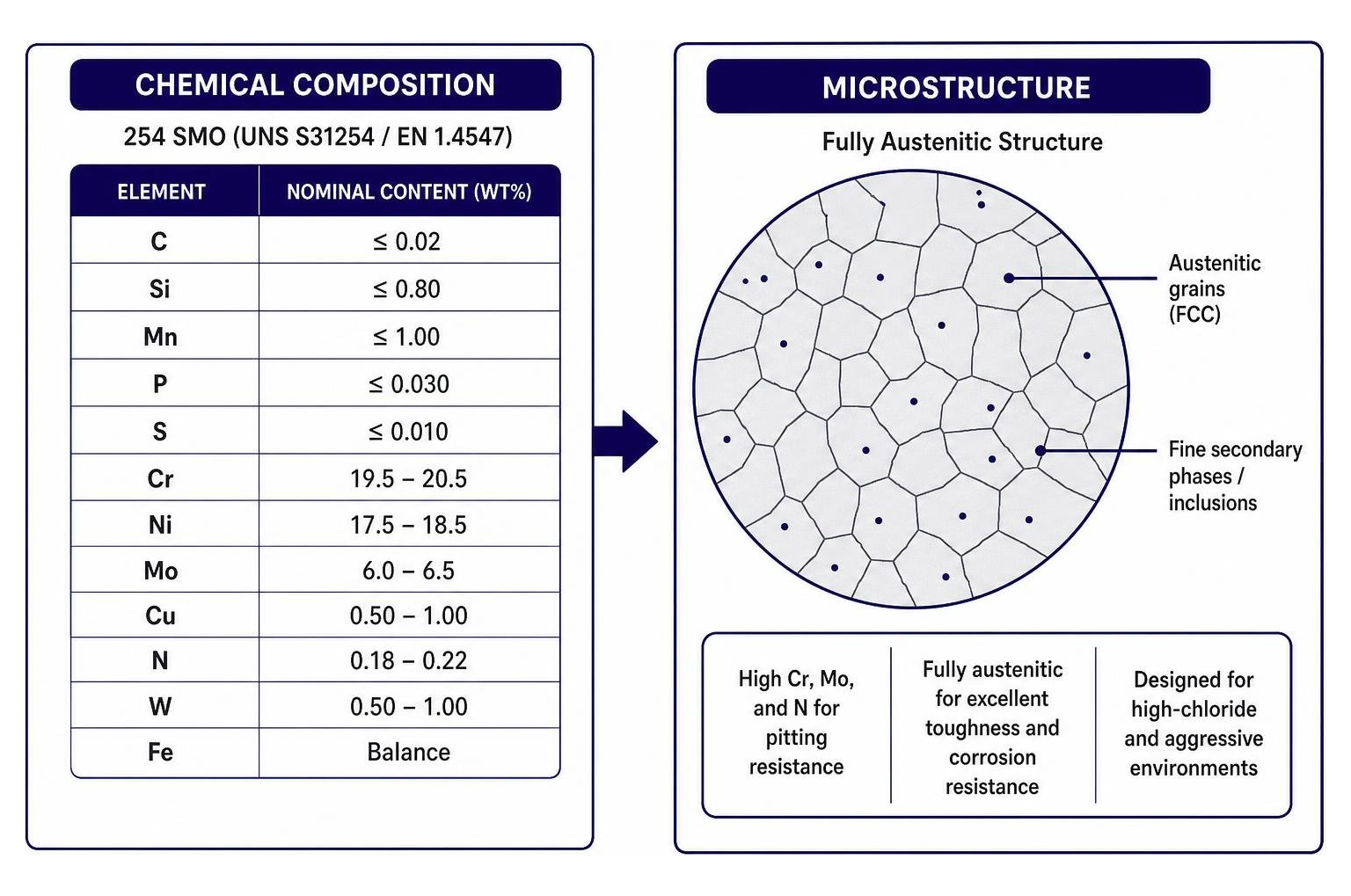
Classified under the Unified Numbering System as UNS S31254 (and as EN 1.4547 in Europe), 254 SMO is a “6% Moly” super austenitic stainless steel. For a detailed breakdown of how different elements change the characteristics of metals, take a look at our In-Depth Guide to Stainless Steel Alloy Properties.
The nominal chemical composition of 254 SMO includes:
- Chromium (Cr): 19.5% – 20.5%
- Nickel (Ni): 17.5% – 18.5%
- Molybdenum (Mo): 6.0% – 6.5%
- Nitrogen (N): 0.18% – 0.22%
- Copper (Cu): 0.5% – 1.0%
- Carbon (C): 0.02% maximum
- Sulfur (S): 1.01% maximum (nominal)
You can find more technical details on this grade’s composition on the Stainless Steel Grade 254 SMO™ (UNS S31254) page. The very low carbon content (0.02% max) is a critical design feature. It minimizes the risk of carbide precipitation at the grain boundaries during thermal processes like welding, ensuring that the material retains its corrosion resistance in the heat-affected zone.
Metallurgical Role of Nitrogen and Molybdenum in 254smo alloy
Molybdenum and nitrogen are the heavy hitters in this alloy’s chemical makeup. Molybdenum drastically increases the material’s resistance to localized pitting and crevice corrosion. Meanwhile, nitrogen acts as an interstitial strengthener, significantly boosting the alloy’s yield strength while stabilizing the austenitic microstructure.
To measure an alloy’s resistance to localized pitting in chloride environments, metallurgists use the Pitting Resistance Equivalent Number (PREN) formula:
$$text{PREN} = % text{Cr} + 3.3 times % text{Mo} + 16 times % text{N}$$
With its high levels of chromium, molybdenum, and nitrogen, 254smo alloy achieves a PREN score of ≥ 42.5 (often rated above 43). To put that in perspective, standard 316L stainless steel has a PREN of only about 23 to 25. This high PREN value translates directly to reliable, long-term protection against localized chloride attack.
Mechanical and Physical Properties of 254smo alloy
Do not let the “austenitic” label fool you; 254 SMO is incredibly tough. It offers a unique combination of high mechanical strength, excellent ductility, and superb physical stability. Below are the key mechanical and physical properties of the alloy:
- Tensile Strength: Minimum of 100 ksi (690 MPa) for sheet and strip; 95 ksi (655 MPa) minimum for plate; and a range of 655–850 MPa for wall thicknesses greater than 5 mm.
- Yield Strength (0.2% offset): Minimum of 45 ksi (310 MPa).
- Elongation: Minimum of 35% in 50 mm (with elongation at break reaching up to 50% for seamless tubing).
- Hardness: Maximum of 96 HRB (Rockwell B) or ≤ 260 Brinell for billets.
- Density: 8.0 g/cm³ (0.29 lb/in³).
- Modulus of Elasticity: 195 GPa at 20°C, which transitions to 158 GPa at high temperatures up to 500°C.
- Thermal Expansion Coefficient: 16 x 10⁻⁶/°C (from 30 to 100°C) and 17.5 x 10⁻⁶/°C (from 30 to 700°C).
- Thermal Conductivity: 10 W/m°C at 20°C, rising to 23 W/m°C at 700°C.
- Specific Heat Capacity: 485 J/kg°C at 20°C, rising to 625 J/kg°C at 700°C.
- Electrical Resistivity: 0.85 μΩm.
- Impact Strength: Retains an impressive impact strength of 60 J even at cryogenic temperatures down to -196°C, fully meeting the strict requirements of EN 13445-2 and EN 10216-5.
Corrosion Resistance in High-Chloride and Seawater Environments
Standard stainless steels like 304 and 316 are highly susceptible to stress corrosion cracking (SCC) in chloride solutions at temperatures exceeding 60°C (140°F). In contrast, 254 SMO is specifically engineered to withstand these aggressive conditions. For a broader look at how metals handle corrosive media, see our Ultimate Guide Stainless Steel Corrosion Resistance.
Performance in Seawater and Aggressive Media
In natural seawater cooling systems, ballast water piping, and offshore firefighting systems, 254 SMO performs exceptionally well. It can handle continuous exposure to warm, aerated seawater without suffering from localized crevice or pitting attacks.
It also shows high resistance in acidic, halide-rich environments, such as those found in pulp mill bleach plants handling chlorine-based bleaching agents, and flue gas desulfurization (FGD) scrubbers where highly corrosive, acidic condensates form.
Comparing 254 SMO to 316L, 904L, and Super Duplex Grades
To help you select the right material, let’s compare how 254 SMO stacks up against other common corrosion-resistant options:
| Alloy Grade | PREN | Yield Strength (MPa) | Key Limitations | Best Use Case |
|---|---|---|---|---|
| 316L | ~23-25 | ~290 | Highly prone to pitting and SCC in warm chloride environments | General piping, mild environments |
| 904L | ~34 | ~220 | Moderate resistance to crevice corrosion in seawater; lower strength | Dilute sulfuric acid handling |
| Super Duplex (e.g., 2507) | >40 | ~550 | Embrittles below -50°C and above 250°C; magnetic; complex to weld | High-strength structural piping in moderate temperatures |
| 254 SMO | ≥42.5 | ~310 | More expensive due to high nickel and molybdenum content | Extreme temperatures (cryogenic up to 400°C+), non-magnetic needs |
While super duplex grades are excellent for cost-efficient, high-strength applications, they run into metallurgical limits at extreme temperatures. Below -50°C, super duplex stainless steel loses its impact toughness, and above 250°C, it risks forming brittle intermetallic phases.
The 254smo alloy remains microstructurally stable and ductile across a much wider operating range. Furthermore, because 254 SMO is fully austenitic, it is completely non-magnetic, making it the preferred choice for specialized marine and instrumentation applications where magnetic interference must be avoided.
For more help deciding which material fits your specific system parameters, refer to our guide on Which Stainless Steel Grade Is Best for Your Project.
Industrial Applications and Key Standards
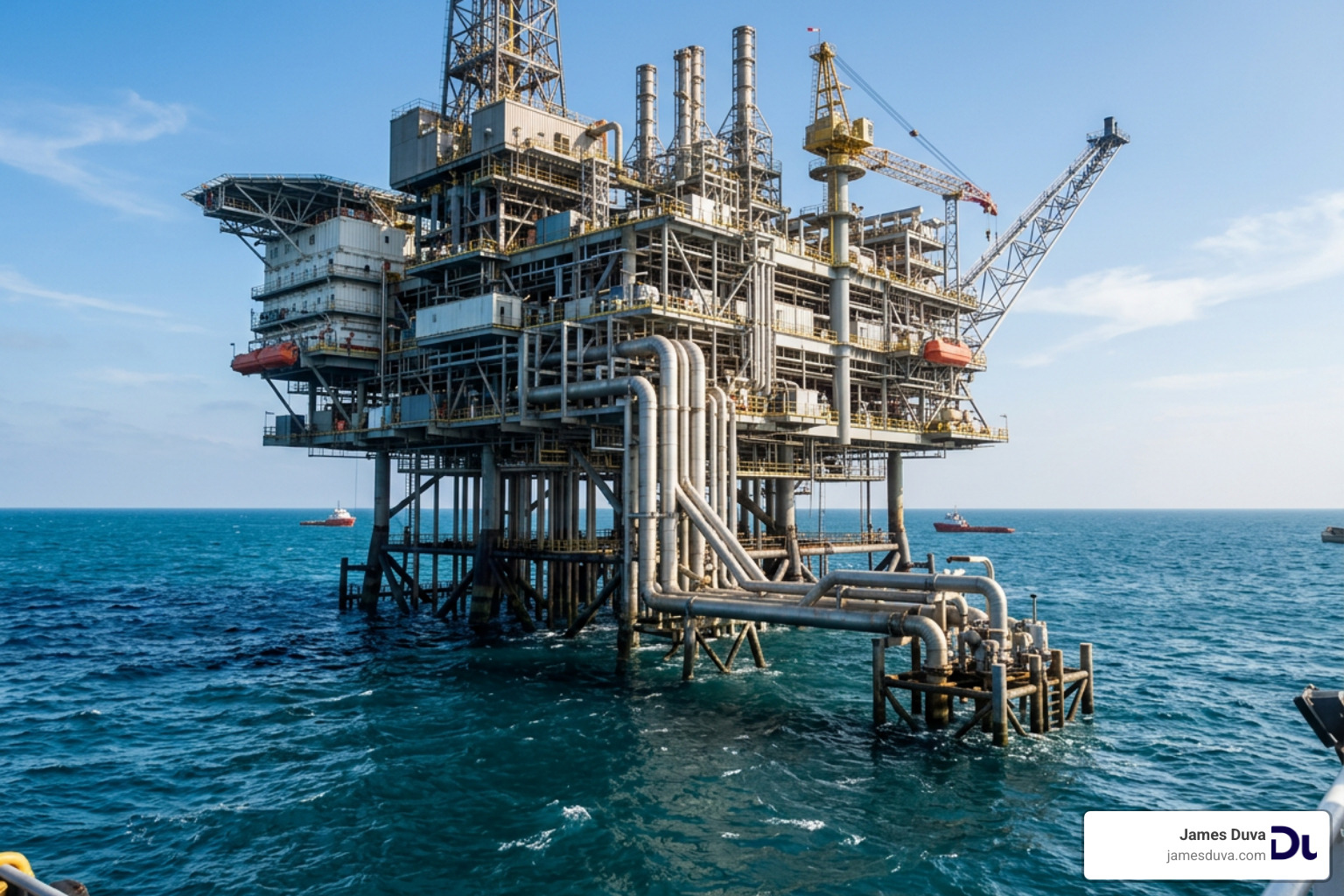
Because of its exceptional resistance to aggressive chemicals and warm seawater, 254 SMO is widely specified across several demanding industries. You can explore these diverse use cases further in our article on Stainless Steel Applications for Every Industry. Typical applications include:
- Offshore Oil and Gas: Subsea piping systems, heat exchangers, ballast water piping, and firefighting lines.
- Desalination Plants: Reverse osmosis piping, high-pressure pumps, and filtration vessels handling high-salinity brackish water and seawater.
- Pulp and Paper: Bleaching towers, drum washers, and piping exposed to corrosive chlorine dioxide and chlorine gas.
- Flue Gas Desulfurization (FGD): Scrubber linings, dampers, and piping handling acidic, sulfur-rich industrial exhaust.
- Chemical Processing: Production equipment and storage tanks handling high-halide chemical solutions and organic acids (such as tall oil distillation columns).
Key Standards and Specifications
To ensure quality and compliance in critical piping systems, 254 SMO must be sourced according to rigorous international standards. These specifications govern the dimensions, manufacturing methods, and testing procedures for various product forms:
- ASTM A312 / ASME SA312: Standard specification for seamless, welded, and heavily cold worked austenitic stainless steel pipes.
- ASTM A403 / ASME SA403: Standard specification for wrought austenitic stainless steel piping fittings.
- ASTM A182 / ASME SA182: Standard specification for forged or rolled alloy and stainless steel pipe flanges, forged fittings, and valves.
- EN 1.4547: The European material standard designation for 254 SMO.
- NACE MR0175 / ISO 15156: Governs materials for use in H2S-containing environments in oil and gas production, certifying 254 SMO for sour service.
For high-integrity flow control in these aggressive systems, we supply premium Ball Valves manufactured from specialized alloys designed to match the corrosion resistance of your 254 SMO piping.
Fabrication, Welding, and Machining Guidelines
Working with 254smo alloy requires an understanding of its metallurgical characteristics. Because it is highly alloyed, it behaves differently during fabrication than standard 304 or 316 stainless steels.
One critical hazard to keep in mind is copper contamination. Any abrasion against copper, bronze, or brass tools must be strictly avoided. If metallic copper is left on the surface of 254 SMO, it can penetrate the grain boundaries during subsequent hot working, welding, or heat treatment, causing severe cracking known as liquid metal embrittlement.
To learn more about how different fabrication processes affect super austenitic grades, read the resource on Alloy 254 Stainless Steel.
Recommended Welding Procedures and Filler Metals
While 254 SMO has good weldability, welding it without filler metal is not recommended. Autogenous welding (welding without filler) causes the alloying elements—particularly molybdenum—to segregate during cooling, leaving the weld joint with depleted regions that are highly vulnerable to localized corrosion.
- Recommended Filler Metals: Always use over-alloyed nickel-base filler metals to maintain optimal corrosion resistance in the weld zone. Excellent choices include ERNiCrMo-3 (Alloy 625) or ERNiCrMo-13 (Exaton Ni59/Ni60).
- Pre-heating: Do not pre-heat the material before welding, as this can lead to unwanted microstructural changes.
- Heat Input Control: Keep heat input low—ideally below 1.5 kJ/mm—to prevent the formation of intermetallic phases.
- Interpass Temperature: Maintain a strict interpass temperature of under 100°C (210°F).
- Welding Technique: Use a stringer bead technique. Carefully plan joint designs and welding sequences to minimize distortion, which is driven by the alloy’s low thermal conductivity and high thermal expansion rate.
Challenges and Best Practices for Machining
Machining 254 SMO can be challenging due to its rapid work hardening rate and the lack of sulfur in its composition. If your machining setup is not rigid, the tool will simply glide over the metal, work-hardening the surface and quickly ruining your cutting edge.
- Tooling: Use tough, sharp cemented carbide inserts.
- Speeds and Feeds: Use significantly slower cutting speeds—typically 55% to 60% lower than what you would use for standard 316L. Maintain positive, constant feeds to ensure the tool continuously cuts beneath the work-hardened layer.
- Lubrication: Use a generous flow of high-quality, sulfur-free cutting fluid to dissipate heat and keep the tool cool.
Heat Treatment and Solution Annealing
Because 254 SMO does not respond to thermal hardening, it can only be hardened through cold working. If the material requires stress relief or post-weld heat treatment to restore its corrosion resistance after severe forming, it must undergo a full solution anneal.
- Temperature Range: Heat the alloy to 1150°C to 1200°C (2100°F to 2190°F).
- Quenching: Follow the heating stage with a rapid water quench (or rapid air cooling for very thin-walled tubes). Slow cooling must be avoided, as exposing the alloy to temperatures between 600°C and 1000°C for prolonged periods will cause brittle intermetallic phases to precipitate at the grain boundaries.
Frequently Asked Questions about 254 SMO
Why is 254 SMO referred to as a 6% Moly grade?
It is called a “6% Moly” grade because its chemical composition contains between 6.0% and 6.5% molybdenum. This high level of molybdenum is the primary element responsible for providing outstanding protection against localized pitting and crevice corrosion in chloride-rich environments like seawater.
Can 254 SMO be hardened by heat treatment?
No. Like other austenitic stainless steels, 254 SMO cannot be hardened by heat treatment. It can only be hardened through cold working (cold reduction), which increases its strength at the expense of some ductility. Heat treatment (specifically solution annealing) is only used to soften the material and restore its corrosion resistance after intensive fabrication.
How does 254 SMO compare to AL-6XN?
Both are excellent 6% Moly super austenitic alloys, but they have minor differences in composition and engineering approvals:
- Strength: AL-6XN exhibits approximately 5% to 10% greater strength than 254 SMO.
- ASME Code Approvals: AL-6XN is ASME approved for pressure vessel design up to 800°F, whereas 254 SMO is approved up to 700°F.
- Copper Content: 254 SMO contains 0.5% to 1.0% copper (nominal 0.7%), whereas AL-6XN typically contains less than 0.1%. While copper can improve resistance to certain acids, some marine testing suggests that lower copper levels in AL-6XN can result in slightly fewer crevice corrosion sites in natural seawater under specific conditions.
Conclusion
When you are designing piping systems for aggressive, high-chloride environments, choosing the right material is the difference between decades of trouble-free service and costly, unexpected shutdowns. The 254smo alloy offers a highly reliable, cost-effective bridge between standard stainless steels and expensive nickel or titanium alloys.
At James Duva Inc., based in Branchburg, New Jersey, we have spent nearly five decades sourcing and supplying high-performance industrial piping products. Whether you need seamless pipes, custom fittings, heavy-duty flanges, or specialized understanding duplex 2205 properties for your hybrid systems, our team has the technical expertise to guide your selection.
Contact our technical sales team today to request a quote or discuss the material specifications for your next project. We are ready to help you build a system that stands the test of time.
About James Duva Inc.
Since 1978, James Duva Inc. has been your trusted source for stainless steel and high-nickel alloy industrial products. Whether you’re in the water treatment, process or power industry, we pride ourselves on always having what you need. Say goodbye to your sourcing problems with just one call to James Duva.