
Which Stainless Steel Grade is Best for Your Project?
Jun 29, 2026
Why Getting Stainless Steel Grade Selection Right Matters
Knowing how to choose stainless steel grade correctly can be the difference between a system that lasts decades and one that fails in months. With over a thousand grades available across five metallurgical families, the choice is rarely obvious — and the cost of getting it wrong is steep.
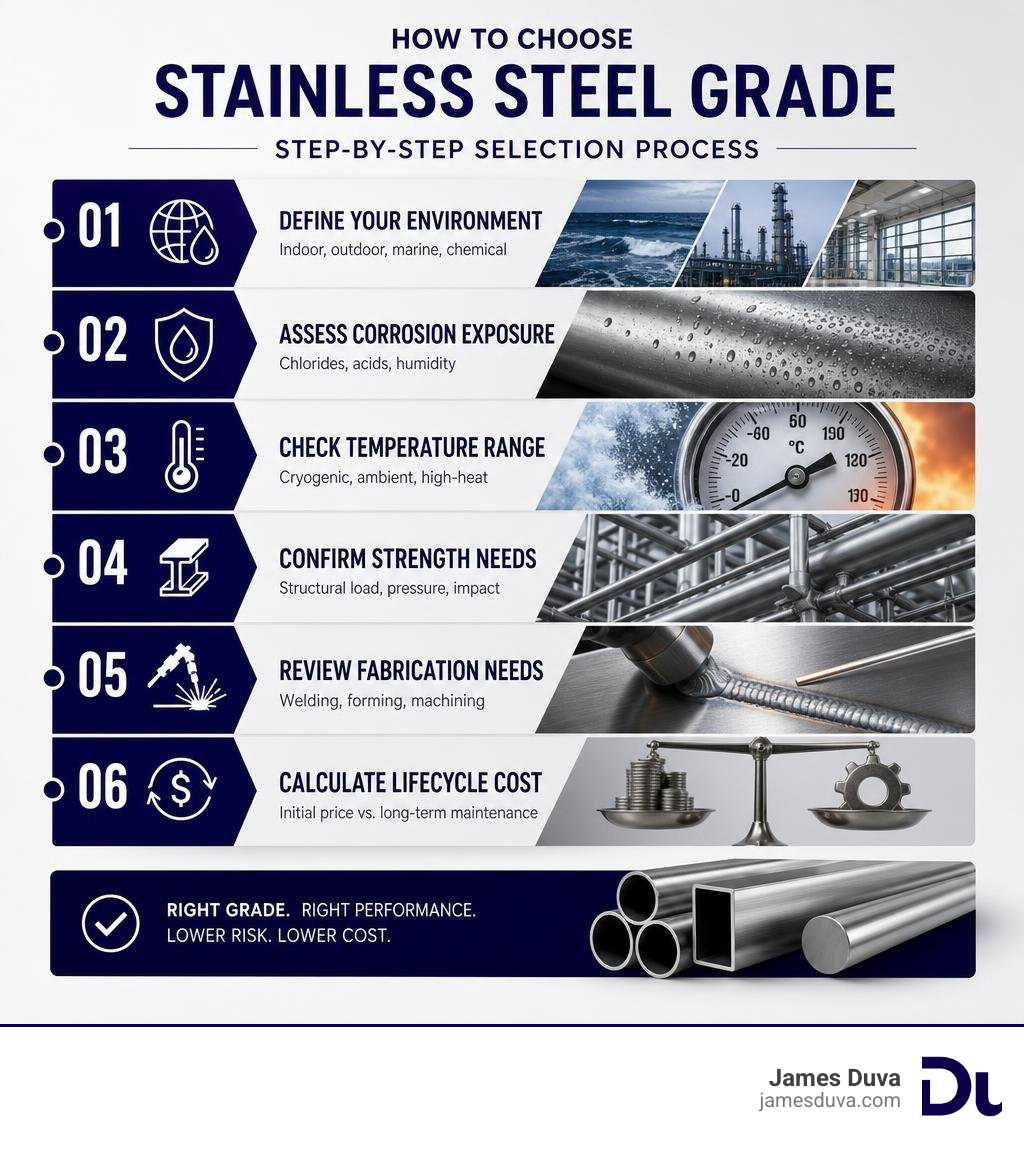
Here is a quick-reference framework for grade selection:
| Step | What to Evaluate | Common Grades |
|---|---|---|
| 1. Define your environment | Indoor, outdoor, marine, chemical | 304, 316L, 2205 |
| 2. Assess corrosion exposure | Chlorides, acids, humidity | 316L, 2205, 904L |
| 3. Check temperature range | Cryogenic, ambient, high-heat | 304L, 310S, 321 |
| 4. Confirm strength needs | Structural load, pressure, impact | 2205, 17-4 PH |
| 5. Review fabrication needs | Welding, forming, machining | 304L, 316L, 303 |
| 6. Calculate lifecycle cost | Initial price vs. long-term maintenance | Match to environment |
The stakes are real. A brine processing line running the wrong grade can fail in under a year, triggering costly shutdowns and repairs. Conversely, specifying an overly premium grade for a dry indoor application wastes 20–30% of your material budget with zero performance gain.
Stainless steel is not a one-size-fits-all material. Grade 304 — the workhorse of the industry — is perfectly suited for food equipment and general fabrication. But in a marine or chloride-bearing environment, 316L or duplex 2205 is the right call. The trick is knowing which factors drive the decision for your specific project.
I’m Billy Walker, Vice President of James Duva Inc., a specialty supplier of stainless steel and high-nickel alloy industrial products serving the power, process, and water treatment industries since 1978. Over the decades, I’ve worked directly with engineers and procurement teams navigating exactly this challenge — how to choose stainless steel grade for demanding applications where the wrong call is not an option. In this guide, I’ll walk you through the decision process step by step, so you can match the right grade to your environment, budget, and fabrication requirements with confidence.
Glossary for how to choose stainless steel grade:
Why Are Alloys So Valuable in Industry?
To understand how to select a grade, we must first look at why alloys are so valuable in industrial applications. Pure metals, such as elemental iron, are rarely suitable for heavy engineering. In their pure form, metals are often too soft, structurally weak, or highly prone to oxidation and rust when exposed to moisture and oxygen.
By strategically introducing other elements, we create alloys. Alloys combine the parent metal with precise percentages of other elements—such as chromium, nickel, molybdenum, manganese, and nitrogen—to completely transform the material’s physical and chemical properties. This alloying process yields superior tensile strength, hardness, wear resistance, and corrosion barriers that pure metals simply cannot match.
In modern industrial landscapes, these tailored alloys are the backbone of critical infrastructure:
- Construction: Large-scale structural beams, concrete reinforcement, and heavy-duty architectural piping rely on the high load-bearing capacity and atmospheric resistance of steel alloys.
- Oil & Gas: High-pressure pipelines, heavy-duty fittings, and robust flanges must withstand extreme subterranean pressures and sour gas environments without cracking or leaking.
- Automotive & Aerospace: High-strength structural frames, jet engine turbines, and exhaust systems demand alloys that maintain their mechanical integrity under extreme heat and cyclical stress.
- Medical & Consumer Goods: Surgical implants require highly biocompatible alloys that will not degrade inside the human body, while consumer kitchenware relies on food-safe, easily cleanable alloy surfaces.
Understanding these alloy fundamentals is key to appreciating the engineering behind stainless steel. For a deeper dive into the science of these metals, you can read A Comprehensive Introduction to Stainless Steel Facts and Industry Insights.

Understanding the Five Families of Stainless Steel
Stainless steel is defined by having a minimum of 10.5% chromium content. This chromium reacts with oxygen in the air to form an incredibly thin, invisible, and self-healing passive layer of chromium oxide on the surface, which blocks oxygen and moisture from reaching the iron beneath.
Beyond this basic requirement, the specific crystalline structure (or phase) of the alloy dictates its performance. Stainless steels are categorized into five distinct metallurgical families, each offering unique trade-offs in strength, magnetism, weldability, and formability.
| Metallurgical Family | Crystalline Structure | Magnetic? | Yield Strength (Typical) | Key Characteristics |
|---|---|---|---|---|
| Austenitic | FCC (Face-Centered Cubic) | No (unless cold worked) | 200 – 300 MPa | Excellent corrosion resistance, highly formable, outstanding weldability. |
| Ferritic | BCC (Body-Centered Cubic) | Yes | 240 – 350 MPa | Good stress corrosion cracking resistance, lower cost (no nickel), moderate formability. |
| Martensitic | BCT (Body-Centered Tetragonal) | Yes | 400 – 1900 MPa | High hardness, heat-treatable, lower corrosion resistance, brittle unless tempered. |
| Duplex | Mixed (Austenite + Ferrite) | Yes | 450 – 650 MPa | Double the strength of austenitic, exceptional chloride resistance, highly weldable. |
| Precipitation-Hardening | Martensitic or Austenitic base | Yes | 700 – 1380 MPa | Ultra-high strength via heat aging, excellent dimensional stability, good corrosion resistance. |
To explore these structural differences in greater depth, see our Detailed Guide to Stainless Steel Types.
Austenitic Stainless Steel (300 Series)
Austenitic stainless steels are the absolute workhorse of the global metals industry, accounting for approximately 70% of total worldwide stainless steel production. Their face-centered cubic crystal structure is stabilized by the addition of nickel. Austenitic grades are generally non-magnetic in their annealed state, though they can become slightly magnetic after undergoing cold working.
The two most common grades in this family are Type 304 and Type 316:
- Grade 304: Often referred to as “18/8” stainless steel due to its composition of roughly 18% chromium and 8% nickel. It offers excellent formability, ease of cleaning, and great resistance to atmospheric corrosion. To learn more about this versatile standard, read The Definitive Guide to 304 Stainless Steel Bar.
- Grade 316: Takes the basic composition of 304 and adds 2% to 3% molybdenum. This single addition dramatically improves the material’s resistance to pitting and crevice corrosion in chloride-rich environments, such as seawater or chemical process streams.
Ferritic and Martensitic Stainless Steel (400 Series)
The 400 series contains no nickel, which makes these grades highly cost-effective and price-stable compared to the nickel-heavy 300 series.
- Ferritic Stainless Steel (e.g., Grade 430): These steels have a body-centered cubic structure, are strongly magnetic, and offer good resistance to stress corrosion cracking. They are commonly used in indoor appliance panels, automotive trim, and mild atmospheric applications where high strength is not required.
- Martensitic Stainless Steel (e.g., Grade 410, 420, 440C): Martensitic grades feature higher carbon content, which allows them to be hardened and tempered through heat treatment. Hardened Grade 420 can provide nearly triple the tensile strength of Grade 304. This makes them ideal for surgical instruments, cutlery, aerospace gears, and wear-resistant industrial components. However, they are brittle compared to austenitic grades and are highly prone to cracking if welded without specialized pre-heating and post-weld heat treatments.
Duplex and Precipitation-Hardening Grades
When standard grades fall short on strength or specialized resistance, advanced alloys step in.
- Duplex Stainless Steel (e.g., Duplex 2205): Duplex steels feature a balanced, roughly 50/50 microscopic mix of austenitic and ferritic structures. This mixed structure allows duplex grades to deliver nearly double the yield strength of standard austenitic grades while maintaining exceptional resistance to chloride stress corrosion cracking. In large-scale piping projects, this high strength allows engineers to reduce pipe wall thickness by up to 30%, saving massive amounts of material weight and reducing overall fabrication costs.
- Precipitation-Hardening (PH) Grades (e.g., 17-4 PH): By adding elements like copper, aluminum, or niobium, these alloys can be hardened through a simple, low-temperature thermal aging process. They achieve ultra-high tensile strengths (up to 1380 MPa) while maintaining excellent dimensional tolerance during heat treatment, making them the premier choice for high-stress aerospace shafts, valve gates, and precision chemical components. To compare these high-performance options, read our In-Depth Guide to Stainless Steel Alloy Properties.
How to Choose Stainless Steel Grade for Your Environment
When determining how to choose stainless steel grade, the surrounding environment is the single most critical factor. Atmospheric moisture, chemical exposure, operating temperatures, and mechanical loads all dictate which metallurgical family is up to the task. Failing to properly analyze these parameters is the leading cause of premature material failure. For a comprehensive high-level framework on environmental matching, you can consult the British Stainless Steel Association’s guide on choosing stainless steel.
Assessing Corrosion Resistance and Chemical Exposure
Corrosion is the quiet killer of industrial systems. To select the right grade, you must identify the specific corrosive agents present in your process.

- Chloride Ions: Chlorides are incredibly aggressive toward stainless steel. In coastal environments, marine applications, or brine-processing plants, standard 304 stainless steel will rapidly develop localized pitting and crevice corrosion. For these environments, the addition of molybdenum is mandatory. Grade 316/316L is the baseline standard for marine hardware, while highly concentrated chloride streams may require Duplex 2205 or Super Duplex 2507 to prevent catastrophic failure.
- Acids and Industrial Chemicals: Highly acidic or alkaline environments demand specialized chemistries. In chemical processing plants, hot acids will quickly strip away the passive oxide layer of standard steels.
To prevent this, specialized grades like 316L, 317L, or 904L are utilized for their superior resistance to sulfuric, phosphoric, and organic acids. You can find a detailed breakdown of these corrosion mechanisms in our Ultimate Guide Stainless Steel Corrosion Resistance and explore why chemical environments demand these advanced chemistries in The Chemistry of Corrosion: Why Chemical Processing Demands 316 Stainless Steel.
Evaluating Operating Temperatures and Mechanical Strength
Temperature extremes fundamentally alter the mechanical properties and corrosion rates of metals.
- Cryogenic Temperatures (Below -196°C): In liquefied natural gas (LNG) storage and cryogenic processing, metals undergo a transition from ductile to brittle behavior, risking sudden, catastrophic shattering under impact. Austenitic grades like 304, 304LN, and 316L retain their exceptional toughness and ductility even at near-absolute zero, making them the standard choice for cryogenic piping.
- High-Temperature Environments (Above 500°C): At elevated temperatures, standard stainless steels lose their mechanical strength and undergo rapid oxidation (scaling). For continuous service in industrial furnaces, heat exchangers, and exhaust systems, specialized high-temperature grades like 310S or 309S are required. These grades feature elevated chromium and nickel contents to maintain structural integrity and resist oxidation at temperatures up to 1100°C. For more on high-heat selection, see Why 310 Stainless Steel is the Coolest Choice for the Hottest Jobs.
- Mechanical Load and Yield Strength: If your project involves high structural loads or high-pressure containment, mechanical properties like yield strength and tensile strength become the deciding factor. While standard austenitic 316L has a yield strength of around 290 MPa, Duplex 2205 offers a yield strength of 450 MPa or higher. This allows engineers to design thinner, lighter structures without sacrificing safety.
For a detailed look at balancing these mechanical and thermal factors, review Industrial Metal Supply’s guide on choosing stainless steel grades and Wasatch Steel’s basics on choosing stainless steel.
Key Factors in the Selection Process
Selecting the perfect stainless steel grade requires balancing raw environmental performance against practical fabrication constraints, material availability, and long-term economics. For a detailed guide on navigating these variables in industrial systems, read How to Select the Right Stainless Steel Grade for Chemical Processing Plants.
Balancing Fabrication Requirements and Weldability
A grade can have outstanding corrosion resistance, but if it cannot be formed, machined, or welded into the final product, it is useless for your project.
- Formability: Austenitic grades (304, 316) offer unmatched formability. They can undergo severe deep drawing and stretch forming (such as forming kitchen sinks or complex vessel heads) without cracking. Ferritic grades (430) are moderately formable, while duplex and martensitic grades are highly resistant to deformation and difficult to cold-form.
- Machinability: Standard stainless steels tend to work-harden rapidly, making machining difficult and wearing out tooling. If your project requires extensive machining (such as producing thousands of precision screws, fasteners, or valve stems), free-machining grades like Type 303 (austenitic) or Type 416 (martensitic) are preferred. These grades contain added sulfur or selenium to act as chip breakers, though this addition does slightly reduce their weldability and corrosion resistance.
- Weldability and the “L” Grades: When standard austenitic stainless steel is welded, the intense heat of the welding arc causes carbon to bind with chromium at the grain boundaries—a phenomenon known as carbide precipitation or sensitization. This leaves the areas immediately adjacent to the weld depleted of chromium, making them highly susceptible to rapid intergranular corrosion.
To prevent this, low-carbon variants designated with an “L” (such as 304L and 316L, which restrict carbon to a maximum of 0.03%) must be specified for any welded structures. Alternatively, stabilized grades like 321 (stabilized with titanium) or 347 (stabilized with niobium) can be used. For a direct comparison of these low-carbon options, read our Detailed Guide to 316L vs 316 Stainless Steel.
Analyzing Lifecycle Cost and Avoiding Over-Specification
A common pitfall in material procurement is looking only at the upfront cost of the raw metal. To make a smart business decision, you must evaluate the total lifecycle cost of the installation.
- The Over-Specification Trap: It is easy to assume that “more alloy is always better.” However, using 316L for a dry, indoor architectural handrail instead of 304 is a waste of capital. Grade 316L is typically 20% to 30% more expensive than 304 due to its molybdenum content. In a non-corrosive indoor environment, both grades will perform identically for decades.
- The Under-Specification Trap: Conversely, trying to save 15% upfront by choosing 304 over 316L for a coastal installation or a chemical process line is a recipe for financial disaster. The minor savings in initial material costs will be completely wiped out by premature system failure, emergency maintenance, unscheduled downtime, and the eventual cost of a complete replacement.
- The Duplex Advantage: In large-scale piping and pressure vessel fabrication, choosing a premium grade like Duplex 2205 over 316L can actually reduce the total project cost. Because duplex is twice as strong, the wall thickness of the pipes and vessels can be significantly reduced. This not only reduces the raw weight of the metal purchased but also slashes shipping costs, structural support requirements, and the total hours of welding labor required.
For further reading on balancing these economic and physical trade-offs, consult Thomasnet’s 5 factors to consider when selecting a grade of stainless steel.
Frequently Asked Questions on How to Choose Stainless Steel Grade
What is the most common mistake when learning how to choose stainless steel grade?
The most common mistake is failing to analyze the specific operating environment and defaulting to either the cheapest available grade (under-specification) or the most well-known premium grade (over-specification).
Many buyers assume that “stainless steel never rusts” and purchase low-cost 304 or 430 for environments with high humidity, salt, or chemical exposure, leading to rapid pitting and structural failure. On the flip side, procurement teams frequently specify 316L for clean, dry, indoor applications where 304 or even ferritic 430 would deliver identical service lives at a fraction of the cost.
How to choose stainless steel grade for marine or high-chloride environments?
For any marine or high-chloride environment, you must select a grade that contains molybdenum. Molybdenum significantly enhances the pitting resistance equivalent number (PREN) of the alloy.
Grade 316/316L is the standard baseline for marine hardware and coastal structures. For highly aggressive chloride environments—such as warm, stagnant seawater, desalination systems, or offshore oil platforms—you should upgrade to Duplex 2205 or Super Duplex 2507. These duplex grades provide exceptional resistance to both pitting and chloride-induced stress corrosion cracking.
Which stainless steel grades offer the best weldability?
Austenitic stainless steels, specifically the low-carbon “L” versions such as 304L and 316L, offer the best weldability of all the families. Their low carbon content (maximum 0.03%) prevents carbide precipitation during welding, ensuring the weld joints retain their full corrosion resistance without requiring post-weld heat treatment.
While ferritic grades can be welded in thin sections, martensitic grades are highly susceptible to cold cracking and generally require complex pre-heating and post-weld thermal stress relief.
Conclusion
Selecting the right stainless steel grade is a precise science that directly impacts the safety, longevity, and profitability of your operations. By systematically evaluating your service environment, chemical exposure, operating temperatures, mechanical loads, fabrication constraints, and total lifecycle costs, you can make an informed decision that maximizes performance while keeping your project on budget.
At James Duva Inc., based in Branchburg, NJ, we have been helping companies solve complex material challenges since 1978. Whether you are sourcing heavy-duty industrial piping, high-pressure fittings, specialized flanges, or high-performance Ball Valves for chemical processing, oil & gas, or water treatment systems, our experienced team is here to guide you. We maintain a deep inventory of high-grade stainless steels and nickel alloys to ensure your project gets the exact specifications it needs, delivered on time.
Ready to secure the perfect materials for your next project? Contact us at James Duva Inc. today to discuss your specifications and request a tailored quote.
About James Duva Inc.
Since 1978, James Duva Inc. has been your trusted source for stainless steel and high-nickel alloy industrial products. Whether you’re in the water treatment, process or power industry, we pride ourselves on always having what you need. Say goodbye to your sourcing problems with just one call to James Duva.