
In Depth Guide to Stainless Steel Corrosion Resistance

Jun 24, 2026
What Is Stainless Steel Corrosion Resistance — and Why Does It Matter?
Stainless steel corrosion resistance is the ability of stainless steel to withstand rust, oxidation, and chemical attack — primarily because of a thin, self-healing chromium oxide layer that forms on its surface when chromium content reaches at least 10.5%.
Here is a quick summary of what you need to know:
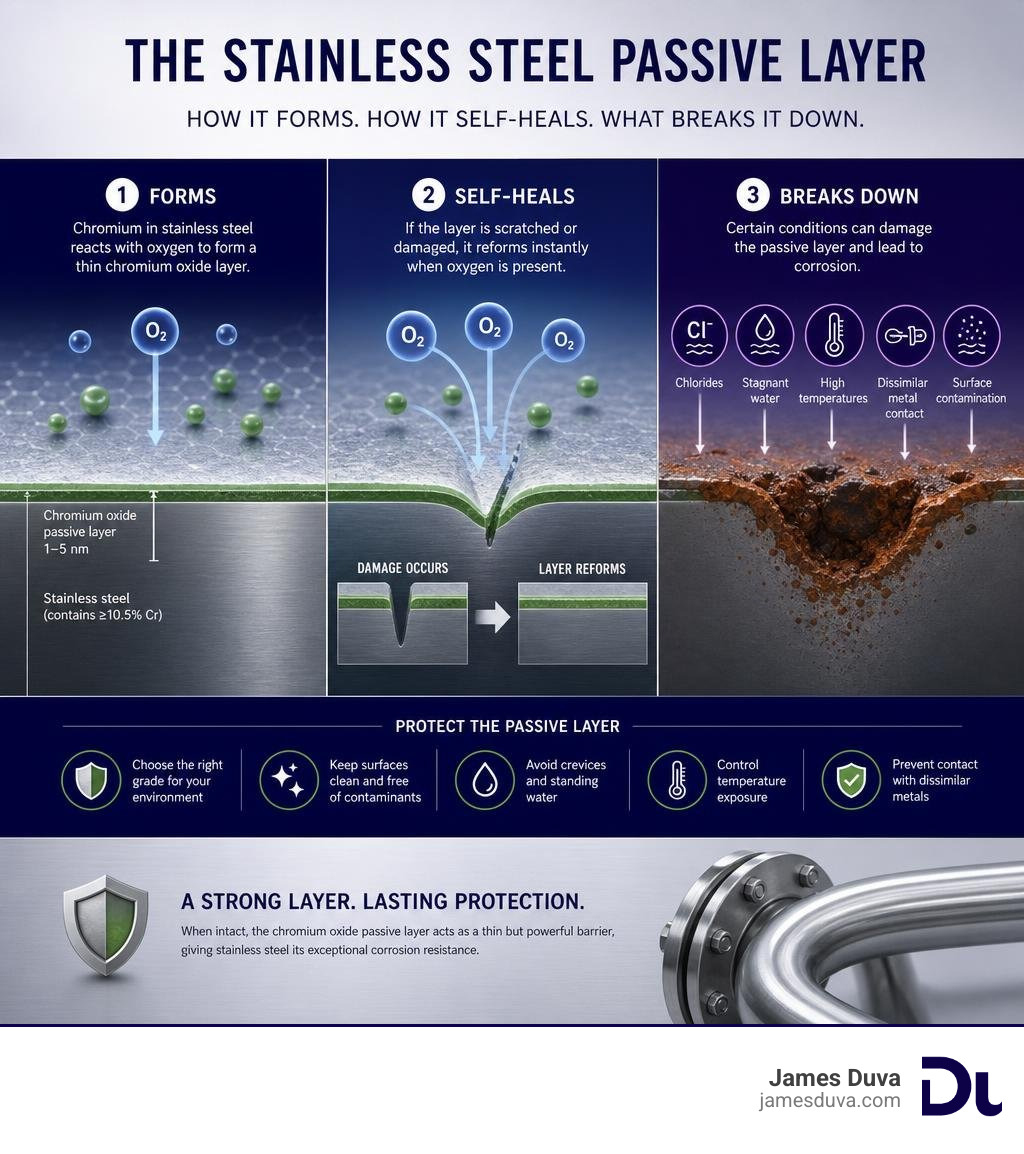
- What protects it: A passive chromium oxide film, just 1–5 nanometres thick, that forms automatically when stainless steel is exposed to oxygen
- What can break it down: Chlorides, stagnant water, high temperatures, dissimilar metal contact, and surface contamination
- Key factor: Higher chromium, molybdenum, and nitrogen content = stronger corrosion resistance
- Does it rust? Yes — stainless steel can rust if the passive film is damaged and not allowed to reform
- How to protect it: Choose the right grade for your environment, maintain clean surfaces, and design to avoid crevices and standing water
Despite the name, stainless steel is stainless — not stain-free. Given the right (or wrong) conditions, it will corrode. Understanding why, and how to prevent it, is critical for anyone specifying materials in demanding industrial environments.
I’m Billy Walker, Vice President of James Duva Inc., where I’ve spent years helping engineers and procurement professionals in the power, process, and water treatment industries source the right stainless steel and high-nickel alloy products for environments where stainless steel corrosion resistance is non-negotiable. In this guide, I’ll break down the science, the failure modes, and the practical steps that make the difference between a material that lasts decades and one that fails prematurely.
The Science Behind Stainless Steel Corrosion Resistance
To understand why stainless steel behaves differently from standard carbon steel, we have to look at the atomic level. Carbon steel reacts with oxygen and moisture to form iron oxide (rust). Iron oxide is flaky, porous, and lacks structural integrity. As it flakes away, it exposes fresh iron underneath to further oxidation, leading to continuous deterioration.
Stainless steel contains a minimum of 10.5% chromium. When exposed to oxygen, this chromium reacts to form a microscopic, highly adherent, and chemically stable layer of chromium-rich oxide and hydroxide on the surface. This is known as the passive film, and it is incredibly thin—typically between 1 and 5 nanometres. To put that in perspective, a single sheet of paper is about 100,000 nanometres thick.
Despite its microscopic scale, this passive film acts as an impermeable barrier that renders the underlying metal electrochemically passive in corrosive environments. More importantly, the film is self-healing. If the surface is scratched or mechanically damaged, the exposed chromium will rapidly react with oxygen in the surrounding air or water to reform the protective layer.
However, this self-healing mechanism relies entirely on the presence of oxygen. If the steel is placed in an oxygen-starved environment—such as under a tight gasket, beneath heavy biofouling, or in stagnant water—the passive film cannot repair itself once broken. This transition from a “passive” state to an “active” state is where corrosion begins.
For a deeper dive into how different alloying elements interact at a molecular level, you can read our In-Depth Guide to Stainless Steel Alloy Properties. To understand the baseline mechanisms of passivation and how environmental factors alter this chemistry, you can consult the Technical Library: Principles of Corrosion Mechanisms (page 1) – British Stainless Steel Association as well as Outokumpu’s foundational resource on What makes stainless steel corrosion resistant? | Outokumpu .
Why Are Alloys So Valuable in Industry?
In industrial applications, pure metals are rarely up to the task. Pure iron, for instance, is relatively soft, mechanically weak, and highly prone to rusting when exposed to normal atmospheric moisture. To overcome these inherent limitations, metallurgists create alloys—mixtures of a base metal with other elements designed to optimize mechanical strength, thermal stability, and corrosion performance.
Alloying allows us to engineer materials that can survive the harshest environments on Earth. By adding elements like chromium, nickel, molybdenum, and nitrogen to iron, we transform a weak, rust-prone metal into a highly durable material capable of handling extreme pressures, temperatures, and chemical exposures.

These engineered alloys find critical applications across virtually every major industry:
- Construction: Structural beams, support columns, and heavy-duty piping systems rely on alloys to ensure long-term structural integrity without the risk of catastrophic failure from rust or environmental degradation.
- Oil & Gas: Downhole tubing, fittings, flanges, and valves must withstand highly sour environments containing hydrogen sulfide, carbon dioxide, and high concentrations of chlorides. Specialized alloys ensure these components do not suffer from sudden, catastrophic cracking.
- Automotive & Aerospace: High-strength structural frames, exhaust systems, and jet engine turbine blades require alloys that maintain their mechanical properties and resist oxidation at extreme operating temperatures.
- Medical & Consumer Goods: From biocompatible orthopedic implants and surgical instruments to hygienic kitchenware and food processing machinery, alloys provide the cleanability and inertness necessary to prevent contamination and resist aggressive cleaning agents.
Choosing the right alloy is a balance of mechanical requirements, environmental conditions, and budget. For a broader look at how different metals stack up when facing extreme conditions, explore our guide on Metals That Can Take the Heat and the Rust: A Comprehensive Guide.
Types of Corrosion That Affect Stainless Steel
While stainless steel is highly resistant to uniform corrosion—where the entire surface of the metal eats away at a predictable rate—it is highly susceptible to localized corrosion. Localized corrosion is far more dangerous because it concentrates material loss in specific, often hidden areas, leading to sudden failures while the bulk of the structure looks perfectly fine.
We generally divide these degradation mechanisms into wet corrosion (occurring in aqueous environments or atmospheric moisture) and high-temperature corrosion (occurring in dry, hot gases).

To select the correct material for your specific industrial environment, it helps to understand the different ways these metals can be classified. You can read more in our Detailed Guide to Stainless Steel Types.
How Pitting and Crevice Attack Compromise Stainless Steel Corrosion Resistance
Pitting and crevice corrosion are closely related phenomena, both typically triggered by halogen ions—most commonly chlorides, which are abundant in seawater, coastal atmospheres, wastewater, and industrial process streams.
Pitting corrosion occurs when the passive film experiences localized breakdown. This is common in environments where chloride ions penetrate the microscopic weak spots in the oxide layer. Once a pit initiates, the chemistry inside the pit becomes highly acidic and depleted of oxygen. The pit acts as an anode, while the surrounding passive surface acts as a massive cathode. This extreme area ratio accelerates the corrosion rate inside the pit, causing it to tunnel rapidly into the metal.
Crevice corrosion occurs in shielded, confined spaces where oxygen cannot easily circulate—such as under washers, gaskets, bolt heads, thread joints, or accumulated surface deposits. Over time, the stagnant liquid inside the crevice becomes depleted of oxygen, preventing the passive film from repairing itself. As chloride ions migrate into the crevice to balance the chemical charge, the environment becomes highly acidic, rapidly dissolving the metal.
To quantify and compare how well different stainless steel grades resist pitting and crevice attack, metallurgists use the Pitting Resistance Equivalent Number (PREN). The standard formula is:
$$PREN = %Cr + 3.3 cdot %Mo + 16 cdot %N$$
A higher PREN indicates superior resistance to localized chloride attack. For example, standard 304 stainless steel has a PREN of around 18 to 20, whereas 316 stainless steel, with its molybdenum addition, achieves a PREN of 23 to 28. For extreme environments, duplex and super-austenitic grades can reach PREN values over 40.
For a detailed look at how the widely used 316 grade performs under these conditions, see our 316 Stainless Steel Corrosion Resistance In-Depth Guide to Performance.
Stress Corrosion Cracking and Its Impact on Stainless Steel Corrosion Resistance
Stress Corrosion Cracking (SCC) is one of the most insidious failure modes in industrial piping and vessel systems. It occurs when three specific conditions are met simultaneously:
- A susceptible material (such as standard 300-series austenitic stainless steels)
- Exposure to a corrosive environment (typically containing chlorides)
- Tensile stress (either applied service stress or residual stress from welding or cold forming)
SCC is highly temperature-dependent, rarely occurring in standard austenitic steels below 50 °C, though high-risk environments like indoor swimming pool ceilings or insulated hot piping can experience failures at lower temperatures due to chloride concentration via evaporation. The corrosion begins as minor pitting, but under tensile stress, cracks propagate rapidly through the grain boundaries, leading to sudden, catastrophic structural failure without warning.
To mitigate SCC, engineers often turn to duplex stainless steels, which feature a mixed microstructure of austenite and ferrite. For a comparative analysis of how duplex alloys handle these stresses, check out Duplex 2205 vs Other Stainless Steels: A Comparative Analysis.
Intergranular and Galvanic Corrosion
Intergranular corrosion occurs when stainless steel is subjected to high temperatures—specifically in the “sensitization” range of 425 °C to 870 °C. This temperature window is commonly reached during welding or improper heat treatment. At these temperatures, carbon atoms within the steel diffuse to the grain boundaries, where they react with chromium to form chromium carbides. This process depletes the areas immediately adjacent to the grain boundaries of free chromium, dropping the local chromium content below the 10.5% threshold needed for passivation. When exposed to a corrosive medium, the grain boundaries dissolve rapidly, causing the metal to lose its structural integrity and take on a “sugared” appearance.
To prevent sensitization, modern steelmaking utilizes the Argon Oxygen Decarburization (AOD) process to produce low-carbon “L” grades (such as 304L or 316L, which limit carbon to less than 0.03%). Alternatively, stabilized grades like 321 (stabilized with titanium) or 347 (stabilized with niobium) are used, as these elements have a higher affinity for carbon than chromium does, preventing chromium depletion.
Galvanic corrosion occurs when two dissimilar metals are in electrical contact within a conductive electrolyte (such as water). The less noble metal (the anode) corrodes much faster than it would on its own, while the more noble metal (the cathode) is protected. For example, if carbon steel bolts are used to secure a stainless steel plate in a marine environment, the carbon steel bolts will corrode at an extremely accelerated rate.
Preventing galvanic corrosion requires proper design practices, such as using electrical insulation (non-conductive gaskets and sleeves) between dissimilar metals, or ensuring that the anode has a much larger surface area than the cathode.
Comparing Stainless Steel Grades and Their Performance
Stainless steels are classified into five metallurgical families based on their crystalline structure, which is determined by their chemical composition. Each family offers a unique balance of stainless steel corrosion resistance, mechanical strength, and fabricability.
- Austenitic: Representing about two-thirds of global production, these grades (e.g., 304, 316) contain high levels of nickel and chromium. They are non-magnetic, highly ductile, excellent at cryogenic temperatures, and offer excellent general corrosion resistance.
- Ferritic: These are straight-chromium alloys (e.g., 430) with low carbon content. They are magnetic, offer moderate corrosion resistance, and are highly resistant to stress corrosion cracking, though they have lower ductility and toughness.
- Duplex: Combining roughly equal parts austenite and ferrite, duplex grades (e.g., 2205) offer twice the yield strength of austenitic grades, outstanding resistance to stress corrosion cracking, and excellent pitting resistance.
- Martensitic: High-carbon, chromium alloys (e.g., 410) that can be heat-treated to high hardness and strength. However, their corrosion resistance is lower than that of austenitic and ferritic grades.
- Precipitation Hardening (PH): These alloys (e.g., 17-4 PH) contain additions of copper, aluminum, or niobium that allow them to be strengthened through low-temperature aging. They offer a combination of high strength and corrosion resistance comparable to 304.
To help you select the right grade for your facility, we have summarized the relative performance and typical chemistry of common industrial grades below:
| Grade | Family | Typical Composition | PREN | Relative Corrosion Resistance | Primary Applications |
|---|---|---|---|---|---|
| 304 | Austenitic | 18% Cr, 8% Ni | ~19 | Moderate | Food processing, architectural, domestic water |
| 316 | Austenitic | 16% Cr, 10% Ni, 2% Mo | ~25 | High | Marine environments, chemical processing, pharmaceutical |
| 2205 | Duplex | 22% Cr, 5% Ni, 3% Mo, 0.18% N | ~35 | Very High | Oil & gas, chemical tankers, pulp and paper digesters |
| 430 | Ferritic | 16% Cr | ~16 | Low-Moderate | Kitchen appliances, automotive trim, mild indoor environments |
| 17-4 PH | Precipitation Hardening | 17% Cr, 4% Ni, 4% Cu | ~17 | Moderate | Valve shafts, aerospace components, high-strength fasteners |
When specifying materials for highly aggressive chemical environments, making the wrong choice can lead to costly downtime. For detailed guidance, consult our resource on How to Select the Right Stainless Steel Grade for Chemical Processing Plants.
Best Practices for Preventing Rust and Corrosion
Achieving long-term stainless steel corrosion resistance requires attention at three distinct stages: design, fabrication, and maintenance.
1. Design Optimization
- Avoid Crevices: Design joints, gaskets, and supports to minimize tight spaces where stagnant water can accumulate.
- Ensure Complete Drainage: Vessels and piping systems should be designed with sloped bottoms and low-point drains to prevent stagnant pooling.
- Manage Flow Velocities: Extremely low velocities can lead to sediment deposition, initiating crevice corrosion. Conversely, excessively high velocities can cause erosion-corrosion. Maintain moderate, consistent flow.
2. Fabrication Hygiene
- Prevent Carbon Steel Contamination: Never use grinding wheels, wire brushes, or handling equipment on stainless steel that have previously been used on carbon steel. Embedded iron particles will rust rapidly, disrupting the passive film and initiating pitting.
- Remove Weld Oxides: Welding produces a high-temperature oxide scale (heat tint) that is depleted of chromium. This scale must be removed through mechanical grinding, pickling (using nitric and hydrofluoric acid mixtures), or electropolishing to restore full corrosion resistance.
- Post-Fabrication Passivation: Treat fabricated parts with a nitric or citric acid bath (in accordance with ASTM A380 or A967 standards) to dissolve free iron contaminants and accelerate the formation of a clean, uniform passive film.
3. Regular Maintenance
- Keep Surfaces Clean: Periodically wash stainless steel surfaces to remove accumulated salts, industrial pollutants, and debris. This is especially important in coastal regions or harsh industrial settings.
- Avoid Aggressive Chemicals: Never use hydrochloric acid or bleach (sodium hypochlorite) on stainless steel, as these chemicals break down the passive film and cause rapid pitting.
For deeper technical recommendations on handling, storage, and fabrication of these alloys, you can review the comprehensive Handbook of Stainless Steel . If you are looking for local fabrication resources or supply chain partners, directories such as New Jersey Stainless Steel Manufacturers – IQS Directory and Stainless Steel Manufacturers and Suppliers Serving New Jersey provide valuable regional insights, while Stainless Steel Fabrication in New Jersey outlines high-standard fabrication practices.
Frequently Asked Questions about Stainless Steel
Does stainless steel rust under normal conditions?
Under clean, well-oxygenated conditions, high-quality stainless steel will not rust. However, it can rust if the surface is contaminated with carbon steel particles, exposed to high concentrations of chlorides (such as marine spray or road salt), or placed in stagnant, oxygen-depleted water where the passive film cannot reform.
What is the minimum chromium content required for stainless steel?
To be classified as stainless steel, the iron-based alloy must contain a minimum of 10.5% chromium. This is the threshold level required to form a continuous, stable, and self-healing chromium oxide passive film on the surface when exposed to oxygen.
How does temperature affect stainless steel corrosion?
Temperature plays a dual role. In aqueous environments, higher temperatures accelerate chemical reaction rates, lowering the threshold for pitting, crevice corrosion, and stress corrosion cracking. In dry environments, elevated temperatures can lead to sensitization (between 425 °C and 870 °C) or cause high-temperature oxidation and scaling if the alloy’s maximum service temperature is exceeded.
Conclusion
At James Duva Inc., we have spent nearly five decades helping industrial operators navigate the complexities of material selection. From our warehouse in Branchburg, NJ, we stock a comprehensive inventory of high-grade stainless steel and nickel alloy pipes, fittings, flanges, and Ball Valves.
Whether you are designing a new chemical processing line, upgrading a wastewater treatment plant, or sourcing replacement parts for an offshore platform, choosing the right grade is the single most important factor in preventing premature failure.
Ready to discuss the material requirements for your next project? Explore our full range of stainless steel products or contact our experienced team in New Jersey today to secure the high-performance alloys your operations demand.
About James Duva Inc.
Since 1978, James Duva Inc. has been your trusted source for stainless steel and high-nickel alloy industrial products. Whether you’re in the water treatment, process or power industry, we pride ourselves on always having what you need. Say goodbye to your sourcing problems with just one call to James Duva.