
Sizing Stainless Steel Piping: An Engineer’s Quick Reference Field Guide
Oct 29, 2026
Stainless Steel Pipe Sizes: Start With the Outside Diameter and Schedule
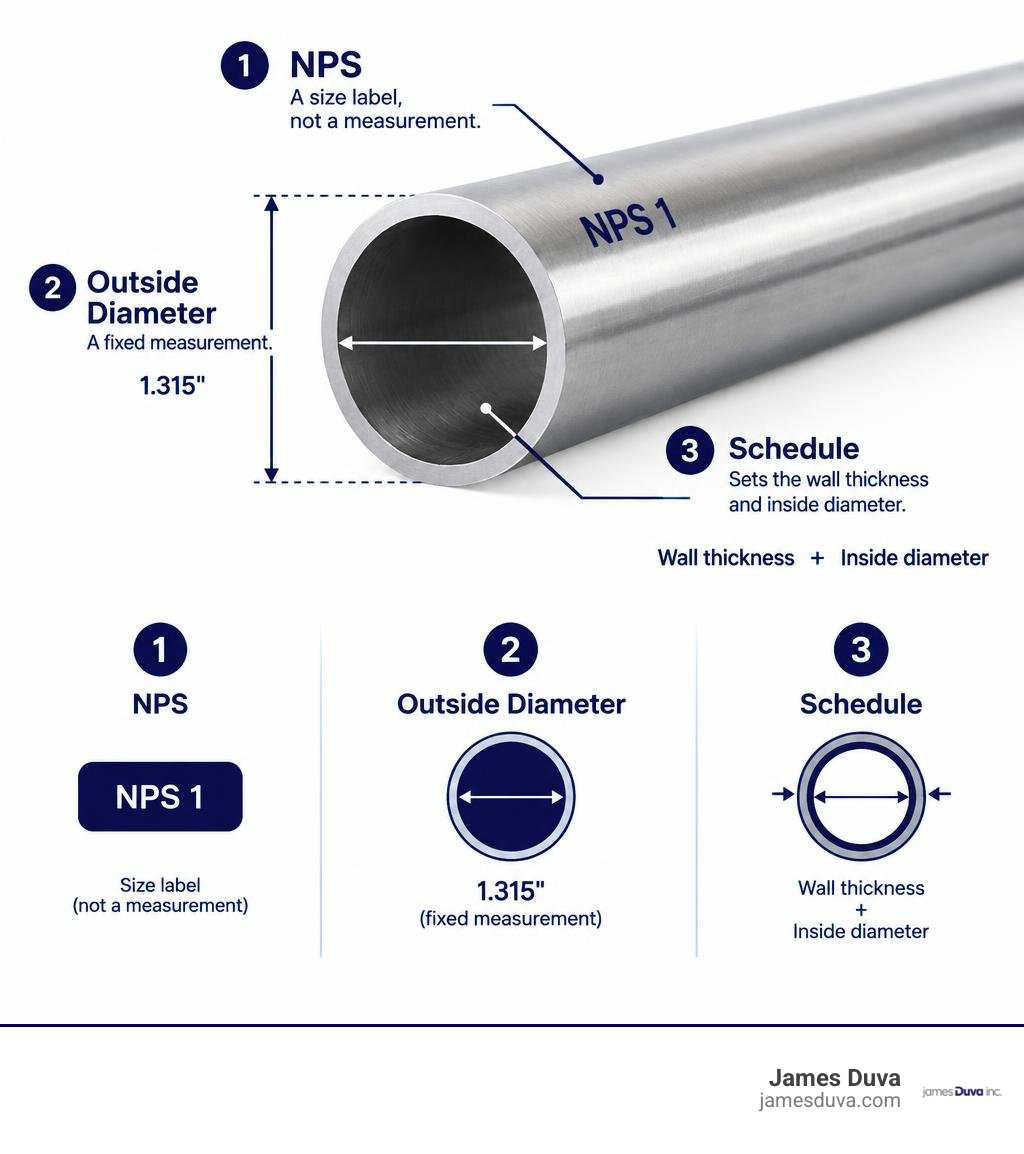
Stainless steel pipe sizes are specified by nominal pipe size (NPS) and wall-thickness schedule. NPS is a size label, not the pipe’s measured diameter. For example, NPS 1 pipe has a 1.315-inch outside diameter. Its schedule sets the wall thickness, which determines the inside diameter. To choose a pipe, check the NPS, the actual outside diameter, and the schedule against the applicable dimensional standard.
I’m Billy Walker, Vice President of James Duva Inc. Since 1978, our company has supplied industrial piping products for power, process, and water treatment projects; that work has shown me why getting stainless steel pipe sizes right matters from design through sourcing.
Why Are Alloys So Valuable in Industry?
Pure metals rarely possess the exact combination of physical and mechanical traits needed for rigorous industrial operations. Elemental iron, for instance, is comparatively soft, malleable, and highly susceptible to oxidation when exposed to moisture and oxygen. In harsh operational environments, using unalloyed iron results in rapid corrosion, structural failure, and costly system downtime.
By combining elemental iron with carbon, chromium, nickel, and other stabilizing elements, metallurgists create robust alloys that overcome these baseline weaknesses. Chromium forms an invisible, self-healing passive chromium-oxide layer on the surface that prevents oxidation. Nickel enhances ductility and toughness, transforming the atomic crystal lattice into an austenitic structure capable of withstanding extreme thermal cycles and mechanical stress.
Our detailed guide to stainless steel types highlights how these chemical formulations translate directly into industrial resilience. Because of their exceptional durability, tailored metal alloys serve as the backbone for critical sectors:
- Construction: Heavy structural beams, architectural supports, and building service piping rely on corrosion-resistant alloys to guarantee multi-decade lifespans.
- Oil & Gas: Severe offshore and downstream environments utilize high-integrity fittings, heavy-duty flanges, and precision ball valves to handle abrasive hydrocarbons, high pressures, and sour gas.
- Automotive & Aerospace: Lightweight structural frames, hydraulic tubing networks, and high-temperature engine exhaust systems depend on high-strength alloys to endure extreme operational stresses.
- Medical & Consumer Goods: Biocompatible surgical implants, pharmaceutical transfer lines, and sanitary commercial kitchenware require non-reactive surfaces that facilitate strict sterilization protocols.
Understanding Stainless Steel Pipe Sizes and Dimensional Standards
Selecting the proper piping requires navigating North American dimensional frameworks. Standardized stainless steel pipe dimensions rely on two governing metrics: Nominal Pipe Size (NPS), which indicates the standard diameter designation, and Schedule (SCH), which identifies wall thickness.
Designers consult ASME/ANSI B36.10/19 dimensional data to verify standardized wall dimensions, outside diameters, and transverse cross-sectional areas. Maintaining constant external profiles across different schedules allows standardized structural supports, threading dies, and welding bevels to fit seamlessly regardless of internal wall thickness variations.
| NPS (Inches) | Outside Diameter (OD in) | Schedule 5S Wall (in) | Schedule 10S Wall (in) | Schedule 40S Wall (in) | Schedule 80S Wall (in) |
|---|---|---|---|---|---|
| 1/2″ | 0.840 | 0.065 | 0.083 | 0.109 | 0.147 |
| 3/4″ | 1.050 | 0.065 | 0.083 | 0.113 | 0.154 |
| 1″ | 1.315 | 0.065 | 0.109 | 0.133 | 0.179 |
| 1-1/2″ | 1.900 | 0.065 | 0.109 | 0.145 | 0.200 |
| 2″ | 2.375 | 0.065 | 0.109 | 0.154 | 0.218 |
| 3″ | 3.500 | 0.083 | 0.120 | 0.216 | 0.300 |
| 4″ | 4.500 | 0.083 | 0.120 | 0.237 | 0.337 |
| 6″ | 6.625 | 0.109 | 0.134 | 0.280 | 0.432 |
| 8″ | 8.625 | 0.109 | 0.148 | 0.322 | 0.500 |
ASME B36.19M vs ASME B36.10M Stainless Steel Pipe Sizes
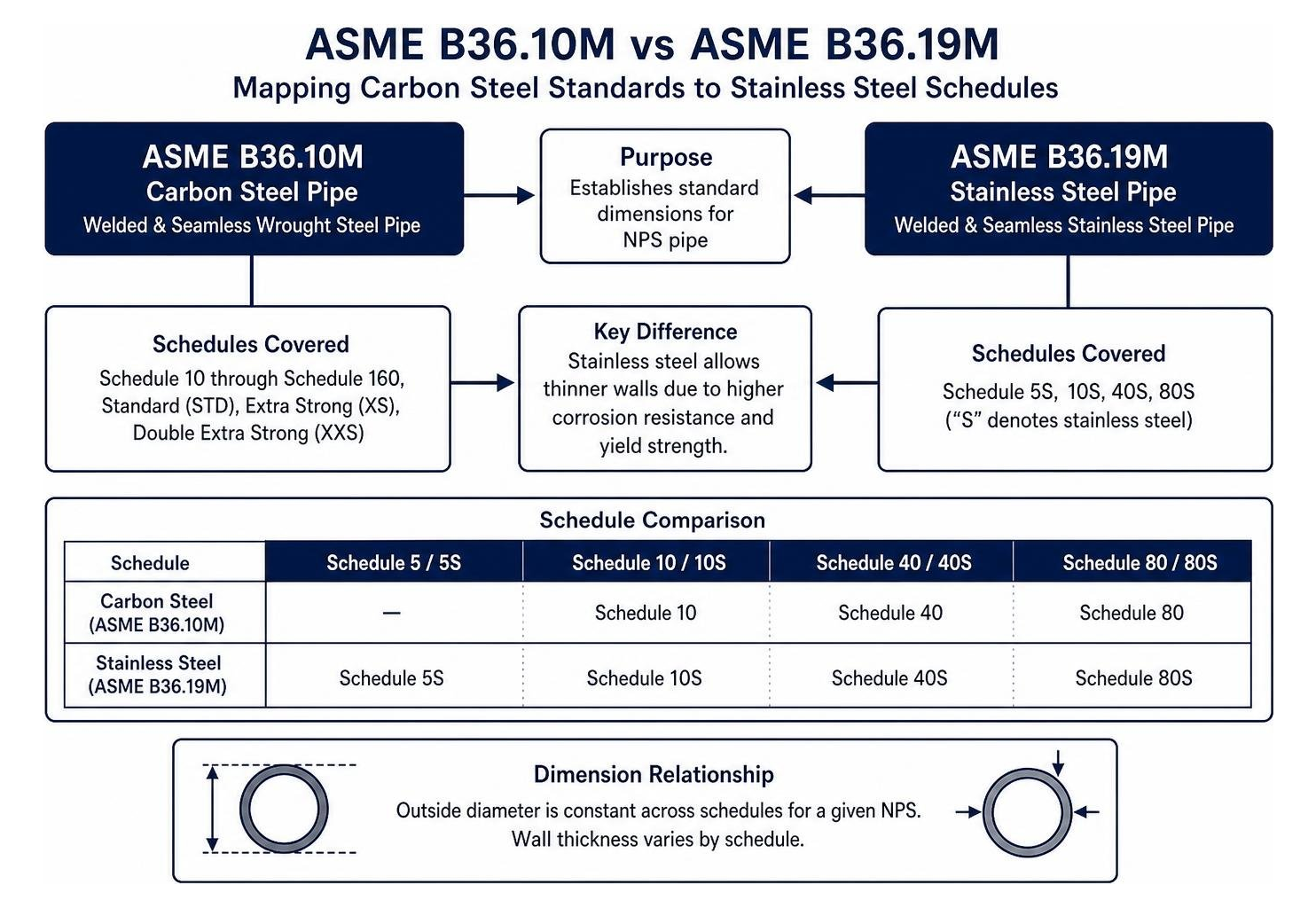
Engineers frequently encounter two related piping standards: ASME B36.10M and ASME B36.19M. ASME B36.10M covers welded and seamless wrought steel pipe, establishing carbon steel schedules ranging from Schedule 10 through Schedule 160, Standard (STD), Extra Strong (XS), and Double Extra Strong (XXS).
Because stainless steel offers higher corrosion resistance and yield strength, engineers can safely use thinner walls without compromising safety. ASME B36.19M was introduced specifically for stainless steel alloys, designating schedules with an “S” suffix—namely Schedule 5S, 10S, 40S, and 80S.
While Schedule 40 and Schedule 40S share identical dimensions across many small-to-mid sizes, they diverge in larger diameters (such as 12-inch and above). Specialized alloys like duplex stainless steel often utilize these streamlined schedules; our review of duplex 2205 pipe specifications shows how optimized wall thicknesses reduce structural weight while maintaining high burst resistance.
How Nominal Pipe Size Relates to Outer Diameter
A frequent point of confusion for newcomers is that the Nominal Pipe Size does not match the actual measured outside diameter for pipes up to 12 inches:
- NPS 1/8 through NPS 12: The actual outside diameter is numerically larger than the nominal designator. An NPS 2 pipe has a true outside diameter of 2.375 inches, and an NPS 4 pipe measures exactly 4.500 inches OD.
- NPS 14 and Larger: The nominal size directly matches the actual outside diameter. An NPS 14 pipe measures exactly 14.000 inches OD, an NPS 16 pipe measures 16.000 inches OD, and so forth.
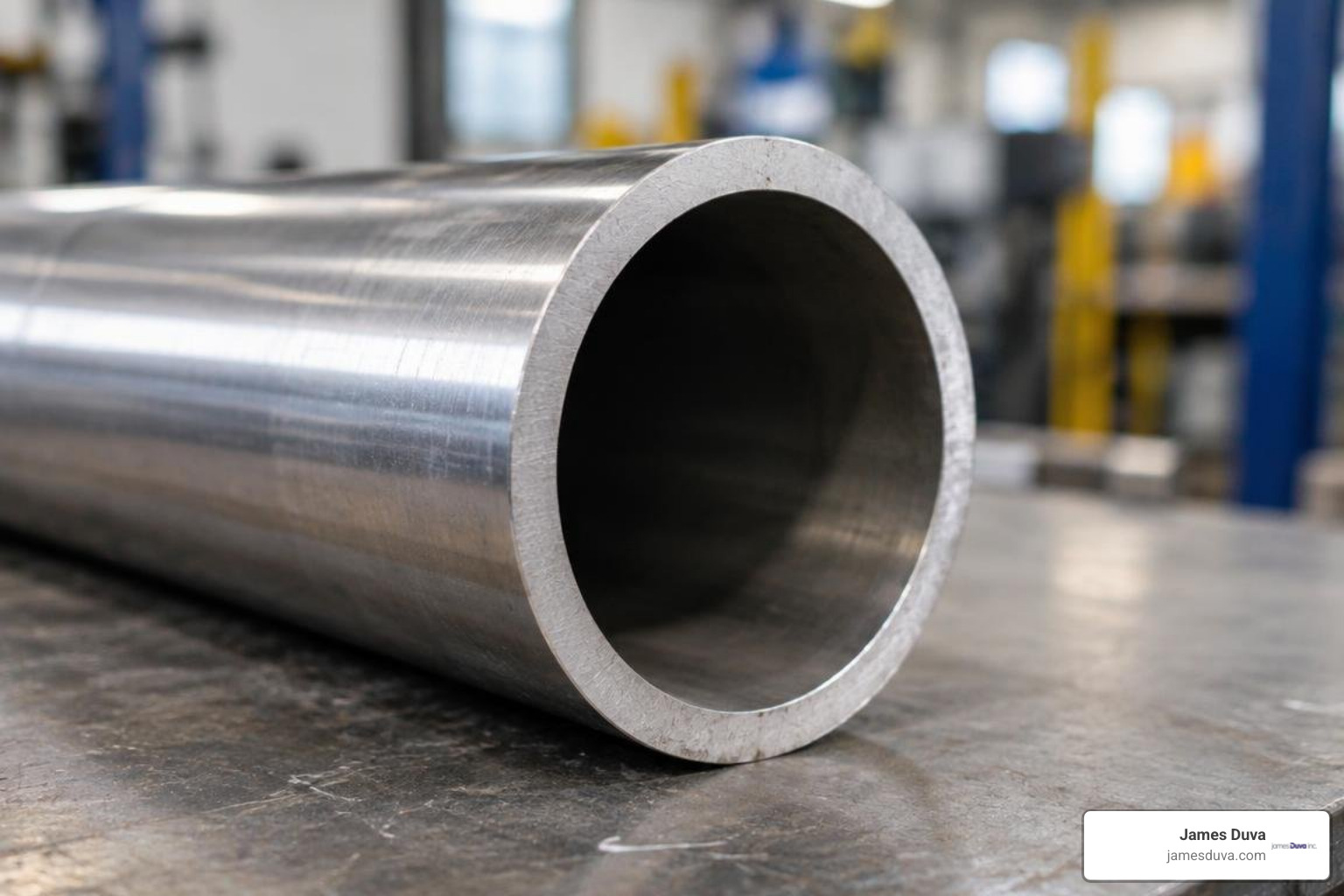
Inside diameter (ID) is always a derived calculation. As wall thickness increases with heavier schedule ratings, the inside diameter decreases, narrowing the internal flow bore while the outer envelope remains constant.
How Flow Rate, Pressure, and Structural Integrity Influence Pipe Selection
Selecting the right pipe size requires balancing hydraulic delivery against mechanical pressure retention. The internal cross-sectional area directly governs fluid velocity and dynamic head loss:
- Flow Bore and Velocity: Undersized piping constricts flow, causing high fluid velocities, localized turbulence, cavitation, and accelerated erosion at bends and junctions. Oversized piping lowers velocity but increases structural weight, material costs, and space requirements.
- Pressure Retention and Hoop Stress: Internal fluid pressure generates circumferential hoop stress along the pipe wall. The pipe must maintain sufficient wall thickness to keep operating stresses well below the allowable design limits established in relevant stainless steel piping building codes.
- System Connectivity: Flow performance also depends on smooth routing transitions; consulting a guide on pipe fittings types ensures compatible geometry between valves, elbows, and reducers.
Engineers calculate the minimum required wall thickness using Barlow’s formula. In plain terms, the required wall thickness equals the internal design pressure multiplied by the pipe’s outside diameter, divided by twice the product of the material’s allowable stress and the longitudinal joint quality factor, plus an adjustment for the material’s temperature coefficient. This calculation ensures the pipe wall can safely contain the operating pressure without exceeding design limits.
Calculating Wall Thickness and Pressure Ratings for Stainless Steel Pipe Sizes
Comparing Schedule 40S and Schedule 80S illustrates how wall thickness affects pressure containment. For an NPS 2 pipe (2.375-inch OD) in standard 316L stainless steel:
- Schedule 40S provides a nominal wall thickness of 0.154 inches, yielding an internal bore of 2.067 inches.
- Schedule 80S increases wall thickness to 0.218 inches, contracting the internal bore to 1.939 inches.
While Schedule 80S reduces internal cross-sectional area by approximately 12%, it significantly increases allowable working pressure and burst resistance. High-pressure steam headers, hydraulic lines, and toxic chemical delivery systems frequently specify Schedule 80S or heavier to ensure adequate safety margins under cyclic loading and thermal shock.

Evolution and Modern Engineering Drivers in Stainless Steel Pipe Sizing
Standard pipe sizing originated in the nineteenth century with Iron Pipe Size (IPS) standards. Early wrought iron pipes required thick walls because manufacturing tolerances were wide and internal corrosion took a steady toll on the metal. When metallurgy advanced to modern austenitic and duplex stainless steels, engineers no longer needed excessive corrosion allowances.
The development of modern standards such as ASME B36.19M introduced thin-wall Schedule 5S and 10S options. These schedules allow engineers to take full advantage of corrosion-resistant alloys without paying for unused wall thickness. Advanced materials showcase this efficiency; exploring why duplex stainless steel is an effective hybrid illustrates how high yield strengths allow thinner walls, reducing raw material tonnage, lowering freight costs, and simplifying structural supports.
Frequently Asked Questions about Stainless Steel Pipe Dimensions
What is the difference between Schedule 40 and Schedule 40S?
Schedule 40 is governed by ASME B36.10M for carbon and general alloy steel piping, whereas Schedule 40S is governed by ASME B36.19M specifically for stainless steel alloys. In sizes from NPS 1/8 through NPS 10, their dimensions are identical; however, at NPS 12 and above, certain wall thicknesses diverge between the two standards.
How do I determine the actual inside diameter of a stainless steel pipe?
Inside diameter is calculated by taking the pipe’s outside diameter (OD) and subtracting twice the nominal wall thickness. In other words, inside diameter equals outside diameter minus two times the wall thickness. Because actual wall thickness varies by schedule rating, engineers reference standard ASME dimensional tables to find exact internal bore dimensions.
Why does outer diameter remain constant when schedule numbers increase?
Maintaining a uniform outside diameter across all schedule variations ensures consistent fitting fitment, flange alignment, and standard pipe hanger dimensions. This standardization allows engineers to change wall thicknesses to handle varying pressure demands without redesigning external structural supports or modifying joint tooling.
Conclusion
Understanding nominal pipe sizes, outside diameters, and wall schedules ensures your industrial fluid systems deliver safe, efficient, and code-compliant performance. Matching the right schedule to your operating pressure, velocity, and corrosion requirements prevents costly over-engineering while protecting against premature system failure.
At James Duva Inc., our team brings deep technical expertise to every project, stocking an extensive inventory of standard and hard-to-find alloys out of Branchburg, New Jersey. Explore our complete stainless steel pipe selection or contact our specialists to source the exact dimensions, schedules, and alloys required for your next project.
About James Duva Inc.
Since 1978, James Duva Inc. has been your trusted source for stainless steel and high-nickel alloy industrial products. Whether you’re in the water treatment, process or power industry, we pride ourselves on always having what you need. Say goodbye to your sourcing problems with just one call to James Duva.