
Selecting the Ideal Food Grade Stainless Steel Supplier for Clean Manufacturing
Oct 29, 2026
Why Are Alloys So Valuable in Industry?
Selecting stainless steel for food processing starts with matching the alloy grade to the process environment, specifying a sanitary surface finish, and verifying material traceability. For most food-contact applications, 304/304L handles dry or low-acid service, while 316L is preferred for wet, acidic, or chloride-bearing product streams. Direct product-contact surfaces should meet a measurable roughness of Ra ≤ 32 μin (0.8 μm), and every heat of material should be supported by certified mill test reports with heat number traceability. Supplier verification should also confirm compliance with applicable sanitary standards such as 3-A, NSF/ANSI 51, and FDA 21 CFR 117.40 before equipment enters service.
Pure metals like elemental iron are often too soft for structural containment and notoriously prone to atmospheric rust. In industrial environments, exposure to moisture, oxygen, and operational stresses quickly degrades unalloyed metals. To overcome these inherent vulnerabilities, metallurgy relies on alloying: introducing precise elements such as chromium, nickel, and molybdenum to baseline iron to build alloys that deliver superior strength, chemical resistance, and long-term durability.
Chromium is the cornerstone of stainless steel. When combined with iron at concentrations exceeding 10.5%, it forms a continuous, self-healing chromium oxide passive film on the metal’s surface. This invisible barrier blocks oxygen and moisture from attacking the underlying steel. Adding nickel enhances mechanical toughness and formability, while molybdenum provides localized resistance against chloride attacks.
Understanding these elemental balances is essential across diverse manufacturing sectors. For a detailed breakdown of chemical compositions and mechanical characteristics, explore this in-depth guide to stainless steel alloy properties. Across modern infrastructure, engineered alloys serve targeted roles:
- Construction: Heavy structural beams, architectural support columns, and utility transfer piping that withstand heavy mechanical loads and weather exposure.
- Oil & Gas: High-pressure fittings, forged flanges, and severe-service line pipe designed to resist sour gas, volatile hydrocarbons, and marine environments.
- Automotive & Aerospace: High-strength chassis frames, lightweight structural components, and high-temperature engine exhaust systems.
- Medical & Consumer Goods: Biocompatible surgical implants, precision medical tools, and commercial kitchenware requiring frequent sanitization.
What Makes Metal Truly Food Grade: Beyond the Alloy Label
In the sanitary manufacturing sector, the term “food grade” is frequently treated as an all-encompassing stamp of approval. However, a grade designation like “304” or “316L” simply defines the metallurgical chemistry of the raw metal—it does not prove that a fabricated component is safe for sanitary food contact.
True food-contact suitability requires a complete system-level assessment. A component must feature non-toxic material chemistry, hygienic geometry free of dead legs or tight crevices, cleanable surface textures, and documented fabrication quality. Relying solely on a raw metal stamp overlooks critical contamination risks, which is why reviewing comprehensive guidelines on food-contact metal certifications helps clarify what documentation actually guarantees.
Regulatory Frameworks: FDA, NSF, 3-A, and EU Compliance
Navigating international sanitary standards requires aligning raw material choices with governing regulatory bodies:
- U.S. FDA 21 CFR 117.40: Outlines Current Good Manufacturing Practice (CGMP) requirements, mandating that food-contact surfaces must be corrosion-resistant, non-toxic, and constructed to withstand the operational environment, including repeated exposure to aggressive cleaning compounds.
- NSF/ANSI Standard 51: Evaluates materials and finishes used in commercial food equipment, confirming that metals will not leach toxic elements into food substances under intended operating temperatures and contact zones.
- 3-A Sanitary Standards: Focuses on cleanability, self-drainage, and measurable surface roughness benchmarks (typically demanding internal product-contact finishes of 32 microinches Ra or 0.8 micrometers) for dairy and liquid food processing equipment.
- European Union Framework (EC 1935/2004 & EC 2023/2006): Mandates that materials do not transfer constituents into food in quantities that endanger human health, supported by specific release limit guidelines from the European Directorate for the Quality of Medicines & HealthCare (EDQM).
Verification and Traceability: MTRs, EN 10204 3.1, and PMI
To ensure the material delivered matches your purchase order specifications, fabricators and plant engineers must implement rigorous material verification protocols. A standard certificate of conformity from an unverified distributor is not enough.
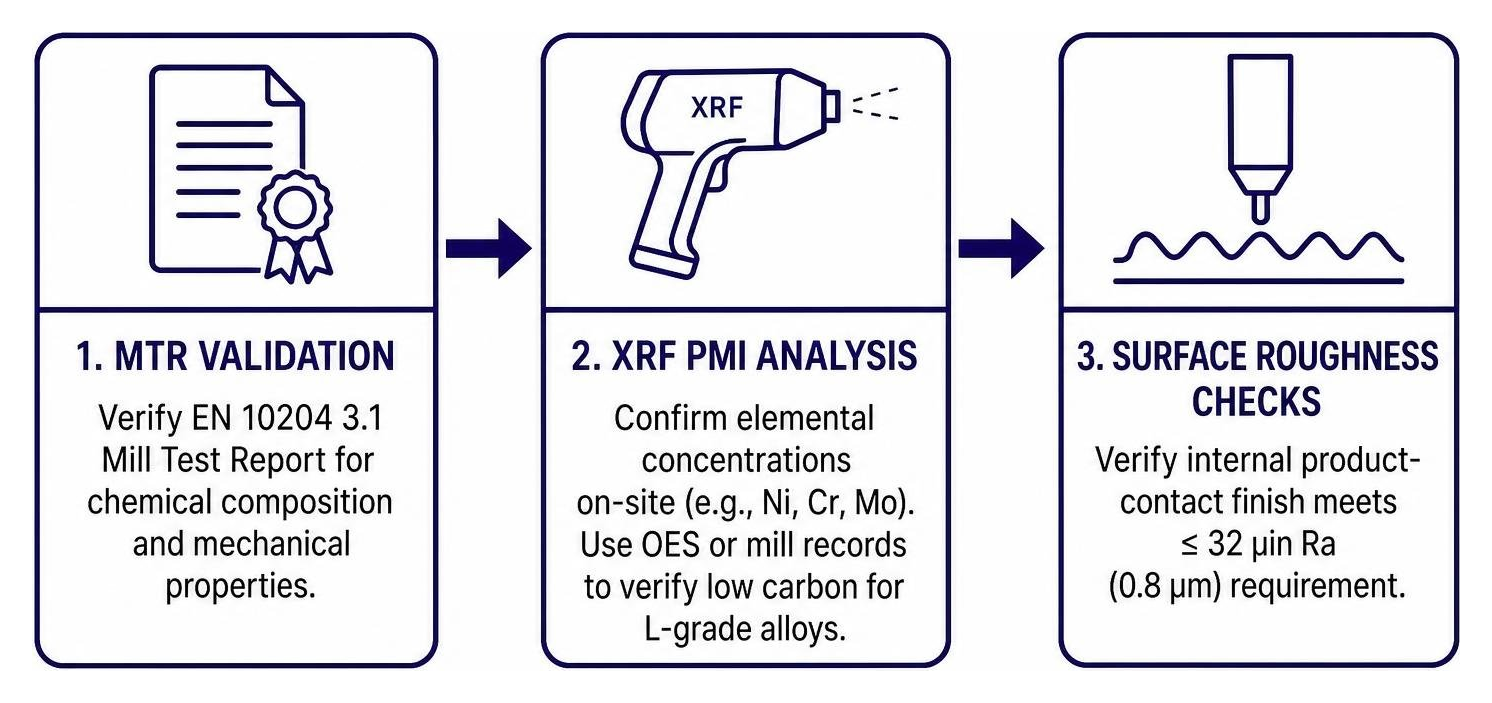
- Mill Test Reports (MTRs): Certified MTRs conforming to EN 10204 Type 3.1 provide validated chemical composition and mechanical test results tied directly to the original melt batch.
- Heat Number Traceability: Every pipe length, sanitary valve body, and fabricated flange must display physical, indelible heat numbers that match the certified mill test report line by line.
- Positive Material Identification (PMI): Handheld X-ray fluorescence (XRF) analyzers confirm elemental concentrations (such as nickel, chromium, and molybdenum) on-site upon receipt. Because standard XRF cannot detect light elements like carbon, optical emission spectroscopy (OES) or certified mill records must be used to verify the low-carbon status (carbon at or below 0.030%) of “L-grade” alloys like 304L and 316L.
Understanding these verification terms is essential when ordering fluid components. For help navigating connection types, clamp geometries, and finish terminology, see our guide to demystifying sanitary fitting terminology.
Sourcing Certified Stainless Steel for Food Processing: Regulations and Standards
Selecting the proper alloy requires balancing mechanical stresses, process fluid chemistry, operational temperatures, and sanitation practices. 304 stainless steel accounts for approximately 50% to 60% of all stainless steel used in food processing equipment globally, offering reliable performance in neutral, dry, or low-acid environments. However, when process streams introduce high salt concentrations, elevated temperatures, or aggressive Clean-In-Place (CIP) chemistries, higher-alloy grades are required.
The table below outlines common food-grade stainless steels, their chemical compositions, Pitting Resistance Equivalent Numbers (PREN, calculated as chromium percentage plus 3.3 times the molybdenum percentage plus 16 times the nitrogen percentage), and typical food plant applications:
| Alloy Grade | UNS Designation | Key Composition | PREN | Common Food-Processing Applications |
|---|---|---|---|---|
| 304 | S30400 | 18% Cr, 8% Ni | ~18.0–20.0 | Dry food handling, sorting tables, bakery preparation surfaces, external framing. |
| 304L | S30403 | 18% Cr, 8% Ni, carbon at or below 0.030% | ~18.0–20.0 | Welded holding vessels, intermediate storage tanks, general non-chloride process lines. |
| 316L | S31603 | 16% Cr, 10% Ni, 2% Mo, carbon at or below 0.030% | ~23.0–25.0 | Dairy pasteurization lines, beverage sanitary piping, tomato/citrus processing, CIP loops. |
| 430 | S43000 | 16–18% Cr, 0% Ni (Ferritic) | ~16.0–18.0 | Splash panels, dry equipment housings, appliance outer covers, non-contact trim. |
| 2205 Duplex | S32205 / S31803 | 22% Cr, 5% Ni, 3% Mo, 0.17% N | ~35.0–36.0 | High-temperature seafood brine tanks, high-pressure soy sauce cookers, aggressive evaporators. |
For detailed guidance on environmental and chemical degradation across these grades, review our in-depth stainless steel corrosion resistance guide.
Corrosion Mechanisms and CIP Chemical Compatibility
Over 80% of corrosion-related equipment failures in food processing facilities stem from localized attack—specifically pitting and crevice corrosion—often caused by aggressive cleaning chemicals rather than the food products themselves.
- Pitting Corrosion: Occurs when free chloride ions break down microscopic areas of the passive oxide film. Once initiated, pits create localized galvanic cells that burrow into the wall of the pipe or vessel, creating harborage points for bacterial biofilms.
- Crevice Corrosion: Develops within narrow, stagnant gaps under unseated gaskets, mechanical clamp joints, or poor-penetration welds where oxygen is depleted and cleaning solutions become concentrated.
- Stress-Corrosion Cracking (SCC): Driven by the combined action of tensile stress (such as internal operating pressure or residual welding stress), elevated temperatures (typically above 140 degrees Fahrenheit or 60 degrees Celsius), and chlorides. Standard austenitic grades like 304 and 316 can fail through transgranular cracking under these conditions, whereas duplex alloys like 2205 provide superior resistance.
- Intergranular Corrosion: Results from weld sensitization, where temperatures between 800 degrees Fahrenheit and 1500 degrees Fahrenheit cause chromium to bind with carbon as chromium carbides along the grain boundaries. This depletes the adjacent alloy of protective chromium, leaving it vulnerable to chemical attack. Specifying low-carbon “L” variants prevents this phenomenon. Learn more by evaluating 316L versus standard 316.
CIP cycles frequently expose processing lines to hot caustic solutions (1% to 2% sodium hydroxide at 160 degrees Fahrenheit to 180 degrees Fahrenheit), hot acid descaling washes (nitric or phosphoric acid), and chemical sanitizers like sodium hypochlorite or peracetic acid (PAA). While 304 can withstand routine caustic washes, repeated exposure to warm chloride-rich sanitizers will quickly pit it. For high-chloride CIP systems, upgrading to 316L can reduce long-term maintenance costs by 30% to 40%.
Selecting Stainless Steel for Food Processing by Operational Zone
Hygienic plant engineering relies on plant zoning to deploy higher-cost alloys only where the operating environment demands them:
- Direct Product-Contact Zones: Piping, pump impellers, and heat exchangers that directly contact wet, acidic, or salted product streams. In these applications, 316L is specified in more than 70% of dairy, beverage, and sauce facilities. For guidance on sizing and finish specifications, review these essential standards for hygienic fluid transfer. Flow management in these zones relies on high-integrity components, including sanitary Ball Valves designed for full-port cleanability.
- Splash and Washdown Zones: External tank surfaces, motor shrouds, and conveyor side rails that encounter frequent sanitation sprays and indirect food splash. 304/304L is the standard baseline here.
- Non-Contact and Utility Zones: Dry electrical enclosures, support structural framework, and utility steam piping. In dry zones, lower-cost ferritic grades like 430 can control structural costs without compromising plant hygiene.
Hygienic Fabrication: Surface Roughness, Welding, and Passivation
Approximately 15% to 20% of sanitary stainless steel equipment returns or warranty claims stem from poor surface finishing or improper weld execution rather than base alloy defects. Even a 316L system will fail if its fabrication introduces rough surfaces or weld defects that trap bacteria.
Surface Finish vs Roughness: Why Ra Matters More Than No. 4
Commercial finish callouts like “No. 4” are mill-level visual designations that describe a directional grain produced by mechanical abrasive polishing. However, a standard commercial No. 4 finish can have an average surface roughness (Ra) ranging anywhere from 40 microinches down to 20 microinches (1.0 micrometers to 0.5 micrometers), depending on the abrasive grit and polishing technique used.
In sanitary manufacturing, visual appearance does not guarantee cleanability. Quantitative surface roughness, measured in micrometers or microinches, is the industry standard benchmark:
- The 3-A Sanitary Benchmark: Demands that direct food-contact surfaces maintain an internal surface roughness of Ra at or below 32 microinches (0.8 micrometers). Maintaining an Ra below this threshold can reduce bacterial adhesion and biofilm retention by up to 90% compared to unpolished or rougher surfaces above 1.6 micrometers Ra.
- Electropolishing (EP): An electrochemical process that removes microscopic peaks and microscopic burrs from the metal surface, creating a mirror-like finish (often achieving Ra at or below 15 to 20 microinches) while enriching the chromium-to-iron ratio in the passive layer. Electropolishing cannot level weld undercuts, close deep pits, or fix structural weld defects.
Key Verification Checks for Stainless Steel for Food Processing Equipment
Fabricating food-contact assemblies requires strict quality controls at each step of the process:
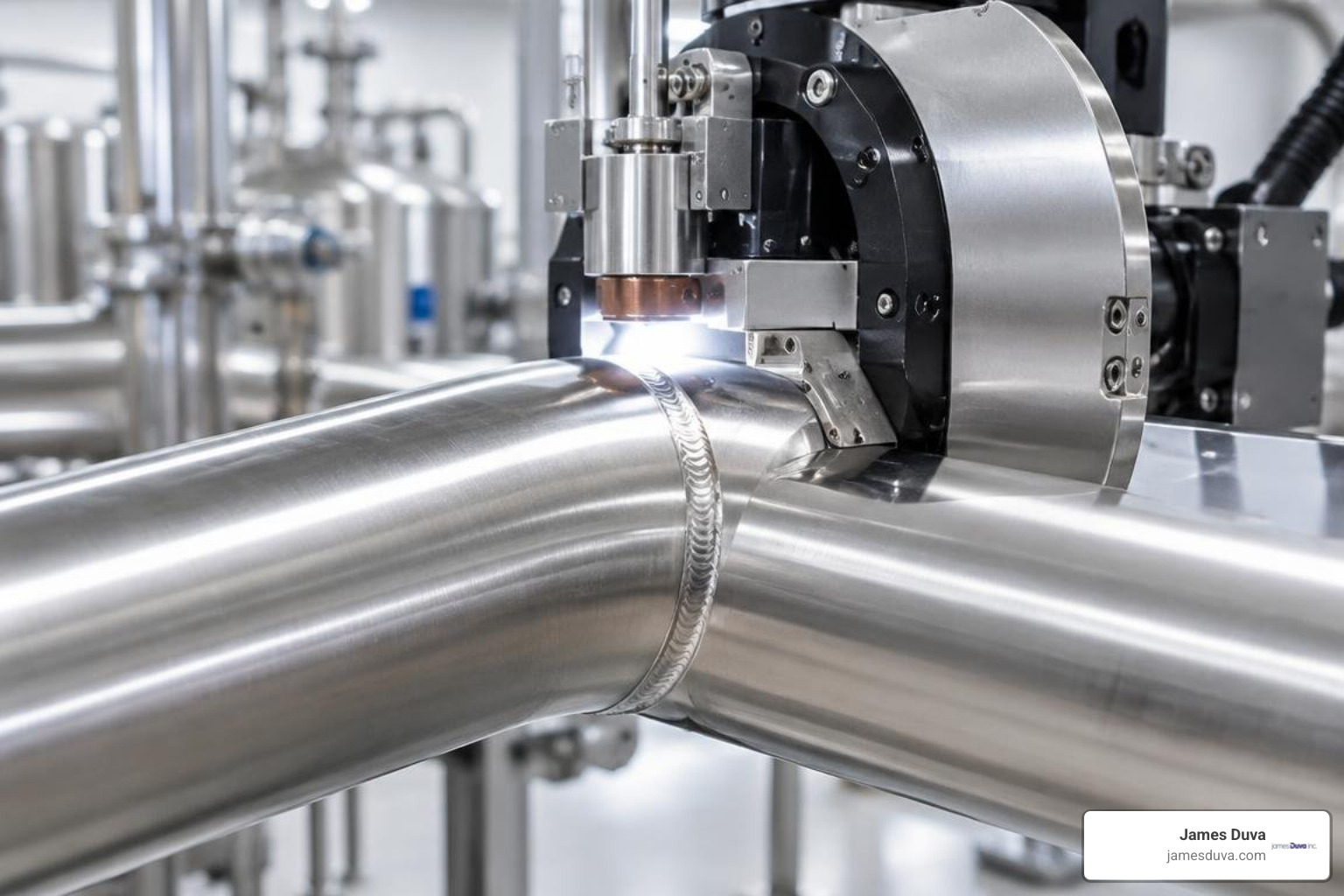
- Orbital Sanitary Welding: Piping butt welds should be executed using automated orbital TIG welding with an inert backing purge gas (such as high-purity argon) to prevent inner-diameter oxidation.
- Heat Tint Inspection: Weld discoloration (blue, straw, or grey oxide scales) represents chromium depletion in the underlying metal. Internal heat tint on product-contact surfaces must be chemically removed to prevent localized corrosion.
- Chemical Pickling: Acid baths (typically hydrofluoric and nitric acid mixtures) dissolve heat tint, embedded tooling scale, and depleted base metal layers.
- Chemical Passivation: Performed according to ASTM A380 and ASTM A967 using nitric or citric acid formulations. This treatment removes free-iron contamination left behind by forming tools and accelerates the development of a clean, chromium-rich passive oxide film. Passivation should be verified using surface free-iron tests, such as the water-wetting test or copper sulfate swab testing where permitted.
Procurement Best Practices: RFQ Specifications and Total Cost of Ownership
Improper material selection—such as specifying standard 304 instead of 316L in chloride-rich or acidic process loops—can reduce equipment service life by up to 50%, resulting in unscheduled downtime and expensive replacements. A successful procurement strategy looks past initial material purchase price to consider total cost of ownership (TCO).
To prevent delivery disputes, cross-contamination, and rework, incorporate these technical requirements into every Request for Quotation (RFQ):
- Material Specification: Require explicit alloy designations and UNS numbers (e.g., “ASTM A270 / 316L / UNS S31603”) rather than generic terms like “food grade.”
- Certified Documentation: Mandate EN 10204 Type 3.1 mill test reports showing full chemical composition, tensile/yield strengths, and elongation for all heat numbers.
- Surface Roughness Parameters: Specify maximum acceptable Ra limits on both internal product-contact surfaces (e.g., Ra at or below 32 microinches) and external surfaces.
- Welding and Fabrication Standards: Require complete internal weld penetration, purge protection on sanitary lines, and compliance with AWS D18.1/D18.2 for sanitary tube welding.
- Post-Fabrication Treatments: Require pickling and passivation documentation per ASTM A967, along with certification of iron-free mechanical handling.
- Packaging and Protection: Require plastic end caps on all sanitary tubing, individual component bagging, and wooden crating that prevents carbon-steel contact during transit.
Frequently Asked Questions About Food Grade Stainless Steel
What makes 316L preferable over 304 for food processing piping?
The primary operational difference is molybdenum content. 316L contains 2% to 3% molybdenum, which substantially increases pitting and crevice corrosion resistance in the presence of chlorides, natural food acids, and aggressive Clean-In-Place sanitizers like sodium hypochlorite. The low carbon content (at or below 0.030%) also prevents intergranular carbide precipitation during welding, protecting process lines from weld-zone corrosion.
Can a mill test report replace 3-A or NSF certification?
No. An MTR only certifies the chemical composition and mechanical properties of the raw melt batch from the steel mill. Equipment-level standards like 3-A Sanitary Standards and NSF/ANSI 51 evaluate the design and cleanability of the finished unit—including self-draining angles, weld smoothness, surface roughness (Ra), gasket material suitability, and cleanability under standard CIP washdowns.
Is electropolishing mandatory for all food-contact stainless steel surfaces?
Electropolishing is not universally required by baseline food safety regulations. Most sanitary standards, such as 3-A, require a measurable surface roughness of Ra at or below 32 microinches (0.8 micrometers), which can be achieved through mechanical polishing and passivation. However, electropolishing is often specified for ultra-clean applications, such as infant formula production, dairy pasteurizers, and aseptic filling lines, because it removes microscopic surface peaks, minimizes bacterial biofilm formation, and enhances CIP efficiency.
Conclusion
Specifying stainless steel for food processing requires an integrated engineering approach: pairing the right alloy with proper surface finishes, controlled welding procedures, validated passivation, and documented heat number traceability. Balancing these factors helps plants avoid premature corrosion, streamline cleaning cycles, and maintain sanitary safety across the equipment lifecycle.
Since 1978, James Duva Inc. has supplied high-grade stainless steel, sanitary tubing, and specialty nickel alloy components to process industries across the United States. Based in Branchburg, NJ, our team provides complete material traceability, certified mill test reports, and technical sourcing support to help you meet demanding sanitary standards.
Discover our full inventory of high-purity components by exploring our sanitary fittings selection or connecting with our engineering sales specialists today.
About James Duva Inc.
Since 1978, James Duva Inc. has been your trusted source for stainless steel and high-nickel alloy industrial products. Whether you’re in the water treatment, process or power industry, we pride ourselves on always having what you need. Say goodbye to your sourcing problems with just one call to James Duva.