
Comprehensive Guide to Sanitary Stainless Steel Fittings
Oct 29, 2026
Why Sanitary Stainless Steel Fittings Are Critical in Hygienic Processing
Sanitary stainless steel fittings are specialized pipe and tube connectors designed to meet strict hygiene standards in industries where product purity is non-negotiable.
Quick answer — what you need to know:
| Factor | Key Details |
|---|---|
| What they are | Polished stainless fittings with smooth bores and hygienic connections for food, beverage, dairy, and pharma lines |
| Common grades | 304, 316, and 316L stainless steel |
| Connection types | Tri-Clamp, butt weld, bevel seat, I-Line, and more |
| Surface finish | 32Ra standard; 15Ra–20Ra for high-purity BPE applications |
| Key standards | 3-A Sanitary, ASTM A270, ASME BPE |
| Why they matter | Prevent contamination, support CIP/SIP cleaning, and meet food safety regulations |
These fittings are built differently from standard industrial pipe fittings. They use polished interior surfaces, crevice-free designs, and traceable materials to keep your process lines clean — and keep regulators satisfied.
Whether you’re sourcing for a dairy plant, a pharmaceutical skid, or a beverage processing line, choosing the right fittings affects everything from cleanability to system uptime.
I’m Billy Walker, Vice President of James Duva Inc., where I’ve spent years helping engineers and procurement professionals source specialty piping components — including sanitary stainless steel fittings — from leading domestic manufacturers. Let me walk you through everything you need to make a confident, informed sourcing decision.
What Are Sanitary Stainless Steel Fittings and Why Do They Matter?
At the simplest level, sanitary fittings connect tubing, valves, pumps, and process equipment in hygienic systems. But unlike ordinary pipe fittings, they are engineered to reduce product hold-up, eliminate crevices, support fast cleaning, and resist corrosion through repeated washdown and sterilization cycles.
That matters because hygienic processing has very little tolerance for trapped residue, microbial growth, or mystery buildup hiding in a rough weld. In food, beverage, dairy, biopharma, cosmetics, and clean-tech systems, a poor connection can become the weakest link in the whole line.
Where sanitary stainless steel fittings are used
You will find sanitary stainless steel fittings in:
- Food processing lines
- Beverage blending and filling systems
- Dairy transfer and pasteurization loops
- Pharmaceutical and biotech skids
- Personal care and cosmetics manufacturing
- Clean utility and high-purity process systems

In these environments, fittings need to support CIP (clean-in-place) and often SIP (sterilize-in-place) procedures without degrading or introducing contamination.
Why hygienic fittings are essential for product quality
A good sanitary fitting helps create:
- Smooth internal flow paths
- Minimal dead legs
- Better drainability
- Lower risk of microbial attachment
- Easier allergen changeovers
- More reliable inspection outcomes
- Less unplanned downtime
In plain English: they make it easier to keep the line clean and harder for contamination to hide. That is why hygienic fitting design directly affects batch integrity and product quality. For a deeper look at compliance expectations, see What Makes a Fitting Food Grade? Your Guide to Sanitary Standards.
How sanitary fittings differ from industrial pipe fittings
Standard industrial fittings are usually designed for strength and utility first. Sanitary fittings are designed for cleanability first, while still handling pressure, temperature, and process demands.
Key differences include:
- Tube OD sizing instead of standard pipe dimensions in many systems
- Polished IDs and often polished ODs
- Hygienic gaskets designed to seal without trapping product
- Clamp-style ends or polished weld ends
- Better traceability through heat numbers and MTRs
- Alignment with standards such as 3-A and ASME BPE
If you want a broader overview, read What Are Sanitary Fittings?.
Common Types of Sanitary Stainless Steel Fittings
The catalog depth in this market is large. Major suppliers commonly stock more than 900 Tri-Clamp configurations and 400-plus butt weld options, which tells you two things: sanitary systems are highly configurable, and choosing the wrong end style is easier than anyone likes to admit.
Tri-Clamp sanitary stainless steel fittings
Tri-Clamp fittings are the best-known sanitary connection style. They use three parts:
- Two ferrules
- One gasket
- One clamp
The ferrules are brought together with the gasket between them, and the clamp compresses the assembly to form the seal.
Their advantages are clear:
- Quick assembly and disassembly
- Easy visual inspection
- Good for lines opened frequently
- Useful for maintenance-intensive systems
- Excellent for modular spool assemblies and skid builds

Tri-Clamp connections are especially popular in food and beverage systems because they make cleaning verification and part replacement straightforward. For practical examples, see Sanitary Tri-Clamp Fittings in Food & Beverage Industry Use Cases.
Butt weld sanitary stainless steel fittings
Butt weld fittings create a permanent connection. Common examples include:
- Elbows
- Tees
- Crosses
- Concentric reducers
- Eccentric reducers
- Ferrules
These are typically used where:
- A permanent, highly cleanable joint is preferred
- Systems are validated and not routinely disassembled
- High-purity service calls for polished welded construction
- Plant teams want fewer gasketed joints
When properly welded and finished, butt weld connections provide excellent flow continuity and reliability. They do require more installation skill and more planning during system changes. For related fitting categories, visit The Ultimate Guide to Sanitary Tube Fittings: Types, Applications, and Benefits.
Bevel seat, I-Line, and specialty connection styles
Not every sanitary line uses Tri-Clamp or butt weld only. Other common sanitary styles include:
- Bevel seat fittings
- I-Line fittings
- Q-Line fittings
- E-Line fittings
- John Perry fittings
- Tube OD fittings
- Hose shank adapters
- Zero dead leg fittings
- High-pressure clamps
- Safety clamps
These specialty styles can be useful where higher mechanical strength, legacy compatibility, specific washdown practices, or reduced dead space are needed. The right choice usually depends on the installed system standard and the cleaning protocol already validated by the facility.
Materials, Finishes, and Standards That Define Performance
Material grade, surface finish, and documentation are not side notes in hygienic service. They are the whole game.
304 vs 316 vs 316L for sanitary stainless steel fittings
The most common alloys are 304, 316, and 316L.
- 304 is the workhorse grade and is often described as 18-8 stainless because it typically contains about 18% chromium and 8% nickel.
- 316 adds molybdenum, which improves resistance to chlorides and more aggressive cleaning environments.
- 316L is the low-carbon version of 316, which improves weldability and helps reduce the risk of sensitization in welded systems.
Research across market inventory shows 316L holds the majority share of sanitary fitting stock, with 962 SKUs compared with 597 in 304. That lines up with real-world demand: many hygienic systems favor 316L for corrosion resistance plus weld performance.
| Grade | Best Fit | Main Advantage | Watchouts |
|---|---|---|---|
| 304 | General food and beverage service | Cost-effective and widely available | Less resistant to chlorides |
| 316 | More corrosive washdowns or product contact | Better pitting resistance | Usually higher cost |
| 316L | Welded sanitary and high-purity systems | Low carbon, strong corrosion resistance, weld friendly | May be more than needed for mild service |
A simple rule: if chlorides, aggressive cleaners, repeated sterilization, or high weld density are part of the picture, 316L is often the safer choice.
Surface finish requirements and why Ra matters
Surface finish is one of the most important specs on a sanitary fitting. The most common standard is 32Ra on the ID and often the OD as well. Across major inventories, over 1,000 sanitary clamp and fitting products are listed with 32Ra ID/OD finish.
Premium BPE-oriented products may offer:
- 20Ra interior finish
- 15Ra interior finish
Why it matters:
- Smoother surfaces are easier to clean
- Rougher surfaces can hold residue and support microbial attachment
- Better finish can improve CIP effectiveness
- Validation and inspection become easier in high-purity service
Ra is the average surface roughness measurement. Rz is another roughness parameter sometimes used for a more complete texture profile. For most buyers, the practical takeaway is this: specify the finish your process actually requires, not just “polished” and hope for the best.
Standards and certifications buyers should verify
For sanitary systems, common standards and documentation include:
- 3-A Sanitary standards
- ASTM A270 for sanitary tubing
- ASTM A269 for stainless tubing in related service
- ASME BPE for bioprocessing and high-purity applications
- Heat numbers for traceability
- Material Test Reports (MTRs)
- Independent material testing
- ISO-based quality systems
You should also verify markings, lot traceability, and whether the supplier can support documentation during audits. For terminology help, see Sanitary Fittings Terms Demystified.
How to Choose Sanitary Stainless Steel Fittings for Your Application
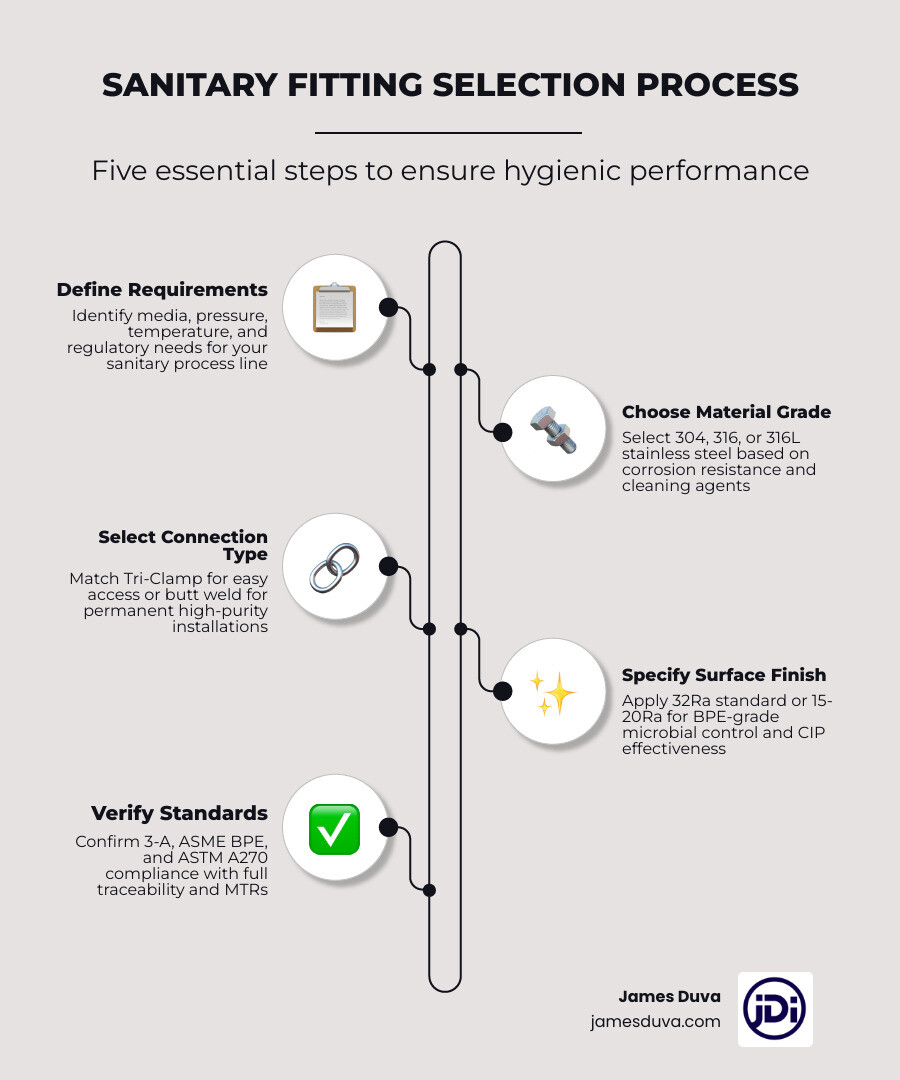
Selecting fittings is not just picking a shape and a size. We recommend evaluating the full process context:
- Product being handled
- Cleaning chemicals
- Operating temperature
- Pressure requirements
- Frequency of disassembly
- Validation requirements
- Existing tubing standard
- Required finish and documentation
How to size fittings correctly and match tube dimensions
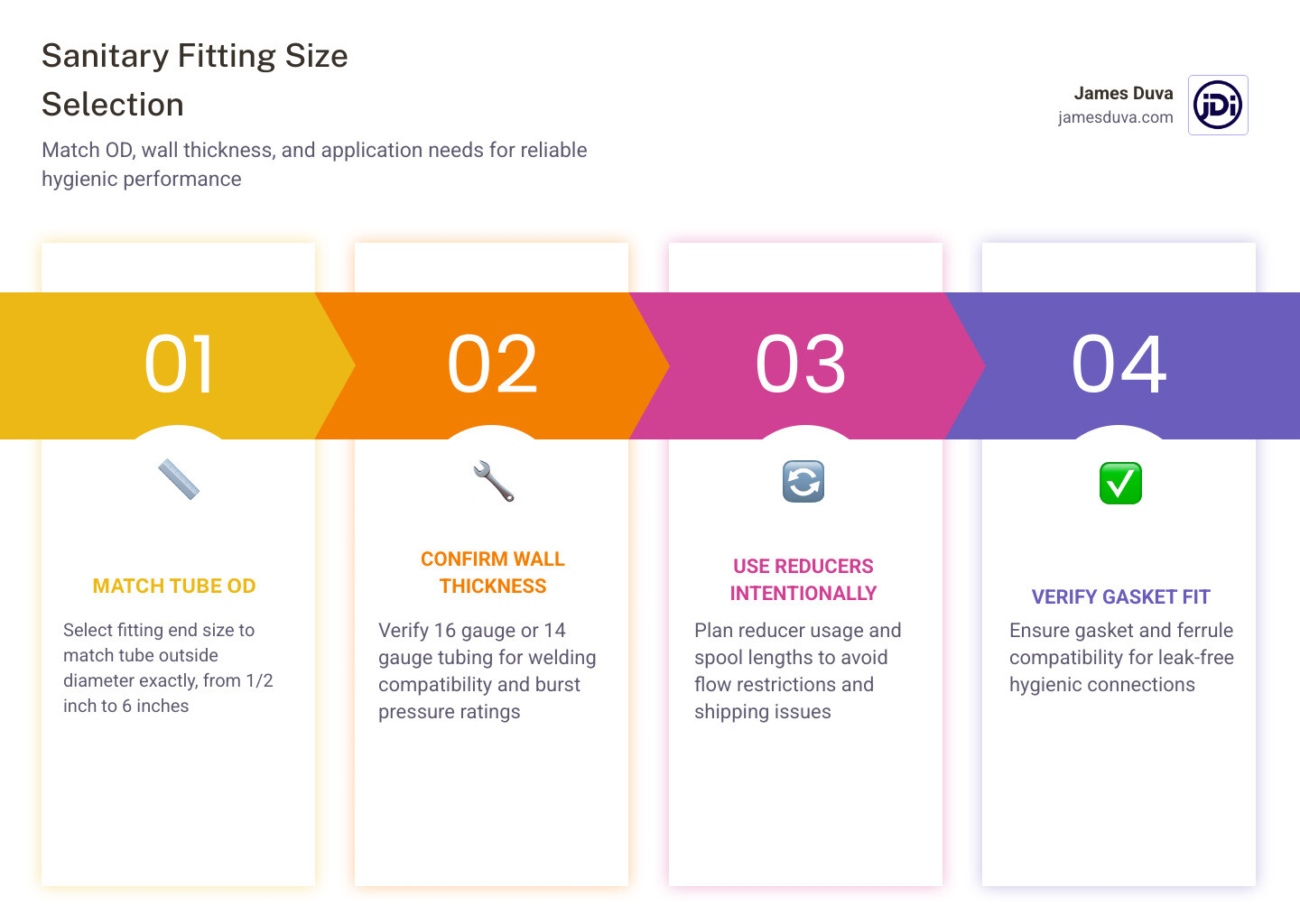
Most sanitary systems are specified by tube outside diameter. Common sizes range from 1/2 inch through 6 inches. Wall thickness also matters, with 16 gauge and 14 gauge common in many tubing systems.
Published sanitary tubing data shows burst pressure varies widely by size, from more than 10,000 PSI for 1/2 inch tubing to about 1,820 PSI for 6 inch tubing. That does not mean every assembled fitting system should be run anywhere near those numbers, but it does show why size selection affects mechanical performance.
Tips for correct sizing:
- Match fitting end size to tube OD exactly
- Confirm wall thickness where welding is involved
- Use reducers intentionally, not as afterthoughts
- Verify gasket and ferrule compatibility
- Consider spool length and shipping constraints on prefabricated assemblies
For related products, see Product Categories: Sanitary Tubing.
Tri-Clamp vs butt weld: which connection should you choose?
Choose Tri-Clamp when you need:
- Fast maintenance access
- Frequent teardown
- Easy inspection
- Retrofit flexibility
- Skid modularity
Choose butt weld when you need:
- Permanent installation
- Reduced gasketed joints
- High-purity construction
- Strong long-term integrity
- Fewer disassembly points
Neither is universally “better.” Tri-Clamp wins on convenience. Butt weld wins on permanence. Your process, cleaning routine, and maintenance strategy decide the winner. As with many engineering choices, the annoying but correct answer is: it depends.
Gaskets, valves, and adjacent components in a hygienic system
A fitting is only as sanitary as the components attached to it. Pay close attention to:
- Gasket material: EPDM, silicone, PTFE
- Cure type where relevant: platinum cured or peroxide cured
- Metal-detectable options for food applications
- Valve end connections and bore continuity
- Hangers and supports that preserve drainability
Valves are especially important because they can create hold-up points if poorly matched. Explore Product Categories: Sanitary Valves and our Ball Valves page for related system components.
Installation, Cleaning, and Maintenance Best Practices
Even the best fitting can be undone by poor installation. A sanitary line is not the place for guesswork, over-tightening, or the famous last words: “That looks close enough.”
Installation tips for leak-free hygienic performance
Best practices include:
- Align ferrules correctly before clamping
- Seat gaskets evenly with no pinch points
- Apply proper clamp torque
- Avoid over-compressing the gasket
- For weld ends, prep and purge correctly
- Maintain smooth bead profile and drainability
- Inspect internal weld quality after fabrication
- Perform leak and fit-up verification before service
For orbital or manual welds, weld profile and finish are critical. A beautiful exterior weld means very little if the interior resembles a tiny stainless mountain range.
Cleaning and sanitizing methods that protect finish quality
To preserve finish quality and corrosion resistance:
- Use validated alkaline and acid cleaning steps as appropriate
- Rinse thoroughly to remove residues
- Use hot water or steam only within material and gasket limits
- Confirm sanitizer compatibility with both alloy and elastomer
- Avoid chloride-heavy exposures when possible
- Do not use abrasive pads or tools that scratch the polish
- Passivate after fabrication or repair when needed
Repeated cleaning is one reason finish and alloy selection matter so much. Read Why Sanitary Fittings Are the Unsung Heroes of Clean Tech in 2025 for more on performance in modern hygienic systems.
Maintenance checklist for long-term hygiene and traceability
Use a routine checklist such as:
- Inspect surfaces for scratches, pits, and discoloration
- Check clamp condition and fit
- Replace worn or swollen gaskets
- Review weld areas for cracks or corrosion
- Confirm markings, heat numbers, and MTR records
- Track replacement intervals for seals and wear parts
- Verify drainability after modifications
- Maintain spare critical fittings and gasket inventory
Good maintenance protects both hygiene and audit readiness.
Why Are Alloys So Valuable in Industry?
Alloys are valuable because pure metals often do not have the balance of strength, toughness, corrosion resistance, and durability required for real industrial service.
Why pure metals often fall short in industrial service
Pure iron is a good example. On its own, it is generally too soft for many demanding applications and too prone to oxidation. By alloying iron with elements like chromium, nickel, and molybdenum, we get steels and stainless steels that perform dramatically better.
That is the core advantage of alloys: they improve what nature started and industry needs.
Key alloy applications across major industries
Alloys matter across nearly every sector we serve:
- Construction: beams, structural members, piping
- Oil and Gas: fittings, flanges, valves, pressure-containing components
- Automotive and Aerospace: frames, exhaust systems, engines, lightweight structures
- Medical and Consumer Goods: implants, instruments, kitchenware, appliances
At James Duva in Branchburg, New Jersey, we work with alloy products because these materials solve practical problems: strength, durability, corrosion resistance, temperature performance, and service life.
Why stainless alloys are especially important in sanitary systems
Sanitary service is one of the clearest examples of alloy value. Stainless alloys provide:
- Corrosion resistance through repeated cleaning cycles
- Smooth, stable surfaces
- Long service life
- Reliable weldability
- Better protection for product purity
In short, stainless sanitary fittings are not just clean-looking. They are cleanable, durable, and built for demanding process environments.
Where to Buy High-Quality Sanitary Stainless Steel Fittings
When sourcing fittings, buyers should look beyond price and part number. The best supplier is the one that helps prevent expensive mistakes.
What to look for in a sanitary fitting supplier
Key factors include:
- Stock depth across common sizes and end styles
- Support for 304, 316, and 316L options
- Surface finish options such as 32Ra, 20Ra, and 15Ra where needed
- Availability of MTRs and heat-number traceability
- Knowledge of 3-A, ASTM A270, and ASME BPE requirements
- Custom spool and fabrication support
- Practical lead-time communication
- Technical help with sizing and compatibility
We also recommend asking whether the supplier can support adjacent components, not just the fitting itself. A one-stop source often saves time and surprises.
Helpful resources for comparing sanitary product options
For additional product and category information, these resources can help:
- Home – DuvaSanitary.com
- Product Categories: Sanitary
- Product Categories: Sanitary Fittings
- Pouring Perfection: A Deep Dive into Beverage Sanitary Fittings
Frequently Asked Questions About Sanitary Stainless Steel Fittings
Are 316L sanitary fittings always better than 304?
Not always. 316L is often preferred when chlorides, aggressive cleaners, repeated sterilization, or extensive welding are involved. But 304 remains a very good choice for many general food and beverage applications where corrosion conditions are milder and budget matters. The best grade is the one matched to the process, not the one with the fanciest number.
What surface finish should I specify for hygienic service?
For many sanitary systems, 32Ra is the standard specification. For higher-purity service, especially BPE-related applications, 20Ra or 15Ra interior finishes may be appropriate. The required finish should match your cleaning validation, product sensitivity, and regulatory environment.
Do Tri-Clamp fittings handle pressure as well as welded systems?
They can handle substantial pressure when correctly assembled, but performance depends on size, clamp design, gasket condition, and operating conditions. Published tubing data shows smaller diameters can support very high burst pressures, while larger diameters support less. In general, welded systems are preferred where permanent joints and maximum structural continuity are priorities, while Tri-Clamp systems excel where serviceability is important.
Conclusion
Choosing the right sanitary stainless steel fittings comes down to a few core decisions: application, alloy, finish, connection type, and documentation. If you verify compliance, specify the proper Ra finish, match fittings to tubing correctly, and maintain them well, you will get cleaner operation, fewer surprises, and better long-term reliability.
If you are comparing options now, start with Product Categories: Sanitary and review your system’s material, finish, and standards requirements carefully. And if there is a sanitary product you need but do not see, use the form to tell us what products we’re missing.
About James Duva Inc.
Since 1978, James Duva Inc. has been your trusted source for stainless steel and high-nickel alloy industrial products. Whether you’re in the water treatment, process or power industry, we pride ourselves on always having what you need. Say goodbye to your sourcing problems with just one call to James Duva.